
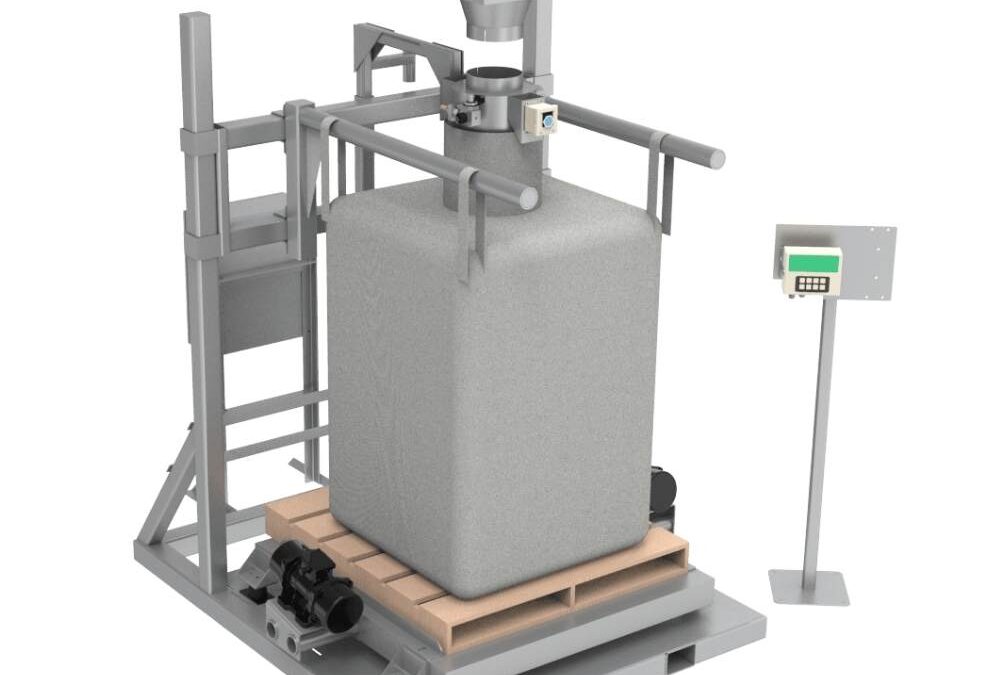
A bulk bag filler is a machine that holds a flexible intermediate bulk container (FIBC) open under a fill spout, loads it with dry material, and stops at a target weight. Our Model 5200 high-speed bulk bag filling machine, for example, fills 1,000 to 4,400 lb bags at up to 25 bags per hour with an integrated scale and a dust-tight fill head. Think of it as the step that turns loose product into a stackable, forkliftable ton.
We have been building bagging equipment in Taylor, Texas since 1978, and most of the bulk bag projects we quote start the same way. A plant has outgrown 50 lb bags, or it is shipping product loose and losing it to spills and dust, and someone has been told a bulk bag filler is the answer. Usually it is. But the right machine depends on your material, your bag, your target rate and how much of the line you want automated, and those details decide whether the bulk bag filling system pays back in one year or five.
In this guide I’ll explain how a bulk bag filler works from bag hanging to forklift removal, compare the main designs, and walk through the components that matter. You’ll also get a buying checklist, safety and dust control notes, and the maintenance habits that keep a filler accurate for decades.
| Spec | Model 5100 | Model 5200 |
|---|---|---|
| Production level | Low to moderate | Moderate to high, oversized FIBCs |
| Top rated speed | Up to 10 bags per hour | Up to 25 bags per hour |
| Bag weight range | 1,000–4,400 lb (454–2,000 kg) | 1,000–4,400 lb (454–2,000 kg) |
| Weighing | Integrated scale | Integrated scale |
| Dust control | Dust-tight fill head with controlled dust takeoff | Dust-tight fill head with controlled dust takeoff |
| Frame | Continuously welded, heavy-wall 4 in box tubing | Continuously welded, heavy-wall 4 in box tubing |
| Typical materials | Powders, flakes and granules: mortars, lime, gypsum, pigments, fertilizer, resins, flours, sugar, hard grains | Same range, plus higher-volume and oversized-bag lines |
Speeds are maximum ratings. Real throughput depends on your material’s flow, bag style, and how quickly operators or automation can hang and remove bags.
How a bulk bag filler works, step by step
Every bulk bag filler runs the same basic cycle, whether an operator does each step by hand or a PLC handles most of them. Understanding that cycle makes it much easier to see where time and dust are lost.
Hanging the bag and sealing the spout
The operator places an empty FIBC under the fill head, hooks its four lift loops onto the loop hooks, and slips the bag’s fill spout over the fill head. On most fillers an inflatable seal or bladder in the fill head expands inside the spout, clamping it tight so product cannot escape around the edges.
Many machines then blow a short burst of air into the bag. Inflation pulls out wrinkles and sets the bag square before any product goes in, which means a fuller, more stable bag at the end. Skip this step on a light powder and you often get a lopsided bag that leans on the pallet.
Filling, weighing and densifying
With the bag sealed and inflated, the feeder opens and material flows in. The scale tracks weight continuously. A good bulk bag filling system runs a fast bulk fill first, then slows to a dribble feed near the target so the final weight lands within tolerance.
For powders and light materials, a vibrating densification deck under the bag settles the product as it fills. That does three things:
- It drives out trapped air, so more product fits in the same bag.
- It squares off the bottom, giving a flat, stable base for stacking.
- It reduces the chance of a bag slumping or shifting in transit.
Releasing and removing the filled bag
Once the scale reaches target weight, the feeder closes, the spout seal deflates, and the loop hooks release. The operator ties off the spout, and a forklift or roller conveyor carries the full bag away. On automated lines, a powered conveyor indexes the next pallet into place while the filled bag moves downstream.
A well-tuned bulk bag filler can turn this cycle in two to six minutes depending on bag size and material. The cycle time is almost never limited by the scale. It is limited by how fast people can hang bags and move them out of the way.
Bulk bag filler types: hanging, platform, gross and net
Many guides compare gravity, auger and volumetric fillers. That is a useful lens, but in practice we classify a bulk bag filler by how it supports the bag, how it weighs, and how it feeds. Get those three right and the rest of the specification follows.
Suspended (hanging) vs bottom-supported (platform) fillers
There are two classes of bulk bag filler. A suspended or “hanging” filler weighs the bag while it hangs from the loop hooks, using tension load cells in the frame. A bottom-supported or “platform” filler sets the bag on a scale deck or roller conveyor and weighs it from below.
- Hanging fillers are simpler and suit free-flowing granules that fill evenly.
- Platform fillers carry the load on the floor scale rather than the loops, which is gentler on bags and better for heavy or dense products.
- Platform designs pair naturally with densification decks and pallet conveyors, so they are the usual choice for powders and automated lines.
Gross weigh vs net weigh bulk bag filler scales
Both classes can be built with either a gross or net weigh scale. A gross weigh bulk bag filler fills and weighs the bag at the same time. A net weigh filler pre-weighs the product in a weigh hopper above the bag, then discharges the batch as a secondary step.
Gross weigh is the default for most bulk bag work because the bags are large and fill times are long anyway. Net weigh can raise throughput on very free-flowing products, since the next batch weighs while the current bag fills, but it adds a hopper and headroom.
Feed methods: gates, rotary valves and augers
Most fillers are gravity fed through a slide gate or butterfly valve, or fed by a rotary valve or auger. Each suits a different material.
| Feed method | Best for | Watch out for |
|---|---|---|
| Slide gate or butterfly valve (gravity) | Free-flowing granules, pellets, grains | Less precise cut-off on light powders |
| Rotary valve | Fine powders, controlled flow from a pressurized or aerated bin | Wear on abrasive products |
| Auger | Powders that flood, bridge or need metered flow | Slower on coarse or granular products |
My view: start with gravity if the material flows well, because it has the fewest moving parts. Add a rotary valve or auger only when testing shows the product floods, bridges, or overshoots the target weight.
Key components of a bulk bag filling system
A bulk bag filling system is more than the frame and scale. The pieces around the filler decide how clean, accurate and safe the operation is.
Fill head, dust takeoff and spout seal
The fill head directs product into the bag and is the main line of defense against dust. Ours are dust-tight with a controlled dust takeoff, which lets you connect a dust collector to pull displaced air out of the bag as it fills. Without that vent, the air pushed out by incoming product has nowhere to go but out around the spout, carrying fines with it.
When you compare one bulk bag filler against another, look closely at:
- The spout seal design and how quickly it inflates and releases.
- The size and location of the dust takeoff port.
- Whether the fill head can be adjusted for different spout diameters.
Frame, loop hooks and height adjustment
The frame takes the weight of a full bag and the shock of loading it, so build quality matters. Our frames are continuously welded from heavy-wall 4 in box tubing. Thin, stitch-welded frames can rack over time, which throws off loop alignment and scale readings.
Loop hooks should release from a single control rather than one at a time. An adjustable-height fill head or loop arm lets one machine run several bag heights, which matters if you sell 1,000 lb and 3,000 lb bags off the same line.
Scales, controls and densification
An integrated scale with load cells and a digital controller handles target weights, bulk and dribble set points, and tare. Better controllers store recipes for each product and bag size, so changeovers take seconds rather than a recalibration.
Densification is optional for granules but close to essential for powders such as hydrated lime or flour. A vibrating deck can raise the packed weight per bag noticeably, which means fewer bags and fewer truckloads for the same tonnage.
Upstream and downstream equipment
The filler is the middle of a line, not the whole line. Upstream, you need a surge bin or hopper and a feeder sized for your fill rate. Downstream, you may want a powered roller conveyor, a pallet dispenser, or a stretch wrapper to secure loads for shipment.
Many of our customers also run the reverse operation at the other end of their process. If you receive raw materials in FIBCs, Bulk Bag Unloaders handle the discharge side with the same frame, dust control and bag-handling principles, and it often makes sense to specify both together.
Materials and industries a bulk bag filler handles
A bulk bag filler can package almost any dry, flowable product, but powders and granules behave very differently in a 2,000 lb bag. Material testing before you buy bulk bag filling equipment is the single best way to avoid surprises.
Powders and fine materials
Fine powders carry air, flood unpredictably and generate dust. They need tighter fill head sealing, a dust takeoff, and usually densification to reach a stable bag. Typical examples we package include:
- Building materials: cement, flyash, mortars, hydrated lime, plaster.
- Industrial minerals: calcium carbonate, kaolin clay, talc, barite, bentonite, gypsum.
- Food powders: wheat, corn and oat flour, powdered sugar, cake mixes, cocoa.
Granules, pellets and flakes
Granular and pelleted materials flow freely and fill quickly, so a simpler gravity-fed bulk bag filling system often does the job. Plastic pellets, resins, fertilizer, seed, corn, soybeans, wood pellets and animal feed all fall into this group. The main risks here are overshooting the target weight and pellet breakage from long drops, both of which a properly tuned dribble feed and fill head solve.
Industries that rely on bulk bags
Bulk bags show up wherever a plant moves product by the ton. The most common sectors we see are:
- Construction and building products, for cement, sand, gravel and refractories.
- Chemicals and plastics, for resins, pigments, zinc oxide, TiO2 and carbon black.
- Food processing, for flours, sugar, salt and spices.
- Agriculture, for feed, seed, grain and fertilizer.
- Mining and minerals, for graphite, alumina, coal and industrial clays.
If your product isn’t on these lists, that doesn’t rule it out. Bulk density, particle size and how the material flows out of a bin tell us most of what we need to recommend a bulk bag filler configuration, so have those numbers ready when you call.
How to choose a bulk bag filler for your plant
Choosing a bulk bag filler comes down to five questions: how many bags an hour, how big, what material, how much automation, and how it fits into the rest of your line. Answer those honestly and the model choice usually becomes obvious. Buyers who skip this step tend to end up with a bulk bag filler that is either oversized for the plant or already maxed out in year two.
Match throughput to bags per hour
Work from tons per hour, not bags per hour. At 2,000 lb per bag, 10 bags an hour is 10 tons an hour, and 25 bags an hour is 25 tons. Size the filler to run at 70 to 80 percent of its rating so you have room for changeovers, bag problems and shift breaks.
If your upstream process only produces 6 tons an hour, a high-speed bulk bag filler adds cost without adding output. If you are bagging out of a large silo to meet truck schedules, speed and automation pay for themselves quickly.
Bag sizes, weights and headroom
Confirm every bag size you plan to run before you buy. Our fillers handle 1,000 to 4,400 lb bags, but bag dimensions, spout diameter and loop style all affect the fill head and frame. Check these points:
- Bag footprint, filled height and spout diameter for each product.
- Clearance from floor to the bottom of your surge bin or feeder.
- Forklift access and turning room around the filling station.
- Whether you need FIBC Type B, C or D bags for static-sensitive products.
Automation level and labor
Manual fillers rely on an operator to hang loops, connect the spout and remove each bag. Semi-automatic and automatic systems add powered loop release, automatic spout seals, pallet dispensers and conveyors so one operator can keep up with a faster line.
The jump in automation is really a labor and payback question. We cover the math in detail in Manual vs. Automated Bagging Systems: The 2026 ROI & Efficiency Guide, including how to price operator hours against equipment cost.
When the Model 5100 or Model 5200 fits
We offer two heavy-duty fillers, and the split is mostly about volume.
The Model 5100 bulk bag filler is our choice for low to moderate production, filling up to 10 bags per hour. It is compact, configurable for a wide range of powders, flakes and granules, and a sensible first machine for plants moving off small bags.
The Model 5200 is built for moderate to high output and oversized FIBCs, filling up to 25 bags per hour. It suits plants that bag around the clock or ship full truckloads daily. If you are on the fence, buy for the volume you expect in three years, not the volume you run today.
Bulk bag filling system safety and dust control
A full bulk bag can weigh two tons and swings if a loop slips. Safety design is not optional, and neither is dust control when you are packing fine powders.
Operator safety features
Look for these on any bulk bag filling system you evaluate:
- Secure loop hooks that cannot release under load, with a single controlled release.
- Guarding around moving parts, including vibrating decks and conveyors.
- Emergency stops within easy reach of the operator’s working position.
- Interlocks that prevent the feeder from opening unless a bag is in place and sealed.
- A fill head and loop arm that bring the connection points to the operator, not the other way round.
The biggest everyday risk is operators reaching under or beside a full, suspended bag. Good design keeps them out of that zone.
Dust control and combustible dust
Dust is a housekeeping problem, a product-loss problem and, for some materials, a fire and explosion risk. A dust-tight fill head with a vented takeoff to a collector handles most of the routine dust. For combustible dusts such as flour, sugar, starch or some plastics, you also need to think about static.
FIBCs come in types A, B, C and D. Type C bags must be grounded during filling, so the filler needs a grounding point and a way to confirm the connection. Type D bags dissipate static without grounding. If your material is combustible, settle the bag type before you specify the filler, and involve your safety team early.
Maintaining a bulk bag filler for long service life
A heavy-duty bulk bag filler should run for decades. The ones that don’t usually suffer from neglected seals, drifting scales or damaged loop hooks rather than frame failure. A few minutes of attention each shift protects both the bulk bag filler and the accuracy of every bag it ships.
Daily and weekly checks
Most upkeep is quick and visual. We recommend operators:
- Inspect the spout seal or bladder for cuts and slow inflation each shift.
- Check loop hooks and release mechanisms for wear or sticking.
- Clear product buildup from the fill head, scale area and densification deck.
- Confirm the dust collector is pulling and its filters are not blinded.
Scale calibration and accuracy
Check-weigh a filled bag on a certified floor scale on a regular schedule and log the result. A steady drift in one direction points to buildup, a damaged load cell or a changed bag tare weight. Recalibrate after any load cell work or after moving the filler.
Parts, rebuilds and rental options
Keep a small stock of spout seals, hook components and common electrical parts on site. When an older machine starts to wear, a factory rebuild can return it to like-new condition for well below the price of a new filler.
If you are testing a new product or unsure of next year’s volume, renting a bulk bag filler can make more sense than buying outright. We lay out the trade-offs in Renting vs Buying Bagging Equipment: A 2026 Strategic Decision Guide.
Bulk bag filler FAQs
What is a bulk bag filler?
How fast can a bulk bag filler fill bags?
What materials can a bulk bag filling system handle?
What bag sizes does a bulk bag filler accept?
Gross weigh or net weigh: which bulk bag filler is better?
How do I control dust in a bulk bag filling system?
Ready to spec a bulk bag filler for your plant? Call our team at 512-352-3694 or request a quote with your material, bag size and target rate, and we’ll recommend the right model and line layout.
Recent Comments