
Selecting the right food packaging machine for your production line is one of the most critical decisions a manufacturer can make. The process can feel overwhelming, with a vast array of technical terms, machine types, and strict hygiene standards to navigate. An incorrect choice can lead to costly downtime and compromised product quality, while the right investment drives efficiency and ensures product safety for years to come. Making this decision with confidence requires clear, practical knowledge.
This guide is engineered to provide that clarity. We will break down the different types of food packaging machinery, from systems designed for fine powders to those built for liquids or fragile solids. You will learn the key performance and safety features to look for, understand how to match equipment to your specific product, and gain the insight needed to create a shortlist of suitable options. Consider this your roadmap to making an informed investment and finding a reliable equipment partner for your operational success.
Key Takeaways
- Learn how the right packaging equipment directly impacts your product’s shelf life, safety, and overall integrity.
- Discover the functional categories of packaging machinery to understand how to build a complete and efficient production line.
- A systematic evaluation is crucial for selecting the right food packaging machine that meets both current demands and future growth.
- Identify the non-negotiable sanitary design features that are essential for ensuring food safety and preventing contamination.
The Critical Role of Packaging Machinery in the Food Industry
In the modern food industry, packaging is far more than a simple container. It is a critical operational component that directly impacts product integrity, consumer safety, and brand reputation. Moving beyond basic containment, the right equipment preserves freshness, extends shelf life, and ensures that every product reaches the customer exactly as intended. By automating these processes, food producers can achieve unmatched levels of production efficiency, significantly reduce labor costs, and guarantee consistent quality, weight, and presentation with every package.
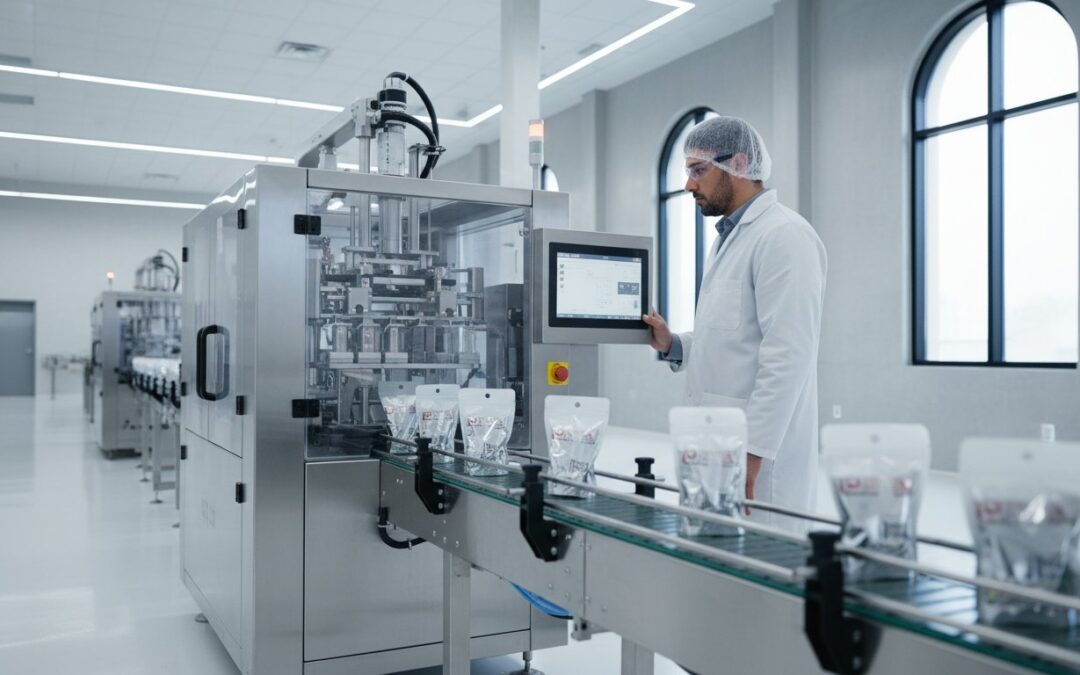
To see this level of automation in action, consider the following example of a modern packaging line:
Key Functions of Food Packaging Machines
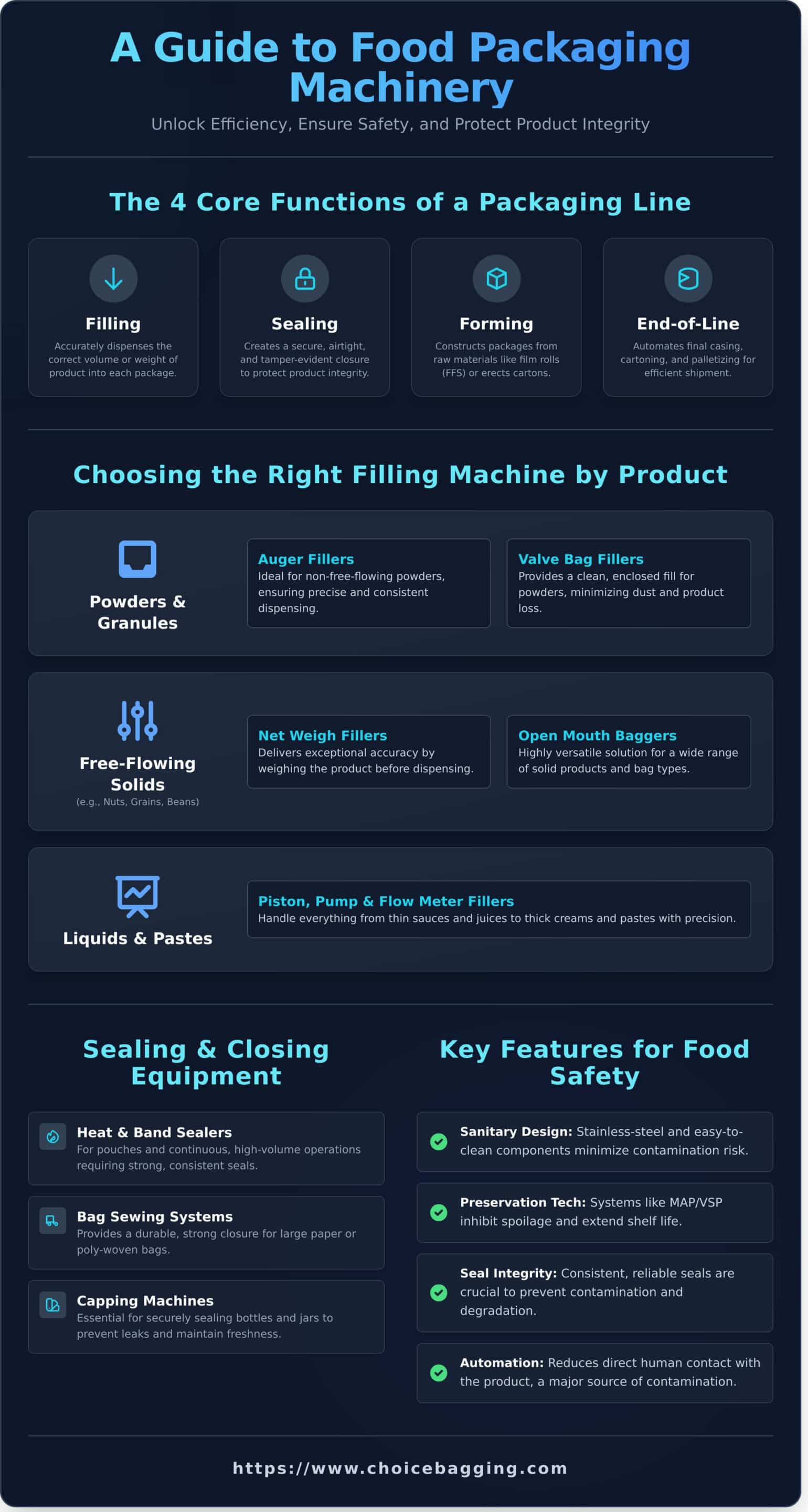
A high-performance food packaging machine integrates several core processes, which are part of the broader types of packaging machinery, to deliver a finished product ready for market. These functions work in sequence to ensure reliability and performance.
- Filling: Accurately dispensing the correct volume or weight of product into each package, minimizing waste and ensuring consistency.
- Sealing & Closing: Creating a secure, airtight, and often tamper-evident closure that protects the product from external elements.
- Forming: Constructing the package itself from raw materials, such as forming a pouch from a roll of film or erecting a carton.
- End-of-Line: Automating the final steps of casing, cartoning, and palletizing to prepare products for efficient shipment and distribution.
Impact on Food Safety and Shelf Life
Beyond efficiency, the primary responsibility of food packaging is to protect the product and the consumer. Automated machinery is engineered to uphold the highest standards of hygiene and preservation, directly contributing to a safer and longer-lasting product. This is achieved through several key features:
- Preventing Contamination: Hygienic, stainless-steel designs and easy-to-clean components minimize the risk of bacterial growth.
- Preservation Technology: Advanced systems like Modified Atmosphere Packaging (MAP) and Vacuum Skin Packaging (VSP) remove or replace oxygen to inhibit spoilage and preserve freshness.
- Ensuring Seal Integrity: Consistent, reliable seals are crucial for preventing contamination and protecting against degradation from moisture and air.
- Reducing Human Contact: Automation minimizes direct human handling of the food product, a major source of potential contamination.
Ultimately, this commitment to quality and safety builds consumer trust and reinforces your brand’s reputation for excellence. Professional packaging is a direct reflection of the care and quality invested in the product itself.
Types of Food Packaging Machines: A Functional Breakdown
To select the right equipment, it is easiest to categorize each food packaging machine by its core function. Most high-performance production lines are not a single machine, but an integrated system combining several specialized units. Understanding these core types is the first step in designing a packaging workflow that delivers unmatched efficiency, reliability, and product protection.
Filling Machines for Different Product Types
The filling machine must match your product’s specific characteristics to ensure precision and control costs. Key types include:
- Powders & Granules: Auger fillers for non-free-flowing powders and valve bag fillers for an enclosed, clean fill.
- Free-Flowing Solids: Net weigh fillers for exceptional accuracy with products like nuts and grains. Versatile open mouth bagging machines handle a wide range of solid products.
- Liquids & Pastes: Piston fillers, pump fillers, and flow meters handle everything from thin sauces to thick creams.
Sealing and Closing Equipment
A secure closure protects product integrity from the plant to the consumer. The method depends on the packaging material and required throughput. Common systems include heat sealers for pouches, high-volume band sealers for continuous operations, durable bag sewing systems for large paper or poly-woven bags, and capping machines for bottles and jars.
Form, Fill, and Seal (FFS) Machines
FFS machines maximize packaging speed by combining three operations into one automated sequence: forming the bag, filling it, and sealing it shut. Vertical Form Fill Seal (VFFS) is ideal for products that can be dropped (e.g., chips, candy), while Horizontal Form Fill Seal (HFFS) is used for items that must be carefully placed, such as baked goods. This integration is a cornerstone of high-throughput operations.
End-of-Line Packaging Systems
The final stage prepares your packaged products for bulk transport. This includes case erectors to form boxes, case packers to fill them, and stretch wrappers to secure pallet loads for stable shipment. Automating this heavy, repetitive work with robotic palletizing systems not only boosts productivity but also improves workplace safety and completes your automated packaging process.
How to Choose the Right Food Packaging Machine for Your Business
Selecting the right food packaging machine is a critical long-term investment that directly impacts your operational efficiency and profitability. A systematic approach prevents costly mistakes by balancing your current production needs with future growth potential. To ensure you invest confidently, focus on four key areas: your product, your packaging, your performance requirements, and the total price of ownership.
Factor 1: Your Food Product’s Characteristics
The physical nature of your product is the primary determinant of the machine technology you need. A system designed for free-flowing granules will not work for a viscous paste. Carefully document your product’s properties to narrow your search.
- Physical State: Is it a powder, granule, liquid, paste, or solid item?
- Flowability: Does it flow freely, or will it require assistance from an auger or vibratory feeder?
- Fragility: Can the product withstand a standard drop, or does it require gentle handling to prevent breakage?
- Other Properties: Consider if the product is sticky, dusty, abrasive, or corrosive, as this affects material choices and cleaning protocols.
Factor 2: Packaging Material and Design
Your choice of packaging dictates the type of machine required for filling, forming, and sealing. The equipment must be compatible with your specific materials and design to ensure package integrity and a professional appearance. Define your packaging needs clearly.
- Format: Are you using flexible packaging like bags and pouches, or rigid containers like trays, bottles, and jars?
- Material: Ensure the machine is engineered to handle your specific film, foil, paper, or plastic materials.
- Size and Weight: What is the full range of package dimensions and fill weights the machine must accommodate?
- Sealing: Does your product require a simple heat seal, an airtight hermetic seal, or another specialized closure?
Factor 3: Production Speed and Automation Level
Your operational goals determine the necessary throughput and level of automation. A fully automatic food packaging machine increases output and reduces labor costs, but a semi-automatic solution may be ideal for smaller operations or varied product runs.
- Required Output: Calculate your target in packages per minute or hour to meet demand.
- Automation: Choose between manual, semi-automatic, and fully automatic systems based on your volume, budget, and labor availability.
- Changeover Time: If you run multiple products or sizes, evaluate how quickly and easily the machine can be adjusted.
- Integration: Consider how the machine will connect with upstream and downstream equipment like conveyors and case packers.
Factor 4: Budget and Total Cost of Ownership (TCO)
A durable, reliable machine with higher uptime will almost always provide a lower TCO than a cheaper, less dependable alternative. Look beyond the initial purchase price to understand the true long-term investment.
- Upfront Costs: Factor in the machine price plus any costs for installation, training, and commissioning.
- Ongoing Expenses: Account for routine maintenance, spare parts availability, and energy consumption.
- Reliability and Support: A dependable machine from a manufacturer offering robust support minimizes costly downtime. As your partner, we can help you evaluate these factors to ensure the best return on your investment.
Key Machine Features for Food Safety and Hygiene
In the food industry, sanitary design is not an optional upgrade-it is a fundamental requirement. The right equipment is your first line of defense against contamination, designed to prevent bacterial growth and protect both your product and your consumers. When evaluating any food packaging machine, prioritize features that simplify cleaning, inspection, and compliance. This commitment to hygiene is a direct investment in your brand’s reputation and long-term success.
Sanitary Design and Construction Materials
The materials and construction of your equipment form the foundation of food safety. Look for designs that eliminate harbor points for contaminants and withstand rigorous sanitation protocols. Key features include:
- Stainless Steel Construction: All product contact surfaces should be made from high-grade stainless steel, typically 304 or 316, for its corrosion resistance and durability.
- Smooth, Polished Welds: Continuous, non-porous welds eliminate the microscopic cracks and crevices where bacteria can colonize.
- Sloped Surfaces: Well-designed equipment avoids flat, horizontal surfaces, ensuring that water, cleaning solutions, and product residue drain completely.
- Washdown Protection: An IP rating of IP65 or higher certifies that electrical enclosures are protected against high-pressure water jets used during cleaning.
Ease of Cleaning and Maintenance
A machine that is difficult to clean is a constant risk. Efficient sanitation and maintenance are critical for uptime and safety. Seek out equipment engineered for accessibility and straightforward service, featuring tool-less removal of change parts for quick disassembly and thorough cleaning. All areas of the machine should be readily accessible for visual inspection. For liquid applications, Clean-in-Place (CIP) capabilities offer automated, reliable sanitation. A clear maintenance schedule supported by a reliable supply of readily available spare parts ensures your equipment operates safely and efficiently for years to come.
Compliance with Food Safety Standards
Your packaging equipment must help you meet or exceed industry regulations. Reputable manufacturers design machines in accordance with standards set by bodies like the FDA and USDA. Look for adherence to the hygienic design principles of organizations such as 3-A Sanitary Standards, which provides assurance of cleanability and inspection. A properly designed machine becomes a critical component in your Hazard Analysis and Critical Control Points (HACCP) plan. Always ask manufacturers to specify the standards their equipment is built to meet to ensure full compliance.
Selecting a food packaging machine is a decision that directly impacts your product’s safety and your brand’s integrity. By prioritizing equipment built with uncompromising hygienic design, you establish a foundation of quality. Contact our team of experts to discuss equipment solutions engineered for the food industry.
Invest Confidently in Your Food Packaging Solution
Selecting the ideal packaging equipment is a critical decision for any food manufacturer. As we’ve detailed, a thorough understanding of different machine types, coupled with a focus on key features for food safety and hygiene, forms the foundation of a successful operation. The right choice is a direct investment in your product integrity, brand reputation, and long-term profitability.
When you are ready to invest in a new food packaging machine, you are choosing more than just equipment-you are choosing a partner dedicated to your success. Since 1978, Choice Bagging Equipment has delivered unmatched performance and reliability. Our durable machines are proudly manufactured in the USA and engineered to last for decades, providing a dependable return on your investment. With our expert integration support, you can be assured of a seamless transition and sustained operational excellence.
Take the next step toward enhancing your production line. Consult our experts to find the right bagging equipment for your food product.
Frequently Asked Questions
What is the difference between a VFFS and an HFFS machine?
The primary difference is the direction of operation. A Vertical Form Fill Seal (VFFS) machine creates bags from a roll of film in a vertical orientation, making it ideal for loose products like snacks, coffee, or powders. A Horizontal Form Fill Seal (HFFS) machine operates horizontally, which is better suited for solid, single-item products like candy bars or baked goods. The choice is determined by your product’s form for optimal handling and efficiency.
How much does an industrial food packaging machine typically cost?
The cost of an industrial food packaging machine is a direct investment in your operation’s long-term performance and reliability. Prices vary based on factors like automation level, speed requirements, product type, and custom integrations. A semi-automated system differs greatly from a fully integrated, high-speed line. We provide detailed consultations to engineer a solution that aligns with your budget and production goals, ensuring a dependable return on your investment for years to come.
What are the most important factors when packaging powdered food products?
When packaging powdered products, three factors are critical: dust control, fill accuracy, and seal integrity. A proper dust collection system is essential for a clean operating environment and worker safety. Precision filling, typically achieved with an auger filler, prevents product waste and ensures consistent weights. Finally, a strong, clean seal is non-negotiable to protect product quality, which requires removing powder from the seal area before the final heat application.
How do I determine the right level of automation for my production line?
Determining the right level of automation depends on your production volume, labor costs, and desired throughput. A small-batch operation may thrive with a semi-automated machine, while a high-volume facility requires a fully automated food packaging machine to maximize efficiency and reduce per-unit costs. We partner with you to analyze your current processes and future growth plans, ensuring the solution we provide delivers unmatched performance and a clear return on investment.
Can one machine handle different bag sizes and product types?
Yes, a single machine can be engineered for versatility. Many of our systems are designed to handle various bag sizes with simple, quick-change forming parts. To accommodate different product types, the machine can be integrated with multiple fillers, such as an auger for powders and a volumetric filler for granules. Defining your complete range of products and packaging during the initial consultation ensures we build a machine with the flexibility your operation demands.
What is the expected lifespan of a quality food packaging machine?
A high-quality food packaging machine, built with durable components and expert craftsmanship, is engineered to last for decades. The expected lifespan of our American-made equipment often exceeds 20 years with proper preventative maintenance and operation. Factors like the operational environment and adherence to service schedules play a role, but investing in a robustly built machine from a trusted manufacturer ensures unmatched reliability and a long, productive service life for your production line.
Recent Comments