

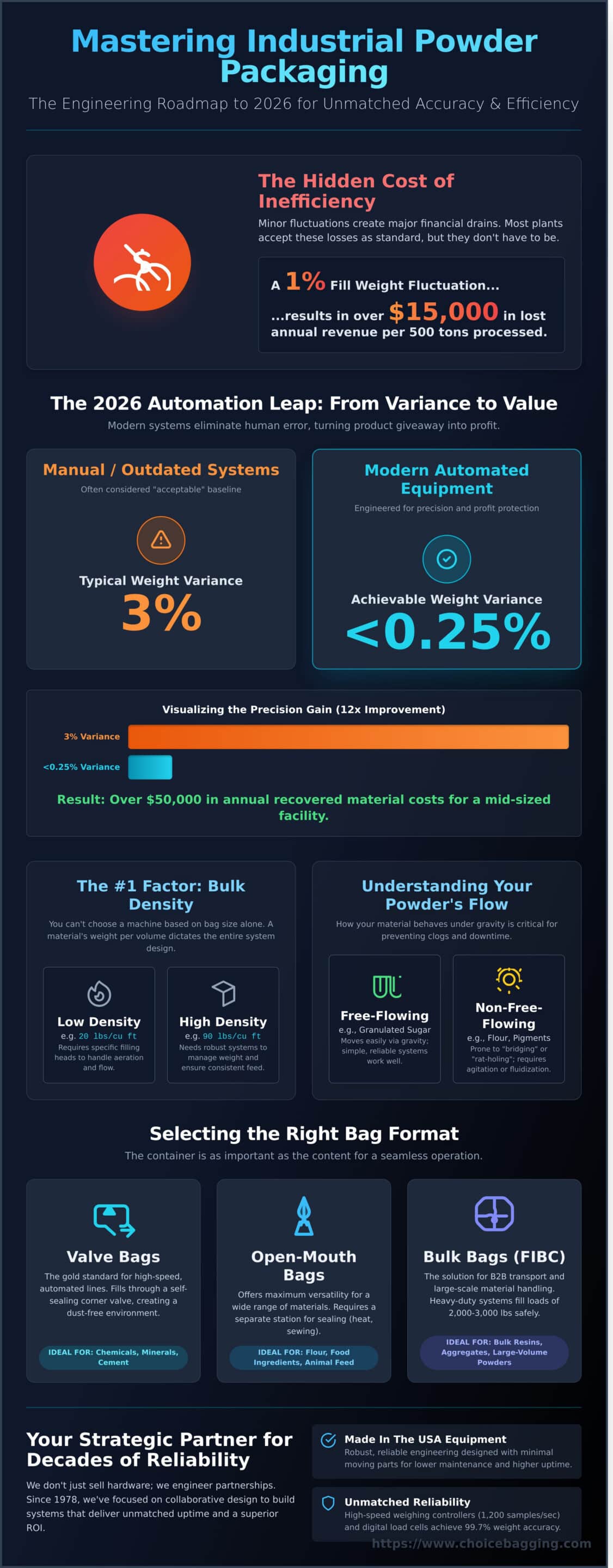
If your current system fluctuates by just 1% in fill weight, you’re likely losing over $15,000 in annual revenue for every 500 tons of material processed. Most plant managers accept material bridging and excessive dust as unavoidable daily hurdles, but these inefficiencies shouldn’t be your baseline. Since 1978, we’ve seen how poorly calibrated automatic powder bagging equipment turns a profitable line into a maintenance nightmare. You shouldn’t have to choose between a clean workspace and high-speed throughput.
We agree that dealing with inconsistent weights and constant hopper clogging is a frustrating drain on your bottom line. This guide provides the engineering roadmap to master industrial powder packaging for 2026, focusing on systems that deliver +/- 0.5% accuracy or better. You’ll learn how to select and integrate technology that eliminates product giveaway while keeping your facility dust-free. We’ll examine the technical specifications for modern hoppers, digital weighing controls, and seamless integration with your existing conveyors and palletizers to ensure your investment delivers unmatched reliability for decades.
Key Takeaways
-
Identify how the latest 2026 advancements in automatic powder bagging equipment eliminate manual errors to ensure unmatched sealing and weight precision.
-
Evaluate the technical differences between air, impeller, and auger filling technologies to select the ideal system based on your material’s abrasiveness and particle size.
-
Address critical safety and profit concerns by mastering dust control and resolving the "Gross Weigh" vs. "Net Weigh" accuracy debate.
-
Learn how to conduct material flow analysis and select the proper closure methods to optimize your line for long-term performance and reliability.
-
Gain insights into engineering a system that lasts decades by partnering with a trusted American manufacturer focused on collaborative system design.
Table of Contents
What is Automatic Powder Bagging Equipment?
Automatic powder bagging equipment is a precision-engineered industrial system designed to automate the measuring, filling, and sealing of fine-particle materials into bags. These machines handle everything from micron-sized chemical powders to granulated food ingredients. Since 1978, Choice Bagging Equipment has seen these systems evolve from simple mechanical scales to high-speed, PLC-controlled powerhouses. This equipment serves as the backbone of any production line where consistency and speed are non-negotiable for the bottom line.
The move from manual bagging to fully automated systems represents a massive leap in operational efficiency. By 2026, advanced sensor technology has effectively eliminated the human error that leads to inconsistent weights and poor seal integrity. In a manual setup, a 3% weight variance is often considered acceptable. Modern automatic powder bagging equipment reduces that variance to less than 0.25%. This precision prevents product giveaway, which can save a mid-sized facility over $50,000 annually in recovered material costs alone. It’s about protecting your profit margins through unmatched reliability.
Our "Bagger Professor" perspective emphasizes one critical factor above all else: bulk density. You can’t choose a machine based on the bag size alone. You must understand how many pounds per cubic foot your material occupies. A powder that is 20 lbs/cu ft requires a vastly different filling head than one that is 90 lbs/cu ft. This metric dictates the flow rate and the specific Powder Filling Technologies required to move the product without clogging or aerating it excessively. If you’re unsure about your material’s behavior, contact our team for a professional consultation to analyze your product’s characteristics.
Free-Flowing vs. Non-Free-Flowing Powders
Free-flowing powders like dry sand or granulated sugar move easily via gravity. These materials don’t clump, so simple gravity-fed systems work with high reliability. Non-free-flowing powders are more stubborn. These cohesive materials often suffer from bridging or "rat-holing" in the hopper, where the powder sticks to the sides and stops flowing. We solve this by using fluidization or mechanical agitators to keep the material moving consistently into the bag, ensuring the machine never starves for product.
Common Bag Formats for Industrial Powders
-
Valve Bags: These are the gold standard for high-speed powder applications. The bag is filled through a small corner opening that self-seals after filling. This creates a virtually dust-free environment, which is vital for chemical and mineral plants.
-
Open-Mouth Bags: These offer the most versatility for various materials. They’re used for everything from flour to minerals and require a separate sealing station, such as a heat sealer or a sewing head.
-
Bulk Bags (FIBC): When you’re shipping 2,000 to 3,000 pounds of material for B2B transport, bulk bags are the right choice. Our heavy-duty systems ensure these massive loads are filled safely and accurately every time.
Reliability is built into every machine we manufacture. We don’t just sell hardware; we’re your partner in ensuring your production line stays active for decades. Whether you’re handling abrasive minerals or delicate food ingredients, choosing the right automatic powder bagging equipment is the first step toward a more profitable operation. Our Made In The USA equipment is designed with minimal moving parts, which translates to lower maintenance costs and higher uptime for your facility.
Comparing Powder Filling Technologies: Air, Impeller, and Auger
Selecting the correct delivery method for your automatic powder bagging equipment determines your long-term ROI and operational stability. Since 1978, Choice Bagging Equipment has engineered solutions that prioritize reliability over complex, fragile components. The 2026 generation of bagging systems utilizes advanced digital load cells and high-speed weighing controllers to achieve 99.7% weight accuracy. These controllers process data at 1,200 samples per second, ensuring every bag meets your specifications without costly overfills. Choosing between air, impeller, or auger technology depends on your material’s abrasiveness, particle size, and required throughput.
Air (Pneumatic) Fillers for Fluidizable Powders
Air fillers utilize low-pressure air to fluidize fine powders, effectively making them flow like a liquid into the bag. This method is the industry standard for materials like cement, bentonite, and fine chemicals that respond well to aeration. Because the product moves through the system via air pressure rather than mechanical force, there is a 30% reduction in internal component wear compared to mechanical systems. You can find these robust systems in our lineup of Valve Bag Fillers, which are designed to minimize dust and maximize speed in high-volume environments.
Impeller Fillers for High-Density Materials
For heavy, abrasive minerals and ores, impeller fillers provide the mechanical force necessary to maintain high production rates. A high-speed rotor, often spinning at 3,600 RPM, drives the powder through the fill spout with consistent velocity. These machines are built for 24/7 operations where durability is the primary concern. To manage the inevitable wear and tear of abrasive materials, we use hardened alloys in all high-impact zones. This engineering choice extends the service life of the impeller by 45% compared to standard steel alternatives. If you’re unsure which technology fits your bulk density, our technical specialists can provide a material test report to confirm the best fit.
Auger Fillers for Non-Free-Flowing Products
Auger fillers utilize a precision-machined screw to deliver non-free-flowing products like flour, starches, and organic powders. This method provides the highest level of volumetric control for materials that resist fluidization or tend to bridge in a hopper. When you’re Integrating Your Powder Bagging Line for food-grade applications, precision and sanitation are critical. These systems are frequently paired with our Open Mouth Bagging Machines to handle diverse bag sizes while maintaining a clean environment. The screw-driven design allows for a 15% increase in weight consistency for difficult, "sticky" powders that other technologies struggle to process.
Maintenance is a primary driver of total cost of ownership. Air fillers generally have the fewest moving parts, which translates to 20% lower annual maintenance costs for many facilities. However, the specific characteristics of your product must dictate the technology. Using an air filler for a non-fluidizable organic powder will result in 0% flow, regardless of the machine’s quality. Our "Bagger Professor" tool helps you identify these technical requirements early in the planning phase. We build performance and reliability into every machine, ensuring your investment is protected by a partner who understands the rigors of the plant floor. To discuss your specific material requirements with an expert, Contact us now for a professional consultation.
Solving the Dust and Accuracy Dilemma in Powder Packaging
Dust is more than a simple housekeeping chore; it’s a significant liability for any industrial facility. When fine particles escape during the filling process, they create a slip hazard for operators and settle on sensitive machinery. More critically, airborne particles pose a severe explosion risk in confined spaces. Adhering to OSHA safety standards for combustible dust is a legal and ethical necessity to prevent catastrophic flash fires. Beyond the safety implications, escaping dust represents literal profit floating away. If a facility loses just 1% of its product to the rafters, an operation processing 10,000 tons annually effectively throws 100 tons of sellable inventory onto the floor.
Selecting the right automatic powder bagging equipment requires a clear understanding of the "Gross Weigh" versus "Net Weigh" debate. Gross weigh systems measure the product and the bag together during the fill cycle. These machines are compact and cost-effective for operations running 4 to 6 bags per minute. Net weigh systems utilize a dedicated internal hopper to weigh the product before it ever touches the bag. This allows the scale to stabilize independently of bag movement, enabling speeds of 15 to 20 bags per minute with superior precision. At Choice Bagging Equipment, we’ve refined these technologies since 1978 to ensure your specific material characteristics dictate the solution, not a one-size-fits-all approach.
Dust Collection and Containment Strategies
Controlling fine pigments, carbon black, or chemical powders requires a hermetic environment at the point of discharge. We utilize integrated dust hoods and displaced air venting to capture particles the moment they leave the supply hopper. Inflatable spout seals are a critical component for fine materials; they expand to create a 100% airtight connection with the bag neck. This containment strategy leads to a 30% reduction in plant-wide maintenance costs because abrasive dust no longer settles on your conveyor bearings or electronic enclosures. By containing the mess at the source, your facility stays cleaner and your team stays safer.
Weight Precision and Product Giveaway
Product giveaway is a silent profit killer that many operators ignore. If a 50lb bag is overfilled by a mere 3 ounces to "be safe," a high-volume plant running 500,000 bags a year loses 93,750 pounds of product. At a value of $0.60 per pound, that is a $56,250 annual loss. Our 2026 digital controllers eliminate this waste by using advanced bulk-and-dribble feed cycles. The system delivers 90% of the target weight at high speed, then switches to a precision trickle for the final ounces. This logic achieves +/- 0.5% weight accuracy consistently across every shift.
Modern automatic powder bagging equipment also incorporates ultrasonic sealing to ensure the bag remains closed after the fill. This high-frequency vibration creates a molecular bond through any residual dust in the seal area, providing a truly sift-proof closure. For operations handling larger volumes, our Bulk Bag Fillers apply these same precision standards to 2,000lb loads. We don’t just sell machines; we’re also your partner in optimizing your entire packaging line for maximum ROI. If you’re ready to stop the giveaway and secure your facility, contact us for a consultation today.
Integrating Your Powder Bagging Line for Maximum ROI
Integration is where long-term profitability lives. An isolated machine is just a tool; a synchronized line is a business asset. Since 1978, we’ve found that 90% of bagging failures stem from poor material characterization. The first step for any successful installation involves rigorous material testing and flow rate analysis. We analyze the bulk density and aeration levels of your specific powder. If your material has a 45-degree angle of repose, you’ll likely need an auger filler rather than a gravity feed. This testing ensures your automatic powder bagging equipment matches the physical properties of your product, preventing 15% more dust waste than non-optimized setups.
Choosing the right filler is only half the battle. You must evaluate how the bag moves from the spout to the closing station. A 2% error in weight can cost a high-volume producer $50,000 annually in product giveaway. We solve this by integrating check-weighers that provide real-time feedback to the filler. This loop maintains precision within +/- 0.25% of the target weight. Proper conveying, using either V-trough or flat belt systems, ensures the bag remains upright and stable during this transition. This prevents spills that typically account for 5% of lost production time in manual facilities.
Future-proofing your investment requires modularity and advanced controls. We utilize Allen-Bradley or Siemens PLCs to ensure your controls aren’t obsolete in five years. IIoT connectivity allows our engineers to diagnose 85% of software issues remotely, reducing potential downtime from days to minutes. Our Bagger Professor tool helps identify these variables early, but we always recommend a physical consultation to map out your specific floor plan. By planning for modularity today, you can add components like metal detectors or printers without replacing the entire automatic powder bagging equipment system later.
Closing the Loop: Bag Sealing and Sewing
The bag type dictates the closure technology. Ultrasonic valve sealing provides a hermetic finish that eliminates 100% of sifting in fine powders, making it the cleanest option for chemical and food applications. For traditional operations, our Bag Sewing Machine Systems handle open-mouth paper and woven poly bags at speeds up to 20 bags per minute. These automated lines include bag top reformers to ensure a consistent, professional stitch every time. This precision reduces the risk of bag failure during transit by 30% compared to hand-guided sewing.
End-of-Line Excellence: Robotic Palletizing
Manual stacking often limits an automated line to 50% of its potential capacity. Human operators fatigue, leading to unstable pallets and potential safety risks. In contrast, Robotic Palletizing Systems deliver perfectly squared loads with 99.9% uptime. A single robotic arm can replace three manual labor positions, usually providing a full return on investment within 18 months of installation. These systems ensure that every pallet leaving your facility is stable, safe, and ready for high-density warehouse storage.
Build a more efficient facility with a reliable production partner. Request a consultation for your custom bagging line.
Why Choice Bagging Equipment is Your Strategic Partner
Investing in automatic powder bagging equipment isn’t just a purchase; it’s a multi-decade commitment to your facility’s efficiency. Since 1978, Choice Bagging Equipment has manufactured industrial machinery right here in the USA. We’ve spent over 45 years refining designs that withstand the most punishing industrial environments. Our team doesn’t just sell you a machine. We engineer a complete system tailored to your specific operational footprint and production goals. This "Partner" philosophy means we’re invested in your uptime long after the initial installation is complete.
We’ve found that 85% of bagging line failures stem from a mismatch between the material characteristics and the machine’s feeding mechanism. We prevent these failures by looking at the entire process. Our engineers evaluate everything from your ceiling height to your dust collection requirements. We use heavy-duty structural steel and name-brand pneumatic components because we know your equipment needs to run 24/7 without constant intervention. You’ll find our machines still operating at peak performance in plants where they’ve been installed for over 25 years.
-
Legacy of Performance: We’ve been building rugged, reliable bagging solutions in the USA for nearly five decades.
-
Engineering-First Approach: Every system is designed to handle the specific flow rates and bulk densities of your unique powders.
-
Durability by Design: We use thick-wall steel tubing and simplified mechanical designs to reduce wear and tear.
Reliable Support for Decades of Operation
Our commitment to quality starts with our "Made in the USA" manufacturing process. We control every aspect of production to ensure the highest standards are met. This local presence allows us to offer superior field service and rapid parts replacement. If your line goes down, you aren’t waiting for a shipping container to cross an ocean. We maintain a massive inventory of wear parts and can have a technician on-site quickly to keep your automatic powder bagging equipment running. Our support team includes experts who’ve been with us for over 20 years, providing a level of institutional knowledge you won’t find anywhere else.
We don’t believe in planned obsolescence. We believe in building machines that your team can rely on every single shift. From the initial consultation where we define your specifications to the field service visits years down the road, we stand by our work. It’s about giving you the confidence to grow your business without worrying about your packaging line.
Ready to automate? [Contact our experts for a custom powder bagging consultation](https://www.choicebagging.com/contact/) and let's build a system that lasts.
Maximize Your Production Potential with Engineered Precision
Selecting the right automatic powder bagging equipment determines the long-term profitability of your facility. You’ve seen how matching the specific technology to your material, whether it’s an impeller or an air packer, eliminates the accuracy issues that drain your bottom line. Since 1978, we’ve focused on building Made in the USA machinery that’s engineered for decades of service rather than a few seasons. We don’t just sell machines; we provide technical certainty through our Bagger Professor material analysis. This ensures your integration project delivers the exact performance metrics your production schedule demands.
It’s time to stop guessing about flow rates and dust containment. Our team is ready to apply over 45 years of industrial experience to your specific application. You can rely on our proven engineering to stabilize your packaging process and maximize your throughput. Let’s build a solution that stands the test of time and keeps your operations running at peak efficiency every single shift. We look forward to helping you achieve unmatched reliability in your bagging line.
Request a Professional Consultation for Your Powder Bagging Project
Frequently Asked Questions
What is the best machine for filling very fine, dusty powders?
An air packer or a vacuum-style filler is the best choice for very fine, dusty powders. These systems use a sealed environment to contain particles during the fill cycle. Our engineering team, which has been building equipment since 1978, recommends an air packer with a dust collection port to capture 99.5% of airborne particulates. This setup ensures a clean workspace and prevents product loss. You can find the right configuration using our Bagger Professor tool .
How do I choose between a valve bag and an open-mouth bag for powder?
Choose a valve bag if you need superior dust control and high-speed palletizing. Valve bags seal themselves during the fill process, which reduces dust by 80% compared to open-mouth alternatives. Open-mouth bags are better if you require a variety of bag sizes or materials like plastic and paper on one machine. If your production exceeds 10 bags per minute, a valve bag system usually provides better stability for 50 pound stacks.
Can automatic powder bagging equipment handle abrasive materials like minerals?
Automatic powder bagging equipment handles abrasive minerals like silica or garnet by using hardened steel contact parts and ceramic liners. We’ve built machines that operate for 20 years in harsh mining environments by replacing standard carbon steel with AR-400 liners. These components resist wear from high-velocity particles. If you’re processing materials with a Mohs hardness of 7 or higher, contact us to discuss specialized coatings for your bagging line.
What level of weight accuracy can I expect from an automated powder filler?
You can expect a weight accuracy of +/- 0.25% to 0.5% on a standard 50 pound bag with our automated powder filler. Modern digital load cells and PLC controls monitor the fill rate 100 times per second to ensure precision. This accuracy level prevents product giveaway, saving a typical facility $12,000 annually in lost material. Consistent weights also ensure your palletized loads remain stable during shipping across the USA.
How much floor space is required for a complete automated powder bagging line?
A complete automated powder bagging line typically requires between 200 and 1,500 square feet of floor space. A standalone packer needs a small 5 foot by 5 foot footprint, while a full system with conveyors and a robotic palletizer spans 50 feet in length. We design custom layouts to fit existing facilities, often utilizing vertical space to minimize the ground footprint. Request a layout consultation at https://www.choicebagging.com/contact/ to see how a system fits your plant.
Is it possible to fill both small bags and bulk bags on the same production line?
It’s possible to fill both 50 pound bags and 2,000 pound bulk bags on the same line using a diverted feed system. We integrate a two-way diverter valve that directs material to either a small-bag packer or a bulk bag station. This configuration allows you to switch between packaging formats in under 5 minutes. Since 1978, we’ve helped processors maximize their 40 foot production bays by installing these versatile, multi-format systems.
What safety features are included for handling combustible or hazardous powders?
We include NEMA 7 or NEMA 9 explosion-proof electrical enclosures and non-sparking brass components for combustible powders. Every machine complies with NFPA 652 standards to manage dust explosion risks effectively. We also install grounded flexible connectors to eliminate static buildup during the fill cycle. If you’re handling Class II, Division 1 materials, our engineers will specify ATEX-rated sensors and motors to ensure total operator safety.
How long does it take to get a return on investment (ROI) from automated bagging?
Most facilities achieve a full return on investment (ROI) within 12 to 18 months of installing automatic powder bagging equipment. This timeline is driven by a 30% reduction in labor costs and the elimination of 2% product giveaway through better weight precision. By replacing two manual bagging stations with one automated line, you’ll see immediate improvements in daily throughput. Calculate your specific savings by reaching out to our team for a performance analysis.
Recent Comments