
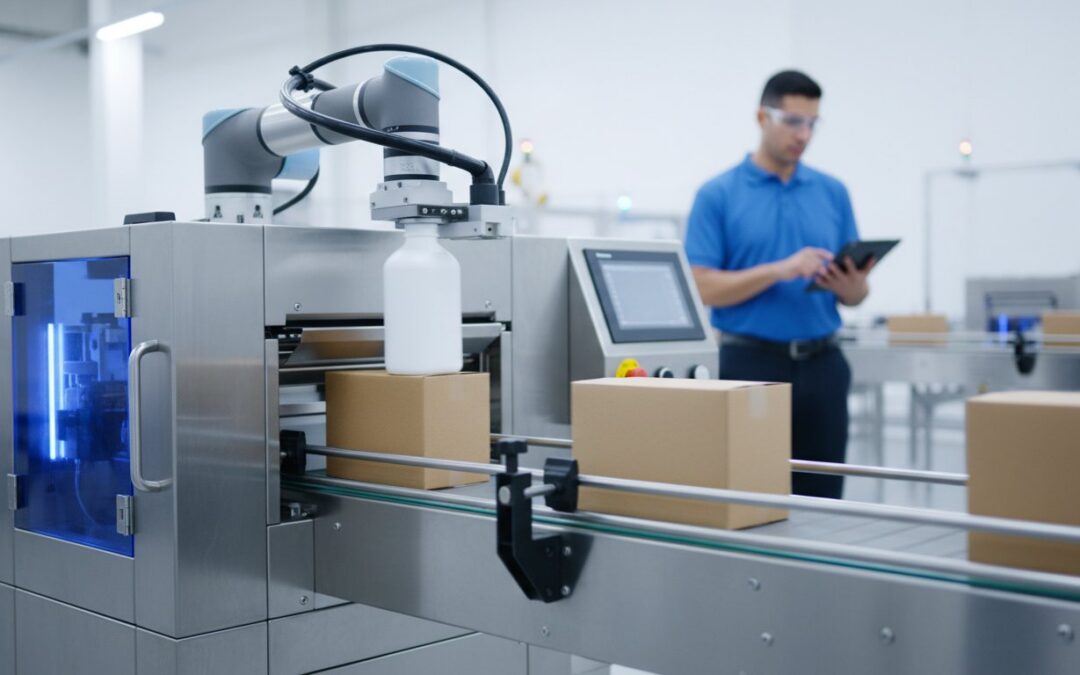
Production bottlenecks, rising labor costs, and inconsistent packaging quality are significant obstacles to achieving peak operational efficiency. When manual processes can no longer keep pace with demand, these challenges directly impact your bottom line and brand reputation. For many growing businesses, the solution lies in strategic automation. Integrating a high-performance cartoning machine is a critical step toward overcoming these limitations, increasing throughput, and securing a competitive edge in the market.
This comprehensive guide is designed to provide the clarity you need to invest confidently in your packaging line. We will explore the fundamental principles of how these automated systems work, from carton erection to product insertion and sealing. You will gain a clear understanding of the key types available and, most importantly, learn the essential criteria for selecting a machine that aligns with your specific product, speed requirements, and long-term production goals. Our aim is to equip you with the expert knowledge to choose a solution that delivers unmatched reliability and performance.
Key Takeaways
-
Understand the core function of automated cartoners and how they streamline end-of-line packaging for improved operational efficiency.
-
Learn the critical difference between horizontal and vertical loading to determine the right machine configuration for your specific product type.
-
Discover the essential performance features to evaluate when selecting a cartoning machine, ensuring it meets your production speed and reliability demands.
-
Recognize how a cartoner integrates into a complete packaging line to ensure seamless communication between equipment and maximize throughput.
Table of Contents
What is a Cartoning Machine and How Does It Work?
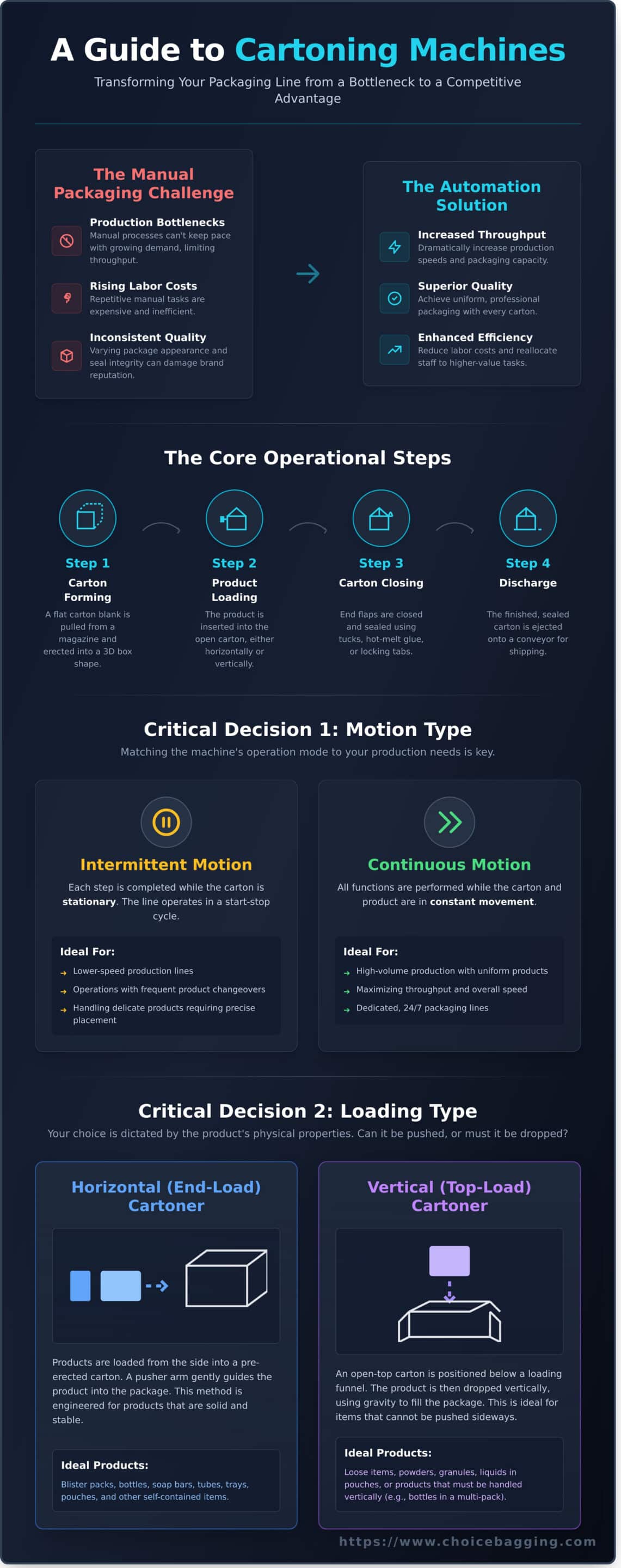
A cartoning machine is a piece of automated, end-of-line packaging equipment designed to deliver unmatched efficiency and precision. Its primary function is to erect flat paperboard blanks into cartons, load them with a product or group of products, and then securely seal them. This process provides a stark contrast to manual packaging, which is often inconsistent, slow, and labor-intensive. For a foundational overview of what a cartoning machine is and its main types, this resource offers further detail. By automating this critical step, businesses can achieve significant benefits, including dramatically increased production speeds, reduced labor costs, and superior, uniform package quality.
To see these concepts in action, the following video demonstrates a high-speed packaging solution at work:
The Core Operational Steps of a Cartoner
Every cartoner, regardless of its specific design, follows a reliable four-step process to ensure consistent and secure packaging:
-
Step 1: Carton Forming. The machine pulls a flat carton blank from a magazine using vacuum cups or mechanical means and erects it into its three-dimensional box shape.
-
Step 2: Product Loading. The product is inserted into the open carton. This can be done horizontally (end-load) or vertically (top-load), either automatically via a conveyor or manually by an operator.
-
Step 3: Carton Closing. The machine closes the carton’s end flaps. Sealing is achieved by tucking the flaps, applying hot-melt glue, or using pre-cut locking tabs for a secure closure.
-
Step 4: Discharge. The finished, sealed carton is ejected from the machine onto a conveyor, ready for case packing, palletizing, and shipping.
Intermittent Motion vs. Continuous Motion
Cartoners operate in one of two fundamental modes, and choosing the right one is critical for optimizing performance. An intermittent motion machine completes each operational step while the carton is stationary. This start-stop cycle is ideal for lower-speed lines, operations with frequent product changeovers, or when handling delicate products that require precise placement.
In contrast, a continuous motion machine performs all functions while the carton and product are in constant movement. This seamless operation allows for significantly higher speeds, making it the preferred choice for high-volume production lines with uniform products where maximizing throughput is the primary objective.
The Two Main Types of Cartoners: Horizontal vs. Vertical
When selecting a cartoning machine, the most critical decision revolves around how your product will be loaded into the carton. This fundamental difference separates the technology into two primary configurations: horizontal and vertical. The choice is not a matter of preference but is dictated entirely by the product’s physical properties-its shape, stability, and whether it can be handled individually or as a free-flowing bulk.
Both types are available in semi-automatic and fully automatic models to match your specific production demands. A simple way to determine your needs is to ask: can my product be pushed horizontally into a carton, or must it be dropped in from above?
Horizontal Cartoning Machines
A horizontal cartoner operates on an intermittent or continuous motion basis, loading products from the side into a pre-erected carton. This method is engineered for products that are solid, stable, and can maintain their shape, allowing a pusher arm to gently guide them into the package. Due to this reliable handling method, horizontal systems are often capable of achieving higher speeds, maximizing throughput for compatible applications.
-
Ideal Products: Blister packs, bottles, soap bars, tubes, trays, pouches, and other self-contained items.
-
Common Industries: Pharmaceutical, cosmetic, personal care, and prepared foods.
Vertical Cartoning Machines
In contrast, a vertical cartoner positions an open-top carton directly below a loading funnel. The product is then dropped vertically, using gravity to fill the package. This top-load configuration is the only practical solution for items that are loose, granular, or cannot be easily handled with a side-push mechanism. It also excels at packaging kits with multiple small components.
-
Ideal Products: Powders, grains, pasta, rice, coffee, small hardware kits, and other free-flowing or irregularly shaped items.
-
Common Industries: Cereal, dry goods, confectionery, and hardware.
This type of cartoning machine integrates seamlessly with upstream equipment. It is often positioned directly under specialized weighers and fillers that accurately dose the product before it is dispensed into the carton, ensuring a streamlined and efficient packaging line.
Key Features to Consider When Selecting a Cartoning Machine
Selecting the right cartoning machine goes beyond choosing between horizontal or vertical models. The critical next step is a detailed analysis of the machine’s specifications to ensure it aligns perfectly with your production requirements. The primary goal is to invest in a system that balances speed, flexibility, and cost-effectiveness, providing a reliable solution for both current needs and future product innovations.
A thorough evaluation of these features ensures you select high-performance equipment that serves as a long-term asset to your packaging line.
Performance and Production Metrics
The true value of a cartoning solution is measured by its output and dependability. Key performance indicators dictate its suitability for your operation. Consider these core metrics:
-
Speed: Measured in cartons per minute (CPM) or pieces per minute (PPM), this must align with your production targets and the capabilities of your upstream and downstream equipment.
-
Carton Size Range: The machine must handle the minimum and maximum dimensions of your current packaging, with enough flexibility to accommodate future SKUs without major re-tooling.
-
Accuracy and Reliability: High-quality systems feature low jam rates and deliver consistent, secure seals. This engineering focus minimizes costly downtime and protects your profitability.
Operational and Physical Specifications
A machine’s physical and operational demands determine how seamlessly it integrates into your facility. Before making a final decision, verify these practical specifications:
-
Footprint: The physical space the equipment occupies is a crucial consideration for effective floor planning and optimizing your production line layout.
-
Changeover Time: For operations running multiple product sizes, fast and tool-less changeovers are essential for maximizing uptime and boosting operational efficiency.
-
Power and Air Requirements: Ensure the machine’s utility needs match your facility’s infrastructure to avoid unexpected and costly site modifications during installation.
Sealing Methods and Material Handling
The final package seal and the method of product delivery are fundamental to both package integrity and line efficiency. Your choice will depend on your product’s specific needs:
-
Sealing Method: Options range from simple tuck-in flaps for reclosable cartons to hot-melt glue systems that provide a more secure, tamper-evident seal required for many retail environments.
-
Product Infeed System: The system that delivers your product to the loading area-whether a conveyor, auger, or robotic arm-must ensure gentle handling and precise placement to maintain product quality.
Integrating a Cartoner into a Complete Packaging Line
A cartoning machine rarely operates in isolation. It is a vital component within a larger, fully automated packaging line, designed for maximum throughput and efficiency. The key to unlocking this performance is seamless integration, where every machine communicates flawlessly to prevent bottlenecks and ensure a smooth, continuous flow of product from start to finish. Proper system design is not just a goal; it is a requirement for reliable, high-speed production.
Achieving this level of synchronized performance requires a partner with proven expertise in end-to-end system design. An improperly integrated cartoning machine can disrupt the entire line’s efficiency, leading to costly downtime and reduced output.
Upstream Integration: Product Filling and Preparation
Before a product reaches the cartoner, it must be packaged and prepared. This upstream process often involves primary packaging equipment like VFFS machines for bagged items or flow wrappers for sealed products. Specialized conveyors then transport these items to the cartoner’s infeed. Success at this stage depends on precision: the system must deliver each product with the correct orientation and timing for the cartoner’s automated loading mechanism to function without error.
Downstream Integration: Case Packing and Palletizing
Once a carton is erected, filled, and sealed, its journey is not over. The newly formed packages are typically conveyed to a case packing station, where they are grouped and loaded into larger shipping cases. Sealed cartons move efficiently via robust handling conveyors to this next stage. The final step in a fully automated line is palletizing, where robotic palletizing systems stack the finished cases onto pallets, preparing them for shipment.
As your partner in packaging automation, we provide the expert consultation needed to build a durable, high-performance system from end to end. Contact us today to ensure your next project is built for unmatched reliability.
Common Industries and Applications for Cartoning Machines
A cartoning machine is an investment in efficiency and reliability, but its true value is revealed in its versatility. These automated systems are engineered to meet the distinct packaging demands of numerous industries, from ensuring product safety in pharmaceuticals to protecting brand integrity in cosmetics. Understanding the specific applications helps demonstrate their wide applicability and potential for a significant return on investment.
Food and Beverage
In the food and beverage sector, cartoners must deliver both performance and hygiene. They handle a diverse range of products, requiring sanitary designs and the capability to manage flexible or loose items. Vertical cartoners are frequently deployed for their top-load functionality, which is ideal for packaging products like:
-
Cereal and granola bags
-
Frozen food trays
-
Wrapped tea bags and coffee pods
-
Snack and confectionery pouches
Pharmaceuticals and Medical
Precision and compliance are non-negotiable in the pharmaceutical industry. Cartoners here are built for high-accuracy operations, incorporating essential features like serialization for track-and-trace, leaflet insertion, and tamper-evident closures. Horizontal cartoners are the standard for their gentle handling of stable, pre-packaged items such as:
-
Blister packs for pills and tablets
-
Glass vials and medicine bottles
-
Syringes and sterile medical devices
Cosmetics and Personal Care
For cosmetics, the carton is a critical part of the brand experience. These applications demand machines that can carefully handle delicate or unusually shaped primary containers without scuffing or damage. The focus is on producing a flawless, high-quality finished package that protects premium branding for products like:
-
Tubes of cream and lotion
-
Perfume bottles and glass containers
-
Soap bars and lipstick tubes
Identifying your industry’s specific needs is the first step toward optimizing your packaging line. The next is partnering with an experienced provider to engineer a solution that delivers unmatched reliability and performance. To ensure you select the right equipment for your application, contact our team for an expert consultation.
Finalize Your Packaging Line with a Trusted Partner
As this guide has shown, selecting the ideal automated cartoning solution is a critical decision that impacts your entire production output. Understanding the key differences between horizontal and vertical systems, identifying essential features for your application, and planning for seamless integration are foundational steps toward achieving greater efficiency. The right cartoning machine is more than just equipment; it is an investment in your company’s productivity and growth.
Choosing the right machinery is only part of the equation; choosing the right partner is essential for long-term success. Since 1978, Choice Bagging Equipment has been a trusted leader in production line integration. We deliver unmatched reliability with durable, USA-based equipment engineered for decades of consistent performance. Our commitment extends beyond the sale, offering expert support to ensure your system operates at peak efficiency.
Invest confidently in a solution built to last. Consult our experts on integrating your packaging line and discover how our expertise can elevate your operations. We look forward to building a more productive future for your business.
Frequently Asked Questions About Cartoning Machine Technology
What is the difference between a cartoner and a case packer?
The primary difference lies in the packaging stage. A cartoner, or cartoning machine, handles primary packaging by placing products into individual cartons-the package a consumer buys. A case packer performs secondary packaging, grouping these filled cartons into a larger corrugated shipping case or box for bulk transport. Each machine is a critical but distinct component in a fully automated packaging line, designed for different scales of containment and handling.
How much does an industrial cartoning machine cost?
The investment for an industrial cartoning machine varies significantly, typically ranging from $50,000 for simpler, lower-speed models to over $500,000 for high-speed, fully integrated systems. Key factors influencing the cost include operational speed (cartons per minute), level of automation, product infeed complexity, and the need for custom engineering. We provide detailed consultations to engineer a solution that aligns with your specific production goals and budget, ensuring a sound investment.
What kind of maintenance does a cartoning machine require?
To ensure unmatched reliability and performance, a cartoning machine requires a consistent preventative maintenance schedule. This includes routine lubrication of moving components, regular inspection and replacement of wear parts like belts and seals, and cleaning of sensors and gluing systems. Following the manufacturer’s recommended maintenance plan is essential for maximizing the operational lifespan of your equipment and preventing unplanned downtime, protecting your investment for decades to come.
Can a single machine handle multiple carton sizes and product types?
Yes, modern cartoning machines are engineered for operational flexibility. A single machine can be configured to handle a range of carton sizes and product dimensions through the use of adjustable guides and quick-changeover parts. When planning your investment, it is crucial to define the full scope of your packaging needs. This allows us to engineer a versatile system from the start, ensuring efficient transitions between production runs with minimal mechanical adjustments.
What is the typical ROI for investing in a cartoning machine?
The return on investment for a cartoning machine is driven by significant gains in efficiency and reductions in operational costs. Key factors include drastically lower manual labor expenses, increased throughput, and improved packaging consistency that minimizes waste. Most operations see a full ROI within 18 to 36 months, with the exact timeline depending on production volume, labor savings, and the specific automation level of the equipment implemented.
Are there semi-automatic options for lower volume production?
Absolutely. For facilities with lower throughput requirements or those transitioning toward automation, a semi-automatic cartoning machine offers a practical and cost-effective solution. In this setup, an operator typically loads the product into the carton manually, after which the machine takes over to reliably fold, glue, and seal the flaps. This approach provides a significant boost in packaging speed and consistency over purely manual methods without the investment of a fully automated system.
Recent Comments