
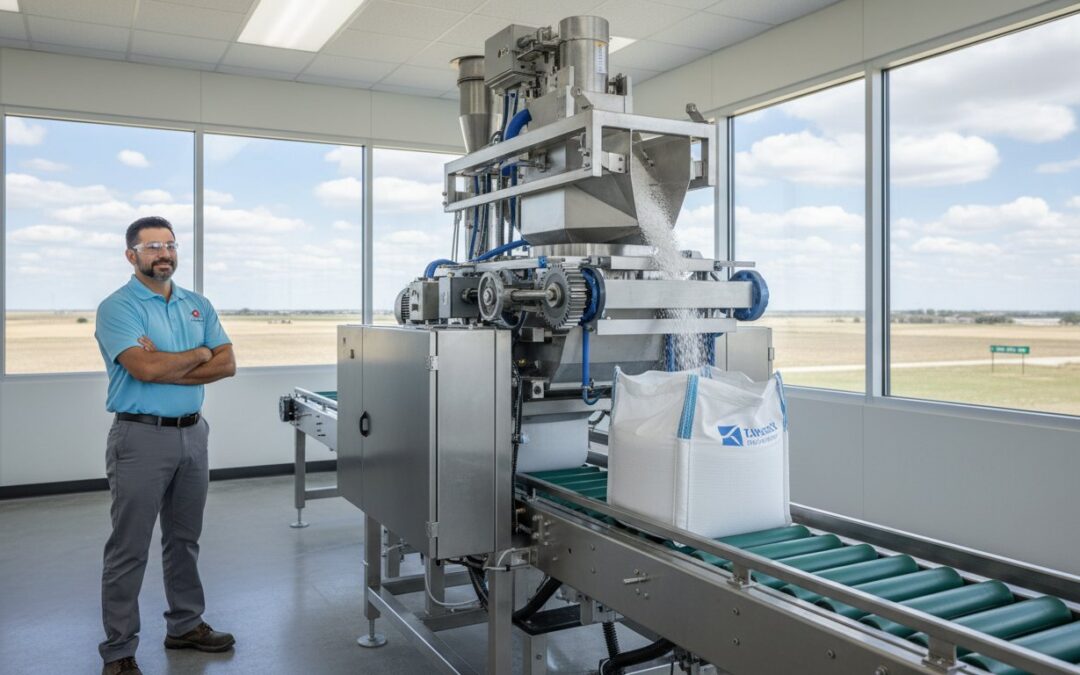
Master the technical nuances of granular packaging and discover how to select a bagging system built for decades of reliable performance.
Understanding Granule Bagging Machine Basics and Material Dynamics
A granule bagging machine is an industrial system designed to precisely weigh and dispense granular solids into bags, typically ranging from 20 to 110 lbs. Unlike fine powders that can aerate or large aggregates that are easy to separate, granules require specialized handling. Their unique size, shape, and density can cause inconsistent flow, leading to inaccurate bag weights and production bottlenecks if the wrong equipment is used.
The key to efficient bagging is understanding your material’s flowability, often measured by its "angle of repose." This single characteristic dramatically affects your potential bagging speed and weight accuracy. At Choice Bagging Equipment , our engineering expertise is focused on matching machine mechanics to your material’s unique dynamics. This expert-led approach is why we developed resources like our online Bagger Professor tool – to help you begin the process of selecting the perfect equipment for your specific granular product.
Identifying Your Granular Material Properties
-
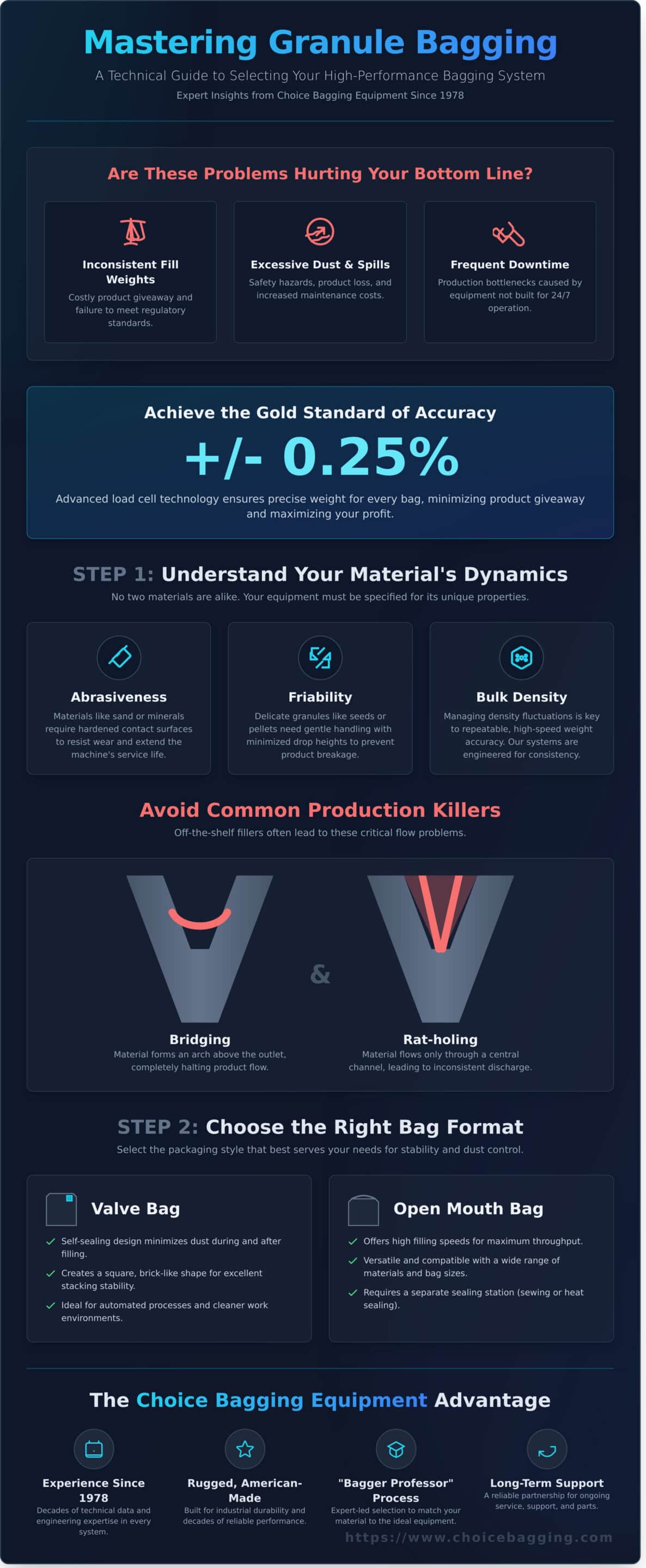
Abrasiveness: Handling materials like sand, minerals, or roofing granules requires equipment built with hardened steel and wear-resistant components to protect your investment from premature failure.
-
Friability: Delicate granules such as seeds, specialty chemicals, or certain plastic pellets can break or degrade during the bagging process. Gentle handling systems, like vibratory feeders, are essential to reduce product breakage and maintain quality.
-
Bulk Density: The weight of a material per a given volume is its bulk density. A consistent bulk density is the secret to achieving high-speed, repeatable weight accuracy in any bagging operation.
Why Standard Fillers Fail with Specialized Granules
Using a generic filler for a specific granular product often leads to costly inefficiencies. Poorly designed hoppers can cause material "bridging" (arching over the outlet) or "rat-holing" (flowing only through a central channel), starving the feeder and causing inconsistent weights. Improper feeding mechanisms can damage the product or fail to deliver a consistent stream, resulting in product giveaway and inaccurate fills.
Ultimately, precise flow-control is the primary factor in granule bagging efficiency.
The Mechanics of Accuracy: How Granule Filling Systems Work
At the core of any granule bagging machine is its weighing system. The fundamental choice is between Net Weigh systems, which weigh the product in a hopper before dispensing it into the bag, and Gross Weigh systems, which weigh the product as it fills the bag. By integrating advanced load cell technology and sophisticated controls, modern systems can achieve exceptional weight accuracy, often within +/- 0.25%.
A clean and safe work environment is also critical. That’s why high-performance bagging machines include integrated dust collection interfaces to manage airborne particles at the point of filling. To minimize operator error and training time, Choice Bagging Equipment systems feature intuitive, easy-to-use controls that simplify operation without sacrificing precision.
Gravity, Vibratory, and Belt Feeders Explained
-
Gravity Feeders: As the simplest and most efficient option, gravity feeders are the best choice for free-flowing granules like grain, corn, soybeans, or plastic pellets. They use a gate to control the flow of material directly from the hopper into the weigh system.
-
Vibratory Feeders: For non-free-flowing, delicate, or irregularly shaped granules, a vibratory feeder provides gentle, controlled handling. It uses vibrations to move material along a pan at a precise rate, ensuring a consistent feed without damaging the product.
-
Belt Feeders: When dealing with sticky, semi-solid, or extremely fragile materials that cannot be handled by gravity or vibration, a belt feeder is the ideal solution. It moves a precise volume of material on a conveyor belt for maximum control.
Net Weigh vs. Gross Weigh: Which Is Right for Your Throughput?
-
Net Weigh Systems: These systems are built for speed and efficiency. By pre-weighing the next product charge in a dedicated weigh hopper while the previous bag is being removed and replaced, they maximize throughput.
-
Gross Weigh Systems: In this configuration, the bag itself is part of the weighing process. This results in a more compact and cost-effective solution, making it ideal for lower-volume operations or applications where space is limited.
For high-speed applications, Net Weigh systems typically offer 20-30% higher throughput than their Gross Weigh counterparts.
Comparing Bagging Formats: Valve Bag vs. Open Mouth for Granules
The type of bag you use is as important as the filling machine itself. For granules, the primary choice is between valve bags and open mouth bags, each offering distinct advantages.
-
Valve Bags: Featuring a self-closing opening, valve bags are the industry standard for products that require minimal dust emission and create dense, stable pallets for stacking.
-
Open Mouth Bags: These are the most versatile option, compatible with a wide range of bag materials (poly, paper, burlap) and sizes. They require a secondary closing step like sewing or sealing.
-
Total Cost of Ownership: While valve bags may have a slightly higher per-unit cost, they often reduce labor by eliminating the need for a separate sealing station. Open mouth systems may have a lower bag cost but require investment in closing equipment and potentially more manual handling.
To learn more about high-accuracy granular packing, explore our Valve Bag Fillers.
When to Choose Valve Bag Fillers for Granular Products
-
Self-Closing Design: The bag’s internal valve flap automatically closes after filling, eliminating the need for secondary sealing equipment and creating a clean, sift-proof package.
-
High-Value or Hazardous Materials: The enclosed filling process makes valve bags the preferred choice for high-value granular chemicals or dusty materials, minimizing product loss and operator exposure.
-
The "Clean-Fill" Advantage: Advanced valve bag fillers often incorporate internal air-evacuation systems (air-probes) that densify the product and keep the bagging area pristine.
The Versatility of Open Mouth Bagging Systems
-
Broad Material Compatibility: A single open mouth bagging machine can often handle a wide range of product types and bag sizes, providing maximum production flexibility.
-
Automation-Ready: These systems are easily integrated with automated bag hangers, which pick and place empty bags onto the spout, significantly reducing manual labor requirements.
For flexible production needs, explore our Open Mouth Bagging Machines.
Optimizing Your Production Line: From Sealing to Palletizing
A fast, accurate granule bagging machine is only one part of an efficient packaging line. Identifying and eliminating downstream bottlenecks is essential for maximizing your return on investment. A filler that bags 20 bags per minute is useless if the bags can’t be closed and palletized at the same speed.
Bag handling conveyors are crucial for maintaining product orientation and moving filled bags smoothly to the next station. At Choice Bagging Equipment, we specialize in full system integration, ensuring every component—from the infeed hopper to the pallet wrapper—works in perfect harmony.
To achieve maximum ROI and automate your end-of-line process, complete your line with our Robotic Palletizing Systems.
Selecting the Right Bag Sealing and Sewing Technology
-
Heat Sealing: For plastic or poly-lined paper bags that require a moisture-proof or airtight closure, heat sealing is the most reliable method.
-
Industrial Sewing: For multi-wall paper and woven polypropylene bags, a high-speed industrial sewing machine provides a strong, durable, and cost-effective closure.
See our range of Bag Sealing and Bag Sewing Machine Systems.
Automating the End-of-Line with Robotic Palletizers
-
Improve Workplace Safety: Robotic palletizers eliminate the repetitive, strenuous task of manual stacking, drastically reducing the risk of workplace injuries and lowering labor costs.
-
Increase Flexibility: A single robotic arm can be programmed to handle multiple bag sizes and complex pallet patterns, adapting to changing production demands on the fly.
-
Ensure Load Stability: Pallet wrapping is the final essential step. An automated stretch wrapper secures the finished pallet, ensuring it remains stable and protected during shipping and storage.
Investing in Durability: The Choice Bagging Equipment Difference
Since 1978, Choice Bagging Equipment has been building industrial-grade equipment in Taylor, Texas. For us, "Made in the USA" is more than a slogan—it is a guarantee of superior engineering, quality domestic components, and readily available replacement parts and support.
Our engineering philosophy is simple: use minimal moving parts to deliver maximum uptime. This focus on robust, straightforward design is why our machines are built to provide decades of reliable service, not just years. Should you ever need assistance, our expert Field Service team is ready to ensure your granule bagging machine continues to operate at peak performance.
Why Industrial Longevity Outweighs Initial Cost
When evaluating equipment, it’s crucial to calculate the real cost of downtime. For many high-volume producers, just one day of unscheduled failure can cost more than the price difference between a standard machine and a premium, industrial-grade system. We have CBE machines still in operation after more than 30 years—a testament to our "Built to Last" promise.
CBE equipment is engineered with heavy-gauge steel and industrial-grade components to withstand the rigors of 24/7 operation in harsh environments.
Expert Consultation for Custom Solutions
We believe in consultative partnerships, not catalog orders. Before we recommend a machine, our engineers analyze your specific granular material, your production goals, and your operational environment. We provide custom hopper designs and full integration support to ensure a seamless installation and rapid commissioning. This hands-on approach ensures you get a system perfectly tailored to your needs.
Ready to upgrade your production with a system built for accuracy and durability? Contact Choice Bagging Equipment for a custom quote today .
Frequently Asked Questions
What is the most accurate way to bag granules?
For the highest accuracy, a Net Weigh filling system is typically best. It uses a dedicated weigh hopper and advanced load cells to pre-weigh the product to a precise target before dispensing it, often achieving accuracy within +/- 0.25%.
How many bags per minute can a granule bagging machine fill?
Production speed depends on the machine type, bag size, and material flowability. Manual systems may fill 5-8 bags per minute (BPM), while fully automated Net Weigh systems can achieve speeds of 20-25 BPM or more for free-flowing granules.
Can one machine handle both powders and granules?
While some machines can be adapted, it’s generally not recommended. Powders and granules have very different flow characteristics. A machine optimized for free-flowing granules (like a gravity filler) will perform poorly with fine powders, and vice-versa. It’s best to use a machine designed specifically for your material type.
What is the difference between a gravity filler and a vibratory filler?
A gravity filler uses a simple gate to control the flow of free-flowing materials. A vibratory filler uses a vibrating pan to gently and precisely move non-free-flowing, delicate, or irregularly shaped granules, providing more control and preventing product damage.
Is it better to use valve bags or open mouth bags for granules?
It depends on your product and priorities. Valve bags are excellent for dust control, high-density stacking, and minimizing labor, as they are self-closing. Open mouth bags offer more versatility in size and material type and are ideal for integration with fully automated bagging and sealing lines.
What maintenance is required for an industrial bagging machine?
Routine maintenance includes inspecting and lubricating moving parts, checking load cell calibration, and cleaning dust collection systems. Machines from Choice Bagging Equipment are designed with minimal moving parts to reduce maintenance requirements and maximize uptime.
Do you offer rental programs for seasonal bagging needs?
Yes, we offer equipment rental programs to help businesses manage seasonal peaks in demand or to test a system before making a capital investment. Please contact our team to discuss your specific needs.
How do I know if I need to automate my bagging line?
Consider automation if you are facing challenges with labor shortages, inconsistent bag weights, production bottlenecks, or workplace injuries related to manual stacking. Automating processes like bag placing, filling, and palletizing can significantly increase efficiency, accuracy, and safety.
Recent Comments