
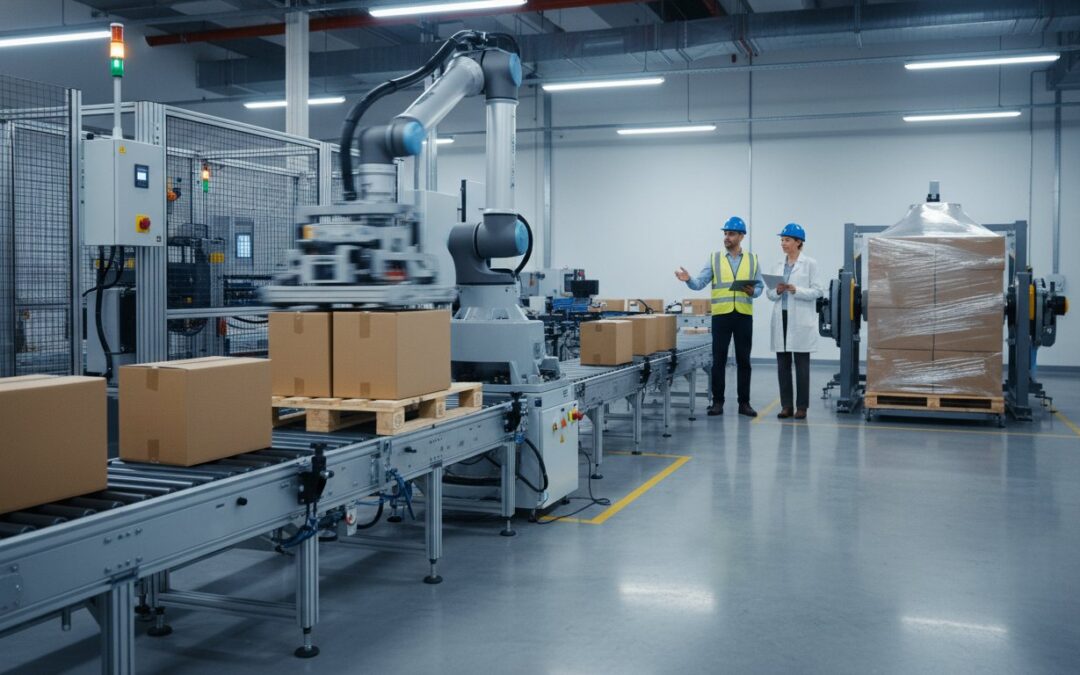
Is your production line’s potential being capped by the final step? If manual palletizing is creating a critical bottleneck, increasing labor costs, and causing inconsistent stacks, you are not alone. These end-of-line challenges directly limit your plant’s capacity and profitability. A high speed palletizing system is engineered to solve these problems, transforming a point of constraint into a source of unmatched performance and reliability.
This advanced automation is more than an equipment upgrade; it is a strategic investment in the long-term efficiency and safety of your entire operation. By replacing repetitive, physically demanding tasks with precise, high-velocity robotics, you can achieve perfectly stacked, stable pallets every time, reducing product damage and creating a more ergonomic work environment for your employees.
In this guide, we will explore the key components, tangible benefits, and essential integration strategies for these powerful systems. You will discover how to eliminate end-of-line bottlenecks for good, dramatically increase your throughput, and maximize your plant’s overall efficiency. Consider this your roadmap to building a more productive and dependable packaging operation.
Key Takeaways
-
Understand that true high-speed palletizing is achieved through an integrated system, not just a fast robot, to ensure consistent end-of-line performance.
-
Investing in a high speed palletizing system delivers a significant ROI by reducing labor costs, minimizing product damage, and improving operational safety.
-
Learn the key differences between robotic and conventional high-speed technologies to select the right solution for your specific application and facility layout.
-
Successful implementation requires a complete system-wide approach, ensuring seamless integration from your bagging machine to the stretch wrapper.
Table of Contents
What Defines a High-Speed Palletizing System?
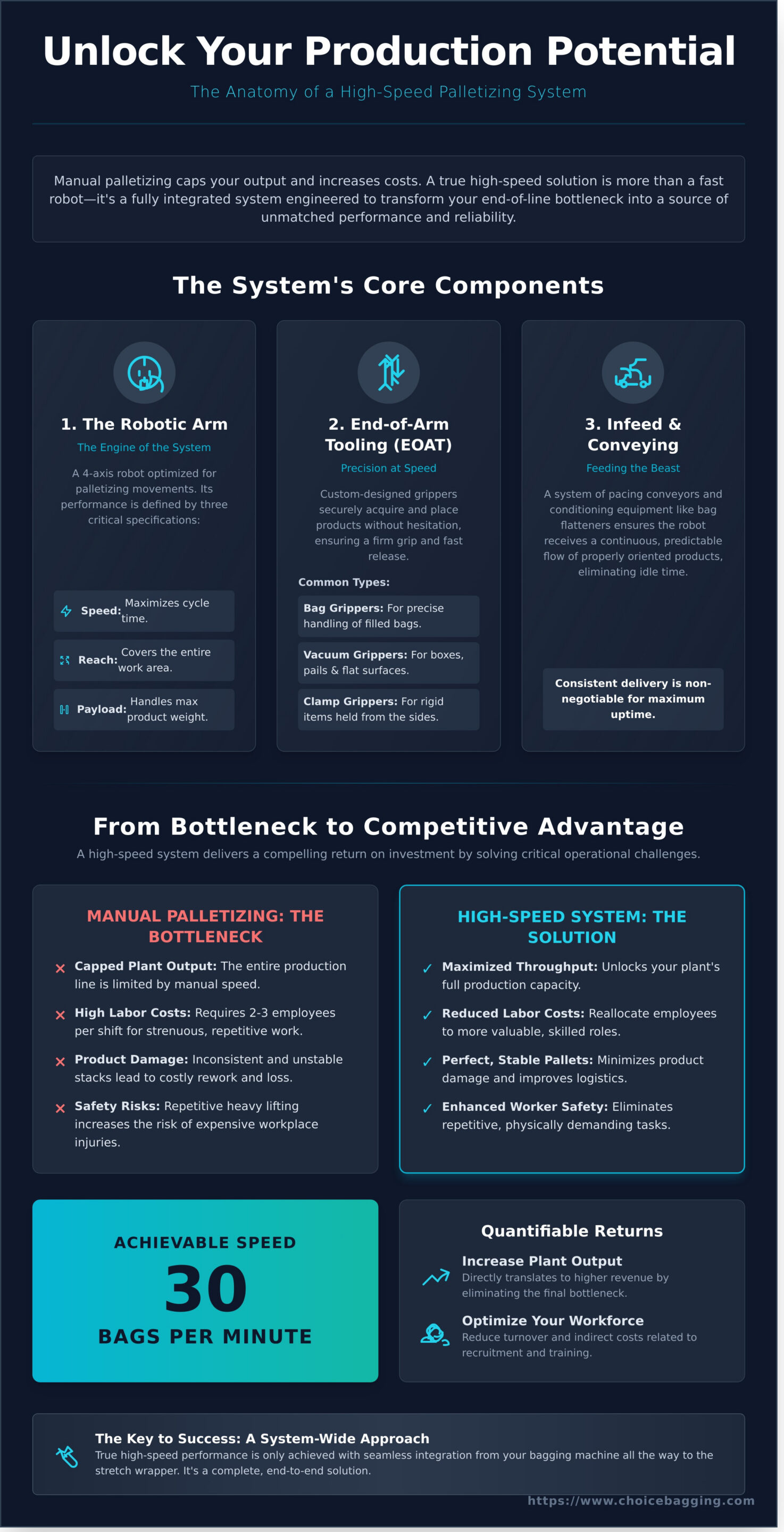
A true high speed palletizing system is far more than just a fast robot. It is a fully integrated, meticulously engineered solution where every component is designed to work in unison to achieve maximum throughput. While a standard Palletizer might prioritize flexibility for handling diverse product types, a high-speed system is purpose-built for one primary goal: stacking products at an exceptional rate, often reaching speeds of up to 30 bags per minute, without compromising stability or accuracy.
Achieving this level of performance requires a holistic approach. If any single part of the line-from the infeed conveyor to the end-of-arm tool-cannot keep pace, the entire system’s efficiency is diminished. This is the key difference: it’s not about one fast machine, but a balanced and reliable end-to-end process.
The Robotic Arm: The Engine of the System
At the core of the system is a powerful robotic arm, typically a 4-axis model optimized for the specific movements of palletizing. When selecting a robot, three specifications are critical: speed, reach, and payload capacity. The arm must be able to move quickly and precisely across the entire work envelope while safely handling the maximum weight of your product. Investing in a robot with an adequate payload ensures it can maintain its target cycle time without strain or premature wear.
End-of-Arm Tooling (EOAT): Precision at Speed
The End-of-Arm Tooling, or gripper, is where the robot meets the product. For high-speed applications, custom-designed EOAT is essential for securely acquiring and placing products without hesitation. Common types include:
-
Bag Grippers: Specifically designed to handle filled bags with precision.
-
Vacuum Grippers: Ideal for boxes and pails with flat, stable surfaces.
-
Clamp Grippers: Used for rigid items that can be securely held from the sides.
A well-designed tool ensures a firm grip during rapid movement and an equally fast, clean release to minimize cycle time.
Infeed and Conveying: Feeding the Beast
Even the fastest robot is rendered ineffective if it is waiting for product. The infeed system must be engineered to "feed the beast" with a continuous, predictable flow of items. This involves pacing conveyors that properly space products and conditioning equipment like bag flatteners to ensure each item is correctly shaped and oriented. Reliable bag handling conveyors are a non-negotiable component, providing the consistent delivery needed to maximize the uptime and overall performance of your high speed palletizing system.
The ROI of Speed: Key Benefits for Your Operation
Investing in a high speed palletizing system is not merely about increasing throughput; it’s a strategic decision that delivers a measurable return on investment across your entire operation. While the upfront capital expenditure is significant, the long-term gains in efficiency, cost reduction, and quality control provide a compelling business case. This section translates raw speed into tangible value, justifying the investment and highlighting the competitive advantage it creates.
Maximizing Throughput and Eliminating Bottlenecks
In many production facilities, manual palletizing is the most significant bottleneck, artificially capping the output of the entire line. Your upstream bagging and sealing equipment may be capable of high-speed performance, but its potential is wasted if the end of the line cannot keep pace. Automating this final step unlocks the full production capacity of your plant. For example, doubling palletizing speed from 15 to 30 bags per minute can directly translate to a proportional increase in overall plant output and revenue.
Reducing Labor Costs and Enhancing Worker Safety
The financial benefits extend far beyond raw output. A fully automated system allows you to reallocate two to three employees per shift from strenuous manual labor to more valuable, skilled roles. Consider the total cost savings:
-
Direct Labor Savings: Eliminates wages, benefits, and overtime for manual handlers.
-
Reduced Indirect Costs: Lowers expenses related to recruitment, training, and high employee turnover.
-
Improved Safety: Drastically reduces the risk of costly, repetitive strain and lifting-related injuries, leading to lower workers’ compensation claims.
Achieving Perfect Pallet Quality and Consistency
Automation delivers a level of precision that manual labor cannot consistently replicate. A robotic high speed palletizing system builds perfectly square, dense, and stable loads every single time. This consistency is critical for reducing product damage during shipping, handling, and warehouse storage. Furthermore, modern systems are capable of executing highly complex and interlocking stacking patterns with flawless accuracy. As research into the development of an intelligent robotic palletizer system shows, this combination of speed and precision ensures your products arrive at their destination safely and professionally presented, protecting your brand’s reputation for quality.
Robotic vs. Conventional High-Speed Palletizers
When designing a high-speed palletizing system, a foundational decision is the choice between conventional and robotic technology. While both are proven automated solutions capable of meeting demanding throughput requirements, they differ significantly in flexibility, footprint, and long-term operational efficiency. The right choice depends on balancing pure speed with the adaptability required in modern production environments.
Understanding Conventional (Layer-Forming) Palletizers
Conventional palletizers, also known as layer-forming palletizers, operate by accumulating and arranging products into a complete layer before transferring it onto a pallet. For dedicated, single-product lines with no variation, their performance is unmatched. However, this specialized speed comes with considerable trade-offs: a large physical footprint, significant mechanical complexity, and time-consuming changeovers that can take hours and require skilled technicians.
The Superior Flexibility of Robotic Systems
In contrast, the primary advantage of a robotic palletizing system is its inherent adaptability. A single robotic cell can service multiple production lines simultaneously, handling a diverse mix of SKUs with ease. Programming new pallet patterns is a simple software adjustment, not a major mechanical overhaul. This flexibility is crucial in today’s market, a trend noted by the Robotic Industries Association, which highlights the industry’s shift toward automation that can handle varied products-from bags and cases to pails and totes-often with a single, versatile end-of-arm tool.
Comparing Footprint, Maintenance, and Uptime
Beyond flexibility, the operational benefits of robotic systems are clear when comparing key performance indicators. The compact and configurable nature of a robotic high speed palletizing system allows for efficient use of valuable floor space.
-
Footprint: Robotic cells are typically far more compact than the sprawling machinery of a conventional system, allowing for easier integration into existing plant layouts.
-
Maintenance: A robotic arm has significantly fewer moving parts than a layer-forming machine with its complex network of chains, sprockets, and conveyors. This translates directly to higher reliability, fewer failure points, and simpler maintenance schedules.
-
Uptime: With near-instantaneous changeovers and superior reliability, robotic palletizers deliver higher overall uptime and greater production availability, maximizing your return on investment.
While conventional machines serve a purpose in high-volume, static environments, the modern demands for agility and efficiency make robotic automation the forward-thinking choice for most applications. To determine the ideal solution for your production goals, contact our engineering team for a detailed consultation.
Integrating a High-Speed System for a Complete Solution
A robotic palletizer is a powerful machine, but its true performance is unlocked only when it is part of a fully integrated end-of-line system. Achieving maximum throughput and reliability requires a holistic view of the entire process, from the moment your product is bagged until it is securely loaded for shipment. A successful high speed palletizing system depends on seamless synchronization between all upstream and downstream equipment. At Choice Bagging Equipment, we are more than just a manufacturer; we are your partner in designing a complete, high-performance solution.
Upstream Synchronization: Bagging and Conveying
The process begins long before the robot. Your bag filling equipment must be able to consistently supply product at a rate that matches or exceeds the palletizer’s capacity. Our systems are engineered to work in concert with high-efficiency machines like our valve bag fillers. Proper bag conditioning and conveying are also critical, ensuring each bag is correctly shaped, flattened, and positioned for precise robotic pickup, eliminating errors and downtime.
System Components: Pallet and Slip Sheet Dispensers
To maintain continuous, automated operation, manual intervention must be eliminated. This is achieved with essential auxiliary components that feed the robotic cell and prepare the load unit.
- **Automatic Pallet Dispensers:** These units store a stack of empty pallets and dispense them one at a time into the palletizing station, ensuring the robot always has a pallet ready.

- **Slip Sheet Dispensers:** For added load stability, a slip sheet is placed automatically on the pallet before stacking begins, or between layers as needed.
These components are fundamental to creating a truly hands-off process that runs without interruption.
Downstream Finishing: Automatic Stretch Wrapping
A perfectly stacked pallet is not ready for shipment until it is properly secured. The final, critical step is integrating an automatic stretch wrapper directly after the palletizing cell. As soon as a full pallet is complete, it is conveyed to the wrapper, where it is tightly wrapped for stability and protection. This creates a fully automated workflow from bag to wrapped load, ensuring your product arrives at its destination in the same condition it left your facility.
Designing a cohesive packaging line requires deep expertise in system integration. When you are ready to implement a complete high speed palletizing system, trust the experts who see the full picture. Contact Choice Bagging Equipment today to start planning your integrated solution.
Unlock Your Production Potential with a Strategic Automation Partner
Ultimately, investing in a high speed palletizing system is a strategic decision that directly impacts your bottom line. These advanced solutions deliver a powerful return on investment by maximizing production throughput and creating a more reliable, efficient end-of-line process. Success depends not just on the machinery, but on choosing the right technology and ensuring it integrates seamlessly into your existing operations to eliminate bottlenecks for good.
Choice Bagging Equipment is more than a manufacturer; we are your trusted partner in packaging automation. Since 1978, we have delivered expert integration support for our durable, high-performance systems, all made in the USA. We build solutions designed to perform under pressure and provide a foundation for your company’s growth.
Ready to eliminate your palletizing bottleneck? Contact our engineers for a system consultation and take the first step toward greater productivity.
Frequently Asked Questions About High-Speed Palletizing Systems
How many bags or cases per minute is considered ‘high speed’?
The classification of ‘high speed’ typically begins at a rate of 20 to 25 units per minute. However, advanced systems designed for maximum throughput often exceed 30 bags or cases per minute, with some custom configurations handling even greater capacities. The precise rate is determined by factors like product weight, dimensions, and the complexity of the required stacking pattern. A thorough analysis of your production goals is necessary to define the optimal speed for your operation.
What is the typical return on investment (ROI) for a high-speed palletizing system?
Most facilities realize a full return on investment for a high-speed palletizing system within 18 to 36 months. This rapid ROI is driven by direct labor cost reduction, increased throughput, and the elimination of expenses related to workplace injuries. Furthermore, the consistent and stable pallet builds created by automation reduce product damage during transit. We can provide a detailed ROI projection based on your specific operational data to help you invest confidently.
How much maintenance does a high-speed robotic palletizer require?
Modern robotic palletizers are engineered for exceptional reliability and minimal downtime. Maintenance primarily consists of scheduled preventative tasks, such as lubrication, routine inspections of wear components, and sensor verification. A properly executed preventative maintenance plan typically requires only a few hours per month to ensure your system delivers decades of dependable performance. We provide comprehensive maintenance schedules and full partner support to keep your equipment operating at peak efficiency.
Can a single high-speed system handle different product sizes and types?
Yes. Versatility is a key advantage of modern robotic palletizing. A single system can be engineered to manage numerous product SKUs, including various bag sizes, case dimensions, and weights. This is accomplished with custom end-of-arm tooling (EOAT) and user-friendly software that allows for quick, pre-programmed recipe changes. This flexibility ensures your operation can adapt to shifting production demands without the need for multiple dedicated lines, maximizing the value of your capital investment.
What safety features are required for a robotic palletizing cell?
A compliant robotic palletizing cell must prioritize operator safety above all else. Standard requirements include robust physical guarding (safety fencing) with electronically interlocked access gates to control entry. Light curtains are installed at pallet entry and exit points to immediately halt the system if the light beam is broken. Additionally, multiple, easily accessible emergency stop (E-stop) buttons are integrated throughout the cell. All systems must be designed to meet or exceed current ANSI/RIA safety standards.
How much floor space is needed to install a high-speed palletizing system?
The footprint of a palletizing system varies based on the robot’s reach, conveyor layout, and safety perimeter. A typical single-robot cell often requires a space of approximately 15′ x 20′. However, we engineer solutions for diverse facility constraints, including more compact layouts and vertical-lift designs for operations with limited floor space. Our process includes a full site assessment to develop a system design that optimizes your available area for both efficiency and safety.
Recent Comments