

Inconsistent bag weights, unexpected downtime, and the high cost of maintaining unreliable equipment are more than just daily headaches-they are direct threats to your profitability. When a bagging line fails, production grinds to a halt, and every minute costs you money. Selecting the right industrial bagging machine is a critical investment in your operation’s long-term performance, not just a short-term fix for a gap in your line.
This guide is engineered to provide the clarity and confidence you need. We will move beyond surface-level features to explore the core technical principles that define a truly reliable and precise bagging system. You will master the nuances of weighing technology, integration strategies, and durability engineering to optimize your production line for maximum throughput. Prepare to build an automated bagging line that delivers consistent accuracy, demands minimal maintenance, and is backed by the dependable US-based support you deserve.
Key Takeaways
-
Maximize filling accuracy and speed by matching your material’s unique flow characteristics to the correct feed system technology.
-
Evaluate the trade-offs between valve and open mouth bags to determine the right balance of throughput speed and packaging integrity for your application.
-
Ensure long-term operational reliability by selecting an industrial bagging machine supplier with proven field service and readily available US-based parts.
-
Understand how a manufacturer’s partnership philosophy directly impacts the total cost of ownership and lifetime performance of your equipment.
Table of Contents
What is an Industrial Bagging Machine and Why Does Engineering Matter?
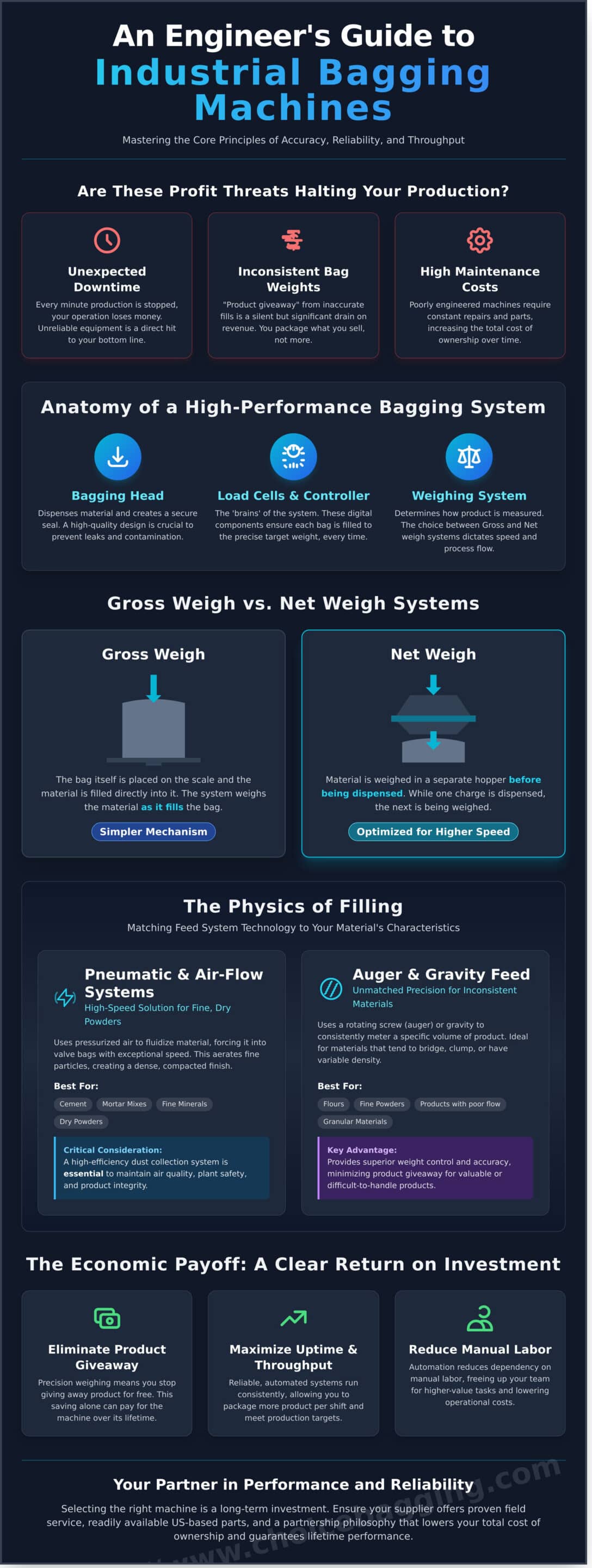
An industrial bagging machine is more than just a piece of equipment; it is a precision-engineered system designed for the high-volume packaging of bulk materials. As the industry moves forward, the standard has shifted far beyond manual filling. Today’s competitive operations demand the speed, consistency, and reliability that only automated bagging systems can provide.
To see this level of automation in action, watch this overview of a modern bagging line:
The engineering behind these systems is critical. Every component is designed to protect your profit margins through two key functions: absolute weighing accuracy and unwavering operational uptime. Inaccurate fills lead to "product giveaway"-a silent but significant drain on revenue. Likewise, downtime from equipment failure halts production entirely. Investing in a ‘built-to-last’ machine is a direct hedge against these business risks.
The Core Components of a Bagging System
The performance of any bagging system depends on the quality of its core components, which work together to ensure efficient and accurate packaging.
-
Bagging Head: This component dispenses material and creates a secure seal. Its design directly impacts seal integrity, preventing costly leaks and product contamination.
-
Load Cells and Digital Controllers: These are the brains of the operation, ensuring each bag is filled to the precise target weight. Achieving consistent accuracy depends on both high-quality load cells and their regular professional calibration, a field of expertise where you can discover CPS (NZ) Ltd.
-
Weighing Systems: Systems are categorized as either gross weigh (the bag is filled while on the scale) or net weigh (product is weighed in a hopper, then dispensed). Many automated systems, such as a Vertical form fill sealing machine, utilize net weigh principles for higher speed.
Economic Impact of Modern Bagging Technology
A modern industrial bagging machine delivers a clear and measurable return on investment. Automation significantly reduces manual labor requirements, especially when integrated with downstream equipment like robotic bag palletizers. The most immediate financial gain, however, comes from eliminating product giveaway. The precision of an automated system can pay for the machine itself over time by ensuring you only package what you sell. Ultimately, bagging efficiency is the ratio of uptime to throughput.
The Physics of Filling: Matching Feed Systems to Materials
Selecting the right industrial bagging machine begins with a deep understanding of your product. Key material characteristics-such as bulk density, flowability, and particle size-fundamentally dictate which filling technology will deliver the speed, accuracy, and reliability you require. An incorrect match leads to inaccurate weights, product damage, and operational inefficiency. A deep understanding of your product’s properties, from its flow characteristics to its interaction with different films as detailed in packaging material science, is the first step toward achieving operational efficiency.
At Choice Bagging Equipment, we call this the ‘Bagger Professor’ approach: a diagnostic process that scientifically matches your material to the ideal machine. The fundamental choice comes down to two distinct principles: using air to fluidize and move the product, or using mechanical force and gravity. Each is engineered to solve specific handling challenges, whether you are packaging highly abrasive minerals or delicate, fragile goods.
Pneumatic and Air-Flow Systems
Pneumatic packers, or air packers, are the high-speed solution for fine, dry powders. These systems use pressurized air to fluidize materials like cement, mortar mixes, and fine minerals, forcing them into valve bags with exceptional speed and a dense, compacted finish. Because this process aerates fine particles, integrating a high-efficiency dust collection system is not just a recommendation-it is essential for maintaining plant safety, air quality, and product integrity.
Auger and Gravity Feed Mechanics
For materials with inconsistent flow or a tendency to bridge, such as flours or fine powders, auger fillers provide unmatched precision. A rotating screw consistently meters a specific volume of product into the bag, ensuring dependable weight accuracy. Conversely, for free-flowing granular products like seeds, grains, or plastic pellets, gravity bag fillers offer a simple and highly reliable solution. These systems leverage the natural flow of the material, which translates to minimal moving parts, reduced maintenance, and exceptional durability.
Valve Bag vs. Open Mouth: Choosing Your Packaging Format
Selecting the right bag type is a foundational decision that directly impacts your production line’s speed, cleanliness, and overall efficiency. The choice between valve bags and open mouth bags dictates the type of industrial bagging machine you need and influences everything from product handling to final palletizing. Understanding the core benefits of each format is essential for investing confidently in your packaging operation.
The Case for Valve Bag Fillers
Valve bags are engineered for clean and efficient filling. Featuring a small, self-closing "valve" in the corner, these bags are filled through a nozzle that is inserted into the opening. Once the bag reaches its target weight, product pressure seals the valve, creating a nearly dust-free packaging environment. This makes valve bag fillers the superior choice for fine powders like mortar, pigments, and chemicals. Their compact station footprint also makes them ideal for facilities with limited floor space.
The Versatility of Open Mouth Systems
For operations handling a diverse range of products, open mouth bagging machines offer unmatched flexibility. These systems fill bags that are completely open at the top, accommodating everything from fine powders to coarse aggregates, animal feed, and food ingredients. This versatility has made them a standard in the agriculture and food processing industries. After filling, the bag top is securely closed using heat sealing or robust bag sewing machine systems for a durable, tamper-evident finish.
When evaluating performance and operational fit, several key differences emerge:
-
Throughput and Sealing: Valve bag packers often achieve higher speeds for uniform products due to their integrated filling and self-sealing design. Open mouth systems require a separate closing station, which can involve heat sealing, ultrasonic sealing, or sewing. The engineering behind these distinct closing methods is a critical factor, as every component must comply with rigorous industrial bagging machine safety standards to ensure operator protection and system reliability.
-
Storage and Palletizing Stability: Valve bags produce a consistent, brick-like shape that creates exceptionally stable and uniform pallets, maximizing warehouse space and shipping security. While open mouth bags are also highly stable, they may require a bag flattener conveyor before palletizing to achieve a similarly uniform stack.
Sourcing and Integrating Your Industrial Bagging Line
Selecting the right equipment is only the first step. The true measure of a successful investment lies in sourcing from a reputable US manufacturer who acts as a long-term partner. Prioritize suppliers who offer robust field service and maintain a comprehensive inventory of local parts. This commitment ensures minimal downtime and protects your production schedule, providing the reliability you need to operate confidently.
A manufacturer’s integration support is critical. Your new industrial bagging machine must function seamlessly within your existing production line. A dedicated partner will evaluate your entire process, from material infeed to final palletizing, ensuring a smooth and efficient workflow. When considering capital expenditure, weigh the benefits of a new system against the flexibility of utilized equipment. For short-term projects or to test a process, bagging equipment rental can be a highly effective solution.
Bulk Handling and Upstream Integration
Consistent bagging performance starts with a steady product flow. Upstream equipment like bulk bag unloaders are essential for safely discharging material, while surge hoppers and conveyors maintain a constant product head. This prevents starvation at the bagger and ensures accurate, repeatable weighments. Before committing, perform a thorough site evaluation.
Facility Measurement Checklist:
-
Total available floor space (length and width) for the complete line.
-
Ceiling height, accounting for tall equipment like unloaders and hoppers.
-
Location of power sources, compressed air lines, and data ports.
-
Aisle clearance for forklifts, pallet jacks, and operator movement.
End-of-Line Automation and Palletizing
After the bag is filled and sealed, the process continues with end-of-line automation. High-speed robotic palletizing systems efficiently stack bags onto pallets with precision, creating stable and consistent loads that are then secured by a stretch wrapper. Importantly, integrating robotics for these tasks significantly reduces the risk of repetitive motion injuries for your workforce, improving both safety and productivity.
A fully integrated bagging line, from infeed to palletizing, maximizes efficiency and delivers the highest return on investment. For expert consultation on designing your complete system, contact our team today.
The Choice Bagging Standard: Reliability Since 1978
Choosing an industrial bagging machine is a significant capital investment. Since 1978, Choice Bagging Equipment has built more than just machines; we’ve built a reputation for unmatched reliability and performance. Our unwavering commitment to being Made in the USA is a promise of superior quality, robust engineering, and lasting durability. We don’t just complete a transaction-we begin a partnership dedicated to your operational success.
This partnership philosophy is proven by our long-term commitment to your productivity. Our equipment is engineered to operate for decades, and we stand behind it with comprehensive support. We guarantee maximum uptime with a full inventory of parts and field service, ensuring your production lines keep moving. This focus on longevity and service is the cornerstone of the Choice Bagging standard.
Uncertainty has no place in your planning process. That’s why we created the Bagger Professor, our proprietary tool designed to provide immediate, expert recommendations. By answering a few simple questions, you can eliminate guesswork and pinpoint the ideal equipment for your specific application, turning a complex decision into a confident one.
Custom Engineering for Unique Applications
Standard solutions don’t always work for unique products. Our engineering team excels at designing custom bagging heads and systems for non-standard or challenging materials. Whether you require the corrosion resistance of stainless steel or the proven strength of carbon steel, we build the right industrial bagging machine for your environment. Get immediate expert guidance with our Bagger Professor search tool.
Investing with Confidence
The true value of our equipment is measured in its total cost of ownership (TCO). Minimal maintenance, reduced downtime, and decades of reliable service deliver a superior return on your investment. Our team provides expert support for seamless production line integration, ensuring your new equipment performs from day one. When you choose Choice Bagging Equipment, you invest in a solution built to last.
Ready to find a bagging solution built for performance and reliability? Contact our engineering team today for a consultation.
Your Partner in Engineered Bagging Solutions
Selecting the right equipment is a strategic investment in your operational efficiency. As this guide has shown, engineering precision is paramount. True performance comes from a deep understanding of your material’s unique properties, choosing the correct packaging format, and planning for seamless integration into your production line.
Since 1978, Choice Bagging Equipment has set the standard for durability and performance. We have engineered and manufactured every industrial bagging machine right here in the USA, building reliability into every component. We don’t just sell equipment; we deliver proven solutions designed to perform for decades.
Ready to enhance your packaging operations with unmatched reliability? Our team provides expert integration support for even the most complex production lines. Request a custom quote for your industrial bagging project and let’s engineer a solution that drives your success.
Frequently Asked Questions About Industrial Bagging Machines
What is the difference between a gross weigh and net weigh bagging machine?
The primary difference lies in how the product is weighed. A gross weigh system weighs the product as it fills the bag. This method is a straightforward and economical solution for applications where high speed is not the primary goal. A net weigh system weighs the product in a separate hopper before dispensing it into the bag. This pre-weighing process allows for significantly higher speeds and greater accuracy, making it the superior choice for high-throughput production lines.
How do I determine if I need a valve bag filler or an open mouth bagger?
The correct choice depends on your product and packaging goals. Valve bag fillers are ideal for fine powders like cement or flour, as the self-closing valve minimizes dust during and after filling. Open mouth baggers are more versatile and are better suited for granular, fibrous, or lumpy products, such as animal feed, mulch, or aggregates. Our experts can help you assess your material to determine the most efficient solution for your operation.
Can one industrial bagging machine handle multiple different types of products?
Yes, many industrial bagging machine models are engineered for versatility. The key to efficiency is minimizing changeover time between products. Machines designed with quick-release components, easy-to-clean surfaces, and user-friendly controls allow for rapid adjustments. The feasibility depends on the variance in product characteristics, such as density and flowability. A consultation can determine the best machine for your specific product range to ensure optimal performance and minimal downtime.
What are the maintenance requirements for a high-speed automated bagging line?
Reliability is built into our equipment, but a proactive maintenance schedule is essential for maximizing uptime and performance. Daily routines include visual inspections and clearing debris, while weekly tasks often involve lubrication and checking common wear parts. Following the manufacturer’s recommended service schedule ensures your equipment will operate with unmatched dependability for decades. Our systems are designed with minimal moving parts to simplify these maintenance requirements and reduce long-term operational costs.
How much floor space is typically required for a complete bagging and palletizing system?
Floor space requirements vary based on the system’s complexity and desired throughput. A compact, semi-automated line may only require 400-600 square feet. In contrast, a fully automated, high-speed system incorporating a robotic palletizer and conveyors could occupy 1,200-1,800 square feet or more. The optimal layout is always engineered to fit your facility’s specific workflow, ensuring maximum efficiency and safety within your available space. We provide custom layout drawings to ensure a perfect fit.
What safety standards should I look for in US-manufactured bagging equipment?
Operator safety is a non-negotiable priority. Ensure any equipment is compliant with OSHA standards. Key features to look for include clearly marked emergency stop buttons, safety interlocks on all access doors, light curtains for hazard guarding, and robust physical guards around all moving components. Reputable US manufacturers engineer equipment to meet or exceed these stringent safety requirements, providing you with the confidence that your team is protected and your operation is compliant.
How does a robotic palletizer improve the efficiency of a bagging operation?
A robotic palletizer delivers significant, measurable gains in throughput, reliability, and operational safety. It operates continuously at high speeds without fatigue, producing perfectly uniform and stable pallet stacks every time. This automation eliminates the strenuous and repetitive manual labor of stacking bags, which drastically reduces the risk of worker injury. By optimizing your end-of-line process, a robotic palletizer lowers labor costs and ensures your products are ready for shipment with unmatched consistency.
Recent Comments