

Discover how to select, integrate, and optimize an industrial valve bag packer system to achieve unmatched weighing accuracy and production reliability.
What is an Industrial Valve Bag Packer System?
An industrial valve bag packer system is a specialized set of machinery designed to fill pre-closed bags through a small, self-sealing opening known as a "valve." Unlike open mouth baggers that fill bags from the top, this method offers superior dust control and is ideal for fine powders and granular materials. The core components of the packer itself are the filling spout, a high-precision weighing scale (typically using load cells), and the material delivery mechanism that propels product into the bag.
However, the true performance of a bagging line is determined by the complete "system." This includes how the packer interacts with upstream equipment like surge bins and downstream machinery such as bag handling conveyors. The strategic shift from manual bagging to integrated, automated systems is a defining feature of modern, high-efficiency production facilities in 2026, driven by the need for accuracy, safety, and reliability.
The Anatomy of a Valve Bag
Understanding the bag is as crucial as understanding the machine. Valve bags feature either an internal valve, which is a simple paper or poly sleeve that uses the product’s own pressure to seal, or an external valve that is tucked in after filling. The choice impacts dust control and sealing efficiency. These bags are available in various materials, including multi-wall paper for products like Portland cement, durable poly-woven for seeds and minerals, and plastic film for chemicals requiring a moisture barrier. Their enclosed design and self-sealing nature make them the industry standard for cleanly and efficiently packaging high-density powders and granules.
How the Weighing System Ensures Accuracy
The heart of a packer’s value lies in its weighing system. While gross weigh systems measure the bag and product together, modern net weigh systems provide superior repeatability by weighing only the product in a dedicated hopper before it is discharged. This isolates the weighing process from vibrations and operator influence. Digital controllers manage a "bulk and dribble" fill cycle, where the majority of the product is filled at high speed (bulk) and the final amount is added slowly (dribble) to hit the precise target weight. In industrial bagging, "Legal-for-Trade" accuracy means the weighing system has been certified by regulatory bodies like the National Type Evaluation Program (NTEP) to meet stringent standards, ensuring that both buyer and seller get a fair measure.
Air, Impeller, and Auger: The Mechanics of Material Flow
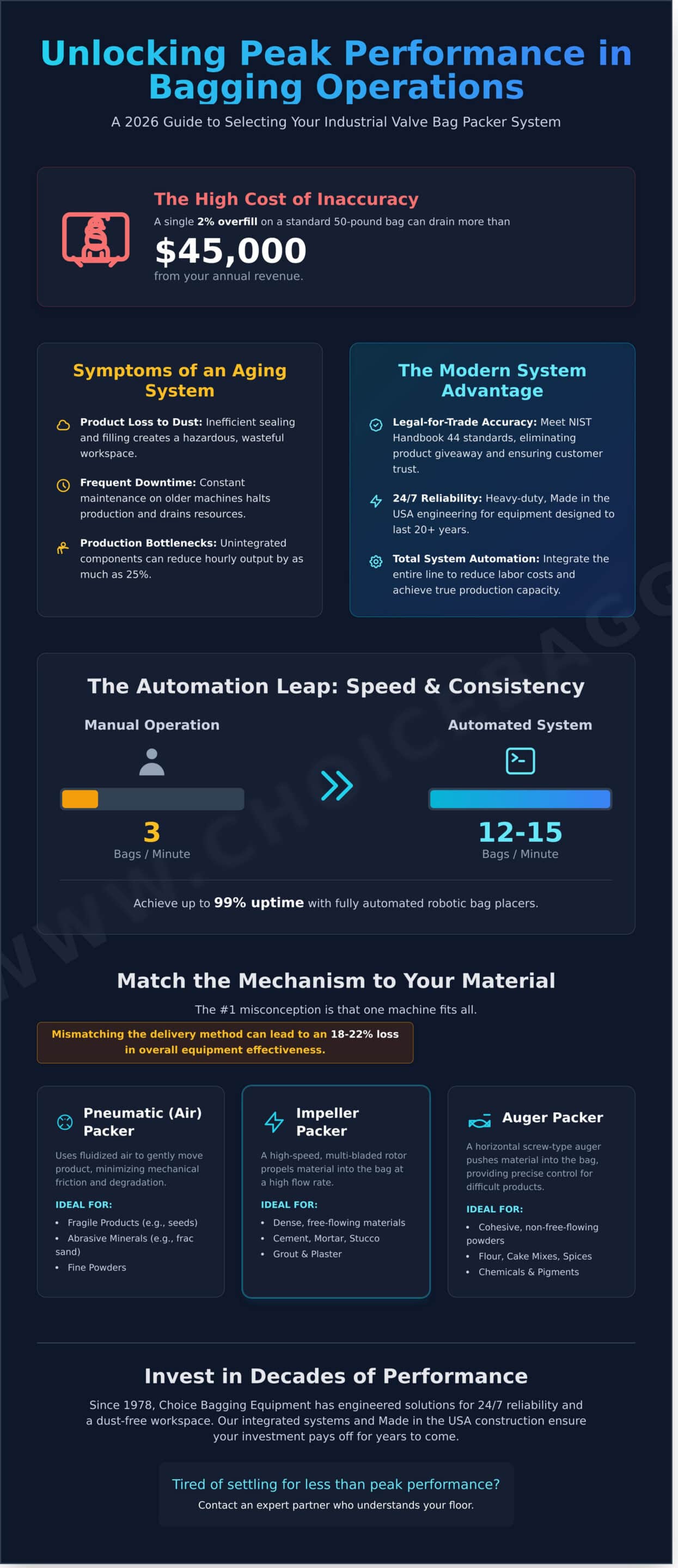
Choosing the correct material delivery method is the most critical decision in designing an industrial valve bag packer system. The physical characteristics of your product—its bulk density, particle size, and abrasiveness—will dictate whether a pneumatic, impeller, or auger packer is the right fit. The trade-offs between these technologies involve speed, maintenance requirements, and the potential for material degradation.
At Choice Bagging Equipment, our engineering philosophy focuses on minimizing moving parts wherever possible to extend machine life and reduce maintenance downtime. A common misconception is that a single machine type can efficiently fill any product; in reality, optimizing for your specific material is the key to achieving a reliable, high-performance bagging line.
| Packer Type | Primary Mechanism | Best For… | Key Advantage |
|---|---|---|---|
| Pneumatic (Air) | Fluidized Air Pressure | Abrasive, granular, or fragile materials (sand, seeds, plastic pellets) | Minimal moving parts, gentle product handling |
| Impeller | High-Speed Spinning Impeller | Dense, fine powders (cement, stucco, flour, barite) | High-speed bagging (up to 20 BPM) |
| Auger (Screw) | Rotating Screw | Difficult-to-flow or sticky powders (bakery mixes, pigments) | Precision, positive displacement for non-free-flowing materials |
Pneumatic (Air) Packers for Fragile or Abrasive Goods
Pneumatic packers, often called air packers, use pressurized air to fluidize the product in a chamber, allowing it to flow like a liquid into the valve bag. This method of pneumatic conveying moves material with virtually no mechanical friction, making it the ideal choice for abrasive products like sand and minerals or fragile goods like seeds that could be damaged by an impeller. The primary maintenance benefit of air-delivery systems is their lack of high-wear moving parts in the product stream, leading to greater uptime and a longer operational lifespan.
Impeller and Auger Packers for Fine Powders
For high-speed bagging of dense, aeratable powders, mechanical impeller packers are the industry workhorse. A multi-finned impeller spins at high RPMs to propel material into the bag, making it perfect for products like cement, grout, and flour. For more challenging, sticky, or non-free-flowing materials, auger (or screw) fillers provide precise, positive-displacement delivery. A custom-flighted screw ensures a consistent volume of product is delivered with each revolution. Selecting the right drive system—whether direct drive or belt-driven—is crucial for maintaining consistent throughput and weight accuracy.
Beyond the Spout: Integrating Your Valve Bagging Line
A high-performance valve bag packer is only as efficient as the equipment supporting it. Adopting a "system" perspective is essential, because the machinery before and after the filler ultimately determines your true production capacity and labor requirements. Automating the beginning of the line with automatic bag placers dramatically reduces labor costs and improves consistency. At the end of the line, a robotic bag palletizer is the ultimate companion to a valve packer, creating perfect, stable pallet loads 24/7. A successful system also requires integrated dust collection at key transfer points and may incorporate ultrasonic sealing technology to create an airtight seal on the bag’s valve for premium products.
Upstream Material Handling
Consistent and reliable bagging starts with what happens before the product even reaches the packer. A properly sized surge bin above the filler is critical for maintaining consistent head pressure, which directly impacts filling speed and accuracy. For operations using super sacks, integrating bulk bag unloaders ensures a steady, uninterrupted supply of material. Proper hopper and chute design, sometimes aided by vibrators or air pads, is essential for preventing common flow problems like material bridging and ratholing.
Downstream Automation and Palletizing
Once a bag is filled, downstream automation prepares it for shipment. Bag squaring and flattening conveyors condition the bag to create a uniform shape, which is fundamental for building stable and secure pallet stacks. Integrating automated stretch wrappers protects the final pallet load from moisture, dust, and shifting during transit. The entire line—from filler to palletizer to wrapper—can be managed by a unified control system, allowing for one-touch product changeovers and seamless communication between machines.
The Choice Bagging Selection Framework
Selecting the right industrial valve bag packer system requires a methodical approach. Follow these steps to ensure you invest in a solution engineered for your specific needs.
-
Step 1: Define your material’s bulk density and flow characteristics. Is your product a free-flowing granule, an aeratable powder, or a sticky mixture? This is the single most important factor in determining the right filling technology.
-
Step 2: Determine your target bags-per-minute (BPM) requirements. Define your current and future production goals to select a machine with the appropriate speed and level of automation.
-
Step 3: Evaluate your space constraints and ceiling heights. Your facility’s layout will influence the system’s design, including the feasibility of gravity-fed surge bins and the footprint of downstream palletizing equipment.
-
Step 4: Assess the level of automation required for your 2026 labor budget. Analyze the trade-offs between the upfront capital investment in automation and the long-term operational savings from reduced labor costs.
Testing Your Product for Success
Theory is no substitute for reality. Material testing is the only way to guarantee bagging performance, accuracy, and speed before you make a capital investment. To begin the process, use our Bagger Professor tool—a guided questionnaire that helps you select the right machine for your material and bag type. This initial match helps our engineers recommend the right system for testing. One of the most common pitfalls we see is companies selecting equipment based on price alone, only to discover it cannot handle their product’s unique properties, leading to costly downtime and inaccurate fills.
The Hidden Costs of Ownership
A machine’s sticker price is only one part of its total cost. The cost of product "giveaway" from inaccurate fills can amount to tens of thousands of dollars over a 10-year machine lifespan. It’s also important to consider ongoing energy consumption—the needs of a large air compressor for a pneumatic system versus the electric motors of an impeller packer. Finally, the value of readily available field service and parts in North America cannot be overstated. Waiting for overseas components can shut down a production line for weeks, erasing any initial savings from a cheaper, imported machine.
Why Choice Bagging Equipment is Your Long-Term Partner
Building reliable bagging solutions is in our DNA. Since 1978, we have been engineering and manufacturing industrial-grade equipment designed to withstand the rigors of 24/7 production. The "Made in the USA" advantage is not just a slogan; it’s a commitment to heavy-duty construction using higher quality materials than you’ll find in standard imports. We don’t just ship a machine; we integrate a complete solution and stand behind it for the long haul. For flexible acquisition, we also offer bagging equipment rental and buyback programs to meet your financial objectives.
Engineering for Decades, Not Years
Our philosophy is simple: build it right, and build it to last. We use thicker steel, premium-grade components, and proven designs to ensure our equipment delivers decades of reliable service. It’s not uncommon to find our valve packers still in operation after 30+ years of continuous service. This longevity is rooted in our design principle of "Minimal Moving Parts," which reduces potential failure points, simplifies maintenance, and lowers the total cost of ownership for our customers.
Start Your System Design Today
A high-performance bagging line begins with a smart design. Our engineering team is ready to consult with you to develop a custom layout that meets your production goals, facility constraints, and budget. By working with a single point of contact for your entire system integration, you ensure seamless compatibility and accountability from the bulk infeed to the wrapped pallet.
Take the first step toward a more efficient and reliable bagging operation.
Request a custom quote for your valve bag packer system.
Frequently Asked Questions
What is the difference between a valve bag filler and an open mouth bagger?
A valve bag filler uses a spout to fill a pre-sealed bag through a small valve, which is ideal for dust control with fine powders. An open mouth bagger fills a bag that is completely open at the top, which then requires a separate sealing process like sewing or heat sealing.
How much does an industrial valve bag packer system cost in 2026?
The cost varies significantly based on the level of automation, speed, and construction materials. A single, manual valve bag packer might start in the tens of thousands, while a fully automated system with a bag placer and robotic palletizer can be a six-figure investment. A custom quote is necessary to determine the exact cost for your application.
Can one valve bag packer handle both powders and granules?
While some machines offer a degree of flexibility, a packer optimized for a fine powder (like an impeller type) is generally not ideal for a coarse granule (better suited for an air packer), and vice-versa. For best performance, the machine should be matched to the material’s specific characteristics.
How accurate are modern valve bag filling machines?
Modern valve bag fillers equipped with digital scales and two-stage filling controls are extremely accurate, typically achieving weight tolerances of +/- 0.5% to 0.25% of the target weight, ensuring minimal product giveaway.
What are the maintenance requirements for an impeller-style packer?
Routine maintenance on an impeller packer includes monitoring the condition of the impeller blades and housing liners (especially with abrasive products), checking drive belts for proper tension, and ensuring bearings are lubricated according to the manufacturer’s schedule.
Do I need an automatic bag placer to achieve high speeds?
While a skilled operator can achieve moderate speeds (6-8 bags per minute), an automatic bag placer is necessary to consistently reach and exceed 10+ bags per minute and to maximize the output of a high-speed filler and robotic palletizer.
How do I reduce dust during the valve bag filling process?
The enclosed nature of valve bagging is inherently less dusty than open mouth filling. To further reduce dust, ensure the filling spout creates a snug fit with the bag’s valve, use an integrated dust collection port on the filler, and consider bags with an ultrasonic sealing valve for a virtually airtight closure.
Is it better to buy new or used valve bagging equipment?
New equipment offers the latest technology, a full warranty, and is designed specifically for your application. Used equipment can offer a lower initial cost but may come with unknown wear, no warranty, and potential challenges in finding parts or service. For mission-critical operations, new equipment from a reputable, US-based manufacturer is a more reliable long-term investment.
Recent Comments