

Your manual bagging line isn’t just a production bottleneck; it’s likely leaking 15% of your annual profit through product giveaway and labor turnover. When you’re managing a facility where 25% of your workforce turns over every year, the process of justifying bagging machine purchase becomes a strategic necessity for operational survival. You already know that manual labor is no longer the most cost-effective way to handle 50-pound bags, especially when a single repetitive motion injury can cost your company over $40,000 in medical claims and lost productivity.
We agree that the initial capital expenditure for automation can feel daunting when you’re focused on current overhead. This guide provides the data-driven framework you need to prove that automated equipment pays for itself through precision, speed, and unmatched reliability. You’ll learn how to calculate a definitive ROI, document the value of equipment durability, and present a persuasive argument to your CFO. We’ll also show you how to use the Bagger Professor tool to identify the right machine for your specific material. Since 1978, we’ve helped operators transition from manual struggles to operational excellence with equipment built to last for decades.
Key Takeaways
-
Recognize the critical economic tipping point where manual labor costs exceed automation, signaling the strategic time to prioritize operational excellence.
-
Build a data-driven business case for justifying bagging machine purchase by quantifying direct labor savings and high-accuracy material weighing.
-
Evaluate technical parameters beyond the initial price, focusing on Total Cost of Ownership and the long-term reliability of American-made equipment.
-
Follow a structured, step-by-step guide to gathering baseline data and developing 5-year financial projections that prove profitability to stakeholders.
-
Leverage the Bagger Professor tool to align your specific material requirements with a proven industrial solution built to last for decades.
Table of Contents
Justifying a Bagging Machine Purchase: Why Now is the Time
By 2026, manual labor is no longer a sustainable strategy for high-volume packaging operations. Manufacturers are currently facing a 22% increase in labor costs compared to 2023 levels. Companies are rapidly adopting automation technologies to remain competitive in a tightening market. Justifying bagging machine purchase decisions often comes down to identifying the tipping point where labor turnover and product waste exceed the monthly cost of a new system. When your production goals increase by 15% but your headcount remains stagnant, automation is the only path forward.
To better understand the impact of automated systems on production speed, watch this helpful video:
The True Cost of Manual Bagging Operations
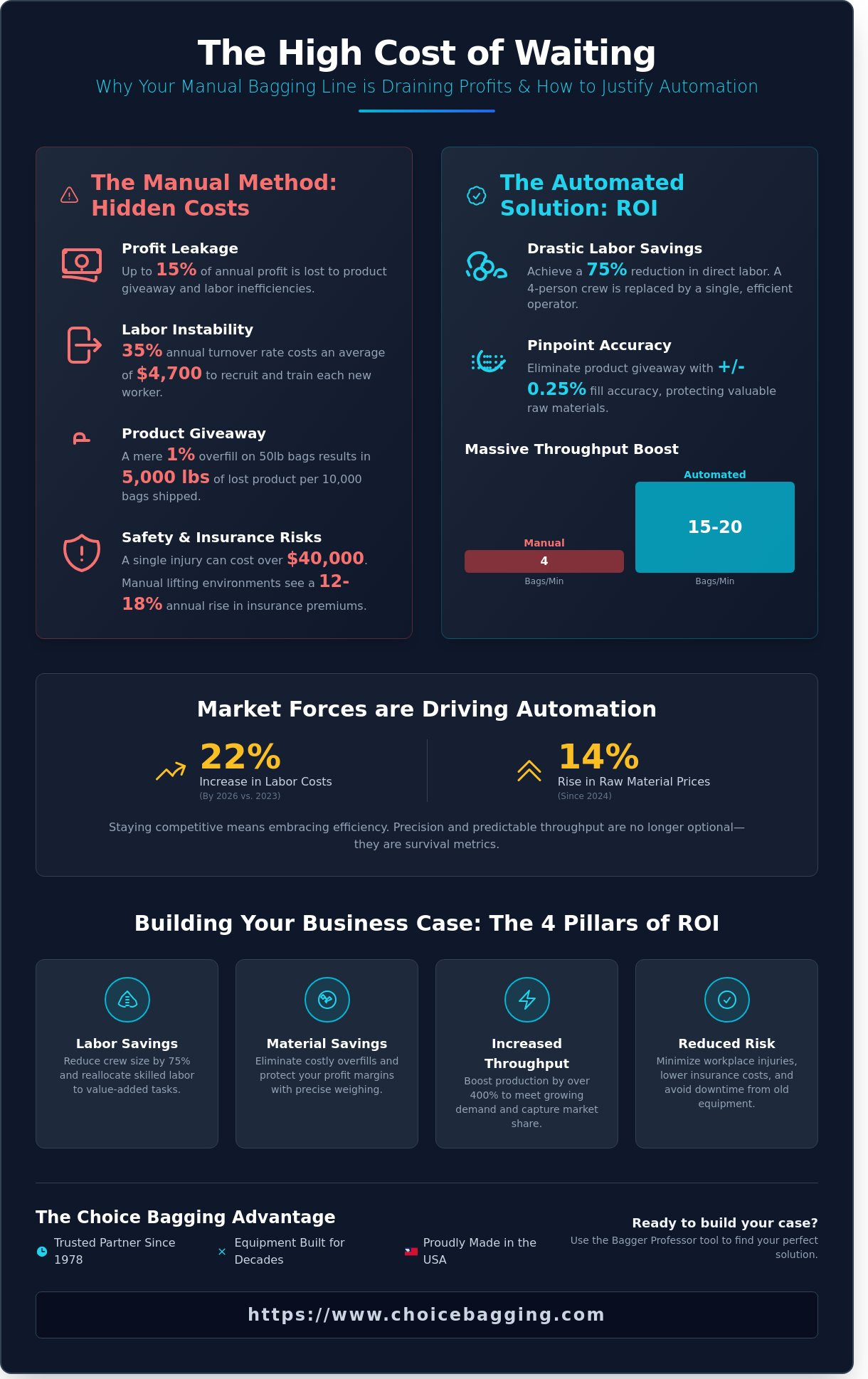
Manual operations carry hidden financial burdens that rarely appear on a single line item. It currently costs an average of $4,700 to recruit and train a single warehouse worker in the industrial sector. If your facility experiences a 35% annual turnover rate, those costs directly erode your profit margins. Beyond labor, human error leads to inconsistent fills that waste material. A 1% overfill on a 50lb bag of specialized grout adds up to 5,000 lbs of lost product for every 10,000 bags shipped. Workplace injuries also drive up workers’ compensation premiums by 12% to 18% annually for manual lifting environments, making the move to machinery a safer financial bet.
Market Trends Forcing Automation in 2026
Precision is the new standard for 2026. In the agriculture and building materials sectors, raw material prices have risen 14% since 2024; this makes fill accuracy a critical survival metric. Competitors using high-speed, automated lines now achieve 15 to 20 bags per minute with +/- 0.25% accuracy. If your manual line averages only 4 bags per minute, you’re losing market share to more efficient players. Predictable throughput is an essential step in justifying bagging machine purchase approvals for the next fiscal year. It ensures your supply chain remains stable even when local labor pools are tight or unavailable.
Choice Bagging Equipment has been a trusted partner and manufacturer since 1978. We’ve seen firsthand how making do with 20-year-old machines is a drain on corporate profits. Older equipment typically requires 40% more maintenance hours and suffers from 15% more unplanned downtime than modern systems. Because our equipment is Made In The USA, we reduce your long-term risk by ensuring parts and technical support are always available. Our machines are built to last decades, featuring easy-to-use controls and minimal moving parts to keep your facility running at peak performance.
If you’re ready to eliminate the hidden drains on your profit, contact us now to discuss your application with an expert.
The Financial Pillars: Calculating Your Bagging Equipment ROI
Calculating the return on investment for new machinery requires looking past the initial price tag. You must evaluate how the equipment transforms your operational costs over a five or ten year period. For most plants, the strongest argument for justifying bagging machine purchase decisions lies in the drastic reduction of overhead. A manual bagging operation typically requires a four-person crew to manage filling, weighing, sealing, and palletizing. By contrast, an automated system from Choice Bagging Equipment allows a single operator to oversee the entire process. This 75% reduction in direct labor costs provides immediate capital recovery.
Reliability and throughput are the engines of profit. Our machines are built to increase bags-per-minute (BPM) without adding a single dollar to your fixed overhead. If your current manual process caps out at 4 bags per minute, moving to an automated 12 BPM system triples your output capacity. Since 1978, we’ve seen that this increased speed allows facilities to clear backlogs and accept larger contracts that were previously impossible to fulfill. Secondary savings also emerge through superior bag integrity. Secure, dust-free seals reduce rework costs and eliminate expensive customer complaints or freight rejections caused by broken bags during transit.
Precision Weighing and Material Recovery
Material loss is a silent profit killer in many industrial plants. High-performance valve bag fillers utilize advanced air or screw feeding technology to minimize dust and product escape. Product giveaway is the difference between target weight and actual weight. While a 1% giveaway might seem negligible, it represents a massive financial drain over a year of production. For a facility bagging 500,000 bags annually at 50 pounds each, improving accuracy from 1% down to 0.2% saves 200,000 pounds of product. That recovered material goes directly to your bottom line instead of being given away for free or swept off the floor. You can request a quote to see how our precision scales compare to your current loss rates.
Labor Reallocation and Productivity
Automation isn’t just about cutting headcount; it’s about maximizing the talent you already have. Shifting workers from repetitive, high-strain tasks to higher-value plant roles improves morale and safety. Integrating robotic palletizing systems removes the physical burden of stacking heavy bags, which significantly lowers workers’ compensation risks. When justifying capital equipment to stakeholders, emphasize that machines provide predictable production schedules regardless of labor market fluctuations. Our equipment doesn’t take sick days or leave for a competitor’s higher hourly wage.
Choice Bagging Equipment builds performance and reliability into every component. We’re also your partner in determining which specific technology fits your material characteristics. Every machine we manufacture is Made In The USA, ensuring you have access to dependable support and parts for decades. If you’re ready to see how these financial pillars apply to your facility, view our products to start your transition to automated efficiency.
Evaluating Technical Parameters for Long-Term Profitability
Focusing solely on the initial purchase price is a common mistake when justifying bagging machine purchase decisions. A machine that costs 20% less upfront can easily become 50% more expensive over a five-year period due to unplanned downtime and high repair costs. Total Cost of Ownership (TCO) accounts for energy consumption, labor requirements, and the frequency of part replacements. Since 1978, we’ve seen that industrial equipment built with heavy-duty steel and minimal moving parts consistently delivers the lowest TCO. These machines don’t just fill bags; they protect your bottom line by running 2,000 hours per year with only basic preventative care.
Choosing equipment with "Made in the USA" components ensures you aren’t waiting weeks for a critical sensor or valve to cross an ocean. Local support and domestic parts availability are the backbones of operational stability. When a bagging line integrates seamlessly with existing conveyors and sealers, it eliminates the need for expensive custom programming or structural retrofitting. Our designs prioritize this compatibility, allowing for a "plug-and-play" environment that maximizes your current facility assets. This approach simplifies the process of justifying bagging machine purchase approvals by showing immediate technical compatibility with your current layout.
Durability and Maintenance Cycles
Machines engineered for decades of service outperform cheaper imports that often fail within 36 months of heavy use. A robust frame and high-quality pneumatic components reduce the vibration and wear that lead to catastrophic failure. Proactive field service plays a vital role here. Scheduled technician visits can identify a worn bearing or a misaligned belt before it causes an eight-hour production halt. Maintaining a consistent supply of replacement parts on-site further guarantees that your uptime remains above 98%. This level of reliability is what separates a capital expense from a long-term investment. It’s about knowing your equipment will start every morning without fail.
Automation and Future-Proofing
Production needs rarely stay static. A modular machine design allows you to add features like automatic bag hangers or ultrasonic sealers as your volume increases. For example, open mouth bagging machines offer the versatility to handle paper, poly-woven, or plastic bags with minimal changeover time. If you’re unsure which configuration fits your product, you can use the Bagger Professor to match specific materials to the right equipment. This functional tool helps you avoid over-specifying or under-specifying your machinery. By selecting equipment that adapts to different bag sizes and materials, you ensure your investment remains relevant for the next 15 to 20 years. If you have specific technical questions about integration, contact us to speak with an application engineer today.
A Step-by-Step Guide to Presenting Your Business Case
Moving from the desire for better equipment to an approved capital expenditure requires a shift from operational intuition to hard financial data. Successfully justifying bagging machine purchase depends on your ability to prove that the investment eliminates specific, documented losses. You aren’t just buying a machine; you’re securing a long-term increase in plant capacity and reliability. Since 1978, we’ve seen that the most successful business cases focus on three core areas: historical performance gaps, multi-year financial gains, and a clear plan for technical integration.
Data Collection and Benchmarking
Your business case begins with a rigorous audit of your current floor operations. Don’t rely on estimates. Instead, track your actual bags per hour (BPH) over a standard 40-hour work week. If your manual line averages 180 BPH but experiences 12% weight variance, those numbers represent direct profit loss. Document every instance where production stops. Common bottlenecks include operator fatigue during the final two hours of a shift or material bridging in the hopper. These "hidden" pains often account for a 15% drop in total daily output.
Interview your floor operators to uncover operational friction that doesn’t show up on a spreadsheet. They might report that current bag sealing methods lead to a 3% rework rate or that manual palletizing causes consistent ergonomic complaints. Accurate benchmarking turns vague "inefficiency" into a dollar amount that a CFO can quantify.
Risk Mitigation and Implementation Planning
Executive stakeholders often hesitate due to the perceived risk of downtime during installation. You must address this by outlining a phased implementation strategy. We recommend a "train-the-trainer" approach where your lead operators receive intensive technical instruction before the machine arrives. This ensures your team feels ownership of the new technology. A well-constructed plan accounts for the entire downstream flow, including seamless integration with bag handling conveyors to prevent new bottlenecks at the palletizing station.
Leverage manufacturer expertise to guarantee performance post-install. When you partner with a seasoned manufacturer, you gain access to decades of application data that minimizes the learning curve. Your presentation should include a 3-year and 5-year financial projection. While the initial ROI often occurs within 14 to 18 months, the 5-year view highlights the durability of the equipment. High-quality machines are built to last decades; therefore, your projection should show how the lower maintenance costs of a robust system outperform cheaper, lighter-duty alternatives over time.
To create a "showstopper" presentation, focus your final slide on "The Cost of Inaction." Compare your current 5-year labor and waste costs against the projected 5-year costs with automation. If the difference is a $250,000 loss by staying manual, the decision becomes a matter of fiscal responsibility. Presenting a clear, data-backed roadmap demonstrates that you’ve considered every variable from labor redirection to mechanical reliability.
Ready to build a high-performance bagging line that stands the test of time? Contact us today for a professional consultation
Partnering for Performance: The Choice Bagging Advantage
Choice Bagging Equipment has operated as a trusted manufacturer in the industrial packaging sector since 1978. We understand that justifying bagging machine purchase involves more than comparing technical specifications. It requires a partner who understands the nuances of material flow, facility integration, and long term ROI. Our 45 years of experience allow us to build performance and reliability into every machine we ship. We focus on heavy duty construction and easy to use controls to ensure your operators stay productive while maintenance costs remain low.
Custom engineering is at the heart of our service. Standard machines often fail to meet the specific demands of complex production lines or unique facility footprints. We analyze your facility layout and material characteristics before recommending a solution. Our systems cover the entire end of line process. We integrate filling stations with conveyors and high efficiency stretch wrappers to create a seamless flow. This holistic approach eliminates the bottlenecks that often occur when mixing equipment from multiple vendors. By providing a single point of accountability, we ensure your entire line hits its performance targets from day one.
US-Based Expertise and Support
Every machine we sell is engineered and manufactured in Taylor, Texas. This US-based presence means you get direct access to the engineers who designed your equipment. You won’t deal with overseas call centers or long lead times for critical components. Our experts have successfully handled over 1,000 unique material types, ranging from hazardous chemicals to abrasive aggregates and food-grade powders. This hands-on experience means we can predict how your material will behave under pressure. We build for 99% uptime because we know that every minute of downtime costs your business money. Our commitment to reliability is why many of our machines built in the 1980s are still in active service today.
Next Steps for Your Automation Journey
Start your transition to automated packaging by speaking with our engineering team. We offer a technical consultation to review your current bagging rates and labor costs. If you need to validate the ROI before committing to a full purchase, consider our bagging equipment rental program. This allows you to integrate automation with minimal upfront capital and test the equipment in your actual production environment on a rent-to-own basis. When you are ready to build your business case with firm numbers and professional lead times, request a custom quote from our experts to get started. We’re ready to help you optimize your production and secure your facility’s future.
Secure Your Production Future with Proven Automation
Investing in automated packaging isn’t just about speed; it’s about long-term stability and measurable ROI. By focusing on technical parameters and building a clear business case, you turn a capital expense into a strategic advantage. You’ve seen how calculating labor savings and throughput increases makes justifying bagging machine purchase a straightforward decision for your stakeholders. Choice Bagging Equipment has manufactured reliable, high-quality machinery since 1978. Every system is proudly Made in the USA and backed by full-service integration and field support. We’re your partner in performance, ensuring your investment delivers durability for decades. Our team provides the expert consultation needed to integrate these systems into your existing workflow seamlessly. Your operation deserves the reliability that only 45 years of engineering expertise can provide. We’re ready to help you optimize your facility with equipment built to last.
Request a Quote for Your Bagging Machine Project
Frequently Asked Questions
How long does it typically take for an automated bagging machine to pay for itself?
Most operations see a full return on investment within 12 to 18 months. When justifying bagging machine purchase, you’ll find that labor savings of 2 to 3 workers per shift often cover the capital expense quickly. Since 1978, we’ve helped facilities transition to automated systems where increased accuracy reduces product giveaway by 0.5% or more. This precision adds up to thousands of dollars in annual savings.
What are the most common hidden costs in manual bagging operations?
Inaccurate weights lead to 1% to 2% product giveaway, which directly erodes your profit margins. Manual bagging also results in an average of 6.5 workdays lost per year due to repetitive motion injuries in industrial settings. You also face high turnover rates in these roles, costing approximately $4,500 to $7,000 to recruit and train every new hire. These hidden expenses often exceed the visible cost of hourly wages.
Can an automated system handle different types of materials and bag sizes?
Our equipment handles a wide range of materials from fine 200-mesh powders to 1-inch aggregates. Most machines feature adjustable bag chairs and spouts to accommodate sizes from 20 to 110 pounds. To find the exact configuration for your specific material and bag type, you can use our Bagger Professor tool. This functional resource helps you select a system built for your unique material and bagging requirements.
What is the difference between a valve bag filler and an open mouth bagger for ROI?
Valve bag fillers typically provide a faster ROI for fine powders because they eliminate the cost of a separate sealing machine. An open mouth bagger requires a sewing or sealing station, adding $15,000 to $40,000 to the initial investment. However, open mouth systems allow for more bag variety. Choosing the right style depends on whether you prioritize 99.9% dust containment or the ability to use different bag materials.
How much floor space is required for a fully automated bagging and palletizing line?
A fully automated bagging and palletizing line generally requires a footprint of 20 feet by 40 feet. This space includes the surge hopper, bagging machine, conveyor system, and robotic palletizer. If you have limited space, we can design compact configurations that fit into areas as small as 15 feet by 30 feet. Contact our engineering team to discuss a custom layout for your facility.
What kind of maintenance is required to keep a bagging machine running at peak efficiency?
Peak efficiency requires 30 minutes of weekly preventative maintenance and a deep inspection every 2,000 operating hours. We build our machines with minimal moving parts to ensure high-quality performance over decades. You’ll need to check pneumatic seals and lubricate pivot points regularly to prevent downtime. Following a strict schedule ensures your equipment remains as reliable as the day it was installed in your plant.
Is it better to buy new equipment or look for used bagging machines?
Buying new equipment is the most reliable path for justifying bagging machine purchase because it includes a modern PLC and a full manufacturer warranty. Used machines often lack support for obsolete electronics, leading to 15% more downtime on average. Our Made In The USA! machines are engineered for durability, ensuring you don’t face the hidden repair costs and sourcing delays common with second-hand industrial equipment.
How does automation improve worker safety and reduce insurance costs?
Automation reduces workers’ compensation claims by up to 75% by removing the need for heavy lifting. Each manual bagger lifts approximately 15,000 pounds per shift, creating a high risk for back injuries. Insurance providers often lower premiums for facilities that implement robotic palletizing and automated bagging. This shift creates a safer environment where your team can focus on higher-level technical tasks rather than physical labor.
Recent Comments