

Discover how pneumatic air-flow technology optimizes granule packaging by reducing product degradation and increasing weight accuracy. For plant engineers and production managers, choosing the right bagging equipment is a critical decision that impacts product quality, operational efficiency, and long-term maintenance costs. When dealing with abrasive or fragile granules, the wrong filler can grind your product into dust and wear out machine components at an alarming rate.
This guide explains why a pneumatic bag filler for granules is often the superior choice over mechanical systems, protecting both your product’s integrity and your equipment’s longevity.
What is a Pneumatic Bag Filler for Granules?
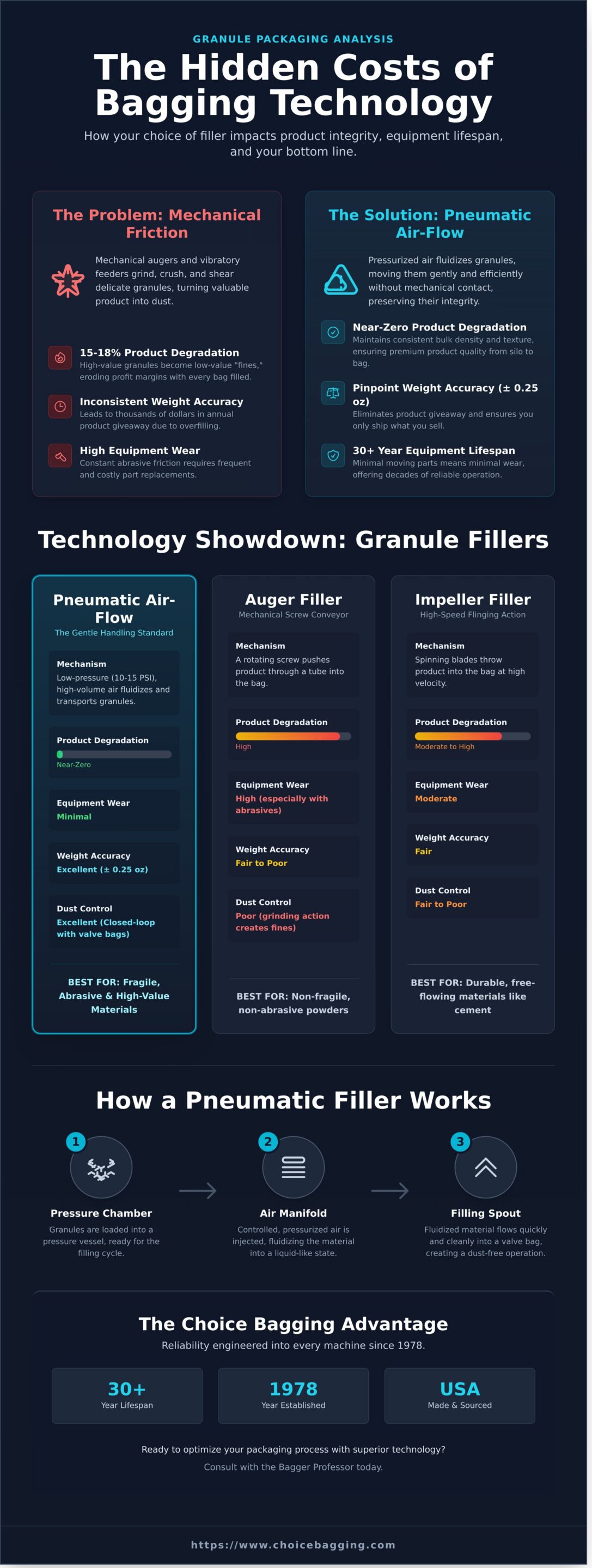
A pneumatic bag filler is a specialized valve bag filling machine that uses pressurized air to fluidize and transport granules into a bag. Instead of using mechanical force from augers or impellers, this technology treats the granules like a fluid, moving them gently and efficiently. The process replaces mechanical friction with controlled air flow, making it the industry standard for abrasive materials like minerals, sands, and pelletized chemicals.
The core components of a pneumatic system include a pressure chamber where material is introduced, an air manifold that injects low-pressure, high-volume air, and a specialized filling spout that discharges the material into the bag.
The Role of Air in Granule Packaging
The genius of pneumatic filling lies in fluidization—the process of making a solid material behave like a fluid. By introducing a precise volume of air into the pressure chamber, the system reduces the inter-particle friction of the granules. This allows them to flow smoothly and quickly into the bag.
Key benefits of this air-flow method include:
- Reduced Friction: Air acts as a cushion, preventing granules from grinding against each other and the machine’s internal surfaces.
- Faster Flow Rates: Once fluidized, materials can be transported at high speeds without the risk of mechanical jamming.
- High Weight Accuracy: Modern load cells and controls precisely manage the flow, shutting it off instantly to achieve consistent bag weights.
This technology is ideal for a wide range of common granules, including sand, garnet, fertilizers, plastic resins, and seeds.
Valve Bags vs. Open Mouth for Pneumatic Systems
Pneumatic technology is almost exclusively paired with valve bag fillers. Valve bags feature a small, self-sealing opening (or "valve") in one corner. The filling spout is inserted into this valve, creating a closed-loop system during the filling process.
This "closed-loop" advantage is significant, as it contains product and dust within the bag, preventing it from escaping into the plant environment. This results in a cleaner, safer workspace and reduces product loss. These systems are compatible with various bag materials, including multi-wall paper, polyethylene (poly), and woven polypropylene (PP).
How Pneumatic Technology Protects Your Granule Integrity
For producers of high-value granules, product degradation is a primary concern. Mechanical fillers with augers or impellers can crush, crack, or grind materials, creating unwanted fines (dust) and altering the product’s bulk density. Pneumatic fillers solve this problem by prioritizing gentle handling.
While it seems counterintuitive, pressurized air is far gentler than a steel auger for fragile granules. The air-flow method ensures granules arrive in the bag looking exactly as they did in the silo, preserving their size, shape, and value. This is especially critical for abrasive materials like garnets, where a pneumatic system can operate for years without destroying the internal machine housing.
Air-Flow vs. Mechanical Force
In an auger or impeller system, product degradation is caused by mechanical friction. The turning screw or spinning blades create high-pressure contact points that crush the material. A pneumatic filler minimizes these contact points. It uses the product’s own air-permeability to facilitate movement, essentially encouraging the material to flow on a cushion of air. This eliminates the grinding action that destroys both the product and the machine.
Managing Abrasive Wear in Granule Handling
For minerals, aggregates, and sand, "Abrasive-Duty" construction is non-negotiable. Pneumatic fillers excel in these environments because they have minimal moving parts in the product stream. With no augers, bearings, or seals directly exposed to the abrasive flow, there are far fewer components to wear out.
This is the secret to Choice Bagging’s "Built to Last" reputation. By reducing mechanical wear, our pneumatic systems significantly cut down on parts replacements and maintenance-related downtime, delivering a superior long-term return on investment (ROI).
Pneumatic vs. Auger vs. Impeller: Which is Best for Granules?
Choosing the right technology depends on your specific product and operational goals. While auger and impeller fillers have their place, pneumatic systems offer a distinct advantage for abrasive, fragile, or mixed-size granules. The following table provides a clear comparison.
| Feature | Pneumatic Filler | Auger Filler | Impeller Filler |
|---|---|---|---|
| Best For | Abrasives, fragile pellets, mixed particle sizes | Powders, fine granules | Free-flowing granules, powders |
| Product Integrity | Excellent (gentle handling) | Fair (can cause grinding) | Poor (high-impact, can degrade product) |
| Maintenance | Low (minimal moving parts) | Moderate (auger/seal wear) | High (impeller/housing wear) |
| Dust Control | Excellent (enclosed system) | Good (can require dust collection) | Fair (can be very dusty) |
| TCO (Abrasives) | Low | High | Very High |
The "Total Cost of Ownership" (TCO) is where pneumatic systems truly shine in harsh environments. While the initial investment may be higher than a simple gravity filler, the drastic reduction in maintenance costs and product loss delivers significant long-term savings.
Performance Comparison for Granular Materials
- Weight Accuracy: A well-calibrated pneumatic bag filler can consistently achieve weight accuracy of +/- 0.5% or better, minimizing product giveaway and ensuring customer satisfaction.
- Speed: Depending on the model and product, pneumatic fillers can achieve high production rates for bags ranging from 20 lbs. to 110 lbs.
- Ease of Cleaning: Purging material from a pneumatic pressure chamber is significantly faster and easier than cleaning out an auger housing, making product changeovers more efficient.
Addressing the Maintenance Myth
A common objection is that pneumatic systems are more complex to calibrate. However, modern PLC controls and user-friendly interfaces have made operation simple and intuitive. Once set for a specific product, adjustments are rarely needed.
Furthermore, the longevity of pneumatic seals and components in dusty, abrasive environments far surpasses that of mechanical bearings and augers, which are under constant attack. With support from Choice Bagging’s expert Field Service team, your pneumatic system will deliver reliable performance for decades.
Key Features to Look for in a Granule Pneumatic Filler
When sourcing a pneumatic bag filler for granules, several key features distinguish a high-performance machine from a standard one.
- Force Flow vs. Pressure Flow: Understand the air delivery mechanism. Force Flow systems use a blower to generate high-volume, low-pressure air, ideal for fluidizing most granules.
- Integrated Weighing Systems: Choose between "Gross Weigh" (weighing the bag during filling) and "Net Weigh" (weighing the product before it enters the bag) configurations to match your accuracy needs.
- Dust Collection Ports: Even with a closed-loop system, dust collection ports are essential for capturing any fugitive dust during the bag discharge cycle, ensuring an OSHA-compliant workspace.
- Digital Controls: Modern PLC interfaces, like those used by the "Bagger Professor," simplify setup, diagnostics, and operation, reducing the need for specialized operator training.
Technical Specifications for High-Density Granules
For dense materials like sand and minerals, look for specific engineering details. A vertical or conical chamber design is crucial to prevent material from bridging or hanging up. Specialized filling spouts with inflatable collars or dust-tight tips ensure a high-speed, spill-free fill cycle. The ability to make fine adjustments to air-flow controls is necessary to optimize performance for varying granule sizes and densities.
Automation and Downstream Integration
Your bag filler should be a component of a larger, seamless system. Ensure the machine you choose can communicate with downstream equipment.
- Robotic Palletizing: A modern filler must be able to signal a robotic palletizing system to create a fully automated end-of-line solution.
- Bag Handling: Integrate with bag handling conveyors to move filled bags efficiently to a sealer or palletizer.
- Bag Sealing: Complete the process with an automated bag sealer for a professional, sift-proof finish that protects your product during shipping.
The Choice Bagging Advantage: Pneumatic Solutions Built for Decades
Since 1978, Choice Bagging Equipment has been engineering and manufacturing high-performance bagging solutions from our facility in Texas, USA. Our experience with the most difficult-to-handle industrial granules has allowed us to perfect air-flow technology for unmatched reliability and longevity.
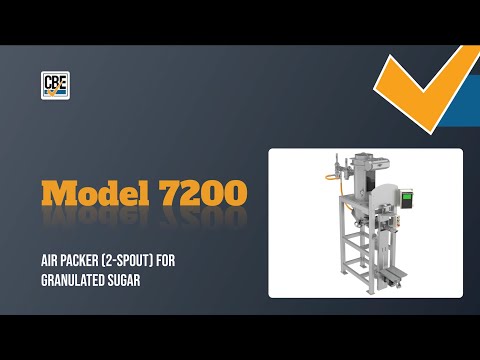
Our flagship Model 7200 is the industry’s leading abrasive-duty pneumatic filler, designed to withstand the harshest industrial environments. It embodies our commitment to quality, durability, and performance.
Watch the Model 7200 in Action:
We believe in partnering for success. Our relationship with clients goes beyond the sale to include expert consultation, system integration, and lifelong support.
Customization for Specific Industrial Granules
No two products are exactly alike. We work with you to tailor our pneumatic systems to your specific needs. This includes:
- Customizing the air manifold to match your product’s flow characteristics.
- Selecting the right materials, from carbon steel to stainless steel, for your production environment.
- Consulting with our "Bagger Professor" experts to engineer your ideal configuration.
Next Steps: Upgrading Your Production Line
If your current bagging line is a bottleneck due to equipment wear, inaccurate weights, or product degradation, it’s time for an upgrade. We make the process easy, and we even offer a Used Equipment Buyback program to help you invest in new, more efficient technology.
Start your project today by speaking with one of our experienced engineers.
Frequently Asked Questions (FAQs)
How does a pneumatic bag filler differ from an auger filler for granules?
A pneumatic filler uses pressurized air to fluidize and move granules, while an auger filler uses a rotating screw. The pneumatic method is much gentler, preventing the grinding and degradation of fragile or abrasive materials.
Is a pneumatic bagger suitable for fragile granules like seeds or plastic pellets?
Yes, it is ideal. The air-flow system cushions the product, minimizing impact and friction, which preserves the integrity of delicate granules.
What is the typical weight accuracy of a pneumatic granule filler?
With modern load cells and controls, a pneumatic filler can consistently achieve a weight accuracy of +/- 0.5% or better, reducing product giveaway.
Can pneumatic fillers handle abrasive materials like sand or blasting media?
Absolutely. They are the preferred technology for abrasives because they have minimal moving parts in the product stream, drastically reducing wear and maintenance costs compared to mechanical fillers.
What kind of maintenance do pneumatic bag fillers require?
Maintenance is generally low. It primarily involves routine checks of air seals, valves, and the air supply system. Because there are no augers or impellers to wear out, the total cost of ownership is significantly lower for abrasive applications.
Do I need a specialized air compressor for a pneumatic bagging machine?
Pneumatic fillers operate on standard plant air and typically require a high-volume, low-pressure air supply. We can help you determine if your existing compressed air system is adequate for the machine.
How many bags per minute can a pneumatic granule filler achieve?
Production rates depend on the product, bag size, and machine model, but speeds of up to 8-12 bags per minute are common for a single-spout filler.
Can I integrate a pneumatic filler into an existing automated palletizing line?
Yes. Our pneumatic fillers are designed with modern PLC controls that can easily communicate with robotic palletizers, conveyors, and other downstream automation for a fully integrated system.
Ready to protect your product and improve your bottom line?
- Manufacturing reliable bagging systems since 1978
- Proven performance with the most abrasive industrial minerals
- Expert engineering support for full line integration
Recent Comments