
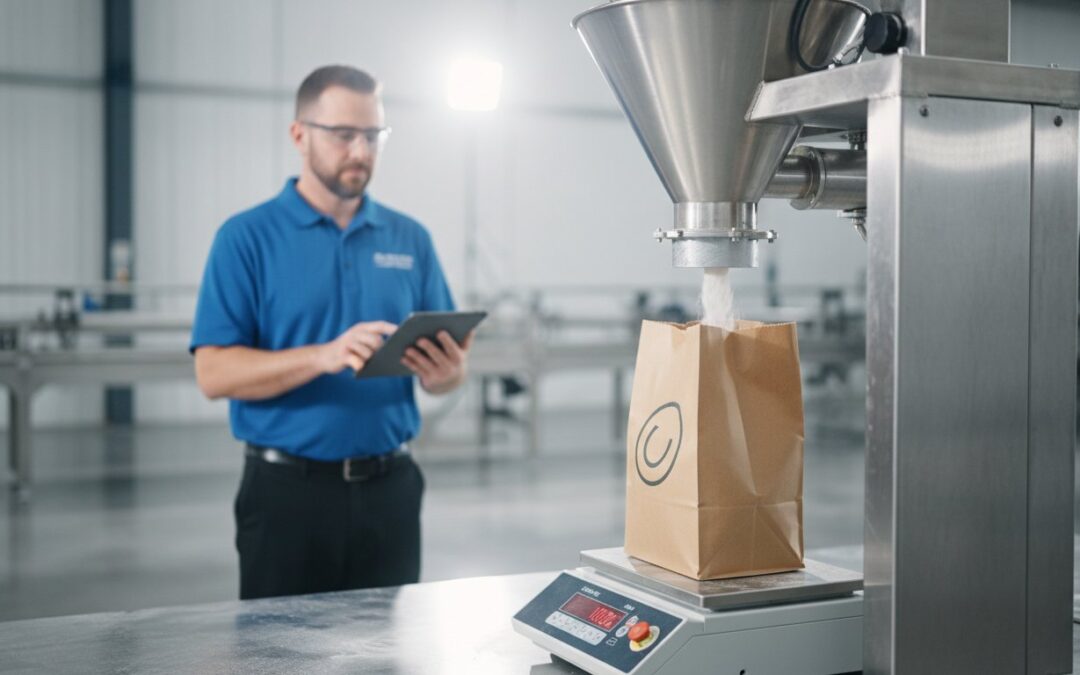
Inaccurate bag weights erode profits, while excessive dust creates unsafe work environments and slows production. For many operations, unreliable equipment represents a significant bottleneck, leading to costly downtime and inconsistent results. Investing in the right equipment is not just an upgrade; it’s a strategic decision that directly impacts your bottom line. A high-performance valve bag filler is engineered to solve these exact challenges, delivering the accuracy, speed, and clean operation your facility demands.
This complete guide provides the expertise you need to invest confidently. We will walk you through the different types of valve bag fillers, explain the critical factors for selecting the right machine for your specific product, and provide actionable insights to maximize your production line’s performance. You will gain the knowledge required to choose a durable, low-maintenance solution that ensures consistent bag weights and boosts your overall throughput for decades to come.
What is a Valve Bag Filler and Why is it Essential?
A valve bag filler is a specialized piece of packaging machinery designed to fill pre-made bags that feature a small opening, or “valve,” in one corner. This enclosed filling process is fundamentally different from open-mouth bagging systems, offering a cleaner, more contained operation. The various mechanisms used, such as auger or impeller packers, fall under the broader category of different Types of Filling Machines designed for specific material properties. The key innovation of this system is the bag’s valve itself-a sleeve that uses the product’s internal pressure to create a secure, self-seal after filling, completely eliminating the need for costly and time-consuming heat sealing or sewing.
This efficiency and cleanliness make the valve bag filler an essential asset in industries handling fine powders and granular materials. You will find these reliable machines operating on production lines for cement, grout, sand, chemical powders, minerals, and even food products like flour and sugar, where minimizing product loss and airborne dust is critical for safety and profitability.
The Anatomy of a Valve Bag System
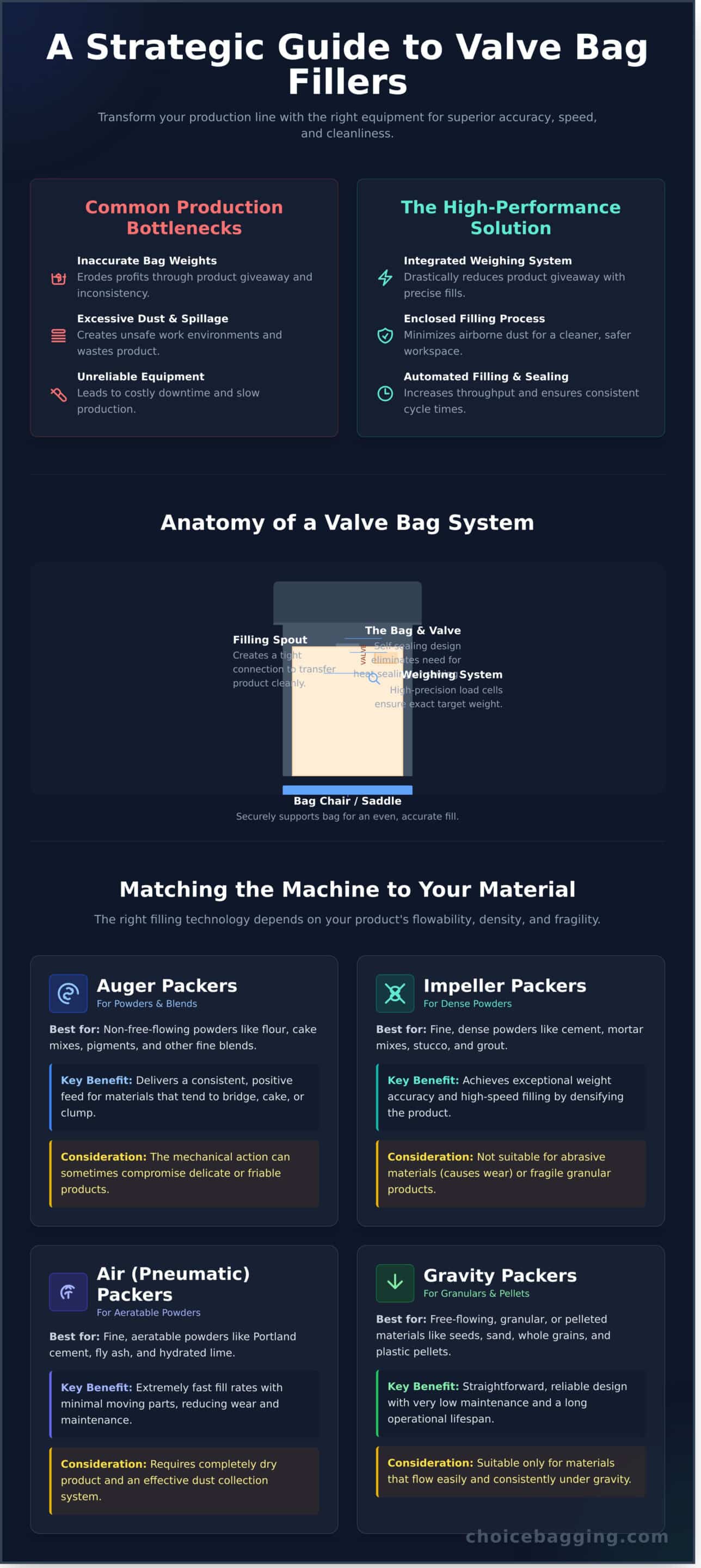
Understanding the core components reveals how this technology achieves its high performance and reliability:
- The Bag: Features a built-in internal or external sleeve (the valve) that allows product to enter but not exit. Once filled, the pressure of the contents pushes the sleeve flat, creating a secure seal.
- The Filling Spout: The machine’s nozzle is precisely engineered to fit into the bag’s valve, creating a tight connection to transfer product cleanly.
- The Weighing System: High-precision load cells or scales are integrated into the machine to ensure each bag is filled to an exact target weight, guaranteeing accuracy and consistency.
- The Bag Chair/Saddle: This component securely supports the bag’s weight during the filling cycle, ensuring it is positioned correctly for an even and accurate fill.
Key Advantages for Your Production Line
Integrating a valve bagging system delivers tangible benefits that directly impact operational efficiency and your bottom line:
- Improved Accuracy: The integrated weighing system drastically reduces product giveaway and ensures consistent package weights, protecting your bottom line compared to less precise manual or semi-automated methods.
- Enhanced Cleanliness: By filling through an enclosed spout, the system significantly minimizes airborne dust and spillage. This creates a safer, cleaner work environment and reduces product waste.
- Increased Speed: Automating the filling and sealing process delivers higher throughput and more consistent cycle times than traditional open-mouth filling, which requires a separate sealing or sewing step.
- Reduced Labor Costs: A modern valve bag filler automates a highly repetitive task, allowing you to reallocate valuable labor resources to other critical areas of your operation.
Types of Valve Bag Fillers: Matching the Machine to Your Material
Selecting the right valve bag filler is not about choosing the fastest or most advanced machine; it’s about matching the technology to the unique characteristics of your product. Key factors like flowability, bulk density, and fragility dictate which filling mechanism will deliver the best performance. Making the correct choice is critical to ensuring weight accuracy, preventing product damage, and maintaining operational efficiency.
We will explore the four primary types of valve bag filling equipment: Auger, Impeller, Air (Pneumatic), and Gravity packers. Each is engineered for a specific class of materials, and understanding their differences is the first step toward a reliable bagging solution.
Auger Packers: For Powders and Blends
Auger packers utilize a screw-like auger that turns to convey and dispense material into the bag. This positive displacement method provides precise control for products that do not flow freely on their own.
- Best for: Non-free-flowing powders such as flour, cake mixes, pigments, and other fine blends.
- Key Benefit: Delivers a consistent, positive feed for materials that tend to bridge, cake, or clump.
- Consideration: The mechanical action of the screw can sometimes compromise the integrity of delicate or friable products.
Impeller Packers: For Dense Powders
This packer features a high-speed, multi-vaned impeller that rotates to ‘throw’ material into the valve bag. The force of the impeller densifies the product as it fills, resulting in a compact and stable bag.
- Best for: Fine, dense powders like cement, mortar mixes, stucco, and grout.
- Key Benefit: Achieves exceptional weight accuracy and high-speed filling with materials that can be aerated.
- Consideration: Not suitable for abrasive materials that cause rapid wear on the impeller or granular products that can be damaged.
Air Packers (Pneumatic): For Aeratable Powders
Air packers, also known as pneumatic fillers, use air pressure to fluidize the product in a pressurized chamber. The material then flows like a liquid through the filling spout and into the bag.
- Best for: Fine, aeratable powders like Portland cement, fly ash, and hydrated lime.
- Key Benefit: Offers extremely fast fill rates with minimal moving parts in contact with the product, reducing wear and maintenance.
- Consideration: This system requires a completely dry product and an effective dust collection system to manage air displacement and potential OSHA Combustible Dust Hazards.
Gravity Packers: For Granulars and Pellets
As the simplest type of valve bag filler, the gravity packer uses the natural force of gravity. A flow-control gate opens to allow free-flowing materials to fall directly into the bag.
- Best for: Free-flowing, granular, or pelleted materials like seeds, sand, whole grains, and plastic pellets.
- Key Benefit: A straightforward, reliable design with very low maintenance requirements and a long operational lifespan.
- Consideration: This method is only effective for products with excellent flow characteristics that do not require mechanical assistance to fill a bag.
How to Select the Right Valve Bag Filler: A Buyer’s Checklist
Investing in a new valve bag filler is a significant decision that impacts your operational efficiency and profitability for years to come. To invest confidently, a systematic approach is essential. By methodically evaluating your needs, you can ensure the equipment you select delivers unmatched reliability and performance. We’ve structured this process around four key pillars: your Product, your required Performance, your Plant environment, and your equipment Partner.
Analyze Your Product Characteristics
The physical properties of your product are the single most important factor in machine selection. An honest assessment is the foundation for accurate and efficient bagging. Consider the following:
- Flowability: Is your product free-flowing like sand, sluggish like flour, or non-free-flowing like animal feed? This dictates whether an auger, impeller, or air packer is most suitable.
- Bulk Density: The weight per cubic foot (lbs/ft³) of your material directly influences the filler’s design and bagging speed.
- Particle Size & Shape: Are you bagging fine powders, coarse granules, pellets, or a mixture? The particle consistency affects the filling technology required.
- Other Factors: Note any unique traits such as abrasiveness, friability (tendency to break), moisture content, or high dust levels.
Define Your Performance Requirements
With a clear product profile, you can define your operational targets. These metrics ensure the machine meets your production goals and quality standards.
- Bagging Rate: How many bags per minute (BPM) or per hour do you need to fill to meet demand?
- Weight Accuracy: What is your required fill precision? Specify a tolerance, such as +/- 2 oz or +/- 0.5%, to minimize product giveaway.
- Bag Size & Weight: Determine your target fill weight (e.g., 50 lbs, 25 kg) and the corresponding bag dimensions.
- Bag Material: Will you be using multi-wall paper, polyethylene (plastic), or poly-woven valve bags?
Assess Your Plant Environment
Your new equipment must integrate seamlessly into your existing facility. A thorough site assessment prevents costly installation surprises and ensures safe operation. These considerations align with broader industry best practices for safe and efficient plant integration, as championed by organizations like PMMI, The Association for Packaging and Processing Technologies.
- Available Space: Measure the exact footprint (length, width, and height) available for the bagging machine and any associated conveyors.
- Utilities: Confirm the availability and specifications of your compressed air (CFM & PSI) and electrical power (Voltage & Phase).
- Dust Control: Do you have a central dust collection system? If so, what is its capacity? Proper dust management is critical for safety and equipment longevity.
- Hazardous Location: If you are handling combustible dusts or operating in a potentially explosive environment, the equipment must have the appropriate NEMA or explosion-proof rating.
Navigating these variables can be complex, but you don’t have to do it alone. The final pillar-your Partner-is about choosing a manufacturer committed to your success. For a personalized recommendation based on your specific needs, use our Bagger Professor tool for an expert-guided equipment match.
Beyond the Filler: Integrating a Complete Bagging System
An efficient valve bag filler is the heart of any packaging operation, but it is only one component of a high-performance system. To achieve maximum return on investment, your filler must be supported by correctly specified upstream and downstream equipment. A fully integrated line ensures consistent product flow, automates manual processes, and delivers higher throughput with less labor dependency.
At Choice Bagging Equipment, we are more than a manufacturer; we are your partner in engineering a complete, end-to-end bagging solution that drives performance and reliability.
Upstream: Consistent Product Feed
The accuracy of your bagging machine begins with what feeds it. A properly sized hopper or surge bin is critical for maintaining a consistent product head pressure, ensuring each bag is filled to the correct weight. For materials that bridge, cake, or flow poorly, we integrate flow aids like industrial vibrators or product agitators. To ensure product integrity, we can also include equipment like screeners or magnets to remove foreign contaminants before they reach the bag.
Downstream: Bag Handling and Palletizing
Once a bag is filled, the process is far from over. Automating the downstream handling process is essential for achieving speed, safety, and a professional final product. Key components include:
- Takeaway Conveyors: Immediately move filled bags away from the operator and toward the next station, keeping the bagging area clear and efficient.
- Bag Conditioners/Flatteners: Press and shape filled bags to create a uniform, stable profile, which is crucial for secure and even pallet stacking.
- Robotic Palletizers: Automate the physically demanding task of stacking bags onto a pallet. This dramatically increases speed, reduces labor costs, and eliminates the risk of lifting-related injuries.
Investing in a complete system designed for your specific needs is the most effective way to guarantee long-term efficiency and profitability. Consult our experts to design your complete bagging line and unlock your operation’s full potential.
Why Partner with Choice Bagging Equipment? The American-Made Advantage
Selecting a bagging machine is a significant capital investment. While initial price is a factor, the true measure of value is the total cost of ownership over the equipment’s lifespan. Since 1978, Choice Bagging Equipment has been a trusted American manufacturer committed to engineering solutions that deliver unmatched reliability and long-term performance. We understand that industrial environments demand equipment that works, day in and day out, without constant intervention.
Our commitment to American manufacturing isn’t just about location; it’s about control over quality. By designing and building our machines here in the USA, we ensure every component and every weld meets our exacting standards. This results in superior durability, predictable performance, and a lower total cost of ownership for our clients. When you choose Choice Bagging, you’re not just buying a machine-you’re investing in decades of operational confidence.
Built for Decades of Reliable Service
Every valve bag filler we produce is engineered for maximum uptime and minimal maintenance. We achieve this through a deliberate design philosophy focused on robust simplicity and high-quality materials. Our equipment is proven to withstand the harshest industrial conditions, providing consistent, accurate bagging for years to come.
- Heavy-Duty Construction: We use thick-gauge steel and premium components to build machines that last.
- Simplified Design: Our engineers prioritize designs with minimal moving parts, reducing wear points and simplifying maintenance.
- Proven Performance: Our systems are trusted in demanding industries, from aggregates and minerals to chemicals and food products.
Expert Support and Partnership
We believe our responsibility extends far beyond the sale. We are your long-term bagging partner, dedicated to your operational success. This partnership means providing direct access to the experts who design and build your equipment. Whether you need help with integration, application troubleshooting, or sourcing a replacement part years down the line, our team is here to provide swift and dependable support, minimizing downtime and protecting your investment.
Choosing the right equipment is critical. Let our experts guide you to a solution that meets your specific needs for product, speed, and accuracy. Discover the difference that American-made quality and a true partnership can make for your operations. Contact us today to start the conversation.
Your Partner for High-Performance Bagging Solutions
Choosing the right bagging equipment is a critical investment in your operational efficiency and accuracy. As this guide has shown, selecting the correct type of valve bag filler for your material and integrating it into a complete system are the keys to long-term performance. This process requires more than just a machine; it demands a partnership with a manufacturer who understands your unique challenges and goals.
At Choice Bagging Equipment, we have been manufacturing reliable bagging equipment since 1978. All our systems are proudly designed and built in the USA, delivering the durability and performance you can count on for decades. We are more than a supplier-we are your partner, providing expert integration and dedicated long-term support to ensure your success and maximize your return on investment.
Ready to invest in a solution built to last? Request a consultation with our bagging experts today. We look forward to helping you achieve your production goals.
Frequently Asked Questions About Valve Bag Fillers
What is the typical weight accuracy of a modern valve bag filler?
A modern, high-quality valve bag filler delivers exceptional accuracy, typically within +/- 0.5% to 0.25% of the target bag weight. This precision is achieved through advanced digital scales and intelligent controls that manage the product flow during both bulk and dribble fill cycles. Such accuracy minimizes product giveaway and ensures consistent, reliable packaging for your operation. Investing in a well-engineered system guarantees performance and protects your bottom line.
How much maintenance does a valve bag filler require?
Our machines are engineered for durability and minimal downtime, requiring very little routine maintenance. With fewer moving parts than competing systems, upkeep is straightforward. We recommend periodic checks of wear components like spout seals and regular lubrication of specified points. This simple preventative schedule ensures your equipment delivers unmatched reliability and performance for decades, reflecting our commitment to building machines that last.
Can one valve bag filler handle multiple types of products?
Yes, a single, well-designed valve bag filler can be configured to handle multiple products with varying densities and flow characteristics. Versatility is achieved through features like variable-speed augers, adjustable settings, and easy-to-clean components that simplify changeovers. For operations bagging a diverse range of materials, a properly specified machine provides significant efficiency and a higher return on investment, making it a flexible and powerful asset.
What is the difference between a gross weigh and net weigh filler?
The primary difference lies in how the product is weighed. In a gross weigh system, the bag and product are weighed together as the bag is filled. In a net weigh system, the product is pre-weighed in a separate weigh hopper above the filler and then discharged into the bag. Net weigh systems typically offer higher speeds and greater accuracy, making them the superior choice for high-volume production environments where efficiency is paramount.
How do you control dust when filling with a valve bagger?
Effective dust control is critical and is managed through several integrated engineering solutions. Our baggers are designed with dust collection ports that connect directly to your central dust collector. Additionally, features like an inflatable spout create a tight seal around the bag’s valve, while deaeration probes can be used to densify the product and reduce air displacement. These systems work together to ensure a cleaner, safer work environment for your team.
What is the average lead time for a new valve bag filling machine?
Standard lead times for a new machine typically range from 8 to 12 weeks from the order confirmation. This timeline allows us to build and test your equipment to our exacting quality standards. Lead times can vary based on the level of customization and current production schedules. As your partner, we provide a firm delivery schedule upon finalizing your project specifications, ensuring a transparent and dependable process from start to finish.
Recent Comments