

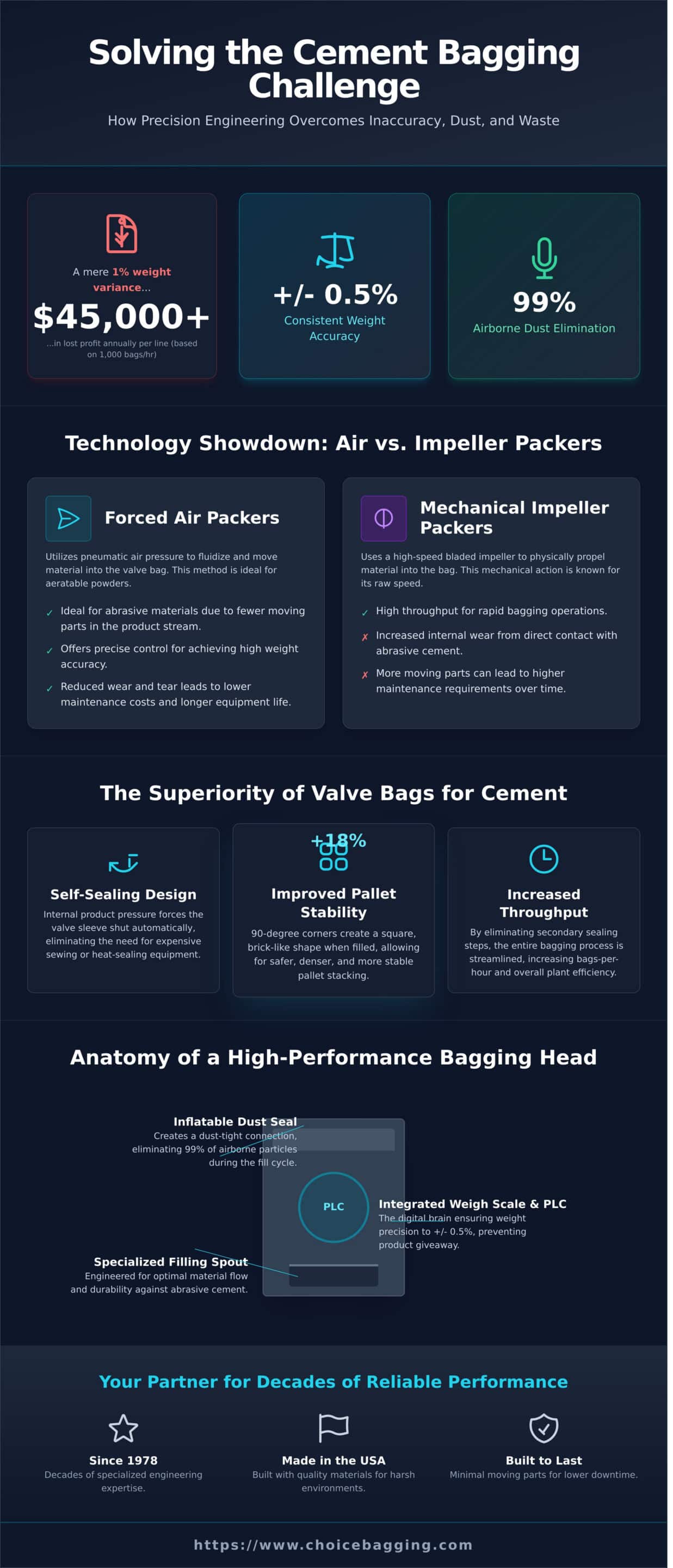
How much product are you actually giving away because of a 1% weight variance? For a plant running 1,000 bags per hour, that small inaccuracy adds up to over $45,000 in lost profit every year. You know that cement is a brutal material to pack. It’s abrasive, it’s dusty, and it’s unforgiving on inferior equipment. Finding a valve bag filling machine for cement that stands up to these conditions while protecting your workers is a constant challenge.
At Choice Bagging Equipment, we’ve been a trusted manufacturer of high-performance systems since 1978. We understand that you need more than just a machine; you need a partner to ensure your operation stays profitable and safe. This guide reveals how to achieve consistent +/- 0.5% weight accuracy and eliminate 99% of airborne dust in your packing room. We’ll walk you through the latest 2026 industrial standards for equipment selection, integration, and maintenance. If you’re ready to upgrade your production speed and invest in a system built for decades of service, contact us now for a professional consultation.
Key Takeaways
-
Understand why specialized valve bags are the superior choice for Portland and masonry cement to minimize product waste and improve pallet stackability.
-
Compare forced air and mechanical impeller technologies to select the ideal valve bag filling machine for cement based on your specific material density.
-
Discover how integrated dust collection systems eliminate environmental hazards and improve weighing accuracy at the point of filling.
-
Learn the essential steps for integrating your filler into a high-speed production line for a seamless transition from the filling spout to the take-away conveyor.
-
Leverage decades of engineering expertise to select durable, "Made in the USA" equipment designed to perform reliably in the harshest industrial environments.
Table of Contents
What is a Valve Bag Filling Machine for Cement?
A valve bag filling machine for cement is a precision-engineered industrial system designed to pack dry bulk materials into pre-closed bags. These machines typically use air pressure or gravity-fed mechanisms to move material from a hopper into the packaging. Since 1978, Choice Bagging Equipment has refined these systems to handle the heavy, abrasive nature of construction materials. To understand the requirements of this process, it is helpful to first define What is Cement? and recognize why its fine particulate size requires a dust-tight solution.
To better understand how these machines operate in a production environment, watch this helpful video:
The valve bag filling machine for cement is uniquely suited for Portland, masonry, and plastic cement because it utilizes a self-sealing bag design. Unlike open-mouth bags that require expensive sewing heads or heat-sealing units, a valve bag features an internal sleeve. As the bag fills, the internal pressure of the cement forces the sleeve shut, creating a secure closure automatically. This design eliminates secondary sealing steps, which increases throughput and reduces maintenance costs. Most industrial operations configure these machines to handle standard weight ranges between 20 lbs. and 110 lbs., providing the flexibility needed for both retail and commercial supply chains.
The Role of Valve Bags in Modern Cement Plants
Modern cement plants rely on multi-wall paper and plastic valve bags for their superior structural integrity. These bags are manufactured with 90-degree corners, allowing them to sit square when filled. This shape improves pallet stability by approximately 18% compared to traditional bags, making them safer for transport and high-density warehouse stacking. You will find these bags used for various materials, including Portland cement, specialized mortar mixes, and high-strength grouts. If you are unsure which bag style fits your operation, you can use our Bagger Professor tool for expert guidance.
Key Components of a Cement Bagging Head
The bagging head is the critical interface between the machine and the package. It consists of a specialized filling spout and an inflatable seal designed for total dust control during the fill cycle. This seal prevents fine cement dust from escaping into the plant environment, protecting both your employees and your equipment. The system also includes an integrated weighing scale that communicates directly with a PLC control system. This digital brain manages weight precision to within 0.5% of the target, ensuring you don’t lose profits through product giveaway. We build this level of reliability into every component to ensure your plant operates at peak efficiency for decades.
When you invest in a Choice Bagging Equipment system, you aren’t just buying hardware; you’re gaining a long-term partner dedicated to your success. Our machines are built in the USA and designed for minimal moving parts, which translates to lower downtime and higher performance. If you need to upgrade your current production speed, contact us now to discuss your specific application requirements.
Air vs. Impeller Packers: Choosing the Right Technology
Selecting the right valve bag filling machine for cement depends on your specific production goals and material characteristics. The two primary technologies used since 1978 are pneumatic forced air systems and mechanical impeller packers. Each method offers distinct advantages for handling the dense, abrasive nature of portland cement. While the full production line involves complex chemical reactions and intense grinding; the bagging stage is where your final product quality meets the customer’s expectations for weight accuracy and package integrity.
High-density cement powders require a system that can move fine particles without excessive internal wear. Impeller packers use a high-speed blade to physically throw the product into the bag. This mechanical action is efficient for raw speed, but it exposes more internal components to the abrasive dust. Forced air systems use low-pressure, high-volume air to fluidize the cement, allowing it to flow like a liquid. This reduces friction and extends the life of the machine components. Choice Bagging Equipment provides both technologies to ensure your facility achieves 99% reliability during peak production seasons.
Forced Air (Pneumatic) Packers for Abrasives
Pneumatic systems excel when maintenance reduction is your primary priority. These machines use a pressurized chamber to move cement through the spout using air as the carrier. Because there are fewer moving parts in the direct product stream, wear is localized to the spout and seals. The Model 7200 Abrasive-Duty Forced Air Filler is a proven solution for these environments. It handles 1 to 4 bags per minute per spout with high weight precision. This technology is ideal for operations that value uptime and durability over maximum velocity.
Impeller Packers for High-Speed Cement Production
When your facility requires maximum throughput, impeller packers are the industry standard. These machines use a vertical or horizontal impeller to mechanically drive the cement into the bag. This process creates a compacting effect, allowing you to use smaller, more cost-effective bags for the same weight of product. A single-spout impeller system can achieve speeds of up to 12 bags per minute. While energy consumption is often 20% higher than air systems due to the mechanical motor requirements, the increased volume often justifies the operational cost. Using a high-quality valve bag filling machine for cement ensures your weights remain within +/- 0.5% of the target, even at these high speeds.
Choosing between these technologies isn’t just about speed; it’s about finding a long-term partner for your facility’s growth. If you aren’t sure which system fits your floor plan, you can contact our engineering team for a detailed consultation. We’ve helped thousands of plants optimize their output since our founding in 1978. Our "Bagger Professor" tool can also help you narrow down the technical requirements based on your specific bulk density and desired bags per hour.
Reliability is the foundation of a profitable bagging operation. Whether you choose the low-maintenance profile of a pneumatic system or the high-velocity output of an impeller, the goal remains the same: consistent, accurate fills every single shift. You can view our full equipment lineup to compare technical specifications side-by-side and invest confidently in your next upgrade.
Solving the "Cement Challenge": Dust, Accuracy, and Abrasion
Handling cement requires more than just moving powder from a silo to a container. It is a constant battle against a material that is fine, heavy, and highly abrasive. Since 1978, Choice Bagging Equipment has refined the technology needed to master these variables. A standard packer simply won’t survive this environment. You need a dedicated valve bag filling machine for cement that is engineered to withstand 24/7 industrial abuse while maintaining high-speed throughput and operator safety.
Advanced Dust Management and OSHA Compliance
Cement dust is a significant respiratory hazard and a primary cause of premature equipment failure. Our systems utilize inflatable spouts that create a 100% airtight seal against the bag valve before the filling cycle starts. This eliminates the "puff" of dust often seen during the initial surge of material. Integrated dust shrouds surround the filling area, capturing fugitive particles and venting them directly to your external dust collector. This closed-loop system is essential for maintaining OSHA Permissible Exposure Limits (PELs) for crystalline silica. By keeping the packing room clean, you protect your personnel and reduce the 40% of maintenance issues typically caused by grit infiltration into mechanical parts.
Achieving Precision Weights with Digital Controls
Inaccurate fills directly impact your bottom line. Under-filled bags lead to customer complaints, while over-filling by just 1% can cost a mid-sized operation $50,000 annually in "giveaway" product. We achieve a consistent weight accuracy of +/- 0.5% using high-resolution load cells and digital controllers. Our approach ensures the scale configuration is tuned to the specific flow characteristics of your cement grade. The machine employs a "bulk and dribble" feed method; it delivers 92% of the target weight at high volume, then switches to a precise trickle for the final 8%. If your production environment changes, our Field Service experts are available for on-site calibration and optimization to keep your tolerances tight.
Durability is the final piece of the puzzle. Cement acts like liquid sandpaper on internal components. Choice Bagging Equipment utilizes "Abrasive-Duty" engineering as a standard framework to combat this. This approach includes:
-
Hardened Steel Components: Internal augers and impellers are treated to resist wear from high-velocity particle impact.
-
Replaceable Liners: We use AR-400 or ceramic liners in high-wear zones to simplify maintenance and extend the service life of the main housing.
-
Sealed Bearings: All rotating parts are protected by double-sealed bearings and air-purge seals to prevent grit ingress.
Our valve bag filling machine for cement is built to last decades, not just years. We don’t just sell you a machine; we’re also your partner in long-term operational success. Every unit is Made in the USA, ensuring you have access to parts and support whenever you need them. If you are ready to modernize your packing line with a solution built for reliability, contact us now to speak with a bagging specialist.
Integrating Your Cement Filler into a Full Production Line
A high-performance valve bag filling machine for cement represents a significant investment in your facility’s daily throughput. However, the machine’s rated speed is only a theoretical maximum if the surrounding infrastructure fails to support it. Since 1978, we’ve observed operations lose 18% of their potential output because of poorly synchronized conveyors or manual stacking bottlenecks. Your filler is only as effective as the equipment that feeds it and the systems that carry the finished product away. A truly efficient system follows a disciplined, automated flow: raw material moves from the Bulk Silo into the valve bag filling machine for cement, then onto a specialized discharge conveyor, and finally to a robotic palletizer.
The transition from the filling spout to the take-away conveyor is a critical moment in the cycle. If a 94-pound bag drops haphazardly or isn’t cleared from the chair quickly enough, the next filling cycle is delayed. We design our systems so the bag discharges cleanly, landing in a consistent orientation every time. This precision prevents downstream jams that can halt production for 10 to 15 minutes at a time. When every component works in harmony, you transform a series of individual machines into a single, cohesive powerhouse that maximizes every minute of the shift.
Automating the End-of-Line with Robotic Palletizers
Manual stacking of heavy cement bags is a leading cause of workplace strain and fatigue. By implementing Robotic Bag Palletizers, you eliminate these safety risks while maintaining a consistent pace that manual labor can’t match during a full 10-hour shift. These systems offer 99.9% repeatable accuracy in stack patterns, which is vital for load stability during truck transport. Our automation solutions are Made in the USA, providing the heavy-duty reliability required for 24/7 industrial environments. One robotic cell often replaces two employees per shift, allowing you to reallocate your workforce to higher-value tasks while ensuring your valve bag filling machine for cement never has to wait for an empty pallet.
Ensuring the finished pallets are handled by properly outfitted commercial vehicles is the final step in the logistics chain. For businesses that manage their own fleets, service providers like Tim Halpin Equipment Corp specialize in the truck equipment and upfitting necessary to handle heavy industrial loads safely.
Conveying and Handling Abrasive Bags
Cement dust is notoriously abrasive; it acts like liquid sandpaper on moving parts. Standard rollers often seize within 5 to 7 months of exposure to fine grit. You need Bag Handling Conveyors specifically engineered with sealed bearings and reinforced belts to withstand this harsh environment. Before reaching the stack, bags should pass through a bag flattener. This device levels the internal product to create a "brick-like" shape, which is essential for stable, high-density stacking. We also recommend integrated cleaning stations to remove surface dust before Stretch Wrappers apply the final film. This ensures the wrap adheres properly and your customers receive a clean, professional package every time.
Ready to eliminate bottlenecks and modernize your facility? Partner with the experts at Choice Bagging Equipment to design a fully integrated system. Request a customized system consultation today .
Why Choice Bagging Equipment is Your Cement Partner
Choice Bagging Equipment has engineered solutions for the most demanding industrial environments since 1978. For over 45 years, we’ve focused on one goal: building machinery that survives the abrasive, dusty nature of cement production. Every valve bag filling machine for cement we manufacture is Made in the USA at our facility, ensuring that quality control remains under our direct supervision. We don’t just ship a crate and walk away. We provide a complete support ecosystem, including immediate access to genuine replacement parts to minimize your downtime. If a component fails on a Tuesday morning, you need a partner who has that specific part in stock and ready to ship. Our 98% on-time parts fulfillment rate reflects our commitment to your continuous operation.
Our consultative approach sets us apart from standard equipment vendors. We treat your facility layout and material characteristics as unique variables rather than using a one-size-fits-all template. Our engineers analyze your specific cement grade, from Portland Type I to specialty masonry blends, to ensure the feeding mechanism matches the flow characteristics. This technical precision prevents common issues like bridging or excessive dusting. We’ve seen how 1/4 inch of misalignment in a conveyor feed can cause 10% more waste over a production year. We don’t let that happen. Our team has performed over 400 on-site audits in the last five years alone to ensure our clients maximize their floor space. We offer a three-step evaluation for every client:
-
On-site material flow analysis to prevent product bridging and clogging.
-
Footprint optimization for seamless integration with existing palletizers.
-
Operator training programs to ensure 100% equipment utilization from day one.
The Bagger Professor: Expert Guidance for Your Plant
Choosing the right configuration requires more than a catalog. Our proprietary Bagger Professor tool streamlines this process by matching your specific material type and bag type with the best machine. Whether you need an impeller feeder for high-speed throughput or an air packer for specific cement blends, this tool provides a data-driven starting point. We’ve helped over 1,200 plants optimize their bagging floors since our founding. We prioritize durability because a machine that breaks down every 500 hours isn’t a solution; it’s a liability. Our systems are built to last 20 years or more with basic maintenance.
Invest Confidently in Your Cement Packaging Future
Your capital investment is protected through our flexible ownership and upgrade paths. If your production needs change, our Used Equipment Buyback program allows you to recoup value and upgrade to higher-capacity systems. For companies managing 6-month seasonal surges or short-term infrastructure contracts, our Rental Program provides a low-risk way to scale up without a permanent commitment.
This flexibility is why 85% of our clients return to us for their next expansion project. We’re ready to help you optimize your next valve bag filling machine for cement purchase to eliminate weight inaccuracies and slow cycles. We stand behind our work with a 12-month standard warranty and lifetime technical support. Your success is the only metric that matters to us. Request a custom quote for your cement bagging project today and secure a partner dedicated to your long-term success.
Future-Proof Your Cement Packing Line with Proven Technology
Selecting the right technology for your facility involves more than just picking a model. You’ve learned how impeller packers handle abrasive materials and why air packers offer the speed required for high-volume output. A modern valve bag filling machine for cement must manage dust effectively while maintaining weight accuracy within 0.5% to ensure your profitability remains high. Choice Bagging Equipment has been manufacturing industrial bagging solutions since 1978. Every machine we build is proudly Made in the USA and engineered to provide decades of dependable service. We don’t just sell hardware; we’re your partner in expert production line integration. Our team ensures your new filler works seamlessly with existing palletizers and conveyors. Our Bagger Professor tool helps you navigate these technical choices with confidence. We focus on minimal moving parts to reduce maintenance costs over a 20 year lifespan. It’s time to eliminate downtime and maximize your plant’s efficiency with a system built for the 2026 industrial landscape.
**Request a custom quote for your cement bagging project today **
We look forward to building a reliable solution that helps your business grow for years to come.
Frequently Asked Questions
How fast can a valve bag filling machine package cement?
A single-spout valve bag filling machine for cement typically packages 3 to 8 bags per minute for standard 94-pound bags. High-speed rotary systems can exceed 100 bags per minute by utilizing multiple spouts in a continuous cycle. Your actual throughput depends on the material flow characteristics and the specific packer model you select. Choice Bagging Equipment designs these systems to maximize cycle times and ensure your production targets are met with precision.
What is the difference between an air packer and an impeller packer for cement?
Air packers use low-pressure air to fluidize and move cement, while impeller packers use a high-speed mechanical blade to throw material into the bag. Impeller packers are often preferred for cement because they create a denser pack and handle abrasive materials efficiently. Since 1978, we’ve found that impeller designs reduce air entrapment in the bag. This leads to a more stable pallet and a cleaner work environment for your operators.
Can I use one valve bagger for different types of cement and mortar?
You can use a single valve bag filling machine for cement to package various formulations like Type I Portland, masonry cement, or pre-blended mortars. Each material has a different bulk density, so you’ll need to adjust the flow controls and scale settings between runs. Our Bagger Professor tool helps you select a versatile machine that handles these variations. We provide clear instructions for quick changeovers to keep your production line moving.
How much maintenance does a cement bagging machine require?
Cement bagging machines require a weekly 30-minute inspection of wear parts like the impeller blades or fill tubes. You should perform a deep cleaning every 160 operating hours to prevent dust buildup in the weighing components. Our machines feature rugged construction and minimal moving parts to reduce these requirements. Keeping the system clean ensures it lasts for decades. If you need replacement parts or technical support, contact us for assistance.
Is it possible to automate the entire cement bagging and palletizing process?
Full automation is achievable by integrating an automatic bag placer, a conveyor system, and a robotic palletizer with your packer. This setup reduces manual labor by 90% and keeps operators away from dusty environments. We specialize in designing these complete, integrated lines to improve your facility’s safety. A fully automated system can run 24 hours a day with minimal human intervention. It’s an investment that pays for itself through increased efficiency and reliability.
What is the expected weight accuracy for a modern cement valve bag filler?
Modern fillers achieve a weight accuracy of +/- 0.5% or better on a standard 94-pound bag. This precision saves you 200 pounds of product for every 1,000 bags filled by eliminating unnecessary overfills. Our digital weighing systems use high-resolution load cells to monitor the fill in real-time. This ensures every bag meets your strict quality standards. You’ll see a direct impact on your bottom line through reduced product giveaway and improved consistency.
Why are valve bags preferred over open-mouth bags for cement?
Valve bags are the industry standard because they’re self-closing and produce 75% less dust during the filling process than open-mouth bags. The squared-off shape of a filled valve bag allows for 15% more efficient pallet stacking and better load stability during transport. This design protects your product from moisture and contamination. It’s the most professional and reliable way to deliver cement to your customers while maintaining a clean warehouse.
Does Choice Bagging Equipment offer installation and training for new systems?
We provide comprehensive on-site installation and operator training for every system we manufacture. Our technicians spend 2 to 3 days at your facility to ensure your team is confident in operating and maintaining the equipment. We’ve been a trusted partner to the industry since 1978. We don’t just ship a machine; we ensure it performs to your specific expectations. To schedule a consultation for your facility, contact us today.
Recent Comments