

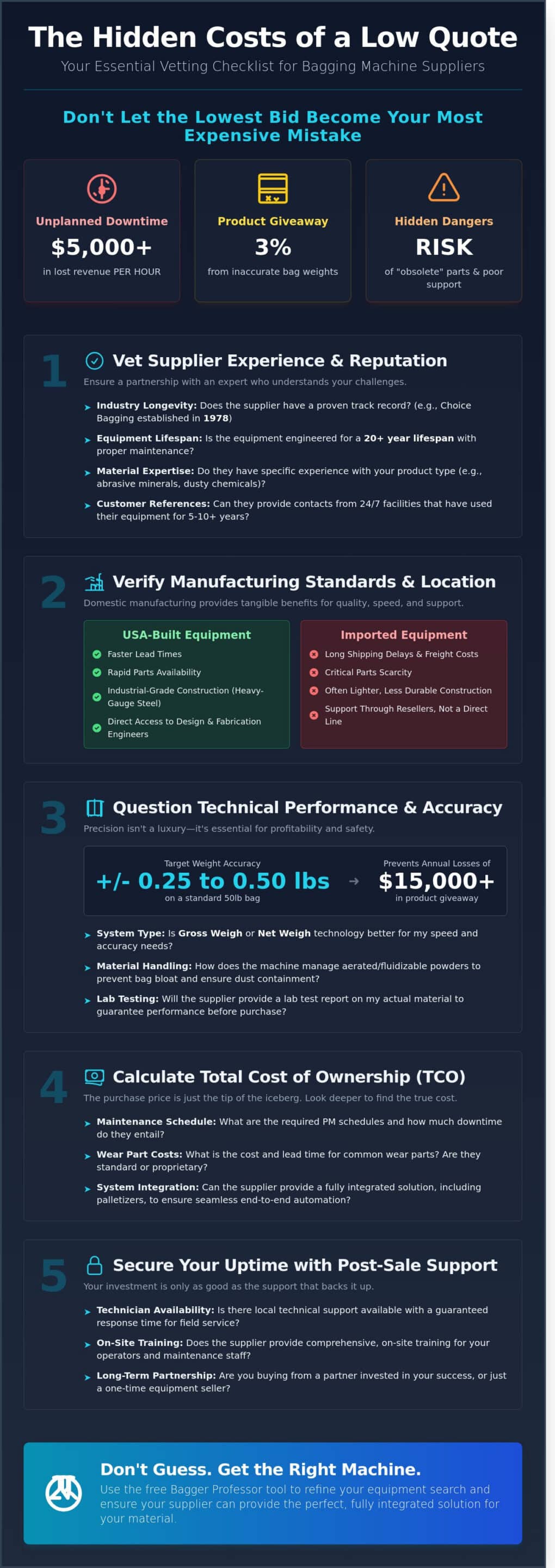
What if the lowest quote you received for a new bagging line is actually the most expensive mistake your facility will make this decade? You understand that unplanned downtime can cost a production plant over $5,000 per hour in lost revenue. It’s equally frustrating when inaccurate bag weights lead to a 3% product giveaway on every shift. When you’re vetting vendors, knowing the right questions to ask bagging machine suppliers is the only way to avoid the nightmare of “obsolete” parts. Since 1978, we’ve seen how a lack of due diligence leads to equipment that fails long before its time.
This guide provides a comprehensive vetting checklist to ensure your bagging equipment supplier is a reliable, long-term partner for your production line. You’ll learn how to secure a 20 year equipment lifespan, ensure seamless integration with palletizers, and verify local technical support. We’ll also show how the Bagger Professor tool helps narrow down the right machine for your material. If you’re ready to invest confidently, contact us to start your consultation today.
Key Takeaways
- Evaluate a manufacturer’s industry legacy and material expertise to ensure your equipment is engineered for unmatched reliability and decades of performance.
- Master the technical questions to ask bagging machine suppliers regarding weight accuracy and dust containment to protect your product quality and facility safety.
- Identify the true total cost of ownership by vetting maintenance schedules and wear part costs before making a long-term investment.
- Use the Bagger Professor tool to refine your equipment search and ensure your supplier can provide fully integrated, end-to-end automation solutions.
- Secure your production uptime by confirming a supplier’s post-sale support capabilities, including technician availability and comprehensive on-site training.
Vetting the Supplier’s Experience and Industry Reputation
Selecting a bagging machine supplier is a decision that impacts your facility’s efficiency for the next twenty years. It’s not just about purchasing steel and electronics; it’s about securing a long-term partnership with an expert who understands your specific production challenges. One of the most critical questions to ask bagging machine suppliers concerns their tenure in the industry. Choice Bagging Equipment has been manufacturing high-performance systems since 1978, proving that our designs withstand the test of time in demanding environments.
To better understand how to evaluate your options, watch this helpful video:
Historical Reliability and Track Record
Longevity serves as the ultimate indicator of quality. Inquire about the typical lifespan of the supplier’s installed machines. A well-engineered system should operate for decades with proper maintenance. When preparing your list of questions to ask bagging machine suppliers, prioritize their experience with your specific material. Handling abrasive minerals requires different engineering than packing dusty chemicals or high-density aggregates. You can use the Bagger Professor tool to narrow down equipment options based on your specific material and bag type. Always ask for reference sites where you can speak with existing customers. A reputable manufacturer will provide contacts who have used their equipment in 24/7, multi-shift operations for at least five to ten years.
Manufacturing Standards and Location
It’s vital to determine if the supplier actually manufactures their own equipment or if they’re simply a reseller of imported goods. Within the broader context of Packaging machinery, domestic manufacturing often correlates with more robust build quality and stricter tolerances. Choice Bagging Equipment proudly builds its machines in the USA. This domestic focus provides several tangible benefits for your operation:
- Faster Lead Times: Shipping from a domestic facility avoids the delays and costs associated with international freight.
- Parts Availability: You can source critical parts quickly to minimize downtime during unexpected repairs.
- Industrial-Grade Construction: Machines are built for heavy-duty use, featuring heavy-gauge steel and minimal moving parts to ensure durability.
- Direct Technical Support: You speak directly with the engineers who designed and fabricated your system.
If you’re ready to discuss a system built for your specific application, contact us today to speak with an application expert.
Technical Questions for Machine Performance and Accuracy
Performance isn’t just about speed; it’s about precision and consistency. When you begin your search, the most important questions to ask bagging machine suppliers focus on how the equipment handles your specific product variables. Bagging 40 bags per minute means nothing if 10% of them are underweight or leaking dust into your facility.
Accuracy and Product Integrity
Ask for the specific standard deviation on a 50lb bag. A high-quality machine should deliver accuracy within +/- 0.25 to 0.50 pounds. This precision prevents product giveaway that can cost a business $15,000 or more annually in lost inventory. You also need to determine if the machine uses gross weigh or net weigh technology. Gross weigh systems weigh the product as it enters the bag; net weigh systems pre-weigh the material in a hopper for faster cycle times.
If you handle aerated or fluidizable powders, inquire about how the machine manages air. These materials require specialized venting or densification to prevent bag bloat. It’s also vital to compare valve bag fillers vs. open mouth options. Valve bags provide a closed filling environment, which is often the best choice for maintaining product integrity and minimizing spills during the transition from the spout to the pallet.
Customization and Material Testing
Never buy a machine based on a catalog description alone. A reputable supplier will offer a lab test report using a sample of your actual material. This report should detail the flow rate, settling time, and any issues with bridging or clogging. Since 1978, we’ve seen that material behavior varies wildly based on humidity and particle size. You should also ask if the machine can be customized for your facility. Many plants have tight footprints or low overhead clearances that require a modified frame or a custom-engineered conveyor path.
You can use the Bagger Professor tool to help narrow down the right equipment for your material and bag type before you speak with an engineer. This helps you enter the conversation with a clear idea of which technology fits your needs. If you have questions about specific material handling challenges, contact our team for a technical consultation.
Dust control is another non-negotiable performance factor. Ask how the machine handles fine powders or hazardous materials. Effective machines include dust collection ports and specialized seals at the fill spout to maintain a clean workspace. If your product is abrasive, ask about the durability of the internal contact parts. Using 304 or 316 stainless steel can extend the life of your equipment by 5 to 10 years compared to standard carbon steel. Versatility is equally important; ask if the tooling can be adjusted for multiple bag sizes, such as switching from a 25lb to a 50lb bag in under 15 minutes.
Assessing System Integration and Automation Capabilities
A bagging machine does not operate in a vacuum. It is a single component in a larger production ecosystem. One of the most vital questions to ask bagging machine suppliers is whether they provide a cohesive, end-to-end solution or just a standalone piece of equipment. Since 1978, we have seen production lines fail because the filler could not communicate with the rest of the facility. You need a partner who understands how to synchronize every stage of the process, from the initial material feed to the final wrapped pallet.
Efficiency depends on the control systems governing the machine. Reliable suppliers use non-proprietary, industry-standard PLCs like Allen-Bradley. This choice ensures your internal maintenance team can perform troubleshooting and software updates without being held hostage by a manufacturer’s service contract. Standardized controls also make it easier to integrate safety protocols that meet OSHA 1910 and ANSI B155.1 requirements, protecting your workforce and your investment.
Upstream and Downstream Integration
The flow of your product must be seamless to maintain high throughput. Ask the supplier how the filler communicates with bag handling conveyors to prevent pile-ups or empty runs. A truly integrated system should also incorporate bag sealing or bag sewing machine systems that match the speed of the filler. If your goal is to eliminate manual labor entirely, inquire about robotic palletizing systems. These systems can reduce labor costs by 65% while increasing stacking precision and safety.
Automation and Ease of Use
Automation should simplify your life, not make it more complex. Evaluate the Human Machine Interface (HMI) for clarity and ease of use. A well-designed HMI allows a single operator to manage the full line after only 4 hours of training. If you aren’t ready for full automation today, ask if the equipment is modular. Many of our clients start with a manual setup and upgrade to an automated bag placer later as their volume increases. This future-proofing protects your capital. You can use the Bagger Professor tool to help identify which level of automation fits your current material and bag type.
When you evaluate potential partners, focus on their engineering depth. A supplier should be able to provide a full layout drawing of your production floor to ensure the equipment fits and flows correctly. This level of consultation transforms a simple purchase into a long-term partnership. If you are ready to discuss a custom-engineered solution for your facility, contact us to speak with an application engineer today.
Calculating Total Cost of Ownership (TCO) and Durability
The initial purchase price usually represents only 30% of the lifetime cost of industrial machinery. To protect your capital investment, your list of questions to ask bagging machine suppliers must address long-term operational expenses. High-performance machines are built to last decades, but they require a structured maintenance schedule to remain efficient. You’re not just buying a piece of steel; you’re investing in a production partner that should deliver a predictable return on investment.
When preparing your questions to ask bagging machine suppliers, ask for a detailed breakdown of daily, weekly, and monthly tasks. Daily tasks often involve clearing dust from sensors and checking air pressure. Weekly maintenance includes lubricating pivot points, while monthly checks focus on belt tension and electrical connections. You should also quantify energy consumption. A typical pneumatic filler might require 15 to 20 CFM of clean, dry air at 80 PSI. If your facility’s compressor can’t handle that load, you’ll face unexpected infrastructure costs immediately after installation.
Wear parts are another critical factor in your TCO calculation. Ask for the average lifespan and replacement cost of items like fill spouts, rubber seals, and conveyor belts. If a machine uses proprietary parts, you’re locked into the supplier’s pricing and lead times. Reliable manufacturers use “off-the-shelf” components for motors and PLC systems so you can source repairs locally if needed. This design philosophy minimizes the risk of extended shutdowns.
Maintenance and Spare Parts Availability
Don’t wait for a breakdown to realize you’re missing a $50 seal. Ask your supplier for a recommended list of spare parts to keep on your shelf. Verify that the supplier stocks these components domestically for overnight shipping. Since 1978, we’ve seen how a two-day delay for a custom part can halt an entire production line. If you’re unsure which machine fits your specific material requirements, use the Bagger Professor tool to narrow down your options based on technical specifications.
Long-Term Value and Support Programs
A machine’s value doesn’t end when it’s installed. Inquire about bagging equipment rental options to handle seasonal peaks without the capital expense of a new unit. You should also ask if the company has a program where they buy used bagging equipment. This provides a clear exit strategy if your production needs change or you decide to upgrade to a higher-speed line.
Consider the cost of downtime compared to equipment quality. A 5% decrease in uptime for a high-volume line can result in over $15,000 in lost revenue per month. Investing in a heavy-duty, Made in the USA machine often pays for itself by eliminating these frequent, small interruptions that eat into your profit margins. Reliability is the most valuable feature any supplier can offer.
Contact our expert team to discuss your specific production goals and TCO requirements.
Vetting the Post-Sale Support and Field Service
Your investment doesn’t end when the machine arrives on your facility floor. In fact, that’s just the beginning of the equipment’s lifecycle. One of the most critical questions to ask bagging machine suppliers involves the depth and location of their technical bench. Ask specifically how many technicians they employ and where they’re stationed. A supplier with only 2 or 3 technicians nationwide can’t guarantee a 24 hour response time when your production line goes down during a night shift. Since 1978, Choice Bagging Equipment has focused on providing the reliability you expect from a high-quality, Made in the USA manufacturer.
Training is another non-negotiable factor for long-term success. Your maintenance and operations teams need more than just a printed manual; they need hands-on instruction. Ensure the supplier offers on-site training that covers both routine operations and deep-level maintenance tasks. Modern machines should also offer remote troubleshooting capabilities. If a technician can log into the machine’s PLC remotely, they can often resolve software glitches or sensor calibrations in less than 20 minutes. This saves you the 48 hour wait and the high cost of a physical site visit.
Review the warranty with a critical eye. Most standard warranties cover parts for 12 months, but you must ask what’s excluded. Often, wear items like bag clamps, seals, or heating elements are left out of the fine print. You need a clear, written list of exclusions to avoid unexpected repair bills in the first year of operation. High-performance machines are built to last decades, but only if the support structure is equally durable.
Technical Support and On-Site Service
Response time is the metric that matters most to your bottom line. Ask if the supplier offers a 24 to 48 hour on-site guarantee for emergencies. Choice Bagging Equipment provides a dedicated Bagger ER emergency support line to give you immediate access to experts who understand your urgency. Every purchase should include professional startup and field service commissioning. This ensures the equipment is calibrated to your specific product density and bag type from day one, preventing 5% to 10% product giveaway due to poor calibration.
The Partnership Mindset
A vendor sells hardware, but a partner ensures your entire production line succeeds. Ask how the supplier handles equipment integration with other manufacturers’ machines, such as upstream bins or downstream palletizers. If you’re still determining your requirements, use the Bagger Professor tool to narrow down the right machine based on your specific material and bag type. This functional tool helps you identify the best solution before you even start the quoting process. True partners don’t walk away after the check clears; they stay involved to ensure your uptime remains consistent for the next 20 years.
Ready to start your project? Contact Choice Bagging Equipment today to speak with a seasoned expert who can guide you through the technical questions to ask bagging machine suppliers for your specific application.
Move Your Operation Forward with Expert Guidance
Selecting industrial equipment is a long-term commitment that impacts your bottom line for decades. You’ve now learned how to evaluate technical accuracy and why calculating the total cost of ownership is vital for long-term profitability. Choice Bagging Equipment has manufactured high-quality equipment since 1978. Every machine is proudly Made in the USA to ensure unmatched reliability and performance. Understanding the specific questions to ask bagging machine suppliers helps you avoid costly downtime and complex integration headaches. We provide expert integration support for full production lines to keep your facility running at peak efficiency. If you need to narrow down your options quickly, use our Bagger Professor tool to find the right match for your material and bag type. It’s time to invest in a system that’s built to last and a partner that stands behind their work.
Request a Quote for Your Bagging Project
We’re ready to help you build a more efficient future for your facility.
Frequently Asked Questions
What is the difference between a valve bag filler and an open mouth bagger?
A valve bag filler uses a specialized spout to inject material into a pre-closed bag through a small corner opening, while an open mouth bagger fills bags that are completely open at the top. Valve fillers are the superior choice for fine powders because they minimize dust and product loss. Open mouth systems are better suited for large, granular products. Choice Bagging Equipment has refined these industrial designs since 1978 to ensure maximum performance for every application.
How do I determine the right bagging speed for my production goals?
You determine the right bagging speed by calculating your required bags per minute based on an 8 hour shift production goal. If you need to move 4,800 bags per day, you require a machine capable of 10 bags per minute. Always factor in a 15 percent buffer for downtime and maintenance. This is one of the critical questions to ask bagging machine suppliers to ensure your equipment meets throughput demands without straining the system.
Why is weight accuracy so important in industrial bagging?
Weight accuracy is critical because it prevents expensive product giveaway and ensures your facility stays in regulatory compliance. A deviation of just 2 ounces on a 50 pound bag can cost a facility over $15,000 annually if they process 500 bags per day. Our machines utilize advanced load cells to maintain tolerances within plus or minus 0.25 percent. Precise weighing protects your profit margins and maintains the trust of your customers.
Can one bagging machine handle different types of bags?
Most bagging machines are designed for specific bag geometries, but some versatile models can handle multiple types with minor mechanical adjustments. A valve bagger won’t fill an open mouth bag without a significant conversion kit. If your operation uses both paper and poly bags, you should consult the Bagger Professor tool to identify a machine configured for your specific material and bag combinations.
What are the common maintenance requirements for a valve bag packer?
Common maintenance for a valve bag packer includes weekly inspections of the fill spout gaskets and monthly calibration of the weighing system. You should also grease the pivot points every 160 hours of operation. Since 1978, we’ve designed our equipment with minimal moving parts to reduce these requirements. Keeping a spare parts kit on hand prevents unscheduled downtime during peak production cycles; it’s a simple way to protect your investment.
How much floor space is typically required for a fully automated bagging line?
A fully automated bagging line typically requires a footprint of at least 30 feet by 50 feet. This space accommodates the bagger, conveyor system, and palletizing station. You must also allow a 3 foot clearance around all sides for operator access and safe maintenance. Providing your supplier with a detailed CAD drawing of your facility ensures the system integrates perfectly into your existing layout without creating workflow bottlenecks.
Is it better to buy new or used bagging equipment?
Buying new equipment is better because it includes a manufacturer warranty, modern safety features, and long term technical support. Used machines often lack 2024 safety standards and may have hidden wear on critical components like PLC controllers. Investing in new machinery ensures you receive a system built to last decades; it’s the most reliable way to scale. Request a Quote to compare the ROI of a new system.
How does a robotic palletizer improve the ROI of a bagging machine?
A robotic palletizer improves ROI by reducing labor costs and increasing stacking consistency. Replacing two manual stackers with a single robot can save a facility $90,000 per year in wages and benefits. These systems operate at 99 percent uptime; this eliminates the bottlenecks often found at the end of a bagging line. This efficiency allows your bagging machine to run at its maximum rated capacity without stopping for human fatigue.
Recent Comments