

Is your production line struggling to keep pace? For manufacturers facing high labor costs, inconsistent bag weights, and persistent bottlenecks, investing in the right automated bagging systems is a critical step toward protecting your bottom line. These operational challenges directly impact profitability, turning a productive facility into a source of constant frustration and waste.
High-performance automation is engineered to solve the exact problems that limit growth. A reliable system reduces reliance on manual labor, eliminates costly product giveaway through superior accuracy, and creates a safer, more efficient work environment. But choosing the right equipment is essential for maximizing your return on investment.
This guide provides the clarity you need. We will break down the fundamental differences between automated open mouth and valve bagging systems, exploring the unique performance benefits and ideal applications for each. You will gain the expert knowledge required to select the durable, high-performance solution that will drive your plant’s productivity and profitability for years to come.
Key Takeaways
-
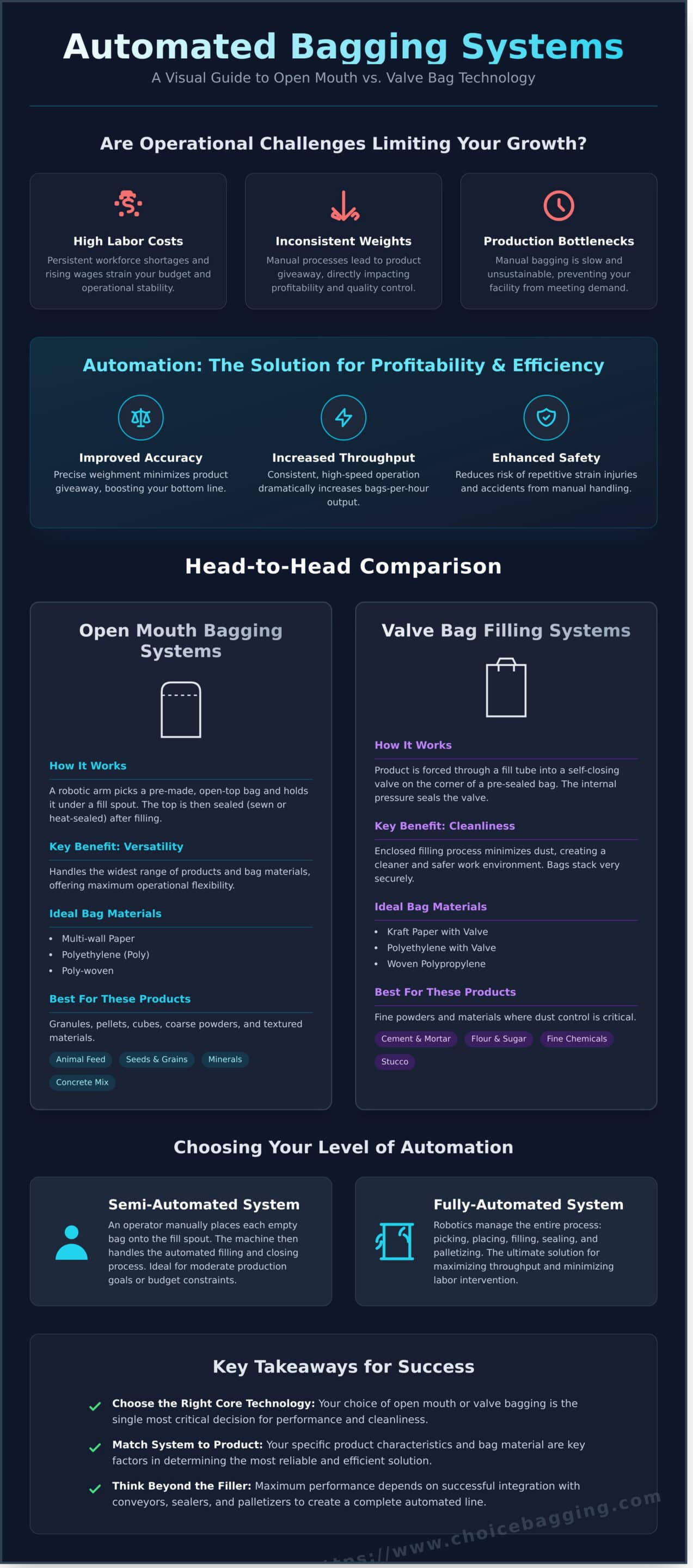
Selecting the right bagging technology—open mouth or valve—is the critical first step to maximizing your packaging line’s performance and cleanliness.
-
Evaluate how automation directly addresses today’s most pressing manufacturing challenges, including labor availability and rising operational costs.
-
The performance of your automated bagging systems depends on successfully integrating the bag filler with equipment like conveyors, sealers, and palletizers.
-
Identify how your specific bag material and product characteristics are key factors in determining the most reliable and efficient bagging solution for your plant.
Table of Contents
What Are Automated Bagging Systems & Why Invest?
In an industrial context, automated bagging systems are heavy-duty machines engineered to precisely fill and seal large volumes of open-mouth bags with consistent speed and reliability. Unlike smaller, light-duty autobaggers, these systems are robustly built to integrate seamlessly into demanding production lines. They represent a critical component of modern packaging machinery, designed to handle a wide range of products, from fine powders and seeds to aggregates and animal feed. The decision to invest in this technology is a strategic one, driven by clear operational and financial objectives.
To better understand how these systems function in a production environment, watch this video demonstration:
The primary drivers for manufacturers to adopt automation are compelling and address the most pressing challenges in today’s market. With rising labor costs and persistent workforce shortages, an automated solution provides stability and predictability to your operation. The benefits extend far beyond labor savings:
-
Improved Accuracy & Profitability: Automated weighment and filling systems are exceptionally precise, minimizing product giveaway. Every ounce of product saved from overfilling contributes directly to your bottom line.
-
Increased Throughput & Consistency: A machine can fill, seal, and convey bags at a rapid, consistent pace that is unsustainable with manual labor, dramatically increasing your bags-per-hour output and ensuring every bag is packaged to the same high standard.
-
Enhanced Operator Safety: Automating the repetitive and physically demanding tasks of handling and positioning heavy bags significantly reduces the risk of operator fatigue and costly workplace injuries.
Calculating the ROI of Automation
A positive return on investment (ROI) is the ultimate justification for a capital equipment purchase. A basic ROI calculation for automated bagging systems weighs the initial investment against key gains: direct labor cost reduction, the financial value of increased throughput, and savings from minimized product waste. When you factor in long-term benefits like unmatched reliability and reduced maintenance needs, the financial case becomes exceptionally strong.
Semi-Automated vs. Fully-Automated Systems
Choosing the right level of automation is crucial for success. A semi-automated system involves an operator manually placing each empty bag onto the fill spout, after which the machine handles the filling and closing process. In contrast, a fully-automated system utilizes robotics and conveyors to manage the entire process—from picking and placing the bag to filling, sealing, and palletizing—with minimal human intervention. Your ideal solution depends on your production goals, budget, and labor strategy.
Core Technology #1: Automated Open Mouth Bagging Systems
Automated open mouth bagging systems represent a cornerstone of industrial packaging, prized for their flexibility, reliability, and high performance. The fundamental process is direct and efficient: a robotic arm or placer picks a pre-made bag from a magazine, presents it to a filling spout, and holds it securely while a precise dose of product is dispensed. This technology is a direct response to the operational demands highlighted in current packaging and processing trends, where efficiency and labor optimization are paramount.
One of the system’s greatest strengths is its versatility. It is engineered to handle a diverse range of bag materials, including multi-wall paper, polyethylene (poly), and poly-woven bags. This adaptability makes it the go-to solution for manufacturers packaging animal feed, agricultural seed, industrial minerals, and concrete mixes. The ability to quickly adjust for various product types and bag sizes ensures that a single machine can serve multiple production needs, delivering a strong return on investment.
How Open Mouth Systems Work
The operational sequence of an open mouth bagger is designed for precision and speed. First, an automatic bag placer presents an empty bag to the fill spout, ensuring perfect alignment. Next, product is accurately dosed into the bag using a high-performance weigher, such as a net weigh or gross weigh scale. Once filled, the bag is securely transferred to a closing station. This streamlined process is ideal for granular and free-flowing products where accuracy and consistent throughput are critical to operational success.
Bag Sealing and Closing Options
Securing the bag is the final, crucial step in the process. Depending on the bag material and product requirements, several reliable closing methods are available:
-
Sewing: The most common and durable method for multi-wall paper and woven polypropylene bags, providing a strong, sift-proof closure.
-
Heat Sealing: Used for polyethylene (poly) bags, this method creates a complete, airtight seal that acts as an effective moisture barrier, protecting product integrity.
-
Pinch Bottom Closing: For paper bags with a pre-applied hot melt adhesive, the top is folded over and reactivated by a heater bar for a clean, secure, and highly marketable seal.
Explore our durable open mouth bagging machines to find a system built for reliable, long-term performance.
Ideal Materials and Industries
These automated bagging systems excel at handling products with consistent particle sizes and good flow characteristics, such as granules, pellets, cubes, and flakes. This makes them indispensable in industries like agriculture, chemicals, building materials, and pet food manufacturing. While highly versatile, these systems may require specialized modifications for very fine, dusty powders that can cause aeration and weighing inaccuracies. For such applications, a consultation can determine the best equipment configuration.
Core Technology #2: Automated Valve Bag Filling Systems
For manufacturers handling fine, dusty powders, maintaining a clean and safe work environment is a primary concern. Automated valve bag filling systems are engineered specifically to address this challenge, offering a contained and highly efficient solution for packaging products like cement, stucco, flour, and industrial minerals.
The system is designed around a unique bag style: a paper or plastic bag manufactured with a small opening, or ‘valve,’ in one corner. Instead of being filled from an open top, the product is propelled directly into the bag through this valve. The primary benefit is a significantly cleaner filling process, as the enclosed system drastically minimizes airborne dust and product waste. This makes it an essential technology within many modern automated bagging systems.
How Valve Bag Fillers Work
The operational principle of a valve bag filler is direct and effective. An operator, or an integrated robotic arm, slides the bag’s valve sleeve onto the machine’s filling spout. The system then propels the product into the bag using a controlled force—air, an impeller, or gravity—until the precise target weight is achieved. Once filled, the internal pressure of the product itself forces the valve sleeve shut, creating a secure, self-closing seal. View our range of high-performance valve bag fillers built for accuracy.
Types of Valve Packers
Choosing the right valve packer depends entirely on your product’s characteristics. Each type is designed for maximum performance with specific material properties:
-
Air Packers: These machines use air pressure to fluidize fine powders, conveying them into the bag gently and accurately. They are the standard for aeratable materials like cement and barite.
-
Impeller Packers: A spinning, multi-bladed impeller is used to move semi-free-flowing powders and materials with poor aeration qualities.
-
Gravity Packers: The most straightforward design, these packers rely on gravity to fill bags with free-flowing granular products like seeds, sand, or plastic pellets.
Ideal Materials and Industries
Valve bag fillers deliver unmatched performance for very fine, dusty powders and some granular materials where dust containment is critical. This technology is the superior choice for minimizing dust because the filling spout is inserted into the bag, creating a nearly-closed system that prevents particles from becoming airborne. This results in less product loss and a safer, cleaner facility. Key industries that depend on these automated bagging systems include:
-
Building Materials: Cement, grout, mortar, and stucco.
-
Industrial Minerals: Bentonite clay, calcium carbonate, and limestone.
-
Food and Agricultural Ingredients: Flour, cocoa powder, and protein powders.
Head-to-Head Comparison: Open Mouth vs. Valve Bag Systems
Selecting the right bagging technology is the most critical decision in designing your packaging line. The choice between an open mouth and a valve bag system directly impacts speed, accuracy, cleanliness, and operational cost. This comparison is designed to provide the clarity needed to make a confident investment. There is no single "best" option; the ideal solution depends entirely on your product, environment, and performance goals.
| Attribute | Open Mouth Bag Systems | Valve Bag Systems |
|---|---|---|
| Speed | Higher potential throughput, especially with full automation. | Generally slower; speed is often limited by filling technology. |
| Accuracy | Superior accuracy due to net-weigh filling. | Less precise due to gross-weigh filling, but improving. |
| Dust Control | Requires dust collection hoods for dusty products. | Excellent, enclosed system ideal for fine powders. |
| Bag Cost & Type | Lower cost bags; high versatility in size and material. | Higher cost bags due to complex valve construction. |
Speed and Throughput
For high-volume operations, open mouth automated bagging systems typically offer a significant speed advantage. When paired with robotic automation for bag placing and sealing, these systems can achieve maximum throughput. Valve baggers, particularly air packers, are often limited by the time it takes to fill the bag without fluidizing the product too much. Product density is a key factor; heavy, granular materials flow quickly in both systems, while light, aerated products can slow valve bagger speeds considerably.
Accuracy and Product Waste
Open mouth systems achieve higher accuracy through net-weigh filling, where the product is weighed in a hopper before it is dispensed into the bag. This isolates the weighing process from vibrations and bag movements, ensuring precise fills and minimizing product giveaway. Valve bag systems use gross-weigh filling, weighing the bag as it is filled. While modern load cells have improved accuracy, this method is inherently less precise and can lead to greater weight variance.
Dust Control and Cleanliness
When handling fine powders like cement, stucco, or flour, valve bag systems are the clear winner for maintaining a clean and safe environment. The bag’s valve creates a self-sealing, enclosed connection to the fill spout, drastically reducing airborne dust. This not only enhances employee safety but also lowers cleaning and maintenance requirements. While open mouth systems can be fitted with effective dust collection hoods, they cannot match the inherent containment of a valve bagger.
Bag Cost and Versatility
From a consumables standpoint, open mouth bags are generally less expensive due to their simpler construction. They are also available in a wider range of materials, sizes, and closure types (sewn, heat-sealed). This provides greater operational flexibility. Valve bags are more complex to manufacture, making them more costly per unit. The versatility of open mouth systems makes them an excellent choice for manufacturers who package multiple products or require frequent changes in bag size.
Ultimately, choosing the right equipment is a partnership. Our experts have integrated both types of automated bagging systems since 1978 and can provide a personalized recommendation based on a thorough analysis of your needs. Contact us today for a professional consultation.
Building a Complete Automated Line: Beyond the Filler
While the bag filling machine is the heart of your packaging operation, true efficiency is achieved when it functions as part of a larger, fully integrated system. A well-designed production line creates a seamless flow from raw material to a finished, ready-to-ship pallet, maximizing throughput and minimizing manual intervention. Understanding this complete process is key to unlocking the full potential of your investment in automation.
At Choice Bagging Equipment, we design and build systems that manage your product’s entire journey after it leaves the filler.
Bag Handling and Conditioning
Once a bag is filled and sealed, it must be prepared for stacking. This intermediate stage is critical for creating stable, uniform pallets. Key components include:
-
Conveyors: These systems reliably transport filled bags from the filler to the palletizer, maintaining consistent spacing and orientation.
-
Bag Conditioners/Flatteners: A roller or press system gently flattens the bag, distributing the product evenly to create a uniform shape essential for stable and secure stacking.
End-of-Line Palletizing and Wrapping
The final stage of the line prepares your product for storage and transport. Modern automation here provides unmatched speed, precision, and safety. High-performance robotic palletizing systems can eliminate the strain and inconsistency of manual labor, precisely placing bags in pre-programmed patterns at high speeds. Once the pallet is complete, an automated stretch wrapper tightly secures the load, ensuring it remains stable and protected during shipment.
Getting Expert Integration Support
Designing and implementing complete automated bagging systems requires deep engineering expertise. The components must not only be high-quality but also communicate flawlessly with one another. A miscalculation in conveyor speed or palletizer capacity can create bottlenecks that undermine the entire operation.
This is why we are more than just an equipment manufacturer—we’re also your partner. Since 1978, we have specialized in designing robust, fully integrated bagging lines tailored to our clients’ specific needs. Our team ensures every piece of machinery works in concert to deliver maximum performance and reliability. Ready to design a system that works for you? Contact our engineers to discuss your complete line today.
Invest Confidently in Your Automated Bagging Solution
Selecting the right equipment is a critical investment in your operational efficiency. As this guide has shown, the choice between open mouth and valve bag technology depends on your unique product and performance goals, and true optimization comes from integrating a complete packaging line, not just a single machine. This is where a trusted partner makes all the difference.
Since 1978, Choice Bagging Equipment has delivered unmatched reliability. We build high-performance automated bagging systems that are proudly Made in the USA and backed by expert integration and field service support. We don’t just sell machines; we provide the foundation for your long-term success and a superior return on investment.
Ready to enhance your productivity? Our experienced team is here to help you design the perfect system for your facility. Request a consultation with our bagging experts to find your ideal solution. ****
Frequently Asked Questions About Automated Bagging Systems
What is the typical ROI for an automated bagging system?
The return on investment for an automated bagging system is typically realized within 12 to 24 months. This rapid payback is driven by significant reductions in manual labor costs, dramatic increases in packaging speed and throughput, and improved accuracy that minimizes product giveaway. A well-integrated system enhances overall operational efficiency, delivering consistent, measurable financial benefits. We can provide a detailed analysis based on your specific production data to project a more precise ROI.
How much floor space is required for a fully automated bagging line?
The required floor space varies based on the system’s complexity. A standalone semi-automatic bagger might only need a 10’x10′ area. However, a fully automated bagging line—incorporating infeed conveyors, bag filling and sealing, and robotic palletizing—can require a footprint of 20’x50′ or more. We design our systems for maximum efficiency within your existing layout, and our engineers conduct a thorough site assessment to ensure a seamless and space-conscious integration into your plant.
Can automated systems handle food-grade or sanitary applications?
Absolutely. Our automated bagging systems are frequently engineered for food-grade and sanitary applications. These machines are constructed using high-quality, corrosion-resistant materials like 304 and 316 stainless steel. Key design features include sloped surfaces to prevent accumulation, quick-release components for easy cleaning, and sealed, wash-down-rated electronics. Our systems are built to meet or exceed stringent industry standards for hygiene, ensuring the integrity and safety of your food, pharmaceutical, or chemical products.
What level of maintenance do automated bagging machines require?
Our machines are engineered for exceptional durability and reliability, featuring minimal moving parts to reduce wear. Routine maintenance is straightforward and primarily involves preventative tasks such as lubrication, inspection of wear components, and regular cleaning. We provide comprehensive documentation and training to your staff. Following a recommended daily, weekly, and monthly maintenance schedule ensures decades of consistent high performance and protects your investment by maximizing operational uptime and production output.
How do I know which system is right for my specific product?
Selecting the correct system depends on a detailed analysis of your product, process, and goals. Key factors include your product’s flow characteristics (e.g., powder, granule, pellet), required bagging speed, bag type and size, and accuracy requirements. As your partner, we conduct a thorough consultation to understand these variables. This collaborative process ensures we configure a solution that is precisely matched to your application, delivering unmatched performance and reliability from day one.
Can you automate the bagging of abrasive or corrosive materials?
Yes, automating the bagging of abrasive or corrosive materials is a common application that requires specialized equipment design. Systems built for these challenging products incorporate heavy-duty, abrasion-resistant steel alloys for all contact surfaces. For corrosive materials, we utilize stainless steel construction, specialized coatings, and fully enclosed systems to protect both the machinery and the operating environment. These robust engineering solutions ensure long-term durability and reliable performance even in the harshest industrial conditions.
Recent Comments