
Investing in new packaging equipment is a significant decision, and the stakes are high. You need a solution that guarantees weigh accuracy, ensures operator safety, and integrates seamlessly without disrupting your workflow. Choosing the wrong bulk bag filler can lead to costly product loss, production bottlenecks, and a poor return on investment, leaving you with more problems than solutions. This uncertainty can make the selection process feel overwhelming.
As your partner in packaging efficiency, we understand these challenges. This comprehensive buyer’s guide is designed to provide clarity and confidence. We will break down the essential features, performance metrics, and optional upgrades to help you specify a machine built for unmatched reliability and durability. By the end, you will have the expert knowledge needed to select a high-performance bulk bag filler that reduces labor costs, improves consistency, and maximizes your profitability for years to come.
Key Takeaways
-
Define your specific operational needs before you shop to prevent costly purchasing mistakes and guarantee performance.
-
Learn how advanced weighing and densification features directly impact your fill accuracy, operational safety, and overall profitability.
-
Understand the core components to specify a bulk bag filler that integrates seamlessly into your production line for maximum efficiency.
-
Discover why choosing the right manufacturing partner is as critical as the equipment itself for ensuring long-term performance and reliable support.
Table of Contents
What is a Bulk Bag Filler and Why is it a Critical Asset?
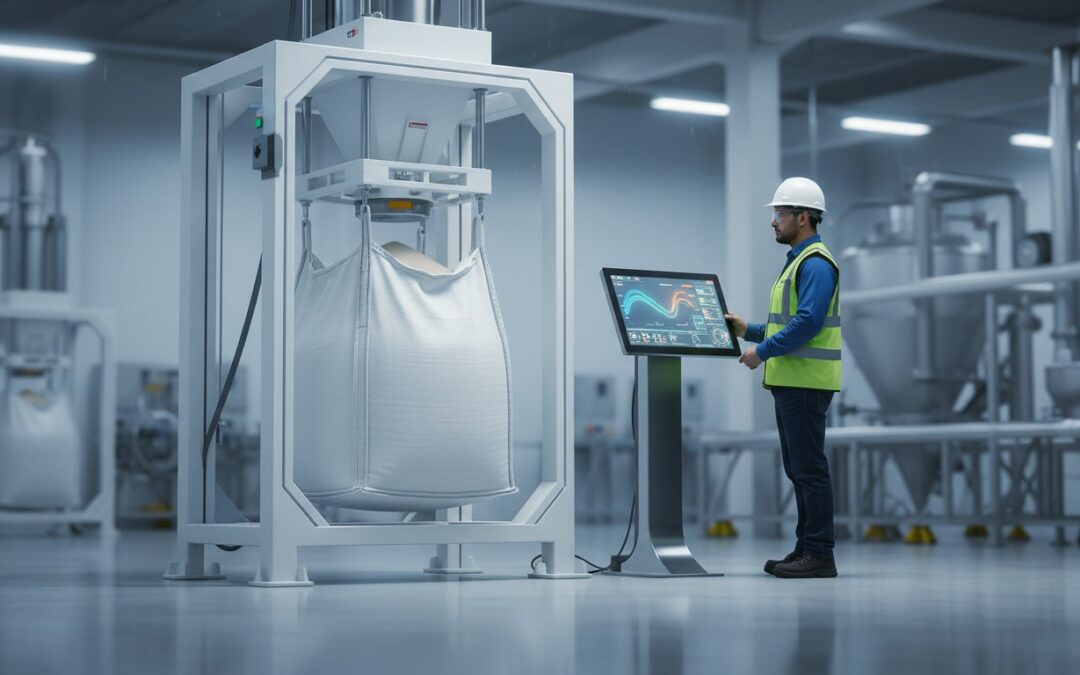
A bulk bag filler, also known as an FIBC filler or super sack filler, is a specialized piece of industrial equipment engineered for the high-speed, precision filling of bulk bags. These large, woven polypropylene bags, formally known as a Flexible Intermediate Bulk Container (FIBC), are the industry standard for transporting and storing dry, flowable products. The filler’s primary function is to securely hold the bag, accurately dispense a specified weight of material, and prepare it for transport, all while minimizing dust and product loss.
To see this equipment in action, the following video demonstrates a standard filling cycle:
For high-volume operations, this equipment is more than just a convenience-it is the heart of the bulk packaging line. Its reliability directly dictates production throughput and operational efficiency. Any downtime can create significant bottlenecks, making the selection of a durable, high-performance system a critical business decision that impacts your entire production process.
Common Industries and Materials Handled
These systems are indispensable across a wide range of sectors due to their versatility and efficiency. Key industries include agriculture (seeds, grains), food processing (flour, sugar), chemicals (resins, fertilizers), minerals (sand, cement), and construction. The design of each filler is heavily influenced by the material’s characteristics-such as flowability, density, and abrasiveness-to ensure optimal performance and equipment longevity.
The Business Case: Key Benefits of a Dedicated Filler
Investing in a dedicated filling system provides a clear and compelling return. Compared to manual or semi-automated methods, a purpose-built filler delivers significant operational advantages:
-
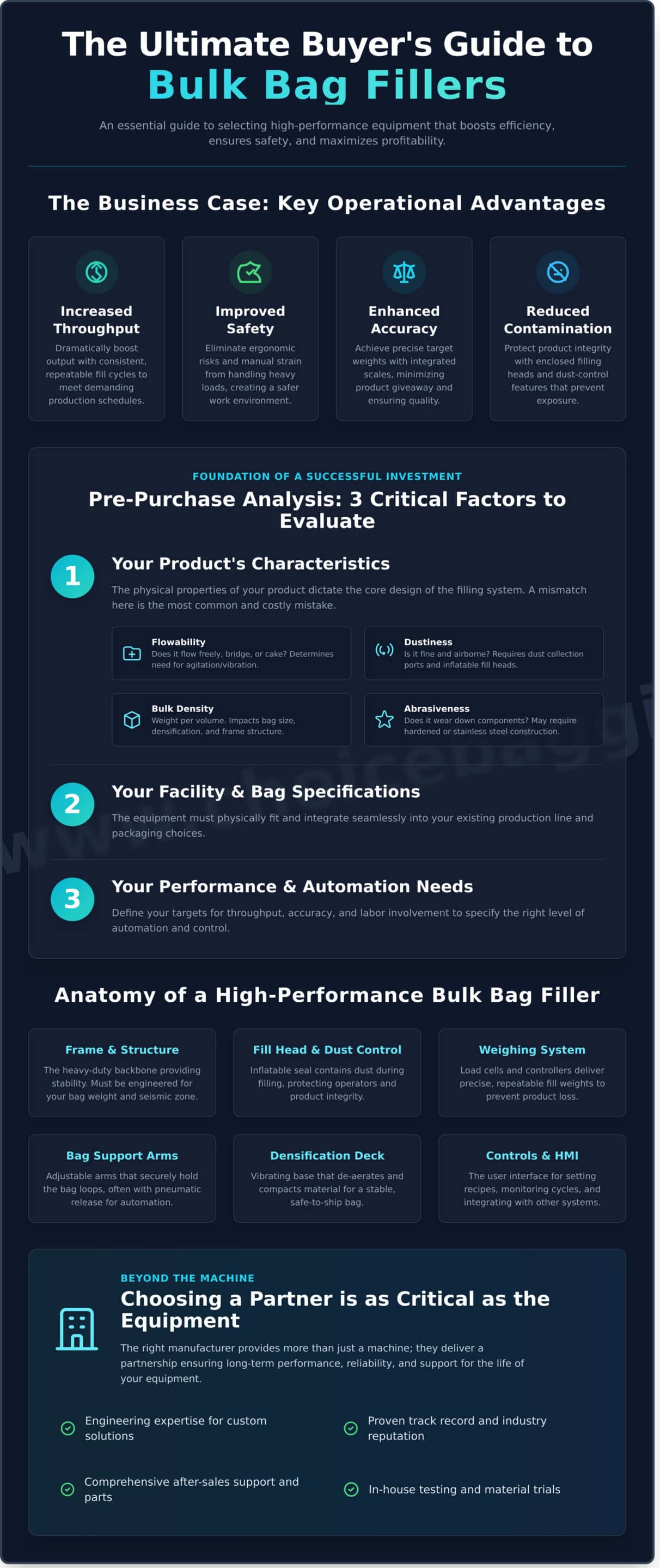
Increased Throughput: Fill more bags per hour with consistent, repeatable cycles, dramatically boosting output and meeting demanding production schedules.
-
Improved Safety: Eliminate the ergonomic risks and manual strain associated with handling heavy loads, creating a safer work environment for operators.
-
Enhanced Accuracy: Utilize integrated scales and controls to achieve precise target weights, minimizing costly product giveaway and ensuring consistent quality.
-
Reduced Contamination: Enclosed filling heads and dust-control features protect product integrity by preventing exposure to airborne contaminants.
Pre-Purchase Analysis: 3 Factors to Evaluate Before You Buy
Investing in a high-volume bagging system is a significant capital expenditure. The most common and costly mistake is selecting a machine based on price alone, without a thorough analysis of your specific operational needs. The best bulk bag filler is not a standard model; it is a system engineered to handle your product, fit within your facility, and meet your performance targets. This pre-purchase evaluation is the foundation of a successful investment, ensuring you acquire equipment that delivers unmatched reliability and efficiency from day one.
1. Your Product’s Characteristics
The physical properties of your product dictate the core design of the filling system. Before you can specify a machine, you must have precise data on what you are bagging. Answering these questions is the critical first step:
-
Flowability: Does your product flow freely like sand, or does it tend to bridge, cake, or clump? Materials with poor flow characteristics often require specialized agitation or vibration systems to ensure a consistent and complete fill.
-
Dustiness: Is your material fine and prone to creating airborne dust? If so, dust control and containment become a primary safety and operational concern, requiring inflatable fill heads, dust collection ports, or even a fully enclosed system.
-
Bulk Density: How much does your product weigh per cubic foot (or meter)? This directly impacts the required bag size, densification methods, and the structural integrity of the entire filling frame.
-
Abrasiveness/Corrosiveness: Will the material wear down or corrode standard components? Highly abrasive or corrosive products demand construction with hardened steel, stainless steel, or special coatings to ensure equipment durability.
2. Your Facility and Bag Specifications
Your equipment must integrate seamlessly into your existing workflow and physical plant. A system that doesn’t fit-either physically or operationally-will create bottlenecks and undermine performance. Consider your environment from end to end:
-
Available Footprint: What are the exact width, depth, and overhead ceiling height limitations in the installation area?
-
Bag Specifications: Document the size, type (e.g., Type A, B, C, D), and loop style of the FIBCs you currently use or plan to use. Following guidelines from industry authorities like the Flexible Intermediate Bulk Container Association (FIBCA) can help ensure bag consistency and safe handling.
-
Upstream & Downstream Processes: How is product delivered to the filler (e.g., screw conveyor, pneumatic line, gravity feed)? How will filled bags be removed (e.g., forklift, roller conveyor)? The filler must be designed to connect efficiently with this equipment.
3. Your Performance and Operational Goals
Finally, define what success looks like. Your operational targets determine the level of automation and the specific technology needed for your bulk bag filler. Clear goals prevent over-engineering or under-performance.
-
Required Fill Rate: How many bags must be filled per hour or per shift to meet production demands?
-
Weight Accuracy: What is the acceptable weight tolerance (e.g., +/- 1 lb)? High-accuracy requirements necessitate sophisticated load cell and control systems.
-
Labor Requirements: How many operators do you plan to allocate to the bagging line? This will influence the need for features like automatic bag loop release and pallet dispensers.
-
Future Needs: Do you anticipate bagging different products or using different bag sizes in the future? A system designed with flexibility in mind can adapt to your company’s growth.
Anatomy of a Bulk Bag Filler: Core Components and Options
A high-performance bulk bag filler is more than just a frame and a chute; it is a system of integrated components engineered to meet specific operational demands. The configuration of your machine directly impacts its efficiency, safety, and reliability. Understanding these core components and their available options is the first step in specifying a filler that aligns perfectly with the production goals identified in your operational analysis.
Frame and Support Structure
The foundation of any filler is its frame, which must provide uncompromising stability and structural integrity. Designs typically include two-post configurations for easy forklift access or four-post designs for maximum rigidity, especially with heavy loads or integrated densification systems. For operational flexibility, adjustable height frames accommodate a wide range of bag sizes. Material choice is critical: rugged carbon steel is ideal for industrial applications, while stainless steel construction is essential for food-grade, pharmaceutical, or corrosive environments. See durable designs in our range of bulk bag fillers.
Fill Head and Bag Spout Interface
The fill head is the critical point of transfer, designed to channel product cleanly into the bag while controlling dust. The most effective systems use an inflatable spout seal, which creates a dust-tight connection around the bag’s inlet spout. This prevents product loss and maintains a safe, clean work environment. Additional options further enhance performance:
-
Liner Inflators: A fan inflates the bag’s inner liner before filling, ensuring it forms properly to accept material without trapping or tearing.
-
Vent Ports: These ports allow displaced air and fine dust particles to be drawn out of the bag during the fill cycle and routed to a dust collection system.
Bag Loop Hangers and Support Arms
Safely and securely holding the bulk bag during filling is the primary function of the loop hangers. Entry-level systems may use simple manual hangers, but for high-throughput or ergonomic-focused applications, automated options provide significant advantages. Pneumatically retracting hangers automatically release the bag loops once the fill cycle is complete, minimizing operator intervention and speeding up bag changes. These systems improve safety by creating a repeatable, secure process that aligns with industry best practices like the FIBC Safe Handling Guidelines and reduces physical strain on operators.
Achieving Accuracy and Stability: Weighing and Densification
In high-volume operations, every gram of product and every inch of transport space impacts your bottom line. Precision and load stability are not just operational goals; they are critical for profitability and safety. An advanced bulk bag filler system achieves this through two core technologies: integrated weighing systems for pinpoint accuracy and product densification decks for creating safe, stable loads. Together, these features deliver unmatched reliability, reduce product loss, and significantly lower transport costs.
Integrated Weighing Systems
At the heart of an accurate filling system are high-performance load cells. These sensors provide precise, real-time weight measurement throughout the fill cycle using a gain-in-weight (GIW) principle. To achieve exceptional accuracy, our controls utilize a two-stage bulk and dribble feed cycle. The system first fills the bag rapidly to near its target weight (bulk feed), then automatically switches to a slower, controlled flow (dribble feed) to top it off precisely. This process eliminates costly overfills and ensures consistent product delivery. For applications requiring certified accuracy for commerce, many systems can be equipped with NTEP-certified components for legal-for-trade weighing.
Product Densification Decks
A product densification deck is a vibrating platform built into the bulk bag filler‘s base. By vibrating the bag during or immediately after the fill cycle, it removes air pockets and settles the material, transforming a loose, rounded bag into a compact and stable cube. This is especially crucial for aerated materials like powders and fine granules that trap air during filling. The benefits are direct and substantial:
-
Enhanced Safety: A flat-topped, stable bag is safer to handle, stack, and transport, reducing the risk of shifting loads.
-
Reduced Bag Costs: By compacting the product, you can often use a smaller, less expensive bag to hold the same weight.
-
Lower Shipping Costs: Denser, squarer bags maximize space on pallets and in trucks, allowing you to ship more product in fewer loads.
Automation and System Integration for Maximum Throughput
A high-performance bulk bag filler is the core of your packaging operation, but its true potential is only realized when it functions as part of a larger, integrated system. To achieve maximum throughput and efficiency, leading manufacturers connect their filling equipment with automated handling systems. This approach reduces manual touchpoints, minimizes the risk of operator error, and eliminates the bottlenecks that slow down production.
At Choice Bagging Equipment, we understand that a complete system is a significant investment. That is why our solutions are designed for scalability. You can begin with a dependable, high-quality bulk bag filler and seamlessly add automation components like conveyors and palletizers as your production demands grow. We partner with you to build a system that meets your needs today and expands for your success tomorrow.
Integrating Conveyors for Bag Handling
Automated conveyors are the essential link for moving bags and pallets efficiently. They automatically transport empty pallets to the filling station and move filled, heavy bags away for staging or palletizing. Roller conveyors are ideal for handling pallets with stable, flat bottoms, while chain conveyors provide robust support for less uniform pallets. For a truly hands-off operation, an automatic pallet dispenser can be integrated to feed pallets into the line, ensuring your filler is never waiting.
Explore options for bag handling conveyors to design a reliable and efficient workflow.
The Final Step: Robotic Palletizing
For the highest level of speed and precision, a robotic palletizer provides the ultimate end-of-line solution. These systems automatically lift and stack filled bulk bags onto a pallet according to a pre-programmed pattern, operating continuously with unmatched accuracy. Integrating a robotic palletizer delivers significant operational advantages:
-
Increased Speed: Robots work faster and longer than manual labor, dramatically increasing line throughput.
-
Enhanced Operator Safety: Automating the heavy lifting of bulk bags removes the primary cause of musculoskeletal injuries in a packaging environment.
-
Perfect Consistency: Every pallet is stacked with precision for superior load stability, making them safer to wrap, store, and transport.
Learn more about our robotic palletizing systems and how they can complete your automated packaging line. Contact the experts at Choice Bagging Equipment to discuss a complete, integrated solution built for performance and reliability.
Choosing a Partner: What to Look for in a Manufacturer
Selecting a bulk bag filler system is a significant capital investment. The performance of the machine is critical, but the quality of the manufacturer behind it is what determines your long-term success. Focusing solely on the initial price tag can lead to higher operational costs, unexpected downtime, and a shorter equipment lifespan. A true manufacturing partner delivers value that extends far beyond the equipment itself, ensuring reliability and performance for decades to come.
When evaluating potential suppliers, consider these essential criteria to identify a partner committed to your operational efficiency and long-term return on investment.
Engineering Expertise and Customization
Your product and process are unique. A premier manufacturer acts as an engineering consultant, working to understand your material’s flow characteristics and your facility’s specific constraints. They should offer application testing to prove performance with your actual product and be capable of customizing a bulk bag filler to integrate seamlessly into your existing line. This collaborative approach ensures you get the right solution, not just an off-the-shelf machine.
American-Made Quality and Durability
The physical construction of your equipment directly impacts its reliability and service life. Look for systems built with heavy-duty, American-sourced steel and high-quality components. Equipment manufactured in the USA not only adheres to rigorous quality standards but also provides you with faster access to the engineering and support resources behind its construction. An investment in durability is an investment in uninterrupted production for decades.
After-Sale Support and Parts Availability
Even the most robust machinery requires maintenance and support. Before committing, ask about technical support response times and the availability of common spare parts. A dependable partner understands that downtime costs you money and maintains a ready inventory to keep your operations running. Their support should last for the life of the machine, because true partnerships don’t end at installation. Understand the value of dependable field service and ensure your supplier can deliver it.
Choosing the right manufacturer is a strategic decision that protects your investment and secures your production future. At Choice Bagging Equipment, we have built our reputation since 1978 by being more than a supplier-we are your partner in performance and reliability. Contact our experts today to discuss a solution engineered to last.
Invest with Confidence: Your Next Steps to Packaging Efficiency
Selecting the right equipment is a critical decision that directly impacts your operational efficiency and long-term profitability. The key to success lies not just in the machine itself, but in a thorough pre-purchase analysis of your product, facility, and throughput goals. By focusing on core components, weighing accuracy, and the potential for system integration, you can ensure your investment delivers maximum performance and ROI.
Ultimately, the most important choice is your manufacturing partner. As your trusted partner in packaging automation, Choice Bagging Equipment has been engineering and manufacturing reliable bagging solutions since 1978. Every piece of our equipment is proudly Made in the USA, built to provide decades of dependable service. We build more than machines; we build partnerships grounded in expertise and support.
Ready to find the ideal bulk bag filler for your application? Consult our experts to configure the right solution for your needs. ****
Frequently Asked Questions About Bulk Bag Fillers
How fast can a bulk bag filler operate?
The operational speed of a bulk bag filling system depends on the model, level of automation, and your specific product characteristics. Typically, systems can fill anywhere from 10 to over 40 bags per hour. Factors like material flow rate, bag size, and required densification will influence the final throughput. A well-designed system is engineered to maximize your operational efficiency while maintaining fill accuracy, ensuring a reliable and high-performance packaging process for your facility.
What is the typical cost of a bulk bag filling system?
The cost of a bulk bag filling system varies significantly based on its configuration and capabilities. Entry-level, manually operated systems can start in a lower price range, while fully automated systems with integrated conveyors, pallet dispensers, and high-accuracy controls represent a larger investment. Key cost factors include the materials of construction (e.g., carbon vs. stainless steel), safety features, and the degree of automation required. We provide detailed consultations to engineer a solution that fits your budget and performance goals.
What level of accuracy can I expect from a bulk bag filler?
High-performance bulk bag fillers deliver exceptional fill weight accuracy, typically within a range of +/- 0.5% to 1% of the target weight. This precision is achieved through integrated scale systems that use high-quality load cells and intelligent controllers. These systems often feature a two-stage fill cycle-a fast bulk fill followed by a slower dribble fill-to precisely hit the target weight. This level of accuracy is critical for minimizing product giveaway and ensuring consistent product quality.
How much operator involvement is required for a bulk bag filler?
The required level of operator involvement is directly tied to the system’s automation. A semi-automatic bulk bag filler requires an operator to hang the bag loops, connect the spout, and initiate the fill cycle. In contrast, a fully automated system can manage the entire process-from dispensing empty pallets and bags to conveying filled bags away for storage. We help you determine the right level of automation to balance your initial investment with long-term labor efficiency and production demands.
What is the difference between a bulk bag filler and a bulk bag unloader?
These two systems perform opposite functions within a material handling process. A bulk bag filler is designed to accurately and efficiently fill an empty bulk bag (or FIBC) with your product for storage or shipment. Its primary purpose is packaging. Conversely, a bulk bag unloader, also known as a discharger, is designed to safely and effectively empty a full bulk bag, discharging its contents into your downstream production process, such as a mixer or conveyor.
What are the main safety features to look for on a bulk bag filler?
A safe and reliable bulk bag filler should include several key features to protect your personnel and facility. Look for a dust-tight fill head to contain airborne particles during the filling process. Other essential features include secure, adjustable bag loop retainers to prevent bag drops, safety interlocks on any access gates or doors, and clearly marked emergency stop controls. These components are fundamental to ensuring a safe and compliant high-volume packaging operation.
Recent Comments