
Selecting the right packaging machinery is more than a purchase; it is a critical capital investment that will define your production efficiency for years to come. The market is crowded with options, technical specifications can be complex, and the fear of choosing an unreliable company is a valid concern. This decision carries the weight of your operational success, making a confident and well-informed choice absolutely essential for long-term performance.
To navigate this complex landscape, you need a clear, strategic approach. Evaluating potential packaging machinery manufacturers goes far beyond comparing initial costs; it requires a deep assessment of engineering quality, durability, and the manufacturer’s commitment to post-sale support. The goal is to find not just a supplier, but a true partner dedicated to your reliability and growth.
This buyer’s guide provides the framework you need to invest confidently. We will outline the essential criteria for thoroughly evaluating manufacturers, helping you justify your investment and select a partner who will deliver unmatched reliability and support for decades to come.
Key Takeaways
- Learn to distinguish between OEMs, integrators, and distributors to ensure you select the right type of supplier for your specific project requirements.
- Move beyond price to evaluate a manufacturer’s engineering depth, build quality, and proven history to assess the true long-term value of your investment.
- Effective evaluation of packaging machinery manufacturers begins with a detailed project specification to ensure accurate quotes and a successful long-term partnership.
- Identify the key indicators that signal when your application demands the focused expertise and superior performance of a niche specialist over a generalist supplier.
Understanding the Landscape of Packaging Machinery Manufacturers
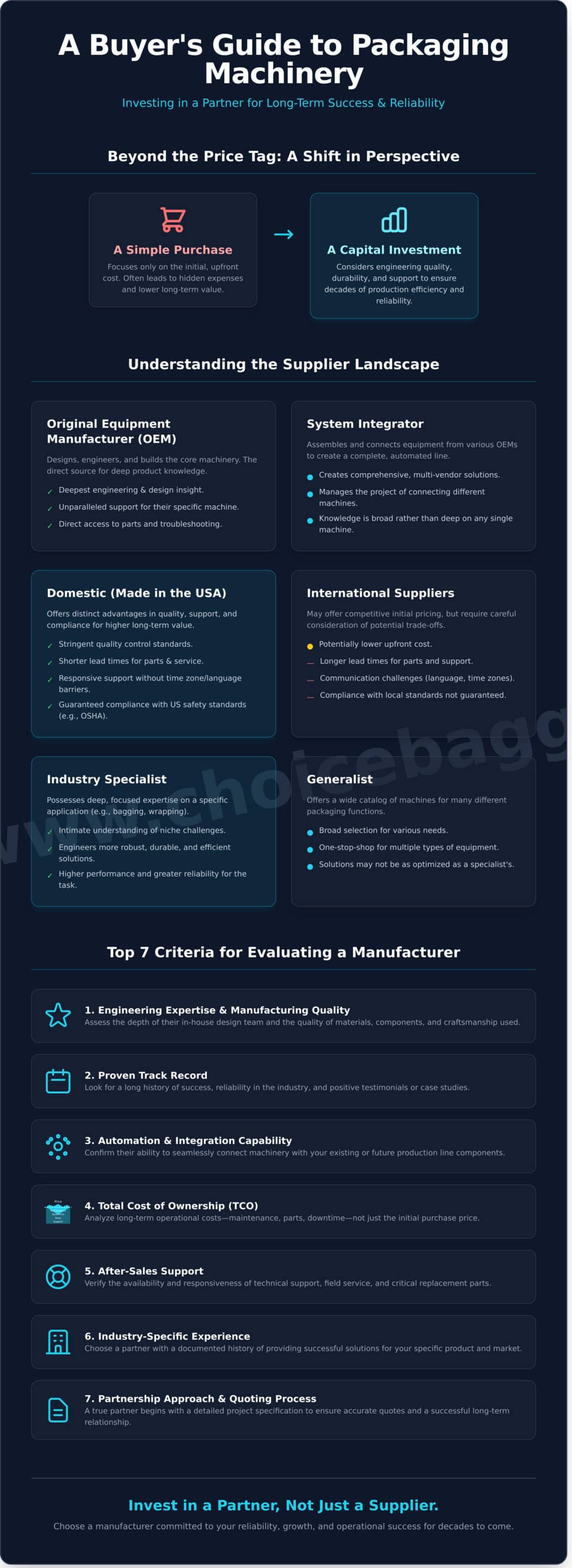
Selecting the right partner for your packaging needs is a critical business decision that extends far beyond a simple price comparison. To invest confidently, you must first understand the different types of suppliers in the market. The world of packaging machinery is diverse, and a well-informed choice ensures your production line achieves maximum efficiency, reliability, and long-term performance. The most successful operations are built on strong partnerships with manufacturers who align with their specific operational and strategic goals.
To see how a manufacturer guides a buyer through equipment selection, watch this helpful overview:
OEMs vs. System Integrators: Who Does What?
Original Equipment Manufacturers (OEMs) are the companies that design, engineer, and build the core machinery. When you work directly with an OEM, you gain access to the deepest level of product knowledge, from initial design intent to troubleshooting and parts. System integrators, on the other hand, assemble and connect equipment from various OEMs to create a complete, automated packaging line. For standalone equipment or deep expertise on a specific machine, an OEM is your direct source for unparalleled support and engineering insight.
Domestic (Made in the USA) vs. International Suppliers
Choosing between domestic and international packaging machinery manufacturers carries significant strategic weight. While global suppliers may offer competitive pricing, Made in the USA partners provide distinct advantages that translate to higher long-term value:
- Quality and Accessibility: US-based manufacturers often adhere to stringent quality control standards and offer dramatically shorter lead times for critical spare parts and service.
- Superior Support: Direct communication without language barriers or significant time zone delays ensures that support is responsive and effective when you need it most.
- Guaranteed Compliance: Equipment built in the USA is designed from the ground up to meet domestic safety and operational standards, such as those from OSHA.
Industry Specialists vs. Generalists
Some manufacturers are generalists, offering a wide catalog of machines for nearly every packaging function. Others are specialists, focusing their expertise on a specific application like bagging, wrapping, or cartoning. A specialist possesses an intimate understanding of the unique challenges of their niche. This deep focus allows them to engineer more robust, durable, and efficient solutions purpose-built for a specific task, resulting in higher performance and greater reliability for your operation.
Top 7 Criteria for Evaluating a Packaging Machinery Manufacturer
Selecting the right partner from a field of packaging machinery manufacturers requires looking beyond the initial price tag. A lower upfront cost can often conceal future expenses from downtime, maintenance, and inefficiency. A superior manufacturer delivers long-term value through robust engineering, quality construction, and a proven history of reliability. True partnership means investing in durable equipment designed for decades of performance and a team capable of providing a complete, integrated solution. Use this checklist to build a shortlist of qualified candidates who will strengthen your production line.
- Engineering Expertise: The depth and experience of their in-house design and engineering team.
- Manufacturing Quality: The materials, components, and craftsmanship used in every machine.
- Proven Track Record: A long history of success and reliability in the industry.
- Automation and Integration: The ability to seamlessly connect with your existing production line.
- Total Cost of Ownership (TCO): An analysis of long-term operational costs, not just the purchase price.
- After-Sales Support: The availability of technical support, service, and replacement parts.
- Industry-Specific Experience: A documented history of providing solutions for your specific product and market.
Focus on these key areas to identify a manufacturer who is not just a vendor, but a long-term partner in your success.
1. Engineering Expertise and Customization Capability
A premier manufacturer employs a seasoned in-house engineering team, not just a sales force. Assess their ability to understand your unique challenges, from non-standard product sizes to specific facility constraints. The right partner will not offer a one-size-fits-all machine but will consult with you to design, engineer, and build a tailored solution that directly addresses your operational needs and goals, ensuring optimal performance and efficiency from day one.
2. Manufacturing Quality and Materials
The durability of packaging machinery begins with high-quality materials and superior craftsmanship. Inquire about the specifics, such as the use of heavy-gauge steel for frames and food-grade stainless steel for contact surfaces. Inspect their equipment for signs of quality, including clean, precise welds and robust, industry-proven components. A “Made in the USA” stamp often signifies a commitment to higher material standards and build quality you can depend on for decades.
3. Proven Track Record and Reliability (Since 1978)
A manufacturer’s history is a direct indicator of their stability and the reliability of their equipment. A company with decades of experience has proven its ability to build durable machines and support its customers over the long term. Ask for case studies or references from your industry and look for affiliations with respected organizations like PMMI, The Association for Packaging and Processing Technologies, which uphold industry standards. A long track record provides confidence that the business and its equipment are built to last.
4. Automation and Integration Capabilities
Modern production lines require seamless communication between all systems. Evaluate a manufacturer’s expertise in integrating their machinery with your upstream and downstream equipment, from product infeed to final palletizing. Their team should be proficient in modern automation, including advanced solutions like robotic palletizing systems. Ensure their control systems and software are flexible and can be programmed to work in harmony with your existing line for truly unified operation.
Beyond the Machine: The Critical Role of Partnership and Support
When evaluating packaging machinery manufacturers, the initial purchase price is only one component of the total cost of ownership. The true value of your investment is revealed over years of operation, where uptime, efficiency, and reliability determine your profitability. A superior machine is only as good as the support structure behind it. Prioritizing manufacturers who act as long-term partners is essential for protecting your investment and minimizing costly downtime.
Long-term operational success depends on a manufacturer’s commitment to supporting your team long after the sale is complete. This partnership is built on three critical pillars: responsive service, accessible parts, and comprehensive training.
After-Sales Support and Field Service
A manufacturer’s commitment is demonstrated through their post-sale actions. Verify they provide on-site installation, commissioning, and initial operator training to ensure a smooth start-up. Inquire about the availability and responsiveness of their technicians. A dedicated field service team that can quickly diagnose and resolve issues is a clear sign of a dependable partner dedicated to keeping your production lines running.
Spare Parts Availability and Lead Times
Even the most durable equipment requires maintenance and eventual part replacement. A machine sitting idle waiting for a part is a significant drain on revenue. Ask potential manufacturers about their policy for stocking critical spare parts. Domestic manufacturers often provide a distinct advantage with faster and more reliable access to components, drastically reducing lead times. Easy access to replacement parts is non-negotiable for any serious production facility.
Comprehensive Training and Documentation
Empowering your team is one of the most effective ways to maximize equipment performance and longevity. Ensure the manufacturer provides detailed and easy-to-understand operator and maintenance manuals. Furthermore, a quality partner will offer training programs for your staff. Proper training ensures your team can operate equipment efficiently and safely, adhering to crucial guidelines like the OSHA machine guarding standards and performing routine maintenance that prevents major breakdowns.
Navigating the Quoting and Specification Process
A successful equipment investment begins long before a purchase order is signed. The quoting and specification phase is where project clarity is established. Providing detailed, accurate information to potential packaging machinery manufacturers ensures you receive proposals that align with your operational needs, preventing costly changes and delays down the line.
Defining Your Project Scope (The URS)
A User Requirement Specification (URS) is the foundational document for your project. It communicates your exact needs and performance expectations, eliminating guesswork for the engineering team. A comprehensive URS ensures the proposed machine is built for your specific application. Key details to include are:
- Product Characteristics: The material name, bulk density, flow properties, particle size, and any abrasive or corrosive nature.
- Bag Specifications: The bag type (e.g., open-mouth, valve), material of construction, dimensions, and required final fill weight.
- Performance Requirements: The target speed in bags per minute (BPM) and the required fill accuracy (e.g., +/- 0.5%).
- Environmental Factors: Any unique plant conditions, such as high dust levels, humidity, or stringent washdown protocols.
How to Interpret a Quote and Compare Apples-to-Apples
When comparing quotes from different suppliers, you must look beyond the final price. A lower initial cost can hide future expenses if critical components or services are excluded. Scrutinize the bill of materials for high-quality, reputable components (e.g., Allen-Bradley controls, SMC pneumatics). Compare materials of construction, warranty terms, and delivery timelines. Pay close attention to what is explicitly excluded, such as freight, installation supervision, or on-site commissioning and training.
Key Questions to Ask Before Signing a Contract
Before committing, asking targeted questions verifies alignment and demonstrates the manufacturer’s competence and transparency. This final due diligence step confirms their commitment to a smooth integration. We recommend asking:
- What does your standard Factory Acceptance Test (FAT) procedure involve?
- Who will be my dedicated project manager or single point of contact after the sale?
- Can you provide a final list of all utility requirements, including compressed air (CFM/PSI) and electrical needs (Voltage/Phase/Amps)?
A manufacturer who welcomes these questions is demonstrating their commitment to being more than a supplier-they are proving themselves as a long-term partner. Investing this time upfront ensures the reliability and performance you expect from your new equipment.
Finding Your Niche: When to Choose a Bagging Equipment Specialist
While many general packaging machinery manufacturers offer a wide catalog of equipment, their breadth can come at the cost of depth. For businesses with specific or challenging bagging requirements, partnering with a specialist is not a luxury-it is a strategic necessity. A focused manufacturer provides a level of engineering expertise and application knowledge that a generalist simply cannot match, ensuring your operation achieves maximum performance and reliability.
If your process involves difficult-to-handle products, frequent changeovers, or stringent accuracy demands, it’s a clear sign that you need a specialist. These partners can anticipate and solve complex challenges that others may not even recognize, preventing costly downtime and production inefficiencies before they start.
Why Specialization Matters for Bagging Operations
Bagging fine powders, abrasive minerals, or inconsistent granules requires technology designed for those specific conditions. A specialist understands the critical nuances of product flow, dust control, and consistent weight accuracy. They engineer machines like high-performance valve bag fillers to overcome material challenges, delivering equipment that is purpose-built for your product, not just adapted for it.
Industries That Benefit from Specialized Equipment
A dedicated bagging equipment partner ensures your machinery not only performs efficiently but also complies with all industry-specific standards. Key sectors that see significant returns from specialized solutions include:
- Building Materials: Handling abrasive products like cement and grout requires durable, dust-tight systems built for harsh environments.
- Minerals & Chemicals: Precision and safety are paramount when bagging valuable or hazardous materials, demanding specialized filling and containment technology.
- Agriculture & Food: Specialists provide sanitary, food-grade equipment designed for accurate weighing of seeds, feeds, and ingredients to meet regulatory and quality standards.
The Result: Higher Efficiency and Lower Product Waste
The ultimate benefit of working with a bagging specialist is a direct impact on your bottom line. Equipment that is correctly specified for your application leads to faster, more accurate, and more reliable filling cycles. This precision dramatically reduces product giveaway and minimizes waste, ensuring higher operational efficiency and a stronger return on your investment. When you choose an expert, you are investing in a proven solution for your packaging line.
Ready to improve your bagging performance? Discuss your application with our bagging experts.
Making the Right Choice: Your Partner in Packaging
Selecting the right equipment is a critical investment in your operational efficiency. As this guide has shown, the process goes far beyond comparing technical specifications. Your decision should be based on a foundation of partnership, proven reliability, and dedicated post-sale support. The best packaging machinery manufacturers distinguish themselves not by flashy promises, but by the long-term performance and expert service they guarantee. This commitment is the true measure of value and the key to a successful, lasting investment.
At Choice Bagging Equipment, we deliver on that commitment. We have been manufacturing reliable equipment, proudly Made in the USA, since 1978. Our dedicated in-house engineering and service teams are not just suppliers; they are your long-term partners, ensuring you receive a durable, high-performance solution tailored to your exact needs. We don’t just sell equipment-we deliver confidence.
Ready to invest in a solution built to last? Contact our engineers to find the right equipment for your needs. Let’s build a more efficient future for your operation together.
Frequently Asked Questions
What is the difference between a packaging machinery manufacturer and a distributor?
A manufacturer designs, engineers, and builds the equipment in-house, offering deep technical expertise and direct support. A distributor is a third-party reseller that represents multiple brands. Partnering directly with a manufacturer ensures you receive a solution tailored to your exact needs, backed by the engineers who designed it. This direct relationship guarantees superior service, parts availability, and long-term performance for your investment.
How important is ‘Made in the USA’ for industrial machinery?
“Made in the USA” is a hallmark of quality, durability, and stringent manufacturing standards. It signifies the use of high-grade materials and expert craftsmanship, resulting in dependable machinery built to perform for decades. For your operations, it also means a secure supply chain, faster access to domestic parts and support, and the assurance that your equipment is engineered for reliability, minimizing costly downtime and maximizing your production efficiency.
What is a typical lead time for custom packaging equipment?
Lead times for custom-engineered packaging machinery typically range from 12 to 20 weeks after the final design is approved. This schedule allows for meticulous engineering, procurement of high-quality components, precision fabrication, assembly, and rigorous pre-shipment testing. A trustworthy manufacturing partner will provide a clear, transparent timeline to ensure your equipment is delivered on schedule and meets all performance requirements from day one.
Should I consider buying new or used packaging machinery?
New machinery provides unmatched performance, the latest technology, and a comprehensive manufacturer’s warranty, ensuring long-term reliability and peace of mind. While used equipment may have a lower initial price, it often carries risks like an unknown operational history, lack of support, and potential for unexpected downtime. Investing in new equipment is an investment in guaranteed efficiency, modern safety features, and a dedicated support partnership.
How do I calculate the return on investment (ROI) for a new packaging machine?
To calculate ROI, divide the net profit generated by the machine by its total cost. Net profit includes measurable gains like reduced labor costs, increased throughput (e.g., bags per minute), and minimized product waste due to higher accuracy. For example, if a machine costs $150,000 and generates $75,000 in annual savings and efficiency gains, it has a two-year payback period and delivers a significant, measurable return.
What is a Factory Acceptance Test (FAT) and why is it important?
A Factory Acceptance Test (FAT) is a final verification process where you witness your machine operate with your specific products at the manufacturer’s facility before shipment. This critical step confirms that the equipment meets all agreed-upon performance specifications and functional requirements. An FAT is essential for identifying and addressing any issues beforehand, ensuring a seamless installation and rapid startup at your plant.
Can a single manufacturer provide a complete bagging and palletizing line?
Yes, experienced packaging machinery manufacturers can design, build, and integrate a complete, turnkey line from bagging to palletizing. A single-source solution ensures all components communicate and function together seamlessly, from the bag filler and sealer to the conveyor and robotic palletizer. This approach simplifies project management, guarantees system-wide performance, and provides one point of contact for all your support and service needs.
Recent Comments