

Manual bagging operations are often the source of production bottlenecks, leading to inconsistent weights, safety concerns, and costly product giveaway. Transitioning to an automated system is a critical step toward greater efficiency, but selecting the right open mouth bag filler can be a complex decision. How do you match a machine to your product’s unique flow characteristics while ensuring durability and performance?
This comprehensive guide is designed to provide the clarity you need. We will explore the different types of open mouth bagging systems, from gross weigh to net weigh fillers, and detail the key factors to consider for your specific application. Our goal is to equip you with the knowledge to invest confidently in a solution that enhances throughput, guarantees weighing accuracy, and seamlessly integrates into your existing production line. Consider us your partner in building a more reliable and profitable packaging operation.
Key Takeaways
-
Learn how to select the correct feeding mechanism based on your product’s unique characteristics to guarantee optimal filling accuracy and performance.
-
Determine the right level of automation for your operation by evaluating your production volume, budget, and long-term efficiency goals.
-
Confidently select the right open mouth bag filler by using a comprehensive pre-purchase checklist covering everything from product flow to bag type.
-
Discover why successful packaging depends on integrating the filler with upstream and downstream equipment to create a seamless, efficient bagging line.
Table of Contents
-
What is an Open Mouth Bag Filler? Core Principles & Applications
-
Choosing Your Level of Automation: Manual to Fully Automatic
What is an Open Mouth Bag Filler? Core Principles & Applications
An open mouth bag filler is a versatile and highly reliable industrial packaging machine engineered to accurately weigh and dispense free-flowing to semi-free-flowing bulk products into pre-made bags. Its core function is to ensure precise product measurement and efficient filling, making it an essential component in packaging lines across numerous industries. This equipment is designed for exceptional adaptability, handling a wide array of bag materials including paper, polyethylene (poly), and poly-woven bags of various sizes.
To see this process in action, the video below demonstrates the straightforward and dependable operation of a typical gross weigh filler :
The Basic Bagging Cycle: How It Works
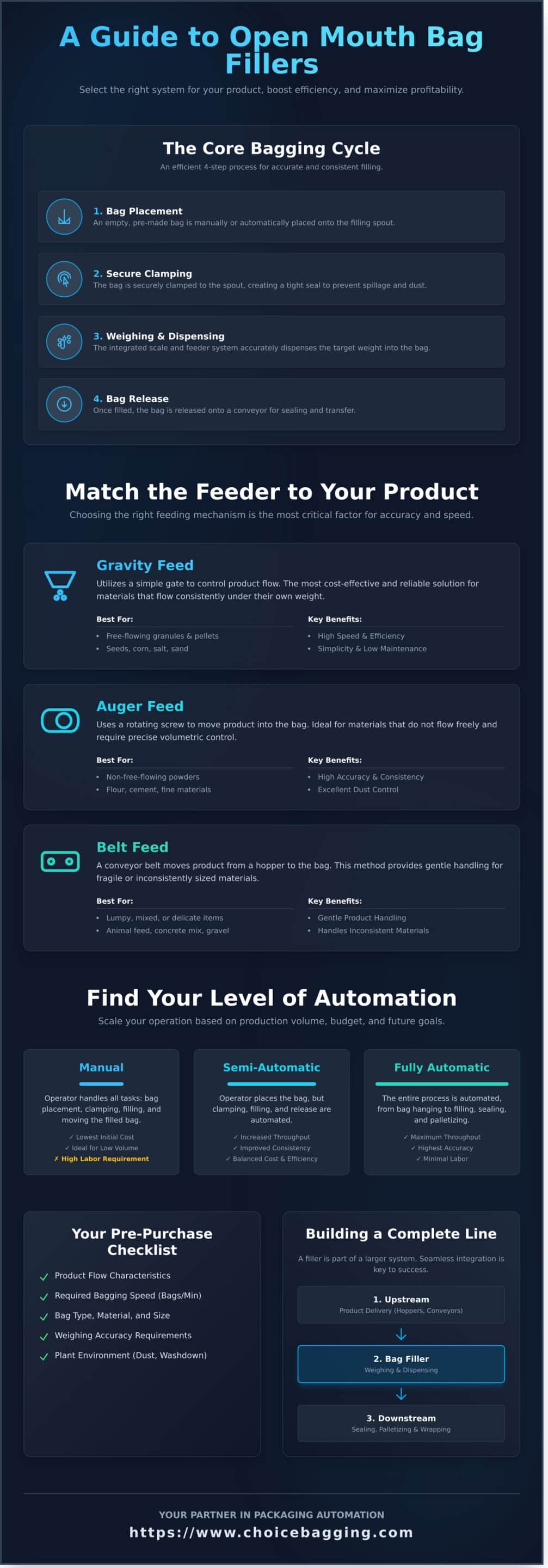
The operational sequence of an open mouth bag filler is designed for efficiency and simplicity, whether operated manually or integrated into an automated system. The cycle consists of four primary steps:
-
Bag Placement: An empty, pre-made bag is placed onto the filling spout.
-
Secure Clamping: The bag is securely clamped to the spout, creating a tight seal to prevent product spillage and dust emission.
-
Weighing & Dispensing: The integrated scale and feeder system accurately weighs the product and dispenses the target amount directly into the bag.
-
Bag Release: Once filled, the bag is released from the spout, typically onto a conveyor, to be transferred to the next station for sealing.
Open Mouth vs. Valve Bag Fillers: A Critical Distinction
While there are many types of filling machines available, a fundamental choice in bagging is between open mouth and valve systems. Open mouth bags are filled through the open top and then sealed (e.g., sewn or heat-sealed). In contrast, valve bags are filled through a small, self-closing opening, or "valve," in the corner. Open mouth systems provide superior versatility, accommodating a wider range of bag types and closing methods, making them an excellent choice for applications requiring high-purity or airtight seals.
Common Industries and Products
The durability and adaptability of this equipment make it indispensable across a wide spectrum of industries. Common applications include:
-
Agriculture: Seeds, animal feed, fertilizers, corn, and grains.
-
Building Materials: Sand, concrete mix, gravel, plaster, and stucco.
-
Food & Ingredients: Flour, sugar, salt, spices, and bakery mixes.
-
Chemicals & Minerals: Plastic pellets, pigments, resins, and mineral powders.
Types of Open Mouth Fillers by Feeding Mechanism
The most critical component determining the accuracy and speed of your bagging operation is the feeding mechanism. An open mouth bag filler is only as effective as its feeder, and choosing the right one is entirely dependent on your product’s unique characteristics-its flow rate, density, and consistency. Mismatching the product and the feeder is a direct path to inefficiency, leading to inaccurate bag weights, product waste, and costly downtime.
To ensure optimal performance and reliability, it’s essential to understand how each primary feeder type operates. Here is a quick overview:
-
Feeder Type: Gravity Feed
Best For: Free-flowing granules & pellets
Key Benefit: Simplicity and high speed
-
Feeder Type: Auger Feed
Best For: Non-free-flowing powders & fine materials
Key Benefit: High accuracy and dust control
-
Feeder Type: Belt Feed
Best For: Lumpy, mixed, or delicate materials
Key Benefit: Gentle handling of inconsistent products
Gravity Feed Fillers: For Free-Flowing Pellets & Granules
The gravity feeder is the simplest design, utilizing a gate that opens and closes to control product flow from a surge hopper into the bag. This mechanism relies on the product’s ability to flow consistently under its own weight. It is an exceptionally reliable and cost-effective solution for materials like plastic pellets, whole grain corn, seeds, salt, and dry sand due to its minimal moving parts and low maintenance requirements.
Auger Feed Fillers: For Powders & Fine Materials
Designed for precision with non-free-flowing products, an auger feeder uses a rotating screw to push a consistent volume of material into the bag. This provides superior control over dusty and aerated products like flour, cement mix, cocoa powder, and fine chemicals. This precision is critical when filling materials into multiwall bags, a common choice for these industries as detailed by the Paper Shipping Sack Manufacturers’ Association. The enclosed auger also significantly minimizes ambient dust.
Belt Feed Fillers: For Lumpy or Mixed-Texture Products
When a product is lumpy, irregular, or a mix of different textures, a belt feeder provides the ideal solution. This type of open mouth bag filler uses a short, variable-speed conveyor belt to move product into the bag. This method offers gentle handling and is highly effective for materials that won’t flow well through a gravity gate or auger, such as soils, mulch, pet food with varied kibble sizes, and sweet feeds containing molasses.
Choosing Your Level of Automation: Manual to Fully Automatic
Selecting the right level of automation for your bagging line is a critical decision that directly impacts operational efficiency, labor costs, and output consistency. The ideal choice depends entirely on your specific production volume, budget, and long-term growth objectives. As operations scale, there is a natural progression from manual systems to fully automated solutions.
Increased automation not only boosts speed and accuracy but also significantly reduces the ergonomic risks associated with repetitive manual bagging tasks, protecting your most valuable asset: your team. Understanding the capabilities of each level ensures you invest confidently in a system built for your needs.
Manual Systems: For Low-Volume or Start-Up Operations
A manual open mouth bag filler requires an operator to place each empty bag on the spout, initiate the fill cycle, and remove the filled bag. This approach offers a low-cost entry point into precise, automated weighing, providing essential functionality without a large capital investment.
-
Workflow: Operator places bag, starts fill, and removes the bag.
-
Typical Speed: 1-6 bags per minute (BPM).
-
Best For: Operations bagging less than 50 tons per week or those with frequent product changeovers that demand flexibility.
Semi-Automatic Systems: The Balanced Approach
Semi-automatic systems represent a significant step up in performance and consistency. While an operator is still needed to place the empty bag on the fill spout, the machine takes over to clamp the bag, perform the fill cycle, and automatically release it onto a conveyor.
-
Workflow: Operator places the bag; filling and release are automated.
-
Typical Speed: 6-12 BPM.
-
Best For: Growing operations that need to increase throughput and weighing accuracy while reducing operator fatigue.
Fully Automatic Systems: For High-Volume Production
For maximum throughput and efficiency, a fully automatic open mouth bag filler manages the entire process. The machine automatically picks and places the bag, fills it to a precise weight, and transfers it to downstream equipment for sealing and stacking, requiring minimal operator oversight.
-
Workflow: Machine handles bag placement, filling, and transfer.
-
Typical Speed: Up to 20+ BPM.
-
Best For: Dedicated, high-volume production lines where speed and reliability are paramount. These systems integrate seamlessly with end-of-line solutions like robotic palletizing systems.
Key Factors to Consider Before Selecting a System
Selecting the right equipment is a critical investment in your operational efficiency. This section serves as your pre-purchase checklist, guiding you toward a confident and informed decision. A thorough evaluation of your specific needs ensures the system you choose will deliver reliable performance for years to come. Working with an experienced equipment partner to analyze these factors is the most effective way to prevent costly mistakes and avoid future production bottlenecks.
Production Rate & Weighing Accuracy
Your analysis should begin with two fundamental questions: What is your required production rate in bags per minute or hour, and what is your acceptable weight tolerance (+/- ounces or grams)? Pinpoint accuracy is crucial for profitability, as it minimizes product giveaway and ensures customer satisfaction. The choice between net weigh (product is weighed in a hopper before discharge) and gross weigh (product is weighed as it fills the bag) will also impact the speed and precision of your open mouth bag filler.
Bag Specifications: Material, Type, and Size
The machine must be engineered to handle the exact bags you use. Document all specifications to ensure a perfect fit and dependable performance. Key details include:
-
Bag Materials: Paper, polyethylene (poly), or woven polypropylene.
-
Bag Types: Pillow, gusseted, or pinch bottom open mouth bags.
-
Bag Dimensions: The full range of widths and lengths for all products.
Verifying that the machine’s bag spout and clamping mechanism are compatible with these specifications is essential for consistent and trouble-free operation.
Product Characteristics & Plant Environment
The nature of your product directly influences machine design. Analyze its flowability, density, and potential for abrasiveness to determine the correct feeder type. For fine or dusty materials, effective dust control is a priority for worker safety and plant cleanliness. Additionally, consider if your operating environment requires special construction, such as stainless steel for corrosive materials or a full washdown-rated design for sanitary applications. To simplify this process, use our Bagger Professor tool to find a match for your specific product.
Building a Complete Bagging Line: Integration is Key
Selecting the right open mouth bag filler is a critical first step, but it is only one component of a high-performance packaging operation. To achieve maximum efficiency, reliability, and throughput, each piece of equipment must be integrated into a seamless system. A well-designed bagging line considers the entire process flow, from the moment a product enters the filler to when the finished pallet is ready for shipment.
At Choice Bagging Equipment, we are more than just a manufacturer; we are your partner in engineering a complete, optimized solution. We provide the expert support needed to ensure every machine works in perfect concert.
Bag Closing & Sealing Equipment
Once a bag is accurately filled, it must be securely closed to protect the product. The ideal method depends on your bag material and operational needs. Common choices include industrial sewing for multi-wall paper or polywoven bags and heat sealing for polyethylene bags. We build robust bag sewing machine systems designed for durability and consistent, high-quality closures in demanding production environments.
Conveying and Bag Handling
Filled bags are often heavy and require automated transport to maintain line speed and ensure worker safety. A bag conveyor is essential for moving bags from the filler to the closing station. More advanced systems can also be used to turn, flatten, or condition the bag, preparing it for a stable and consistent stack on the pallet. View our range of durable bag handling conveyors built to withstand years of rigorous use.
End-of-Line Palletizing and Wrapping
The final stage of automation is stacking and securing your bags for transport. Robotic palletizers deliver unmatched speed, precision, and consistency, safely building perfect pallet loads shift after shift. Once stacked, an automated stretch wrapper tightly secures the pallet, ensuring load stability for storage and shipping. This end-of-line automation completes the system, transforming your packaging process into a highly efficient, reliable operation.
A properly integrated system built around your open mouth bag filler minimizes downtime, reduces labor costs, and maximizes your return on investment. Contact Choice Bagging Equipment today to discuss how we can help you build a complete, high-performance bagging line.
Your Partner in High-Performance Bagging Solutions
Selecting the right bagging equipment is a critical investment in your operational efficiency. As we’ve explored, understanding the core differences between feeding mechanisms and choosing the appropriate level of automation are fundamental to building a system that meets your production goals. True success, however, comes from integrating each component into a seamless, high-performance bagging line.
This is where expertise makes the difference. Since 1978, Choice Bagging Equipment has manufactured reliable, high-quality systems right here in the USA. We don’t just sell machines; we partner with you to engineer a complete solution. Our durable equipment is built to provide decades of service, and our expert engineering team ensures your new open mouth bag filler integrates perfectly with your existing production line for maximum performance.
Invest confidently in a solution designed for reliability and longevity. Take the next step toward optimizing your packaging process. Request a Quote to Configure Your Open Mouth Bagging System and let our specialists design a system that works for you.
Frequently Asked Questions About Open Mouth Bagging Equipment
How much does an open mouth bag filler cost?
The cost of an open mouth bag filler varies based on the model, level of automation, and features required for your specific application. A basic machine represents a lower initial cost, while a fully automated system is a larger capital investment. We provide a detailed consultation to assess your product and production goals, ensuring you receive an accurate quote for a high-performance solution that delivers a strong return on investment and allows you to invest confidently.
What is the difference between net weigh and gross weigh filling?
Net weigh filling measures the product in a weigh hopper before it enters the bag, offering superior accuracy and higher speeds ideal for high-volume operations. In contrast, gross weigh filling measures the product as the bag is being filled. This method is simpler and more cost-effective, making it a reliable choice for applications where slight weight variations are acceptable and operational simplicity is a priority.
What kind of maintenance do these bagging machines require?
Our bagging machines are engineered for durability and unmatched reliability, requiring minimal routine maintenance. Standard preventative tasks include regular cleaning, lubrication of key components, and inspection of wear parts like spout seals. We design our equipment with fewer moving parts to reduce wear and potential downtime. We provide comprehensive manuals and dedicated partner support to ensure your equipment maintains peak performance for decades.
Can a single open mouth filler handle multiple products and bag sizes?
Absolutely. Versatility is a core design principle of our equipment. A single open mouth bagging machine can be engineered to handle a wide range of products and bag sizes with minimal changeover time. Features like adjustable bag clamps, interchangeable spouts, and programmable controls allow operators to quickly switch between different product densities and bag dimensions. This built-in flexibility ensures your machine adapts to evolving production demands.
How do you control dust when bagging fine powders?
Effective dust control is critical for safety and efficiency. Our systems incorporate several proven solutions, including a dust-tight filling spout with an inflatable collar that creates a secure seal on the bag. We also integrate dust collection ports that connect to your facility’s system, capturing fugitive dust at the source. These features ensure a cleaner, safer work environment and minimize product loss for maximum operational performance.
What is the typical lead time for a new bagging machine?
Our standard lead times typically range from 8 to 12 weeks, depending on the machine’s complexity and our current production schedule. Because every machine is Made In The USA and engineered to meet your specific requirements, this timeframe allows for meticulous assembly and rigorous quality control. We provide a precise delivery schedule upon finalizing your project specifications, ensuring a smooth and predictable integration process for our partners.
Recent Comments