
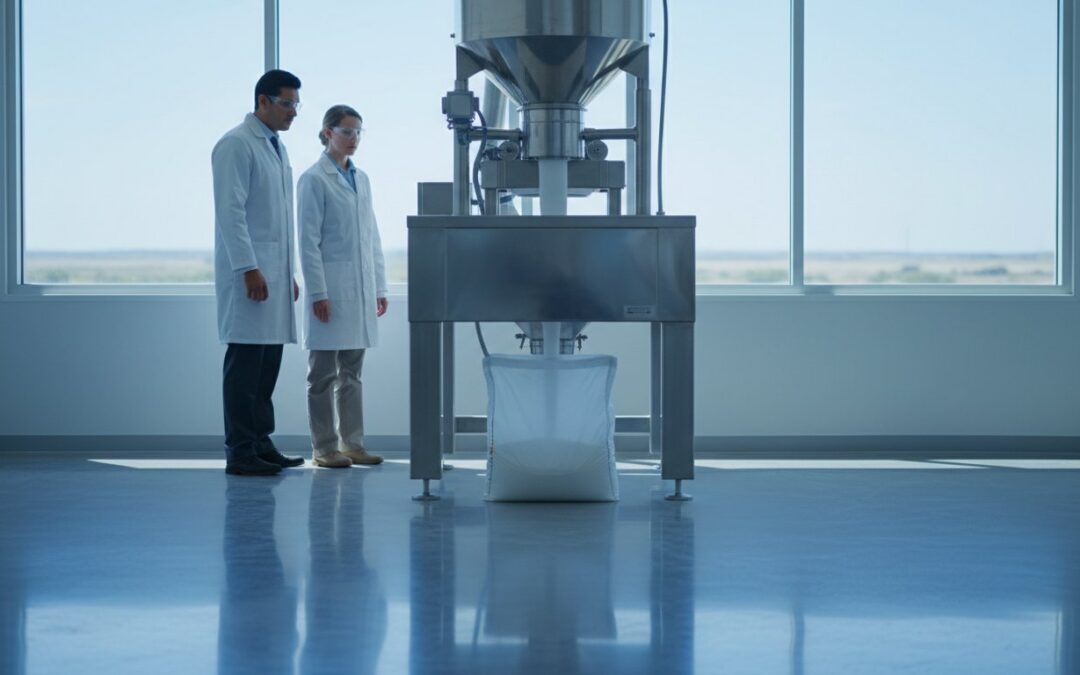
A single batch contamination event in 2026 can cost a mid-sized facility more than $150,000 in lost product and regulatory fines. You already know that strict FDA and USDA compliance is the only way to protect your brand, but the reality of four-hour cleaning windows and cross-contamination risks is a constant threat to your throughput. Selecting a high-performance sanitary grade powder bagger shouldn’t feel like a compromise between safety and speed. Since 1978, Choice Bagging Equipment has partnered with processors to turn these engineering hurdles into reliable, long-term operational wins.
This guide will help you master the technical requirements and selection criteria to identify a bagger that meets 3-A standards while reducing your cleaning time by as much as 50%. We’ll preview the latest innovations in zero-leakage containment and tool-less disassembly that keep your lines running at peak efficiency. If you need to narrow down your search, use our Bagger Professor online tool to find the right machine for your specific material and bag type. For personalized guidance on your next project, you can always reach out to us at our contact page to speak with an expert.
Key Takeaways
-
Learn to navigate FDA, USDA, and 3-A standards to ensure your packaging line meets the highest levels of hygienic compliance and safety.
-
Identify the critical engineering features of a sanitary grade powder bagger, including seamless construction and specialized seals that prevent product accumulation.
-
Evaluate the performance trade-offs between valve and open-mouth bagging systems to optimize dust control and ease of manual inspection.
-
Implement expert-level cleaning protocols, including CIP and COP methodologies, to maintain long-term operational efficiency and equipment durability.
-
Leverage our engineering expertise and use the Bagger Professor online tool to find the perfect bagging machine for your specific material and bag type.
Table of Contents
Understanding Sanitary Grade Standards for Powder Packaging
Investing in a sanitary grade powder bagger is about more than just moving product; it’s about protecting your consumers and your brand’s future. Since 1978, Choice Bagging Equipment has helped processors understand that "sanitary grade" isn’t a casual marketing term. It defines equipment engineered with non-toxic, non-absorbent materials and surfaces that are completely smooth and accessible. In high-stakes production, every surface that contacts the powder must be reachable for inspection and cleaning to prevent microbial growth.
Governing bodies like the FDA, USDA, and 3-A Sanitary Standards provide the framework for these requirements. The FDA’s Code of Federal Regulations Title 21 sets the baseline for food safety, while 3-A standards focus specifically on the hygienic design of equipment. This level of engineering is what separates "Clean-Duty" machines from standard industrial duty. While an industrial bagger might prioritize raw speed for minerals or aggregates, a sanitary unit prioritizes the prevention of contamination within the broader Food Packaging Overview. Roughly 85% of our clients in the food, nutraceutical, and pharmaceutical sectors require these high-hygiene builds to meet strict safety audits.
Primary industries requiring these standards include:
-
Food Processing: Specifically for dairy powders, infant formula, and spices.
-
Nutraceuticals: For protein powders and concentrated supplements.
-
Pharmaceuticals: Where active ingredients require zero cross-contamination.
-
Specialty Chemicals: For high-purity resins or additives that react to trace impurities.
The Consequences of Non-Compliance
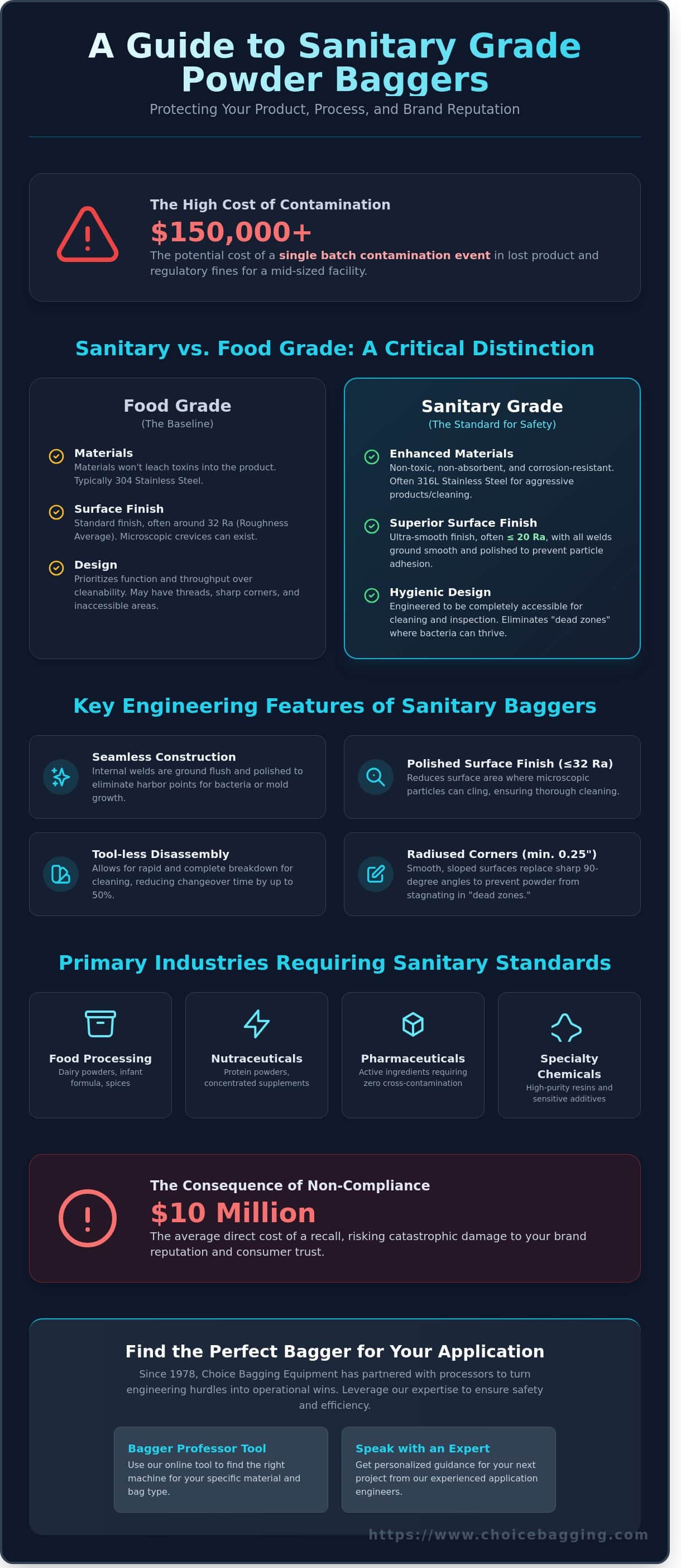
Bacteria like Salmonella and Listeria thrive in "dead zones" where powder accumulates and stays hidden. A single recall costs a company an average of $10 million in direct costs according to data from the Grocery Manufacturers Association. Beyond the immediate financial hit, your reputation is at stake. Sanitary engineering eliminates pits and crevices in the bagging head. This level of precision protects your brand and ensures every batch remains pure. We’re also your partner in ensuring these risks are managed before the machine ever hits your floor.
Sanitary vs. Food Grade: Clearing the Confusion
Food grade is the baseline, but it’s not the same as sanitary grade. Food grade simply means the materials won’t leach toxins into the product. Sanitary grade implies enhanced cleanability and specific construction materials. We typically move from 304 stainless steel to 316L for corrosive powders or aggressive cleaning cycles. Surface finish is the deciding factor; standard food-grade finishes often sit at 32 Ra (Roughness Average), whereas high-hygiene requirements often demand 20 Ra or better with all welds ground smooth and polished. This prevents microscopic particles from clinging to the metal.
If you’re unsure which machine your application requires, use our ****Bagger Professor online tool . This tool assists you in narrowing down and finding the right bagging machine based on your specific material and bag type. For a more detailed consultation on your specific facility requirements, contact us here to speak with an application expert.
Key Engineering Features of Sanitary Grade Powder Baggers
Engineering a high-performance sanitary grade powder bagger requires more than just using stainless steel. It demands a design philosophy that prioritizes microbiological safety and ease of maintenance. Since 1978, we’ve seen how small design flaws can lead to significant contamination risks. We build our equipment to eliminate harbor points where bacteria or mold can grow. Adhering to Hygienic and Sanitary Design Principles means every internal weld is ground flush and polished. Threads, pits, and sharp 90-degree corners are replaced with smooth, radiused curves of at least 0.25 inches. This prevents powder from stagnating in dead zones during production runs.
Surface finish is a critical metric for any food or pharmaceutical application. A 180-grit or higher finish, which typically results in a 32 Ra (Roughness Average) or better, is the standard for our internal components. This level of smoothness reduces the surface area where microscopic particles can cling. It’s not just about aesthetics; it’s about ensuring a 100% effective washdown. When you use FDA-approved elastomers like EPDM or Viton for gaskets, you ensure the machine withstands caustic cleaning agents without degrading. We often use blue-tinted gaskets because they’re easily detectable if a fragment ever enters the product stream, providing an extra layer of safety for your customers.
Tool-less disassembly is another feature that separates professional equipment from entry-level machines. Quick-disconnect components allow operators to strip the machine down for inspection or cleaning in under 15 minutes. This design choice reduces downtime by 35% compared to bolted assemblies. It also guarantees that every internal component is accessible for scrubbing. If you’re unsure which configuration fits your facility, you can use The Bagger Professor. This is our online tool designed to help you find the right bagging machine solutions based on your specific material and bag type.
Advanced Augers and Feed Systems
Hygienic augers use centerless screws and polished flights to move material without leaving a heel of product behind. Vertical auger fillers generally offer superior hygienic containment compared to horizontal designs. They use gravity to maintain a linear product path and minimize the footprint where dust can settle. For fragile powders that can’t handle mechanical shearing, vibratory feeders provide a gentle alternative. These systems maintain product integrity while meeting the strict 180-grit finish standards required for sanitary processing.
Dust Containment and Air Filtration
Controlling airborne particles is essential for plant safety and preventing cross-contamination. Our systems use dust-tight bag clamps that create a hermetic seal during the fill cycle, which is vital for fine powders. Integrating HEPA filtration with 99.97% efficiency ensures that particles as small as 0.3 microns don’t escape into the ambient environment. Total enclosure strategies are often necessary for sensitive pharmaceutical applications. These enclosures create a physical barrier that protects the product from the external environment and protects your operators from inhaling fine dust. If you need a customized containment strategy for your facility, contact us today to speak with our engineering team.
Comparing Sanitary Bagging Systems: Valve vs. Open-Mouth
Selecting the correct sanitary grade powder bagger requires a precise balance between throughput speed and strict sanitation requirements. Since 1978, Choice Bagging Equipment has helped processors determine which mechanical delivery system best protects their product integrity. The choice between valve and open-mouth systems often dictates the entire layout of a packaging line. While both systems meet high-hygiene standards, they solve different operational challenges related to dust migration and inspection access.
Processors handling 50-pound bags typically face a trade-off between the sealed environment of a valve bag and the total visibility of an open-mouth container. Our experience with over 1,000 installations shows that choosing the wrong interface can lead to a 15% increase in cleaning time. We focus on delivering a solution that matches your specific material characteristics, whether you’re bagging whey protein, spices, or pharmaceutical precursors.
When to Choose a Sanitary Valve Bag Filler
Valve bag fillers are the preferred choice for high-density, fine powders where dust containment is the primary concern. These systems utilize a small opening in the bag that fits snugly over the filling spout, creating a closed-loop environment during the fill cycle. This design can reduce airborne particulates by up to 98% compared to non-sealed systems. Our Valve Bag Fillers are engineered with minimal horizontal surfaces to prevent powder accumulation on the machine exterior.
Sanitary valve systems often use internal impellers or specialized air-flow systems to move product. Maintenance teams must account for the cleaning of these internal components. We design our sanitary models with quick-release clamps and polished internals to ensure that every contact point is accessible for swabbing. For fine powders that behave like fluids, the valve bag offers a compact, squared-off finished package that stacks efficiently on pallets for global shipping.
The Advantages of Open-Mouth Systems in Food Plants
Open-mouth bagging machines provide unmatched visibility of the entire product path. This is a critical advantage for facilities that require frequent visual quality control checks or run multiple product flavors on the same line. Adhering to FDA regulations for food contact substances is simpler when every weld and surface is visible to the operator. Our Open Mouth Bagging Machines feature "tool-less" disassembly, allowing a full washdown in under 30 minutes in many applications.
These systems are compatible with various sealing technologies, including ultrasonic sealing and heat-sealing, which provide an airtight finish. Because the bag is completely open during the filling process, these machines are highly versatile, accommodating different bag sizes and materials with minimal changeover time. If your facility handles 10 or more product changeovers per week, the open-mouth configuration often provides the best return on investment through reduced labor costs.
Handling Bulk Volumes and High-Hygiene Liners
When your operation scales beyond 50-pound bags, bulk bag fillers become the focus. These systems handle 2,000 to 4,000-pound loads while maintaining a sanitary environment. We utilize high-hygiene liners and inflatable discharge spouts to ensure the product never touches the ambient warehouse air. This level of containment is essential for maintaining the "sanitary grade" designation across large-scale transfers. Our bulk systems are built to last decades, featuring heavy-duty stainless steel frames that withstand daily chemical washdowns.
Finding the exact sanitary grade powder bagger for your facility doesn’t have to be a manual guessing game. We developed The Bagger Professor as a dedicated online tool to assist you in this selection. By inputting your material density and bag type, this online tool identifies the specific system that fits your production goals. If you need a more personalized consultation, we’re also your partner in engineering. You can contact us at any time to discuss your specific project requirements and request a detailed quote.
Operational Excellence: Cleaning and Maintenance Protocols
Maintaining a sanitary grade powder bagger requires more than a simple wipe-down; it demands a rigorous approach to hygiene that protects your product and your reputation. Since 1978, Choice Bagging Equipment has focused on engineering machines that simplify these essential tasks. You must choose between Clean-in-Place (CIP) and Clean-out-of-Place (COP) methodologies based on your specific material and throughput needs. CIP systems use integrated spray nozzles to clean internal surfaces without disassembly. However, many powder applications benefit more from COP. This method allows operators to remove contact parts for thorough cleaning in a dedicated wash station, ensuring no hidden pockets of powder remain to harbor bacteria.
Developing a Master Sanitation Schedule (MSS) is your first line of defense against cross-contamination. This document should detail exactly what needs cleaning, how it should be cleaned, and how often. We recommend a tiered approach where daily surface cleanings are supplemented by deep-dive disassemblies every 168 hours of operation. Predictive maintenance also plays a vital role in food safety. For instance, approximately 85% of contamination events in powder packaging are linked to seal degradation. By monitoring seal integrity and replacing gaskets before they fail, you prevent environmental contaminants from entering the product stream.
Operator training is the final pillar of operational excellence. Your staff must understand the nuance of sanitary handling, such as the "zone" concept where different levels of hygiene are required for different parts of the facility. Training should emphasize that a sanitary grade powder bagger is a precision instrument. When employees understand the "why" behind specific torque settings for sanitary clamps or the importance of using food-grade lubricants, your overall compliance rate can improve by as much as 40%. Consistency in these small details ensures your investment continues to perform at peak efficiency for decades.
Minimizing Downtime During Changeovers
Productivity hinges on how fast you can switch between different powders. Our designs prioritize tool-less disassembly, featuring quick-release parts that can reduce total cleaning time from four hours down to just 45 minutes. We design for "wash-down" capability by utilizing IP69K-rated motors and waterproofing all sensitive electronics. This modular design doesn’t just speed up cleaning; it increases your production flexibility, allowing you to run smaller batches without sacrificing a full day to sanitation protocols.
Testing for Cleanliness
Visual inspection is never enough in a high-stakes sanitary environment. We recommend using ATP bioluminescence testing to verify surface hygiene immediately after a cleaning cycle. This process provides results in 15 seconds, giving you the data-backed confidence to restart production. All cleaning activities must be logged in a digital or physical ledger to ensure audit readiness for SQF, BRC, or FSMA inspections. Proper documentation turns your cleaning routine into a competitive advantage during third-party safety audits.
If you aren’t sure which configuration fits your facility, use our Bagger Professor online tool to narrow down the right bagging machine based on your specific material and bag type. Our experts are ready to help you build a reliable, high-performance packaging line.
Why Choice Bagging Equipment is the Partner for Sanitary Solutions
Choice Bagging Equipment has established a legacy of excellence since 1978. With over 45 years of engineering expertise, we’ve refined the art of American-made bagging technology to meet the most rigorous industrial standards. We understand that a sanitary grade powder bagger isn’t a one-size-fits-all purchase. Your material has specific flow characteristics, bulk densities, and hygiene requirements that demand a tailored approach. We don’t just provide hardware; we’re also your partner in process optimization and long-term success. Our engineering team excels at customization, having developed solutions for thousands of unique materials across various industries.
This commitment to precision extends from the initial design phase through to long-term field service and maintenance. We ensure your production line remains efficient and compliant for decades. Our team provides comprehensive support, including installation guidance and technical troubleshooting, to keep your operations running smoothly. Our machines are engineered and assembled in our own facility, giving us complete control over quality and lead times. This hands-on approach ensures that every weld and component meets our strict durability standards before it reaches your floor.
Reliability Built into Every Sanitary Model
We build performance and reliability into every machine we manufacture. Our design philosophy focuses on minimal moving parts. This reduces mechanical wear and significantly lowers the risk of product contamination. When you invest in a Choice Bagging system, you’re buying a machine built to last decades, not just years. Because our equipment is Made in the USA, you get immediate access to technical support and replacement parts. You won’t face the long lead times often associated with international suppliers. Our commitment to quality means your sanitary grade powder bagger will provide consistent results shift after shift.
-
Minimal moving parts for reduced maintenance and better hygiene.
-
High-grade stainless steel construction for easy washdown.
-
Precision controls to minimize product giveaway and dust.
-
Direct access to American engineering support and parts.
Start Your Sanitary Project Today
Ready to upgrade your facility? Use the Bagger Professor online tool to find the ideal match for your product. Our machines are designed for seamless integration with high-efficiency robotic palletizing systems. This allows you to automate your entire line from filling to stacking, increasing safety and throughput. Invest confidently in a system that delivers unmatched reliability and performance. Request a Quote for your Sanitary Bagging Project today and see why we’re the industry’s trusted manufacturer.
Secure Your Production with Proven Hygiene Standards
Operating a high-performance facility in 2026 requires more than just standard machinery; it demands a sanitary grade powder bagger engineered to meet rigorous safety protocols. We’ve explored how tool-less cleaning designs and 304 stainless steel construction can reduce maintenance downtime by 50% compared to legacy models. Selecting the right equipment shouldn’t be a guessing game. Our Bagger Professor online tool assists you in narrowing down and finding the right bagging machine based on your specific material and bag type.
Choice Bagging Equipment has been a trusted manufacturer since 1978. We provide custom-engineered sanitary solutions that are proudly Made in the USA. We’re not just a supplier; we’re your partner in achieving long-term reliability and performance. Our team ensures every machine delivers the durability you need to protect your brand and your bottom line. You can rely on our 46 years of engineering expertise to streamline your operations.
Let’s work together to build a more efficient and hygienic future for your packaging facility.
Frequently Asked Questions
What is the difference between food grade and sanitary grade powder baggers?
Food grade equipment focuses on using non-toxic materials, but a sanitary grade powder bagger must meet rigorous design standards for complete microbial decontamination. While food grade machines often use 150-grit finishes, true sanitary designs require 32 Ra or better surface smoothness. These units eliminate cracks and crevices where bacteria hide. Since 1978, we’ve seen that high-purity applications require these specific finish levels to ensure product safety and compliance.
Can a valve bag filler be truly sanitary?
A valve bag filler can be truly sanitary if it incorporates specialized features like cantilevered impellers and USDA-accepted split seals. Standard designs often trap material in the filling tube or internal housing. Our sanitary models eliminate these risks by using 100% continuous welds and tool-less disassembly. These engineering choices allow for full internal inspection, ensuring your bagging line remains 99.9% free of cross-contamination between different product batches.
How often should a sanitary powder bagger be disassembled for cleaning?
You should clean your sanitary powder bagger every 24 hours of operation or whenever you change product types to prevent cross-contamination. High-risk ingredients like dairy powders often require a full wet-wash or dry-cleaning cycle every 8 to 12 hours. We design our equipment for rapid access, which reduces total cleaning downtime by 45% compared to standard industrial machines. This efficiency ensures your production schedule remains on track while maintaining total compliance.
What stainless steel grade is best for pharmaceutical powder bagging?
316L stainless steel is the industry standard for pharmaceutical powder bagging due to its superior corrosion resistance and durability. This grade contains 2% to 3% molybdenum, which prevents pitting from harsh sanitizing chemicals. While 304 stainless works for some food applications, pharma processes demand the higher nickel and chromium content found in 316L. We use these materials to build machines that last 20 years or more in aggressive cleaning environments.
How does The Bagger Professor tool help me find a sanitary machine?
The Bagger Professor is an online tool designed to help you find the right bagging machine based on your specific material and bag type. By entering your product characteristics, you can narrow down dozens of configurations to the top 3 options that fit your sanitary requirements. It’s a fast, reliable way to start your equipment search. If you need more technical guidance, you can always contact us at https://www.choicebagging.com/contact/ for a professional consultation.
Are robotic palletizers compatible with sanitary bagging environments?
Robotic palletizers are fully compatible with sanitary bagging environments when they feature IP67 or IP69K washdown ratings. These robots use food-grade lubricants and stainless steel pedestals to maintain the cleanliness of the entire packaging line. Integrating a robot can increase your throughput by 15 bags per minute while reducing human contact with the finished product. We’ve been a trusted partner in providing these integrated, high-performance solutions for decades.
What are the most common "dead zones" in a powder bagging machine?
The most common dead zones in a powder bagging machine are 90-degree internal corners, exposed threads, and flat gaskets. These areas can trap 5 to 10 grams of material, leading to spoilage or batch contamination. A high-quality sanitary grade powder bagger solves this by using radiused corners and sanitary tri-clamp fittings. We eliminate these "dust traps" to ensure your machine is 100% cleanable and ready for the next production run without delay.
Does Choice Bagging Equipment offer rentals for sanitary grade machines?
Choice Bagging Equipment doesn’t offer rentals because we focus on providing custom-built, permanent solutions that are engineered for your specific facility. Every machine we’ve built since 1978 is designed for decades of service and unmatched reliability. Investing in a permanent sanitary machine ensures you have a dedicated asset that meets your exact performance needs. To discuss your long-term equipment requirements, reach out to our team at https://www.choicebagging.com/contact/ today.
Recent Comments