
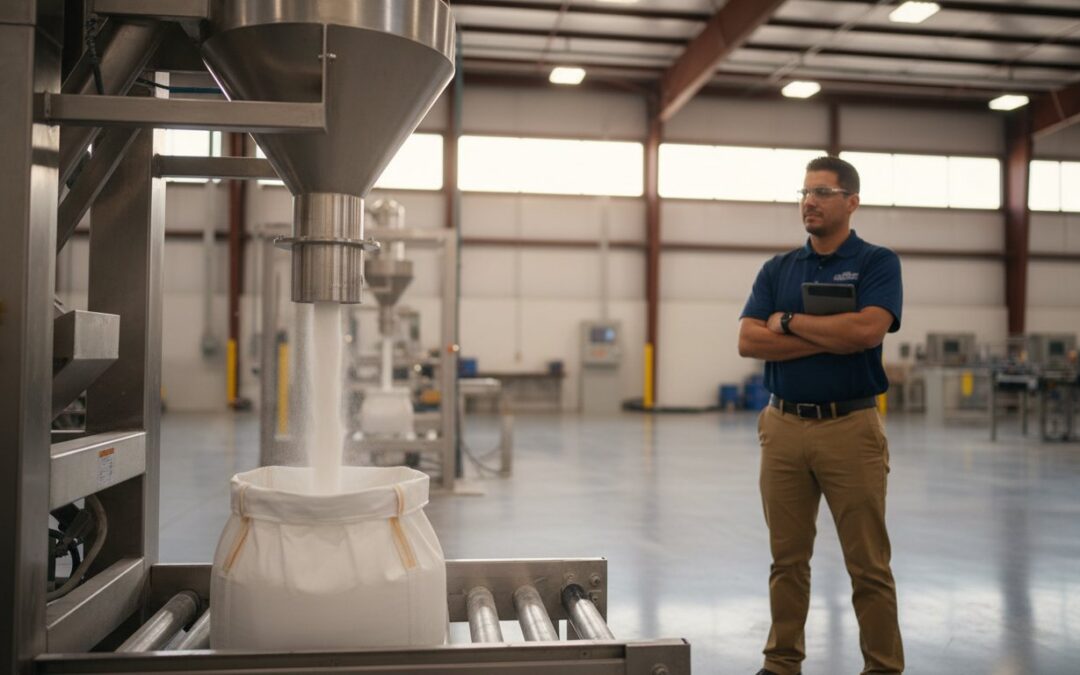
If your bagging line loses just 15 grams per bag due to overfilling, a facility processing 500 bags per day effectively throws away $27,000 in annual profit. You already understand that precision isn’t just a luxury; it’s the difference between a profitable quarter and a massive waste of raw material. Inaccurate fills and the resulting dust clouds compromise your plant safety and your bottom line. An auger filler for powder products must do more than move material; it has to control it with surgical precision. Since 1978, we’ve seen how the wrong equipment leads to excessive giveaway and costly health hazards.
You’ll master the technical nuances of auger filling technology to achieve unmatched accuracy and dust control in your powder packaging operations. We’ll show you how to eliminate product giveaway and simplify those difficult 45 minute changeovers. This guide breaks down the engineering behind consistent bag weights and the structural features that ensure your equipment lasts for 30 years or more in harsh industrial environments. Using the same expertise that powers our Bagger Professor tool, we’ll help you build a more efficient line. If you’re ready to optimize your facility, contact our team of experts for a consultation.
Key Takeaways
-
Understand why specialized volumetric systems are essential for handling fine powders that standard gravity or liquid fillers cannot manage effectively.
-
Discover how modern servo-motor technology optimizes an auger filler for powder products to ensure unmatched dosing precision and superior dust control.
-
Compare auger systems against air and impeller packers to identify the most efficient filling method for your specific material and bag type.
-
Learn to evaluate product micron size and calculate throughput targets to select a technical framework built for long-term industrial reliability.
-
Leverage the Choice Bagging experience to solve complex packaging challenges using engineering expertise refined since 1978.
Table of Contents
What is an Auger Filler for Powder Products?
An auger filler for powder products is a precision volumetric system designed to move material through a tube using a rotating screw. Since 1978, Choice Bagging Equipment has refined these systems to handle the unique challenges of fine-mesh materials. Unlike simple gravity fillers, an auger uses mechanical force to ensure consistent dosing. This is vital for products like flour, chemicals, or spices where flowability varies by the minute. You’re not just buying a machine; you’re investing in a system that eliminates the guesswork of packaging powders.
Powders require specialized handling because they compress and aerate easily. A cubic foot of talcum powder might weigh 25 pounds when settled but only 18 pounds when aerated during transport. This 28% variation in bulk density can ruin your packaging accuracy if you don’t use the right equipment. Auger/agitator fillers solve this by maintaining a constant product state before the screw dispenses it. This mechanical control leads to a 30% reduction in airborne dust compared to traditional belt feeders, keeping your facility cleaner and your product weights exact.
Our machines are built to last decades, prioritizing durability and performance. When you’re dealing with difficult materials, the auger filler for powder products serves as the backbone of your production line. It provides 99.7% repeatability in dosing, ensuring that every bag or container meets your specifications without costly overfills. If you have questions about your specific material, contact us now to speak with an expert who understands your industry.
The Anatomy of an Industrial Auger Filler
The hopper is the starting point, acting as a reservoir that maintains consistent product "head pressure." Without this pressure, the flow becomes unreliable. Inside the hopper, the auger (screw) is the primary tool for dosing. The pitch and diameter of this screw dictate the exact volume of powder moved with every turn. Finally, the agitator blade rotates independently around the auger. This prevents bridging and "rat-holing," two common issues where powder gets stuck or forms a hollow core. These components work together to provide the unmatched reliability our customers expect.
Volumetric vs. Gravimetric Filling
Volumetric filling is the standard for high-speed operations. It doses by counting the number of screw revolutions. It’s fast, efficient, and works perfectly for products with consistent density. Gravimetric filling, or net-weight filling, integrates load cells to weigh the product as it’s dispensed. This offers maximum precision for high-value powders where even a few grams of giveaway impact your bottom line.
Choosing the right method for 2026 depends on your production goals and material costs. High-speed lines often favor volumetric setups for their simplicity and minimal moving parts. However, if your bulk density fluctuates by more than 2%, a gravimetric system is the safer investment. Our "Bagger Professor" tool can help you determine which technology fits your specific application. We’re also your partner in long-term maintenance, ensuring your system performs at peak efficiency for years to come. If you’re ready to upgrade your bagging process, call today for a professional consultation.
The Mechanics of Precision: How Auger Fillers Work
An auger filler for powder products operates through a highly controlled mechanical sequence designed to deliver repeatable accuracy. The cycle starts when the product enters the supply hopper from a bulk source. Inside the hopper, independent agitator blades rotate continuously to stir the material. This motion breaks up clumps and maintains a consistent bulk density before the powder reaches the vertical screw. This preparation ensures that every revolution of the auger delivers a predictable, measured volume of product into the container below. Choice Bagging Equipment has refined these mechanical interfaces since 1978 to ensure they withstand the rigors of 24/7 industrial production.
Modern systems rely on high-torque servo-motor control to drive the auger screw with extreme precision. Unlike older clutch-brake systems that suffer from mechanical wear and timing drift, servo-motors allow for infinite adjustment of rotation speed, torque, and acceleration. This technology enables the machine to achieve filling accuracies within 0.1% to 0.5% of the target weight. A dribble feed is a secondary slow-speed cycle that tops off the container to reach the exact target weight after the bulk fill is complete. By slowing the screw’s RPM for the final 5% of the fill, the system eliminates the risk of overshooting the target weight due to product inertia.
Managing Dust and Product Containment
Controlling airborne particulates is critical for maintaining a safe workspace and adhering to FDA and EU packaging standards during the bagging process. We integrate custom-engineered dust shrouds and vacuum take-off points directly at the discharge nozzle to capture 99% of stray dust before it escapes. For facilities handling hazardous or high-value chemicals, total containment systems provide a sealed path from the hopper to the bag. Our designs also prioritize hygiene; tool-less disassembly features allow operators to strip the filling assembly for cleaning in under 10 minutes, which reduces traditional changeover times by 40% compared to bolted assemblies.
Handling Different Powder Characteristics
The physical properties of your material dictate the specific configuration of the auger. Free-flowing powders, such as salt or granulated sugar, require a mechanical "cut-off" valve or a spinner plate at the end of the screw to prevent product leakage after the motor stops. Without this, the material would continue to flow under the force of gravity. Non-free-flowing powders like flour, fine starch, or cocoa tend to compress and stick. These materials require specialized flighting on the screw and specific agitator speeds to move consistently without bridging in the hopper.
Vertical augers remain the industry standard for industrial bagging because they utilize both gravity and mechanical force to handle these varying textures with 100% reliability. This design allows for a compact footprint while delivering the high torque necessary for dense materials. If you’re unsure which screw geometry or valve type fits your specific material, you can consult with our engineering team for a technical evaluation and product test. We focus on providing a solution that’s built to last decades, ensuring your investment remains a cornerstone of your production line.
Auger vs. Other Filling Methods: Making the Right Choice
Selecting the correct delivery system is the most critical decision in your packaging line. While gravity fillers excel with free-flowing granules like 20/40 mesh sand, an auger filler for powder products is the industry standard for materials that clump, bridge, or resist flow. Since 1978, we’ve seen operators struggle with air packers when handling cohesive powders. Air or impeller systems use fluidization, which can introduce too much air into the product. This often leads to "bag bloat" and unstable pallets that are difficult to wrap and transport safely.
An auger uses mechanical displacement to move product. This provides a level of volumetric precision that pneumatic systems can’t match. According to academic research on powder filling, the mechanical consistency of a screw feed is essential for maintaining dosage accuracy in sensitive applications. In industrial settings, this translates to weight accuracies of ±0.25% or better, even with variable product densities.
Some managers believe the myth that auger fillers are inherently slower than centrifugal or air-slid systems. This isn’t the case with modern engineering. A high-speed servo-driven auger can comfortably fill 10 to 12 bags per minute. While a centrifugal system might hit higher raw speeds, the cleanup time and product degradation often negate those gains. Maintenance costs also favor the auger. A typical pneumatic packer requires frequent seal replacements and filter cleanings. In contrast, an auger’s primary wear part is the screw itself, which typically lasts 3 to 5 years even in abrasive environments.
Auger Fillers in Valve Bag Applications
For valve bag fillers, the auger serves as a high-pressure feed tool. It forces difficult materials through a narrow nozzle, effectively venting air back through the hopper. This creates a dense, solid bag that’s easier to stack. To ensure a completely dust-free warehouse, we integrate these units with advanced bag sealing technology. Ultrasonic sealers or pasted valve tuckers close the opening immediately after the spout retracts, preventing any puff of product from escaping into the work environment.
Open Mouth Bagging Integration
When you use an auger filler for powder products with open mouth bagging machines, the focus shifts to containment. We use a custom-engineered transition spout to bridge the gap between the auger discharge and the bag mouth. This prevents product splash, which is common when dropping 50 pounds of fine powder from a height. You can easily automate this setup. By adding a robotic arm for bag hanging and a V-track conveyor for transport, a single operator can oversee a line producing 600 bags per hour without manual lifting.
If you’re unsure which method fits your specific bulk density, contact our application engineers for a professional consultation. We’ll help you run the numbers on throughput and accuracy to ensure your investment delivers the reliability your facility demands.

Choosing the Right Auger Filler: A Technical Framework
Selecting an auger filler for powder products requires a shift from viewing equipment as a simple purchase to seeing it as a long-term engineering partnership. Since 1978, Choice Bagging Equipment has refined this selection process to ensure every machine we build delivers unmatched reliability. You don’t want a solution that merely works today; you need a system that thrives under your 2026 production demands. Our approach focuses on four critical technical milestones to guarantee performance.
-
Step 1: Define Micron Size and Abrasiveness. A 5-micron pharmaceutical powder behaves differently than a 150-micron industrial mineral. Abrasive materials like cement or silica can increase component wear by 45% if the auger isn’t properly treated. We analyze your product’s flow characteristics to prevent bridging and rat-holing.
-
Step 2: Calculate 2026 Throughput Targets. If your current line runs at 15 Bags Per Minute (BPM), don’t buy a 15 BPM machine. We recommend scaling for a 25% growth margin. Planning for 20 to 22 BPM now prevents costly equipment replacements in two years.
-
Step 3: Evaluate Construction Materials. Standard Stainless 304 works for 85% of industrial applications. However, if you’re handling high-saline food products or corrosive chemicals, Stainless 316 is a non-negotiable requirement to prevent pitting and contamination.
-
Step 4: Determine Automation Levels. Decide if your facility benefits from a semi-automated manual start or a fully robotic integration. Labor costs have risen by roughly 6% annually in the manufacturing sector, making automation a hedge against shrinking margins.
Material Selection for Durability
Durability isn’t a vague promise; it’s a result of metallurgy. For abrasive products like minerals or grout, we utilize hardened auger flights that resist scouring. In pharmaceutical environments, a 32-Ra sanitary finish is mandatory to eliminate bacterial growth pockets. We take pride in our "Made in the USA" construction because it ensures we control every weld and tolerance. This domestic oversight results in machines that last decades, not just years. Reliability starts with the quality of the steel and the precision of the American craftsmen who shape it.
Future-Proofing with Automation
Modern facilities are moving toward total system synchronization. Your filler shouldn’t be an island. By linking your equipment to robotic palletizing systems, you create a seamless flow from the hopper to the shipping dock. We integrate high-end PLC systems that provide real-time data logging and weight tracking. This precision allows for "Smart Filler" capabilities, where the machine provides predictive maintenance alerts before a part fails. These systems reduce unplanned downtime by approximately 30% compared to legacy mechanical fillers. It’s about investing confidently in technology that grows with your business.
Success in powder packaging depends on technical precision and proven expertise. If you’re ready to upgrade your facility with a high-performance system, request a technical consultation with our engineering team today.
The Choice Bagging Advantage: Since 1978
Since 1978, Choice Bagging Equipment has remained a trusted manufacturer of industrial packaging solutions. We don’t just supply hardware; we serve as your technical partner. Most of our machines remain in active service 25 years after their initial installation. This longevity stems from our refusal to cut corners during the design and fabrication phases. We use heavy-duty materials like 10-gauge stainless steel and high-torque drives that withstand the abrasive nature of industrial powders. When you select an auger filler for powder products from us, you’re investing in a Made in the USA solution designed for 24/7 reliability and performance.
Our team understands that every powder behaves differently. A flowable granule and a cohesive flour require different flighting, agitation settings, and hopper geometries. We solve these complex challenges through a methodical engineering approach that prioritizes your specific throughput needs. We provide full-scale support from the moment of integration through years of field service and parts availability. We keep 90% of critical wear parts in stock for immediate shipment, ensuring your downtime is measured in hours rather than weeks. This commitment to long-term support has allowed us to maintain a 98% customer retention rate among industrial powder processors.
De-Risking Your Investment
We take the guesswork out of the procurement process. Contact us to help us understand your requirements to help match your bulk density and flow characteristics to the right mechanical configuration. We also offer rigorous factory testing to ensure total compatibility. You send us a 50-pound sample of your material, and we run it through our test lab under real-world conditions. We provide a detailed report showing fill weights within a 0.25% margin of error. This data-driven approach ensures that your investment is secure and your performance targets are met before the machine ever reaches your production floor.
Ready to Optimize Your Production Line?
Auger technology is the gold standard for powder handling because it manages dust and maintains product integrity with high precision. Our systems help facilities achieve a 15% to 20% increase in bagging speed compared to manual or gravity-fed methods. This efficiency directly impacts your bottom line by reducing labor costs and product giveaway. Our engineers are ready to consult with you on your next project to ensure you get the right fit for your facility layout. We invite you to contact us today for a professional consultation. We’ll work together to build a customized auger filler for powder products that meets your exact specifications and stands the test of time.
Invest in Long-Term Precision for Your Bagging Line
Selecting the right equipment determines your facility’s efficiency for the next 20 years. You now understand how internal mechanics drive dosing accuracy and why a technical framework is vital for matching machine specs to your specific material. Implementing a high-performance **auger filler for powder products ** eliminates costly product giveaway; it keeps your production schedule on track without constant downtime. Precision isn’t just a goal; it’s a requirement for industrial scalability.
Choice Bagging Equipment has manufactured reliable, heavy-duty bagging solutions since 1978. Every machine features industrial construction and is proudly Made in the USA to ensure it stands up to the most demanding environments. You don’t have to navigate these complex technical decisions alone. Our Bagger Professor tool provides expert consultation to help you find the perfect match for your application. We’re more than a supplier; we’re your long-term partner in performance. Let’s build a solution that grows with your business.
Request a custom quote for your powder bagging project to see how 45 years of engineering expertise can transform your production floor. We look forward to helping you achieve unmatched bagging reliability.
Frequently Asked Questions
How accurate is an auger filler for fine powder products?
An auger filler for powder products delivers high precision, typically achieving accuracy rates within +/- 0.5% to 1% of the target weight. This consistency is due to the precise servo-motor control that governs the number of revolutions. Since 1978, we’ve refined these systems to ensure that even the finest materials don’t drift during high-speed production. You’ll reduce product giveaway and maintain strict quality standards across every cycle.
Can one auger filler handle multiple types of powders?
You can use a single machine for various materials by utilizing interchangeable auger and funnel sets. Changing the tooling takes approximately 15 minutes, allowing you to switch from fine flour to granulated sugar without long periods of downtime. Our engineers design these components for quick swaps. This versatility makes the equipment a reliable long-term investment for facilities with diverse product lines.
What is the difference between a volumetric and a weight-based auger filler?
Volumetric fillers measure product by counting the specific number of auger revolutions, while weight-based systems use an integrated scale to verify the mass. Volumetric units are faster, often reaching 60 fills per minute; however, weight-based units provide superior accuracy for high-value products where every gram counts. Choosing the right method depends on your specific density requirements and production speed goals.
How often does an auger filling machine require maintenance?
Standard maintenance involves a 10 minute daily cleaning and a more thorough mechanical inspection every 160 operating hours. Our machines feature minimal moving parts to reduce wear and tear over decades of use. You should check seals and bearings monthly to ensure peak performance. If you need a detailed service schedule, contact us for expert guidance.
What is the best way to control dust during the powder filling process?
Integrated dust extraction hoods and pressure-tight enclosures are the most effective ways to manage airborne particles. These systems capture 98% of fugitive dust at the point of discharge, keeping your facility clean and safe for operators. We also offer specialized "slow-speed" start cycles that prevent the initial puff of air often seen in high-speed bagging operations.
Are auger fillers suitable for abrasive materials like grout or sand?
Yes, but these applications require augers constructed from hardened stainless steel or coated with abrasion-resistant materials like tungsten carbide. Standard components might wear out in less than 6 months when handling grout, so we build specialized versions to handle these heavy-duty demands. This ensures your auger filler for powder products maintains its structural integrity even under 24/7 industrial use.
How do I determine the correct auger size for my bag volume?
You determine the correct size by calculating the volume of your product and matching it to the displacement per revolution of the auger flighting. For example, a 2 inch auger is often ideal for 1 pound bags, while a 4 inch version is better for 50 pound containers. Our "Bagger Professor" tool helps you identify the exact specifications needed for your specific bag dimensions and material density.
Can I integrate an auger filler into an existing automated bagging line?
Our equipment is designed for seamless integration into 95% of existing automated lines using standard PLC communication protocols. You can sync the filler with conveyor systems, baggers, and checkweighers to create a fully autonomous workflow. If you’re looking to upgrade your current setup, request a consultation to see how our Made in the USA equipment fits your floor plan.
Recent Comments