

The most cost-effective path to peak production isn’t always a total facility overhaul. Many operators assume that once a machine starts showing its age, it’s time to scrap the entire system. In reality, upgrading an old bagging line through strategic modernization often delivers the same reliability and throughput as new equipment for about half the capital expenditure. This approach allows you to secure your investment while extending the mechanical longevity of your existing hardware.
We understand the frustration of dealing with unplanned downtime and the struggle to find obsolete electrical components that haven’t been manufactured in years. You’re likely seeing inconsistent bag weights and rising labor costs that impact your bottom line. This article provides a technical roadmap to help you identify operational bottlenecks and evaluate the specific ROI of a rebuild versus a full replacement. We’ll explore how targeted automation can lower labor requirements and help your facility achieve a throughput of 12 to 20 bags per minute. By the end of this guide, you’ll know exactly how to transition from a legacy system to a high-performance, compliant operation.
Key Takeaways
- Recognize critical signs of equipment failure, such as when unplanned downtime exceeds 10% of scheduled production hours.
- Learn how upgrading an old bagging line through surgical rebuilds can provide near-new performance while preserving your existing mechanical assets.
- Identify bottlenecks beyond the filler by integrating automated sealing and robotic palletizing to eliminate inefficient manual stacking.
- Evaluate the financial impact of modernization, including the move from a four-person crew to a single-operator system.
- Discover how a collaborative engineering partnership ensures your legacy equipment meets modern standards for weight accuracy and reliability.
Identifying the Tipping Point: 5 Signs Your Bagging Line Needs an Upgrade
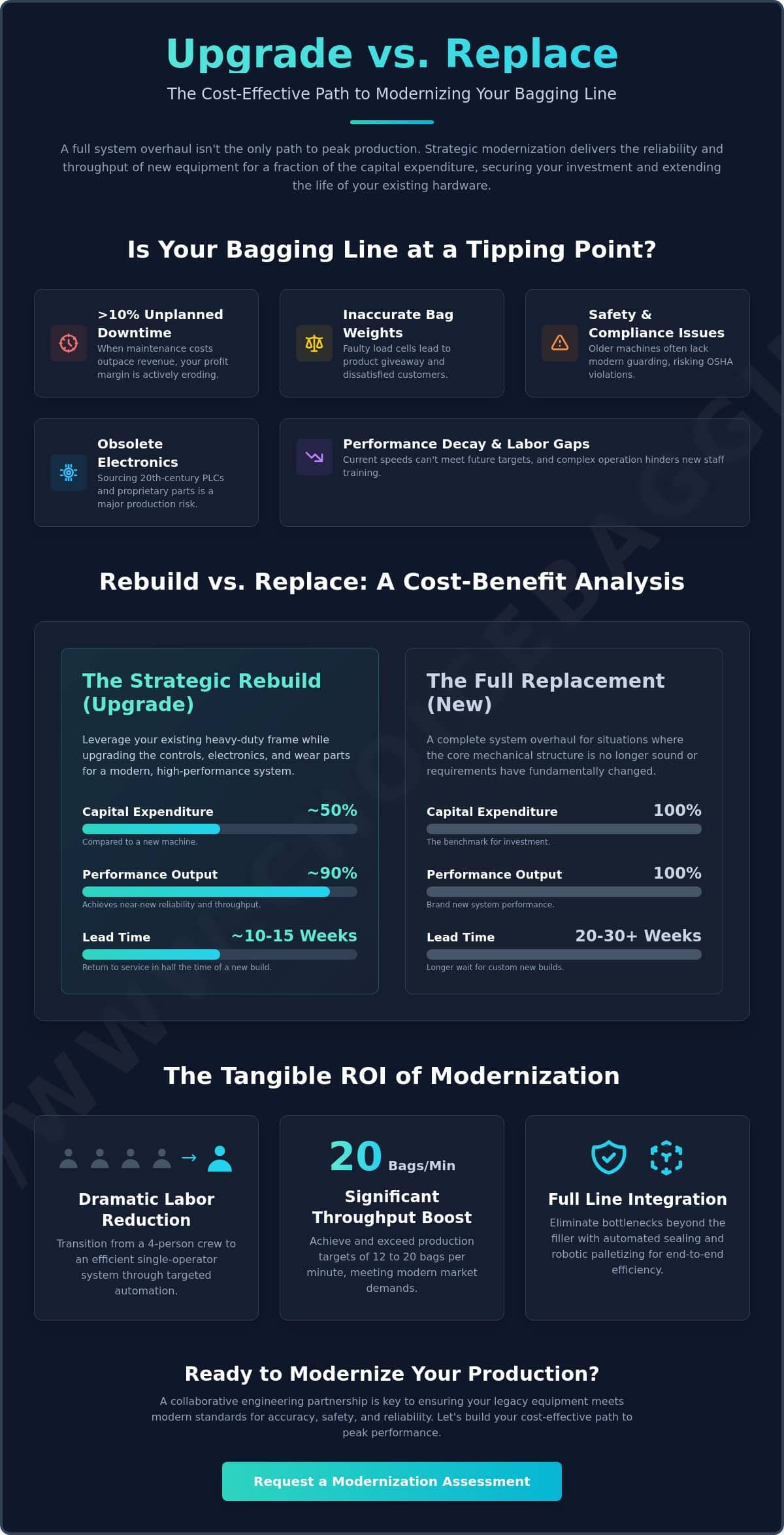
Operational excellence is built on reliability, but even the most robust machinery eventually reaches a point of diminishing returns. Determining when to stop patching a legacy system and start upgrading an old bagging line requires a clear analysis of your current performance metrics. If your facility is experiencing unplanned downtime that exceeds 10% of scheduled production hours, you’re no longer just losing time; you’re eroding your profit margin and damaging customer trust. Our field service teams frequently observe that once this threshold is crossed, the cost of maintenance often outpaces the revenue generated by the machine.
To better understand the impact of a modernized facility, watch this helpful video:
Beyond downtime, weight inconsistencies serve as a major red flag. Inaccurate load cells lead to significant product giveaway or, worse, customer complaints regarding underfilled bags. Safety is another non-negotiable factor. As of June 2026, OSHA regulation 29 CFR 1910.212 remains the primary standard for machine guarding. There’s no grandfather clause for older equipment. If your machines lack modern safeguarding for rotating parts and nip points, they must be updated to avoid being one of OSHA’s top 10 most cited violations. Finally, if you’re struggling to handle new sustainable packaging materials, such as high-recycled content bags, your hardware is likely the bottleneck.
The High Cost of Obsolete Electronics
Legacy PLC systems are a significant risk for your production schedule. Sourcing specialized proprietary parts for older brands is becoming increasingly difficult as manufacturers phase out support for 20th-century technology. While a vertical form-fill-seal (VFFS) machine or a valve bagger might still have a solid frame, its “brain” is often a ticking time bomb. Modern controls replace these obsolete components with intuitive interfaces that simplify operator training and provide real-time data. The Bagger-ER program is specifically designed to address these electronic failures before they cause a total line stoppage.
Performance Decay vs. Market Demand
Structural fatigue in bagger heads and frames can lead to subtle performance decay that’s hard to spot until it’s too late. Evaluate whether your current speed can keep up with 2026 production targets, which often demand throughputs of 12 to 20 bags per minute. Additionally, old machines are harder for new staff to operate. With the average cost to recruit and train a single warehouse worker reaching $4,700, you can’t afford a steep learning curve. Upgrading an old bagging line bridges the labor gap through user-friendly automation, making the facility more attractive to a shrinking workforce while ensuring mechanical longevity for years to come.
Rebuild vs. Replace: Finding the Most Cost-Effective Path
The most efficient use of capital often lies in the equipment you already own. Upgrading an old bagging line doesn’t always require a six-figure investment in a brand-new system. Rebuilding core assets is a surgical engineering process that can deliver 90% of the performance of new equipment for about half the cost. If your machine features a heavy-duty, structural steel frame that remains sound, it likely serves as a prime candidate for a professional restoration rather than a total replacement.
Lead times also play a critical role in this strategic decision. In the current industrial climate, a custom new build can require a 20 to 30-week lead time. In contrast, a rebuilt unit typically returns to service in half that time. This speed allows you to address production bottlenecks without the long-term disruption associated with a total line overhaul. It’s a pragmatic way to secure your investment while ensuring your facility stays on track with 2026 production targets.
The Bagger ER Process: Giving Old Machines New Life
Our Bagger ER approach isn’t a simple refurbishment; it’s a complete mechanical and electrical overhaul. We strip the machine to its frame and replace obsolete components with current technology. This process is especially effective for valve bag fillers, where modernizing the load cells and pneumatic controls can restore original accuracy and speed. Because we use the same high standards of manufacturing as our new builds, these machines perform as well as comparable new units while extending their mechanical longevity for another decade or more.
Decision Framework: The 50% Rule
To determine the best path forward, we recommend using the 50% rule. If the “Cost to Restore” your equipment—including modern safety guarding and updated PLC controls—is less than 50% of the cost of a new machine, the ROI of a rebuild is nearly impossible to beat. This assessment considers the residual value of your existing hardware and the operational output gains of the upgrade. You can request a professional assessment through our Bagger ER service to see if your line qualifies for this strategic modernization. If the technology gap is too wide to bridge, we’ll help you transition to a new system that meets your specific material requirements.
If you’re unsure which direction is right for your facility, contact our engineering team for a collaborative review of your current operations.
Modernizing the Full Line: Sealing and Robotic Palletizing
Achieving maximum operational output requires a holistic view of your packaging process. While the filling station is the heart of the operation, upgrading an old bagging line often reveals that the true bottlenecks exist further down the line. A high-speed valve bagger loses its value if the closing station or palletizing crew cannot keep pace. Modernization is about balancing the entire system to ensure a steady, uninterrupted flow from product intake to the shipping dock. By addressing these secondary stations, you secure the mechanical longevity of your entire investment.
Enhancing End-of-Line Efficiency
The transition from manual closure to automated bag sealing or modern sewing systems is a critical step in protecting your product’s integrity. Older sealing methods often lead to inconsistent closures and product leakage, which results in waste and customer dissatisfaction. By integrating precision heat sealers or high-speed sewing heads, you ensure every bag meets the same high standard of security. This efficiency is further supported by bag handling conveyors that orient and transport bags without manual intervention. This doesn’t just increase overall throughput; it also significantly reduces the risk of repetitive motion injuries, creating a safer environment for your remaining staff.
Robotic Integration for Legacy Lines
One of the most common questions we encounter is whether a legacy filling machine can successfully communicate with modern robotic palletizing systems. The answer is yes. Through expert line integration support, we bridge the technology gap between different eras of equipment using updated PLC controls and sensors. A robotic bag palletizer offers 24/7 consistency and stack stability that manual labor simply can’t match.
In many facilities, a manual crew might average 4 bags per minute, whereas an automated line can achieve 12 to 20 bags per minute. This represents a 75% reduction in direct labor, allowing a single operator to oversee the entire process. Beyond speed, robots provide a typical throughput increase of 25% to 30% by eliminating the fatigue-related slowdowns common in manual stacking. This level of automation is no longer a luxury; it’s a verified requirement for staying competitive in the 2026 industrial landscape. When you look at upgrading an old bagging line, the integration of a robotic palletizer often provides the fastest path to a full ROI, typically realized within 8 to 10 months.
Calculating ROI: The Financial Impact of Modernization
Modernizing your facility is a strategic financial decision that extends far beyond simple equipment replacement. When you begin upgrading an old bagging line, the most immediate impact is found in labor optimization. Transitioning from a manual four-person crew to a semi-automated system allows a single operator to manage the entire process. This 75% reduction in direct labor costs significantly accelerates your return on investment, often achieving full payback within 12 to 18 months for bagging operations. These savings provide the capital necessary to further enhance your facility’s operational excellence.
Maintenance costs also shift dramatically during this transition. Legacy machines often trap facilities in a cycle of reactive repairs, where the cost of unplanned downtime and expedited shipping for obsolete parts erodes profitability. Modernizing these systems allows you to implement predictive maintenance cycles, reducing the frequency of emergency interventions. Additionally, modern pneumatic and electrical systems are engineered for energy efficiency, lowering the utility overhead required to maintain peak production levels. These cumulative savings ensure that your capital expenditure translates into mechanical longevity and secure investment.
The Value of Weight Accuracy
Product giveaway is often the most overlooked expense in a legacy operation. Inaccurate load cells on older bulk bag fillers or valve baggers can result in consistent overfilling that goes unnoticed without real-time tracking. Consider a scenario where a machine averages just 0.2 lbs of giveaway per bag. Over a production run of 1 million bags, that equates to 200,000 lbs of lost product. By modernizing weighing controllers with high-accuracy load cells, you gain precision filling and eliminate this waste. This accuracy ensures that every ounce of material contributes to your revenue rather than your giveaway statistics.
Tax Incentives and Depreciation
The financial benefits of modernization are supported by favorable tax regulations. As of 2026, Section 179 of the tax code remains a powerful incentive for industrial upgrades. It allows many businesses to deduct the full purchase price of qualifying equipment in the year it’s placed in service. This applies to both new machinery and professional rebuilds, providing a significant immediate tax shield for your business. If capital constraints are a temporary concern, our rental program serves as an effective interim solution, allowing you to prove the ROI before committing to a permanent upgrade.
To see how these financial benefits apply to your specific facility, request a comprehensive ROI analysis from our engineering team.
The Choice Bagging Advantage: A Collaborative Upgrade Partnership
Choice Bagging isn’t just an equipment provider; we operate as a long-term technical partner for your facility. With over 45 years of experience in the industry, our engineering team in Taylor, Texas, specializes in the intricate process of upgrading an old bagging line to meet modern performance standards. We view every project through the lens of a collaborative alliance. This means we don’t just ship a machine; we provide the production line integration support necessary to ensure your legacy hardware and new automation work in perfect synchronization.
Our commitment to operational excellence is reflected in our “Choice Quality” standard. Every refurbished component undergoes a rigorous verification process to ensure it meets or exceeds original manufacturing specifications. This focus on durability and mechanical longevity allows you to invest with confidence, knowing that your modernized line is backed by decades of technical competence and a steadfast commitment to quality. We prioritize functional clarity and verified results over superficial marketing claims, ensuring your procurement decisions are based on sound engineering.
Brands We Service and Rebuild
We possess deep technical expertise across a wide range of industry-standard brands, including St. Regis, Black Diamond, and Taylor Products. When upgrading an old bagging line, the most significant hurdle is often the lack of available spare parts for discontinued models. To solve this, we leverage our in-house manufacturing capabilities to produce hard-to-find replacement parts that are no longer supported by the original equipment manufacturers. This capability ensures your machines remain operational even when the original brand has moved on.
Every rebuilt machine and individual component we provide comes with comprehensive warranty protection. This assurance is a cornerstone of our reliability, giving you the security that your procurement decision is protected. We don’t believe in temporary fixes; we believe in delivering results that extend the life of your assets for years to come. Our goal is to provide the same level of dependability you would expect from a brand-new unit at a fraction of the cost.
Next Steps for Your Production Line
The path to a more efficient facility begins with a methodical audit of your current hardware. We recommend scheduling a professional field service evaluation to identify the specific mechanical and electrical weaknesses in your system. Our engineers will provide a detailed breakdown of your options, helping you navigate the technical requirements of a successful modernization. This collaborative review ensures that any upgrade we propose aligns perfectly with your material types and bag specifications.
To start your assessment, you can contact us today for a detailed Bagger ER quote. We also provide proprietary resources to help you maintain your current equipment, such as the Ultimate Bagging Machine Maintenance Checklist. By taking these proactive steps, you move closer to achieving the throughput and reliability your production targets demand.
Secure Your Production Future Through Modernization
Modernizing your facility doesn’t require a total equipment replacement to achieve peak efficiency. Strategic upgrading an old bagging line allows you to leverage your existing mechanical assets while integrating the latest in load cell accuracy and robotic palletizing. By focusing on the 50% rule and addressing bottlenecks beyond the filling station, you can significantly reduce labor costs and eliminate product giveaway. This approach ensures your operation remains competitive and compliant with modern safety standards without the extreme lead times of a custom new build.
Choice Bagging supports your facility through a collaborative alliance rooted in technical competence. We bring over 45 years of experience in equipment rebuilding to every project, ensuring that every refurbished part meets our rigorous standards. Our systems are proudly manufactured and serviced in Taylor, Texas; additionally, we provide a limited warranty on all rebuilt components to guarantee your long-term success. It’s time to transition from reactive maintenance to a stable, high-output production environment.
Request a Quote for Your Bagging Line Upgrade to start your facility’s transformation today.
Frequently Asked Questions
Can any brand of bagging machine be upgraded or rebuilt?
Most industrial bagging machine brands can be modernized if the structural frame remains intact. We specialize in rebuilding legacy equipment from manufacturers like St. Regis, Black Diamond, and Taylor Products. Our engineering team evaluates the mechanical integrity of the frame before proceeding with an upgrade to ensure the machine can support modern high-speed components and safety guarding.
How much does it typically cost to rebuild an old bagging machine vs. buying new?
Rebuilding an existing machine typically costs approximately 50% of the price of a comparable new unit. This upgrading an old bagging line strategy provides near-new performance while preserving your initial capital investment. It allows facilities to achieve modern throughput levels and weight accuracy without the higher overhead associated with a total system replacement or facility redesign.
What is the average turnaround time for a Bagger ER rebuild?
The average turnaround time for a Bagger ER rebuild is approximately 10 to 15 weeks. This is significantly faster than the 20 to 30 weeks often required for a custom new build in the current industrial market. This reduced lead time minimizes production disruptions and allows your facility to return to peak operational output much sooner than a total replacement would allow.
Will upgrading my old bagging line require a complete overhaul of my electrical system?
Upgrading your line usually involves modernizing the machine’s specific control panel and PLC rather than a total facility electrical overhaul. We replace obsolete proprietary components with current industry-standard electronics and intuitive interfaces. This targeted approach ensures your equipment communicates effectively with modern sensors and safety systems without requiring a massive infrastructure project or long-term facility downtime.
Can I add robotic palletizing to a manual bagging line?
You can integrate robotic palletizing into an existing manual bagging line through professional integration support. This transition often involves adding bag handling conveyors and updated sensors to bridge the gap between legacy fillers and modern robotics. Adding a robotic palletizer is one of the most effective ways to lower labor costs and improve stack stability across the entire production line.
What are the most common parts that need replacing during a bagging line upgrade?
The most common components replaced during upgrading an old bagging line include load cells, pneumatic cylinders, and PLC controllers. We also focus on high-wear items such as bag clamps, filling spouts, and seals that degrade over years of continuous operation. Replacing these critical parts restores the machine’s original precision and ensures mechanical longevity for another decade of service.
Does Choice Bagging Equipment offer a warranty on rebuilt machinery?
We provide a limited warranty on all rebuilt machinery and individual components processed through our Taylor, Texas facility. This protection ensures that your investment in modernized equipment is secure and performs to our “Choice Quality” standards. Our commitment to reliability means we stand behind every refurbished part to provide you with peace of mind regarding your procurement decisions.
How do I know if my bagging machine is too old to be rebuilt?
A bagging machine is generally considered too old to be rebuilt if the main structural frame has suffered severe corrosion or metal fatigue. If the frame is compromised, it cannot safely support the high-speed vibrations of modern components. We recommend a professional field service evaluation to determine if your specific legacy hardware is a viable candidate for a surgical modernization project.
Recent Comments