

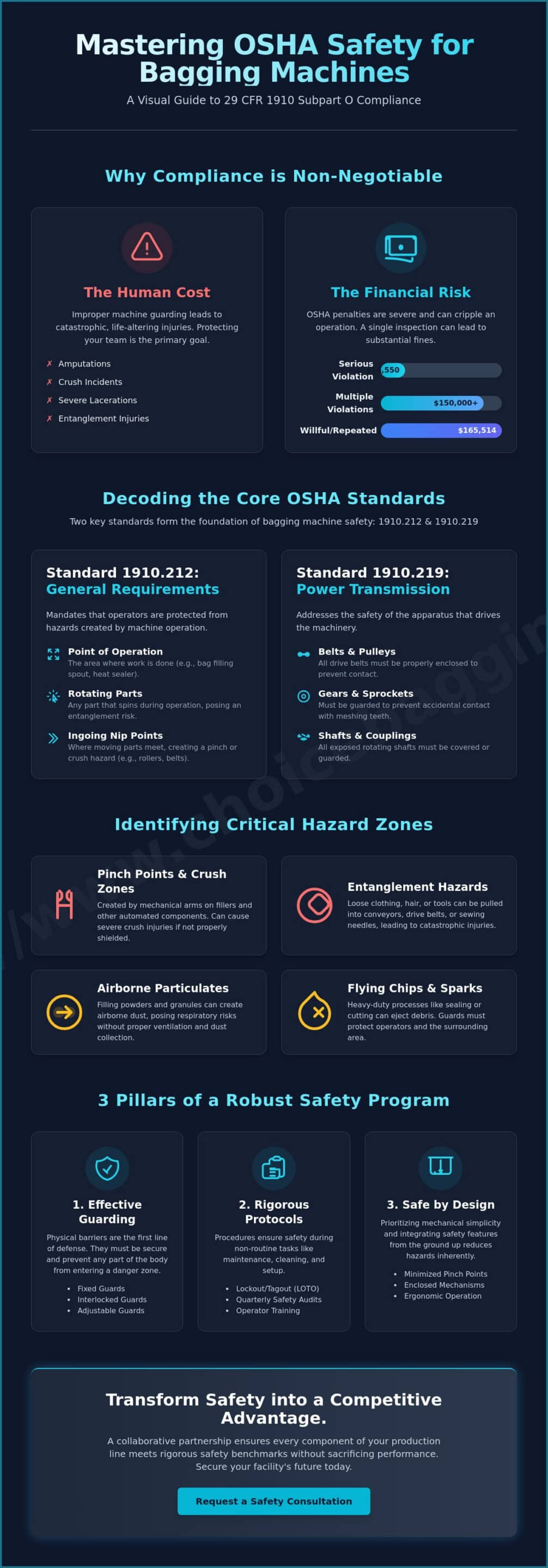
A single OSHA inspection can result in total penalties exceeding $150,000 for multiple serious violations. While these financial risks are substantial, the human cost of improper machine guarding is far greater. You likely view the bagging machine safety standards OSHA requires as a complex administrative burden that threatens to disrupt your production flow. It’s understandable to feel frustrated when general regulations don’t seem to account for the mechanical nuances of your specific hardware. However, operational excellence and workforce protection aren’t mutually exclusive goals; they’re the twin pillars of a stable, long-term manufacturing strategy.
This guide will help you master the specific safety protocols necessary for 2026. You’ll learn how to navigate the requirements of 29 CFR 1910 Subpart O to prevent catastrophic injuries like amputations or crush incidents. We’ll provide a clear compliance checklist and explain how to integrate robust safety measures without sacrificing equipment performance. By the end of this article, you’ll have the technical knowledge needed to transform your safety protocols into a secure investment for your facility’s future.
Key Takeaways
- Identify the core requirements of 29 CFR 1910 Subpart O to ensure your facility adheres to the bagging machine safety standards OSHA enforces for industrial equipment.
- Recognize critical hazard zones such as pinch points and mechanical arms to implement the correct fixed or interlocked guarding solutions.
- Implement a rigorous Lockout/Tagout (LOTO) protocol and quarterly safety audits to prevent injuries and avoid costly regulatory penalties.
- Discover how prioritizing mechanical simplicity in your bagging hardware can reduce workplace accidents while maintaining high operational output.
- Learn the benefits of a collaborative partnership for production line integration to ensure every component of your system meets rigorous safety benchmarks.
Understanding OSHA 29 CFR 1910 Subpart O for Bagging Equipment
OSHA 29 CFR 1910.212 serves as the foundational regulation for industrial safety. It outlines the general requirements for all machinery, mandating that operators remain protected from hazards created by point of operation, ingoing nip points, and rotating parts. In the context of bagging operations, the “point of operation” is the specific area where work is performed on the material. This typically includes the spout where a bag is filled or the mechanical components of a heat sealer that secures the top. By understanding these definitions, you can better identify where your bagging machine safety standards OSHA compliance might be lacking.
Employers must provide effective protection through one or more methods of machine guarding. These Machine guarding principles apply to every piece of equipment on your floor, regardless of its age. Whether you utilize manual fillers or sophisticated automated bagging systems, the responsibility to ensure a safe work environment remains constant. Compliance isn’t a suggestion; it’s a mandatory requirement for operational stability.
To better understand this concept, watch this helpful video:
The Core Standards: 1910.212 and 1910.219
Standard 1910.212 focuses on the direct interaction between the operator and the machine. It requires guards that prevent the operator from having any part of their body in the danger zone during the operating cycle. This includes protection against flying chips or sparks that might occur during heavy-duty bagging processes. Standard 1910.219 complements this by addressing the mechanical power-transmission apparatus. It covers the safety requirements for belts, gears, and shafts that drive the bagging line. Together, these standards form the essential baseline for any bagging line safety audit, ensuring that both the functional parts and the internal drive mechanisms are properly shielded.
Why OSHA Compliance is a Secure Investment
Compliance isn’t just about avoiding legal friction; it’s about protecting your most valuable assets and ensuring long-term mechanical longevity. As of May 2026, the financial risks of negligence are high. A single serious violation can carry a maximum penalty of $16,550. For willful or repeated violations, that figure climbs to $165,514 per instance. Beyond avoiding these penalties, maintaining rigorous bagging machine safety standards OSHA compliance leads to reduced insurance premiums and improved employee retention. The General Duty Clause requires employers to provide a workplace free from recognized hazards that are likely to cause death or serious physical harm, making safety a non-negotiable part of any equipment procurement strategy.
Identifying Critical Hazards in Industrial Bagging Lines
Industrial bagging lines present unique mechanical risks that generic safety manuals often overlook. While OSHA 29 CFR 1910.212 provides the legal framework, your facility’s safety depends on identifying specific hardware hazards. Mechanical arms on valve bag fillers create powerful pinch points that can lead to crush injuries if not properly shielded. These automated movements happen quickly, often leaving operators little time to react if a guard is bypassed or missing. Safety starts with a precise understanding of where these physical threats exist within your workflow.
Entanglement is another significant concern, particularly around bag handling conveyors and sewing machine needles. Loose clothing or hair can easily be pulled into drive belts or rotating shafts, leading to severe lacerations or worse. Additionally, filling powders and granules creates respiratory risks from airborne dust. Without proper ventilation or dust collection systems, these particulates compromise the long-term health of your workforce. Maintaining high bagging machine safety standards OSHA compliance requires a holistic view that accounts for both sudden mechanical impacts and gradual environmental exposure.
Valve Bag vs. Open Mouth Hazards
Valve bag fillers rely on high-speed impellers or augers that present internal entanglement risks during maintenance. The bag discharge mechanism also creates a specific crush hazard as it moves to release the finished product. In contrast, open mouth systems pose different threats, primarily centered on bag clamping and the heat or pressure from sealing jaws. You can mitigate these risks by using presence-sensing devices that halt operation if a hand enters the danger zone. This approach preserves your cycle time while ensuring that mechanical excellence never comes at the cost of operator safety.
Bulk Bag Handling and Unloading Safety
Managing the stored energy of a suspended 2,000lb bag requires more than just a sturdy hook. Stability is the primary requirement for bulk bag unloaders, as any structural failure can result in a catastrophic overhead hazard. You must ensure that bag loops are secure and that heavy-duty support frames show no signs of fatigue or wear. FIBC handling demands rigorous inspection protocols to prevent accidental releases. If you’re unsure about the structural integrity of your current setup, our field service experts can help evaluate your equipment’s condition to ensure it remains a secure investment for your operation.
Implementing Effective Safeguarding and Machine Guarding Solutions
Effective safeguarding transforms a hazardous bagging line into a secure, high-performing asset. While identifying risks is the first step, implementing the correct engineering controls ensures long-term mechanical longevity and operator safety. Fixed guards represent the gold standard for non-access areas, such as transmission belts or internal drive gears. These permanent barriers prevent any contact with moving parts and should only be removed by authorized maintenance personnel. For areas requiring frequent access, such as cleaning ports or adjustment panels, interlocked guards are essential. These systems automatically cut power when a guard is opened, acting as a primary safety layer before the formal Control of hazardous energy (lockout/tagout) protocols are initiated.
Electronic safeguarding solutions provide flexibility in high-throughput environments. Presence-sensing devices, such as light curtains, create an invisible barrier around danger zones. If the beam is broken, the machine stops instantly. This technology is particularly effective for large-scale operations where physical fencing might impede the flow of materials. Additionally, two-hand controls are a practical solution for manual bagging stations. By requiring the operator to use both hands to trigger a cycle, you ensure their limbs are clear of the point of operation. Adhering to these bagging machine safety standards OSHA requirements doesn’t just prevent injuries; it optimizes your facility for consistent operational excellence.
Choosing the Right Guard for Your Bagging Head
The bagging head is a high-activity area where physical barriers and electronic sensors often work in tandem. Physical guards provide a tangible shield against mechanical impacts, while sensors offer a responsive backup. It’s critical that these guards are tamper-resistant. Operators sometimes attempt to bypass safety features to increase speed, but modern bagging machine safety standards OSHA compliance requires guards that are difficult to defeat. Integrating these components directly into the machine’s control logic ensures that the hardware cannot operate unless every safety parameter is met. This technical synergy protects the operator without compromising the cycle time of your filling process.
Safety for Robotic Bag Palletizers
Automation introduces specific safety requirements, particularly under the ANSI/RIA R15.06 standards. For robotic palletizing systems, safety fencing and interlocked gates are mandatory to define the automation cell. These barriers keep personnel away from the high-speed arc of the robotic arm. Emergency stop (E-stop) buttons must be strategically placed at every entry point and operator station for rapid response. A well-designed palletizing zone uses a combination of hard fencing and presence-sensing floor mats to ensure the robot only operates when the cell is clear. This methodical approach to automation safety protects your workforce while securing your investment in advanced bagging technology.
Maintenance, LOTO, and Operator Training for Continuous Compliance
Stability in a bagging operation depends on more than just physical guards. It requires a disciplined approach to maintenance and energy control. Establishing a rigorous Lockout/Tagout (LOTO) program per OSHA 1910.147 is a foundational requirement for any facility. While physical guards protect during operation, LOTO protocols protect your team during maintenance and field service tasks. You must manage both electrical and pneumatic energy sources to ensure the equipment is completely inert before work begins. Documented operator training serves as your primary defense against OSHA citations. It demonstrates a proactive commitment to bagging machine safety standards OSHA compliance that goes beyond mere hardware installation.
Quarterly safety audits are essential to identify guard wear or unauthorized bypasses. Operators sometimes prioritize speed over safety, but a consistent audit schedule ensures that mechanical integrity is maintained. During these inspections, check for worn interlocks, loose fencing, and the presence of all required signage. This methodical approach ensures your equipment remains a secure investment for the long term. Detailed records of these audits and subsequent repairs provide the technical evidence needed during an official inspection.
The LOTO Procedure for Bagging Machines
Performing LOTO on a bagging machine requires specific attention to pneumatic systems, which often store residual pressure in cylinders. Follow these four steps to ensure a zero energy state:
- Step 1: Preparation and Notification. Identify all energy sources and notify all affected personnel that the machine will be shut down for service.
- Step 2: Equipment Shutdown and Isolation. Power down the machine and isolate all electrical breakers and pneumatic supply valves.
- Step 3: Application of Locks and Tags. Apply individual locks and highly visible tags to every isolation point to prevent accidental re-energization.
- Step 4: Verification of Zero Energy. Attempt to start the machine and manually bleed any remaining air pressure to confirm the system is completely safe.
Creating a Culture of Safety
A safe facility is built on a collaborative partnership between management and operators. Empower your team to report unsafe conditions or mechanical failures without fear of reprisal. This open communication often identifies risks before they lead to an incident. Additionally, keep the equipment clean. Dust accumulation isn’t just a maintenance issue; it’s a significant safety hazard that can lead to dust explosions in certain environments. See our bagging machine maintenance tips for more details on keeping your line running at peak efficiency.
For expert guidance on integrating these safety protocols into your facility, view our full range of industrial bagging solutions.
The Choice Bagging Commitment: Engineering Safety into Every Machine
Choice Bagging Equipment views safety not as a regulatory hurdle but as a fundamental design principle. Mechanical simplicity is the cornerstone of our engineering philosophy. By reducing the complexity of the hardware, we naturally eliminate many of the redundant pinch points and mechanical failures that lead to workplace injuries. Our commitment to high manufacturing standards ensures that your investment remains safe and productive for decades. This focus on longevity and operational excellence provides the stability you need to grow your business without the fear of sudden safety-related shutdowns.
Adhering to bagging machine safety standards OSHA enforces requires more than just high-quality hardware. It demands a technical partner who understands how each component fits into a broader production ecosystem. We prioritize US-based manufacturing to maintain total control over the quality and safety specifications of every unit that leaves our facility. This regional pride translates into tangible benefits for your facility, including easier access to parts and specialized support that understands your local regulatory environment. Assessing your current line for compliance gaps is the first step toward a more secure and efficient operation.
Safety as a Standard Feature, Not an Add-on
Our valve bag fillers are engineered with integrated safeguarding from the start. We don’t treat safety as an optional add-on. Every machine includes robust physical barriers and responsive control logic designed to meet the most stringent bagging machine safety standards OSHA mandates. Our engineering team provides ongoing support to help you integrate these machines into your existing production line while maintaining a zero-hazard environment. This built-in protection ensures that your equipment stays safe throughout its entire operational lifecycle, protecting your workforce and your bottom line.
Collaborate with the Experts
Navigating the specifics of federal regulations is a complex task for any plant manager. We offer a collaborative partnership that extends far beyond the initial equipment sale. Our field service professionals are available to conduct comprehensive safety audits, identifying potential compliance gaps before they result in fines or accidents. We help you translate general standards into actionable facility improvements, ensuring your hardware is both safe and high-performing. This technical competence provides the security you need to make confident procurement decisions.
Ensure your facility meets the highest benchmarks for safety and efficiency. Contact us today for a safety-focused equipment consultation and let our engineers help you secure your production line.
Securing Your Operational Future with Compliant Infrastructure
Prioritizing mechanical integrity and operator protection is the most effective way to ensure the long-term stability of your facility. By mastering the bagging machine safety standards OSHA requires, you transform potential regulatory friction into a secure investment. You’ve seen how identifying specific hazard zones and implementing rigorous LOTO procedures prevents catastrophic injuries while shielding your business from substantial civil penalties. These measures aren’t just administrative requirements; they’re the components of a high-performing production line that values its workforce and its mechanical endurance.
Choice Bagging Equipment has been manufacturing reliable industrial hardware since 1978. Our US-based engineering and support teams specialize in expert production line integration services that prioritize both safety and operational output. We invite you to Request a Safety-Focused Equipment Quote to begin optimizing your facility for 2026 and beyond. Partnering with an industry authority ensures your equipment remains compliant and your operation stays productive. Your path to a safer, more efficient workplace starts with a collaborative alliance focused on technical excellence.
Frequently Asked Questions
What is the most common OSHA violation for bagging machines?
The most frequent citation involves inadequate machine guarding under standard 1910.212. This typically occurs when rotating parts, nip points, or the point of operation are left exposed. Ensuring your facility adheres to bagging machine safety standards OSHA enforces prevents these common serious violations. Regular audits help identify missing or damaged guards before an inspector arrives, protecting both your personnel and your financial interests.
Does OSHA require light curtains on all robotic palletizers?
OSHA requires effective safeguarding but doesn’t mandate a specific technology like light curtains. You must ensure that no personnel can enter the robotic cell while the arm is in motion. Common solutions include physical safety fencing with interlocked gates or presence-sensing devices. The choice depends on your specific layout and throughput requirements, provided the solution meets ANSI/RIA R15.06 safety benchmarks for robotic systems.
How often should I inspect the machine guards on my valve bag filler?
You should conduct formal safety inspections at least quarterly, though daily visual checks by operators are a best practice. These inspections focus on identifying worn components, loose fasteners, or evidence of tampering. On a valve bag filler, pay close attention to the discharge mechanism and high-speed impellers. Consistent documentation of these checks proves your commitment to operational excellence and provides a clear record for regulatory compliance.
Can I modify an old bagging machine to meet current OSHA standards?
You can certainly retrofit older equipment to meet current compliance requirements. This process involves adding modern interlocks, fixed guarding, and emergency stop buttons to legacy hardware. Engineering these safety upgrades ensures that your older assets remain productive without posing a risk to your workforce. It’s a cost-effective way to secure your investment while maintaining high bagging machine safety standards OSHA expects in a modern facility.
What are the specific LOTO requirements for pneumatic bagging equipment?
Pneumatic equipment requires the complete isolation and dissipation of stored air pressure. Unlike electrical energy, pneumatic systems often hold residual energy in cylinders or lines that can cause unexpected movement. Your LOTO procedure must include a step to bleed this pressure to achieve a verified zero energy state. This ensures that the machine is completely inert before maintenance personnel begin any field service or internal repairs.
Are there different safety standards for food-grade bagging machines?
OSHA safety standards remain the same, but the design of the guards must accommodate sanitary requirements. Food-grade equipment often requires stainless steel construction and guards that are easily removable for washdown procedures. The challenge is ensuring that these removable barriers are properly interlocked. You must balance the need for hygiene with the mandatory requirement to protect operators from mechanical hazards at all times.
What should I do if an operator bypasses a safety interlock?
You must immediately stop the machine and address the violation through formal retraining and equipment inspection. Bypassing an interlock is a willful violation that significantly increases the risk of severe injury. Investigate the root cause to determine if the guard is poorly designed or if it unnecessarily hinders production. Redesigning the guard for better usability often prevents operators from attempting to circumvent safety protocols in the future.
How does OSHA 1910.212 apply to manual open mouth bagging stations?
Standard 1910.212 requires that operators be protected from the point of operation, even during manual tasks. In a manual station, this often involves the clamping mechanism or the heat sealer jaws. You must use guards or devices that prevent the operator’s hands from entering the danger zone during the cycle. Implementing two-hand controls or physical shields ensures that manual operations remain safe without sacrificing the throughput of your bagging line.
Recent Comments