

Powder unloading is an engineering challenge that requires more than just gravity; it demands a total containment strategy to protect your workspace and your bottom line. With the global FIBC market projected to reach $8.8 billion in 2026, the pressure to maintain high-output, dust-free environments has never been greater. If you’ve dealt with excessive dust or material bridging, you know that a standard FIBC unloader for powders isn’t just a piece of hardware. It’s a critical link in your production chain that determines your daily throughput and operational safety.
We recognize that safety risks during bag hanging and the frustration of rat-holing can stall your entire operation. You’re likely looking for a way to eliminate these bottlenecks while maintaining a clean, compliant facility. This guide provides the technical insights you need to select the right configuration for your specific material and facility layout. We’ll explore how to achieve total dust containment, consistent flow, and seamless integration with your downstream packaging equipment. Our goal is to help you establish a collaborative partnership with your equipment to ensure a secure, long-term investment in your production line.
Key Takeaways
- Understand why specialized frames and heavy-duty systems are required to handle the unique flow characteristics of industrial powders compared to standard granules.
- Learn how to select an FIBC unloader for powders equipped with flow-aid technologies to prevent operational bottlenecks like bridging and rat-holing.
- Compare the mechanical advantages of forklift-style and integrated hoist configurations to determine which system best fits your facility’s ceiling height and workflow.
- Discover how active dust collection ports and negative pressure systems create a secure environment by containing fine particles during the discharge process.
- Gain insights into the collaborative engineering approach necessary to integrate your unloader as the high-performance head of a complete bagging line.
Understanding FIBC Unloaders for Industrial Powder Handling
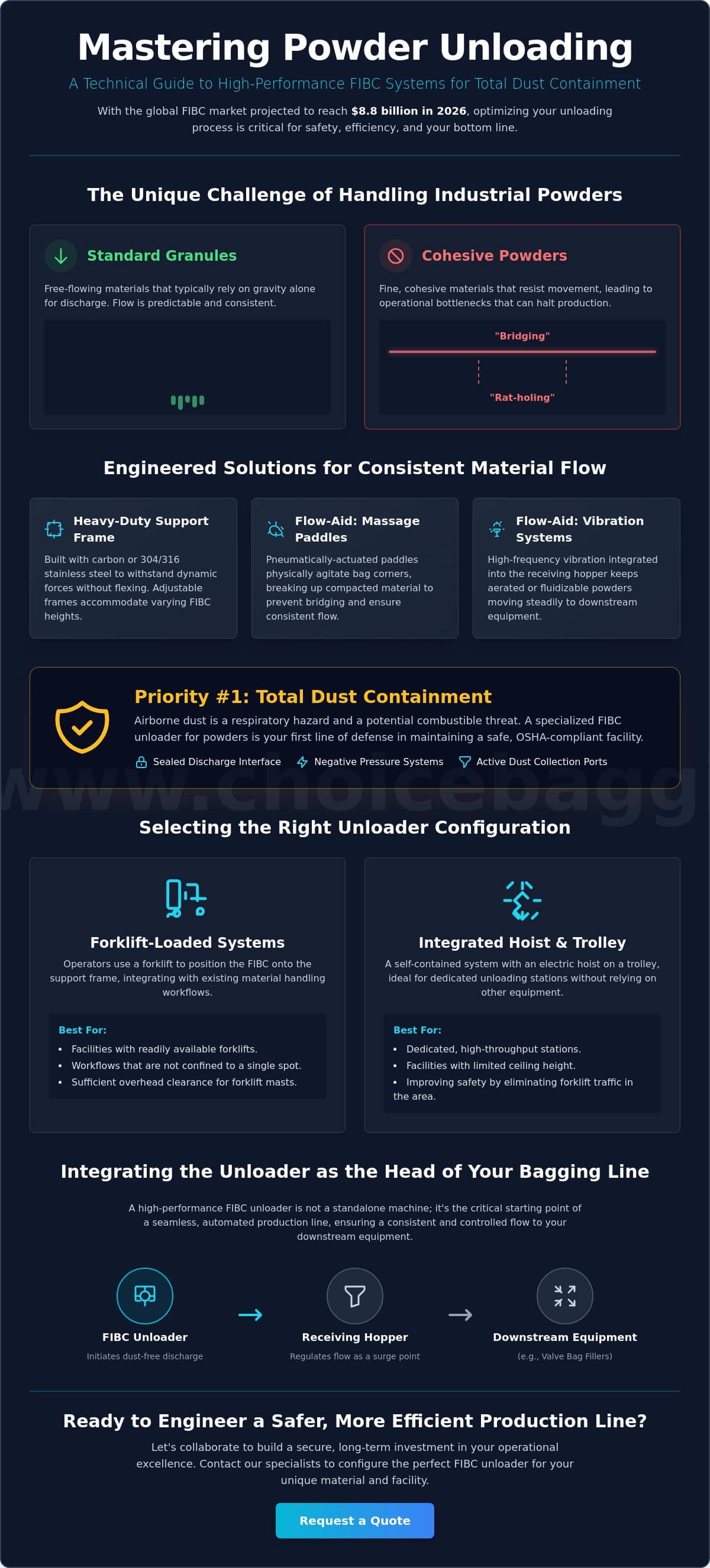
A Flexible Intermediate Bulk Container (FIBC) is the global standard for transporting large volumes of dry material. Discharging these containers efficiently requires a heavy-duty frame system designed for structural longevity. While free-flowing granules might rely on gravity alone, an FIBC unloader for powders must be engineered to handle cohesive materials that resist movement. These systems serve as the foundation of a closed-loop production environment. They prevent external contaminants from entering your product stream while ensuring that fine particles don’t escape into the facility air.
Every reliable unloader consists of three baseline components: the support frame, the receiving hopper, and the discharge interface. The support frame must be built to withstand the dynamic forces of a full bag without flexing. The receiving hopper acts as a vital surge point, regulating the flow to downstream machinery. Finally, the discharge interface provides the critical seal that makes dust-free operation possible. Together, these components form a secure investment that ensures operational excellence in high-output facilities.
How Bulk Bag Dischargers Facilitate Material Flow
The unloading process begins with a cycle of loading and securing the bag. Operators use a forklift or an integrated hoist to position the FIBC onto the support frame. Once the bag is suspended, the operator secures the spout to the discharge interface. Gravity initiates the initial flow, but powders often require mechanical assistance to maintain momentum. Cohesive materials can bridge or rat-hole, stopping the flow entirely. High-performance unloaders utilize agitation techniques to ensure a consistent transition from the bulk bag spout to your valve bag fillers or other downstream equipment.
The Critical Importance of Powder Containment
Managing fine powders presents significant safety risks that granules simply don’t share. Airborne dust is a respiratory hazard and a potential source of combustible material. OSHA guidelines increasingly focus on warehouse safety and the prevention of dust-related incidents. Maintaining a dust-tight spout connection is the industry benchmark for protecting your workforce. Modern systems utilize sealed interfaces that create a physical barrier between the product and the facility air. These interfaces often integrate with dust collection points to capture any stray fines during the untying process. Choosing a dedicated bulk bag unloader designed specifically as an FIBC unloader for powders is a proactive step toward a cleaner facility.
Key Features for Managing Fine and Cohesive Powders
Fine powders present unique handling difficulties that standard granules don’t share. Unlike free-flowing pellets, these materials often become cohesive or highly aerated, leading to unpredictable discharge rates. A standard discharger won’t suffice in these environments. You need an FIBC unloader for powders designed for mechanical reliability and precision. Durable construction using heavy-duty carbon steel or 304/316 stainless steel ensures your hardware survives the rigors of high-volume production. Additionally, adjustable frames are a necessity. They allow you to accommodate varying bulk bag heights from different suppliers without needing a complete system overhaul.
Flow Aids: Agitators and Massage Paddles
Cohesive powders tend to pack tightly at the base of the bag during transit. This creates “bridging” where the material refuses to drop even after the spout is opened. Pneumatic massage paddles solve this by physically agitating the bag’s bottom corners. These paddles work in timed cycles to break up compacted material and push it toward the center spout. High-frequency vibration systems can also be integrated into the receiving hopper. This keeps material moving consistently without requiring operators to manually beat the bags. Eliminating manual intervention improves safety and ensures a predictable discharge rate for your downstream equipment.
Discharge Interfaces: Iris Valves and Spout Clamps
Managing the flow of fines requires a level of precision that basic manual ties can’t provide. An iris valve is an excellent tool for controlling the discharge rate or closing the bag for partial unloading. For abrasive or exceptionally heavy powders, pneumatic pinch valves provide a more robust solution. Before you even untie the bag, a spout clamping system should create a dust-tight seal. This is vital for maintaining combustible dust safety guidelines within your facility. By sealing the connection point, you prevent fine particles from escaping into the air during the initial surge of material.
Selecting a configuration that balances dust containment with flow efficiency is a strategic decision for any plant manager. If you’re currently evaluating your facility’s needs, you can explore our range of bulk bag unloaders to see how these features integrate into a complete system. Investing in the right flow-aid technology today prevents costly downtime and maintenance issues in the years to come.
Selecting the Right Unloader Configuration for Your Facility
Selecting an FIBC unloader for powders requires a thorough evaluation of your facility’s physical constraints and existing mobile equipment. A configuration that works in a high-bay warehouse may fail in a low-ceiling processing room. You must consider how the bag reaches the discharge point and how much vertical space remains for downstream integration. Choosing a modular frame is a strategic decision. It allows for future upgrades, such as adding automated flow aids or taller support columns, as your production requirements evolve. This adaptability ensures your initial investment remains viable for the long term.
The choice between manual and semi-automated unloading systems often depends on your throughput goals and labor availability. Manual systems are cost-effective for low-volume operations but increase the risk of dust exposure during the untying process. Semi-automated systems utilize pneumatic controls to manage the discharge interface, significantly reducing the physical burden on operators. These systems provide more consistent results and tighter containment, which are essential for high-purity or hazardous powder applications. We view our equipment as a collaborative partner in your process, designed to enhance both safety and efficiency.
Hoist and Trolley vs. Forklift Loading
An integrated hoist and trolley system offers superior safety and speed for high-volume operations. By utilizing a dedicated I-beam, you eliminate the need to tie up a forklift during the entire unloading cycle. The operator simply attaches the bag to the hoist at floor level and lifts it into position. This reduces traffic in the processing area and minimizes the risk of forklift-related accidents. Conversely, forklift-style unloaders are a practical choice for facilities where mobile equipment is already available. These models often feature target plates and secure bag adapters to ensure precise positioning. The adapter stays with the bag, providing a stable connection that prevents bag sway during discharge.
Low-Profile and Space-Saving Designs
Headroom is a common objection when installing new hardware. Low-profile designs solve this by using specialized bag frames that minimize the distance between the bag and the hopper. These systems can be integrated directly onto a bulk bag filler or a conveyor to maximize floor space. When planning your layout, you must measure the clearance for both the machine and the forklift mast at its maximum extension. If you’re dealing with extremely tight quarters, we can customize the frame height to fit your specific ceiling dimensions. This level of technical precision ensures that your bulk bag unloader fits perfectly within your existing production line without requiring expensive structural modifications.
Solving Powder Challenges: Dust Control and Material Bridging
Many operators work under the misconception that all powders flow identically under the influence of gravity. In reality, the physical properties of a material, such as its moisture content, particle size, and cohesiveness, dictate its behavior during discharge. Bridging and rat-holing are the primary enemies of efficient production. These issues don’t just slow down your line; they often force operators to take manual risks to restart the flow. A high-performance FIBC unloader for powders is engineered specifically to counteract these mechanical hurdles through superior geometry and active flow assistance.
Safe operation also requires a dedicated access chamber. This enclosed space allows an operator to reach in and untie the bag spout without being exposed to a sudden surge of material or a cloud of displaced dust. By isolating the untying process, you create a controlled environment that protects both the employee and the facility. This approach transforms a potentially hazardous task into a routine, secure procedure that maintains the integrity of your clean-room or warehouse standards.
Active Dust Collection and Sealed Systems
Effective dust containment relies on maintaining a slight negative pressure within the unloading system. Active dust collection ports integrate directly with the unloader hopper to capture fines at the moment of discharge. For highly dusty or hazardous materials, a glove-box style access chamber provides an absolute barrier. This setup allows for total containment while the operator manipulates the bag spout. To ensure the entire process remains secure, many facilities integrate bag sealing equipment further down the line to manage the product once it reaches its final packaging stage. These combined technologies prevent facility contamination and product loss.
Eliminating Material Bridging and Rat-holing
Bridging is the formation of an arch over the discharge opening that halts material flow. When this occurs, gravity is no longer enough to move the powder into the downstream process. To solve this, we utilize a combination of steep hopper wall angles and mechanical agitation. Ultrasonic or pneumatic vibrators are often mounted to the hopper to keep stubborn materials in a fluid state. Proper hopper geometry is essential; a steep, polished interior prevents the friction that leads to rat-holing, where only a small center column of material discharges while the rest remains stuck to the sides. If you’re facing persistent flow interruptions, contact our team today to discuss an FIBC unloader for powders configured for your specific material challenges.
Integrating FIBC Unloaders into Your Production Line
An FIBC unloader for powders serves as the primary intake point for your entire facility. It isn’t just a heavy-duty frame; it’s the “head” of a high-performance system that dictates the pace of your entire operation. Achieving seamless operation requires a collaborative engineering approach that looks beyond the unloader itself. You must consider how the material moves through every subsequent stage of your line, from the initial discharge to the final palletizing. This holistic perspective ensures that your bulk handling stage doesn’t become a bottleneck for your final packaging goals.
We believe in establishing a collaborative alliance with our clients, moving beyond simple transactions to provide verified results. By viewing the unloader as a vital link in a larger chain, you can optimize your facility for maximum output and minimal waste. Our engineering focus remains on mechanical simplicity and operational excellence, providing you with a secure investment that stands the test of time.
Downstream Compatibility with Bagging Machines
The transition from bulk bags to smaller, retail-ready containers must be precise and controlled. High-performance unloaders often feed directly into valve bag fillers to ensure accurate weight control and high-speed output. To maintain this flow, bag handling conveyors are frequently used to transport material from the unloader’s surge hopper to the filler’s intake. Synchronization between these components is critical. If the unloader discharge rate doesn’t match the packer’s intake, you risk either starving the machine or causing a material overflow. We engineer these systems to communicate effectively, ensuring a steady, regulated feed that maximizes your production uptime.
Custom Engineering for Seamless Material Transfer
Managing material surges is a common challenge when dealing with a high-capacity FIBC unloader for powders. Integrating surge hoppers or screw conveyors between the unloader and the bagging machine provides a necessary buffer. This setup allows the unloader to discharge a full bag quickly while the downstream equipment processes the material at its optimal, calibrated rate. Choice Bagging Equipment provides comprehensive production line integration support to help you design these custom configurations. Our team works with you to ensure that every transition point is sealed and every flow rate is optimized for your specific powder characteristics.
Our commitment to American-made reliability means your hardware is built for mechanical longevity and enduring performance. We focus on pragmatic, tangible results that reduce the need for frequent maintenance or operator intervention. Because we understand the complexities of industrial powder handling, we provide ongoing technical support to ensure your system continues to perform as expected years after installation. This authoritative approach to manufacturing gives you the security of a verified result, transforming your procurement decision into a secure, long-term investment for your facility.
Securing the Future of Your Powder Handling Operation
Optimizing your facility for the challenges of 2026 means moving beyond basic gravity discharge. You’ve seen how specialized flow aids and active dust containment are essential for managing cohesive materials. Selecting the right FIBC unloader for powders is the first step toward a seamless, integrated production line. Choice Bagging Equipment has been manufacturing industrial bagging equipment since 1978. We provide rugged, American-made frames designed for 24/7 operation. Our expert integration support ensures that your bulk handling stage works in perfect harmony with your downstream packaging equipment.
It’s our mission to serve as a technical collaborator. We view every project as a collaborative partnership. Our goal is to provide you with a secure investment that delivers verified results for years to come. Don’t let material bridging or dust contamination stall your growth. Request a Quote for a Custom FIBC Unloader System today and take the first step toward total operational excellence. We look forward to helping you build a more efficient, dependable facility.
Frequently Asked Questions
What is the difference between a bulk bag unloader and a bulk bag discharger?
These terms are used interchangeably within the material handling industry. Both refer to the structural frame and mechanical system designed to empty bulk bags. While some regional preferences exist, with “discharger” often implying a gravity-based system, they describe the same category of equipment intended to facilitate safe and efficient material transfer.
Can an FIBC unloader handle highly abrasive or corrosive powders?
Yes, but the system must be engineered with specific materials to withstand these conditions. For corrosive powders, we utilize 304 or 316 stainless steel construction to ensure mechanical longevity. For abrasive materials, we integrate reinforced liners and heavy-duty valves that resist wear and prevent premature failure of the discharge interface.
How do I prevent dust from escaping when I untie the bulk bag?
Prevention requires a sealed discharge interface paired with an active dust collection port. This setup creates a slight negative pressure within the access chamber to capture fine particles before they migrate into the facility. Utilizing a high-quality FIBC unloader for powders with these features is the industry standard for maintaining a clean and compliant workspace.
What ceiling height is required for a standard hoist-style unloader?
A standard hoist-style system typically requires between 15 and 20 feet of vertical clearance. This height accommodates the structural frame, the I-beam, the hoist, and the full length of a suspended bulk bag. If your facility has restricted headroom, we offer low-profile configurations that utilize specialized bag frames to reduce the necessary vertical footprint.
How do flow aids like massage paddles improve powder discharge?
Massage paddles use pneumatic pressure to physically agitate the base of the bag. This action breaks up compacted material and prevents the formation of arches, known as bridging, over the discharge spout. These flow aids ensure a consistent discharge rate and eliminate the dangerous practice of operators manually striking the bags to restart flow.
Is it possible to weigh the material as it is being unloaded from the FIBC?
Yes, you can integrate load cells directly into the unloader frame to monitor material weight in real time. This allows for precise loss-in-weight or gain-in-weight measurements for batching and inventory management. Integrating scales into the unloading process provides an added layer of technical precision for high-output production environments.
Can I use a forklift-style unloader if I have limited floor space?
Forklift-style models often have a smaller physical footprint than hoist-style systems because they don’t require an integrated I-beam and trolley. They’re an excellent choice for facilities with existing mobile equipment and tight quarters. You must still ensure there’s enough room for the forklift to maneuver and position the bag safely onto the support frame.
What safety certifications should I look for in a bulk bag unloader?
Ensure your equipment complies with OSHA safety standards and follows recognized guidelines for combustible dust containment. All structural frames should be load-tested and clearly labeled with their certified weight capacity. Choosing an FIBC unloader for powders that meets these rigorous standards protects your workforce and ensures a secure, long-term investment for your facility.
Recent Comments