
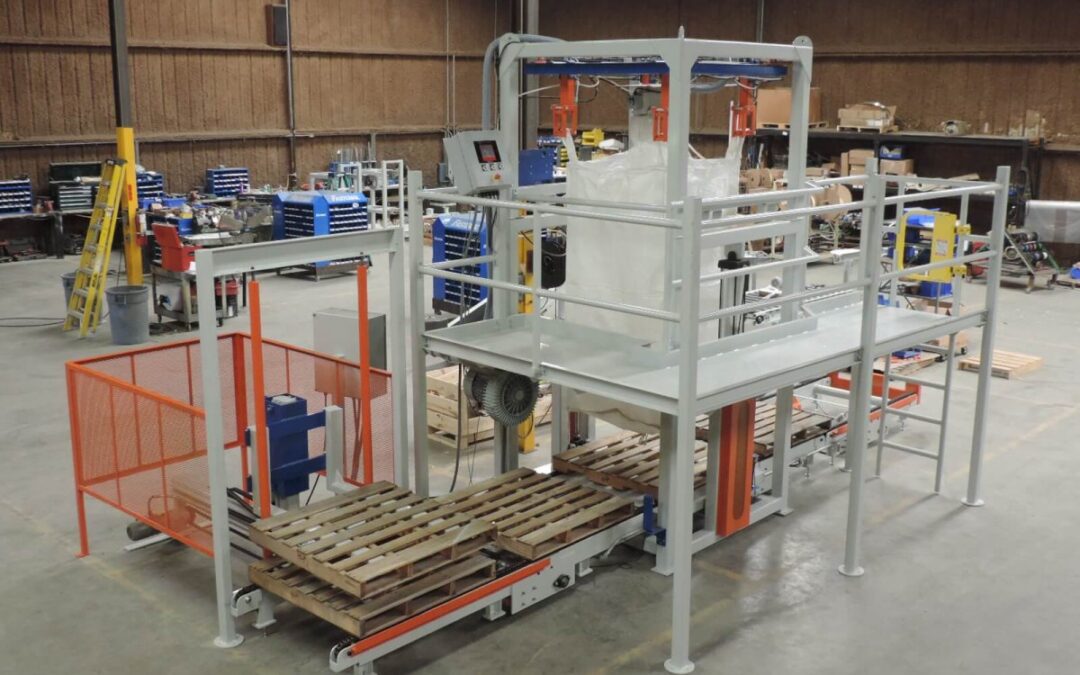
Manual material handling often acts as a hidden tax on your facility’s bottom line. The most significant costs aren’t always found in equipment depreciation, but in the labor hours lost to manual bag untying and the product wasted through hopper bridging. Implementing an automatic bulk unloader is the most effective way to eliminate these inefficiencies while maintaining a clean, dust-tight environment. This hardware serves as the critical link between your bulk storage and high-speed packaging equipment, ensuring your production remains consistent and profitable.
You’ve likely dealt with the operational headaches of excessive workspace dust and the safety risks of manual material discharge. It’s a common challenge that impacts both employee morale and your compliance with updated OSHA 29 CFR 1910.178 standards. This guide will show you how to transition to a more reliable, automated system that prioritizes operator safety and mechanical longevity. We’ll explore the essential features for consistent material flow and explain how these units integrate into your broader production line to maximize throughput. If you’re ready to optimize your operation, you can contact us to discuss your specific material handling needs and explore a long-term collaborative partnership.
Key Takeaways
- Learn how an automatic bulk unloader functions as a critical discharging station to maintain continuous production flow and eliminate manual handling bottlenecks.
- Identify advanced mechanical features like pneumatic agitation and massage paddles designed to ensure consistent flow for non-free-flowing powders and clays.
- Analyze the return on investment through reduced labor costs and the recovery of expensive raw materials with discharge rates reaching 99.9%.
- Understand the technical requirements for integrating your unloading system with downstream valve bag fillers and bag handling conveyors for a seamless operation.
- Discover how a collaborative alliance with technical experts provides the custom engineering necessary to align hardware with your specific material characteristics.
What is an Automatic Bulk Unloader and Why Does Efficiency Matter?
An automatic bulk unloader is the essential interface for dust-free material transfer between bulk storage and downstream processing equipment. This specialized discharging station is designed to automate the release of dry solids from Flexible Intermediate Bulk Containers (FIBCs), replacing the inconsistencies of manual labor with mechanical precision. In high-volume environments like chemical plants, mineral processing, and food production, this equipment serves as the heartbeat of the production line. Without a reliable unloader, your entire operation remains vulnerable to material contamination and costly downtime.
Efficiency in material handling isn’t just about speed; it’s about the precision of the discharge and the total elimination of product waste. Manual untie stations often require operators to physically reach into hazardous areas to untie bag spouts, which leads to uneven flow and excessive dust. Optimizing your material handling with an automatic bulk unloader ensures that your facility maintains high standards of manufacturing while protecting your staff. This transition is a secure investment in facility hygiene and operational stability that pays dividends through consistent output.
To see how these systems operate in a real-world industrial setting, watch this demonstration of automated handling:
The Core Components of an Automated Discharger
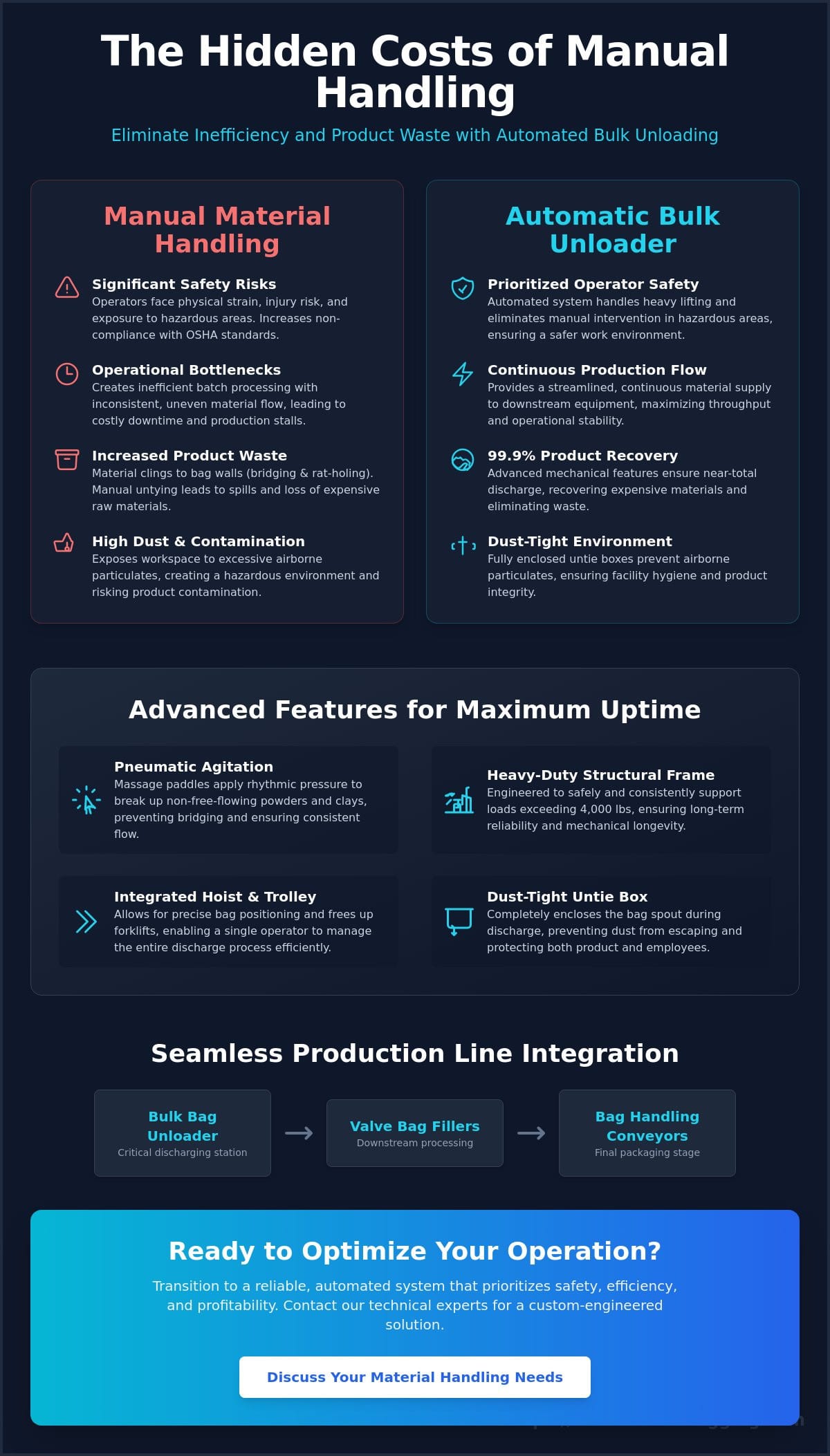
Stability starts with the foundation of the machine. High-quality bulk bag unloaders utilize heavy-duty structural frames engineered to support loads exceeding 4,000 lbs safely and consistently. An integrated electric hoist and trolley system allows for precise bag positioning, which removes the need for a forklift to remain at the station during the discharge process. To maintain a clean workspace, dust-tight untie boxes enclose the bag spout completely. This enclosure prevents airborne particulates from escaping into the facility, protecting both your product and your employees. This mechanical simplicity ensures long-term reliability and reduces the total cost of ownership.
Addressing the Shift from Manual to Automated Processes
Moving away from manual processes significantly reduces the physical strain and injury risk for your workforce. Instead of operators struggling with heavy bags and awkward ties, the automated system handles the heavy lifting and creates a secure connection. This shift enables your facility to move from inefficient batch processing to a streamlined, continuous material supply that feeds downstream equipment without interruption. By following standardized FIBC handling protocols, your facility achieves a predictable output that manual stations simply can’t match. It’s a strategic move toward a more sophisticated, collaborative production environment that prioritizes operational excellence.
Advanced Features: Solving Material Flow and Dust Challenges
High-efficiency material handling requires more than just a structural frame. An automatic bulk unloader must actively manage material behavior to prevent production stalls. Powders, clays, and other cohesive materials often resist gravity, leading to inconsistent feed rates that disrupt downstream packaging. Advanced systems address these challenges through targeted mechanical intervention and robust dust containment protocols that ensure your facility remains both productive and compliant with safety regulations.
Managing Difficult Materials with Pneumatic Agitation
Non-free-flowing materials are prone to bridging and “rat-holing,” where material clings to the bag walls while a small hole forms in the center. Pneumatic massage paddles solve this by applying rhythmic pressure to the base of the FIBC. These paddles are adjustable, allowing operators to set cycle times that match specific material densities and flow rates. This active agitation is essential for maintaining the momentum of your production line.
- Pneumatic Paddles: These break up clumps and promote a steady, predictable flow to the discharge spout.
- Integrated Vibration: High-frequency vibration systems assist in achieving complete bag evacuation, which is critical when handling expensive raw materials.
- Customized Cycles: Programmable logic allows you to tailor the agitation intensity to the specific characteristics of your minerals or chemicals.
Dust Containment and Workplace Safety
Facility hygiene is a primary concern for modern industrial operations. To meet the rigorous standards of OSHA 29 CFR 1910.178, an automatic bulk unloader utilizes specialized interfaces to capture nuisance dust at the source. A dust-tight pinch ring creates a secure seal around the bag spout before the tie is even released. This prevents particulates from escaping into the workspace, protecting your employees from respiratory hazards and reducing the time spent on facility cleaning.
Spout closure valves and oversized tie boxes provide an additional layer of protection. These components ensure that any residual dust stays within the system rather than entering the atmosphere. For facilities dealing with fine particulates, integrating these unloaders with existing vacuum or dust collection systems is a standard requirement for maintaining a safe workspace. If you’re evaluating how these features can improve your specific workflow, you can explore our full range of bulk bag unloaders to see these technical specifications in detail.
Safety interlocks and hydraulic gripping technology further enhance bag stability. These systems prevent the machine from operating unless the bag is correctly positioned and secured. This mechanical assurance protects your operators from accidental releases or shifting loads, providing a sense of security regarding your procurement decisions and long-term operational safety.
Calculating ROI: Automatic vs. Manual Bulk Bag Unloaders
Investing in an automatic bulk unloader is a strategic financial decision that extends far beyond the initial purchase price. While manual untie stations may seem like a lower capital investment, they carry hidden, recurring costs that diminish your facility’s profitability over time. A comprehensive ROI analysis focuses on labor reallocation, material recovery, and the mitigation of workplace hazards. By transitioning to an automated system, you’re choosing a path of operational excellence that stabilizes your overhead and secures your production schedule.
Throughput metrics provide the most immediate evidence of this value. Manual unloading is inherently limited by human fatigue and the physical constraints of handling heavy FIBCs. An automated system maintains a consistent bags-per-hour rate that manual intervention simply can’t match. This reliability allows you to plan downstream packaging with greater precision, ensuring that your fillers never sit idle waiting for material.
Labor Efficiency and Operational Output
The most significant shift in your balance sheet comes from the reduction in dedicated labor hours. Manual stations often require a full-time operator to manage bag positioning, untying, and material flow. An automatic bulk unloader streamlines these tasks, allowing you to reallocate your personnel to higher-value positions within the facility. This shift doesn’t just save money; it improves the overall quality of your output by focusing human expertise where it’s needed most.
- Time Savings: Automation eliminates the slow process of manual bag preparation and spout manipulation.
- Consistency: Machines provide a uniform discharge rate, removing the variability of manual intervention.
- Personnel Reallocation: Staff can focus on quality control or logistics rather than repetitive physical labor.
Long-Term Durability and Maintenance Considerations
Reliability is built into the hardware through heavy-duty construction and mechanical simplicity. High-quality systems are engineered to withstand the rigors of 24/7 industrial environments, which significantly extends the equipment’s lifespan compared to lighter-duty manual frames. Transitioning to an automated platform also facilitates a move from reactive repairs to predictive maintenance. This proactive approach prevents unexpected downtime and ensures that your investment continues to perform at peak efficiency for decades. Choice Bagging’s established legacy since 1978 ensures that your facility benefits from long-term part availability and reliable technical support throughout the machine’s lifecycle.
Material recovery also plays a critical role in your return on investment. Manual unloading frequently leaves residual product in the folds of the bag, which is often discarded. Advanced automated systems, equipped with massage paddles and vibration, ensure a 99.9% discharge rate. When handling expensive raw materials, this reduction in waste can account for thousands of dollars in annual savings. Furthermore, the dust-tight operation reduces the risk of dust explosions and respiratory injuries, potentially lowering your insurance premiums and ensuring a safer, more compliant workspace.
System Integration: Connecting Unloaders to Your Production Line
An automatic bulk unloader functions as the primary material source for your entire packaging operation. It doesn’t operate in isolation; it’s the critical first step in a synchronized sequence that determines your facility’s total output. Feeding downstream machines like valve bag fillers or open mouth baggers requires a precise transfer mechanism that prevents material degradation and maintains a steady flow. This integration is where mechanical engineering meets operational strategy to create a seamless bridge between bulk storage and finished product.
Surge hoppers and de-weigh scales play a vital role in this process. These components act as a buffer, ensuring that the filler always has a ready supply of material even during bag changeovers. By using de-weighing technology at the unloader, you can monitor material usage in real-time, providing an extra layer of precision for high-value minerals or chemicals. We specialize in customizing frame heights and footprints to fit within your existing facility constraints, ensuring that new hardware integrates without requiring expensive structural modifications.
Selecting the Right Conveying Method
Maintaining material integrity is paramount during the transfer from the unloader to the filler. The choice between flexible screw conveyors and pneumatic conveying depends entirely on your material characteristics. Flexible screws are often preferred for fragile materials that are prone to attrition, while pneumatic systems offer greater flexibility for complex routing across the facility. Synchronizing the unloader’s discharge rate with the intake requirements of your bagging machine prevents overfilling and minimizes the mechanical stress on your bag handling conveyors.
End-of-Line Automation Synergy
The efficiency gained at the start of the line must be maintained through the final palletizing stage. A well-integrated system utilizes a centralized PLC (Programmable Logic Controller) to manage the communication between the automatic bulk unloader, the filling station, and the robotic palletizers. This standardization ensures that every component operates at the same cadence, reducing the risk of bottlenecks. Standardizing your bag sizes and FIBC types further optimizes this synergy, allowing for predictable stacking patterns and secure transport.
If you’re planning a new facility layout or upgrading an existing line, our team provides comprehensive production line integration support to ensure your hardware works in harmony. This collaborative partnership ensures that your investment in automation delivers the maximum possible throughput with minimal manual intervention.
The Choice Bagging Advantage: More Than Just Hardware
Procuring an automatic bulk unloader is a significant capital investment that requires more than just a standard equipment purchase. We believe this transaction should be the start of a collaborative alliance rather than a simple exchange of hardware. Our approach is rooted in technical competence and a deep understanding of industrial material handling. By choosing a partner based in Taylor, Texas, you gain access to regional expertise and a commitment to high standards of manufacturing that imported systems often lack. We focus on mechanical simplicity and operational excellence to ensure your facility remains productive for decades.
Every material has unique characteristics that dictate how it behaves during discharge. Whether you’re handling abrasive minerals or fine chemical powders, our custom engineering services ensure your unloader is configured for your specific flow requirements. We don’t just provide a machine; we provide a verified result that integrates into your existing workflow. This focus on long-term stability provides you with a sense of security regarding your procurement decisions.
Engineering Support and Line Integration
Our engineers assist you in incorporating your automatic bulk unloader into larger, complex production systems. This includes synchronizing the discharge rates with downstream fillers and palletizing equipment to prevent bottlenecks. If your facility is managing a short-term project or testing a new material, our bagging equipment rental program offers a flexible solution without a long-term capital commitment. As your operation expands, our buyback and upgrade programs allow you to scale your technology alongside your business growth, ensuring your hardware never becomes a limitation.
Dependable Support Since 1978
Machine longevity is a core brand value that we’ve upheld since our founding era. We’ve provided dependable bagging solutions since 1978, establishing a legacy of reliability and technical authority in the industry. Maintaining your hardware with OEM parts is essential for ensuring the enduring nature of your equipment and preventing unnecessary downtime. Our field service team is available to provide ongoing technical support and on-site assistance, ensuring your facility remains operational and efficient. This focus on long-term service integration distinguishes us as a seasoned industry partner committed to your success.
Take the next step in optimizing your material handling and facility hygiene. Contact Choice Bagging to discuss your bulk unloading project and discover the benefits of a true collaborative partnership.
Securing Your Facility’s Operational Excellence
The technical features discussed in this guide detail how precise agitation and dust containment eliminate common industry pain points like material bridging and respiratory hazards. These improvements directly translate into a measurable return on investment through labor reallocation and material recovery. A well-integrated system provides the stability needed to meet aggressive production targets without compromising operator safety. By prioritizing these mechanical advantages, you ensure your facility maintains a high standard of manufacturing excellence.
Implementing an automatic bulk unloader ensures that your production line remains a secure and profitable investment for years to come. Choice Bagging has been manufacturing high-quality bagging equipment since 1978, providing US-based engineering and support from our facility in Taylor, Texas. We specialize in both manual and fully automated solutions, offering the technical authority required for complex industrial environments. Our team is ready to serve as your long-term collaborator in optimizing your workflow.
You don’t have to manage these technical decisions alone. Our collaborative partnership ensures that your hardware is precisely engineered for your specific material characteristics. Request a Quote for an Automatic Bulk Unloader to begin your facility’s transformation today. We’re committed to helping you achieve lasting results. You can also visit Choice Bagging to learn more about our complete range of industrial solutions.
Frequently Asked Questions
What is the difference between a bulk bag unloader and a discharger?
These terms are frequently used interchangeably to describe the equipment used to empty Flexible Intermediate Bulk Containers (FIBCs). While a discharger focuses specifically on the mechanism of material release, an automatic bulk unloader generally refers to the entire structural station, including the hoist, frame, and dust containment system. Both systems aim to provide a secure, controlled interface between the bulk bag and your downstream processing equipment.
Can an automatic bulk unloader handle different bag sizes?
Most industrial systems are designed with adjustable bag frames to accommodate a wide range of FIBC heights and widths. Telescoping frames or adjustable hoist positions allow the machine to handle bags ranging from 36 inches to over 72 inches in height. This flexibility is essential for facilities that source raw materials from multiple suppliers using different packaging standards. We ensure the structural frame is engineered to handle these variations without sacrificing stability.
How do I prevent dust during the bulk bag discharging process?
Effective dust control is achieved through a combination of a dust-tight untie box and a spout pinch ring. These components create a mechanical seal around the bag spout before the tie is released, preventing particulates from escaping into the workspace. Integrating the unloader with a facility’s central vacuum or dust collection system further ensures compliance with OSHA 29 CFR 1910.178 standards. This approach maintains high standards of facility hygiene and operator safety.
What safety features should I look for in an automated unloading station?
Priority safety features include electrical interlocks that prevent operation if the access door is open and heavy-duty structural frames rated for maximum load capacities. You should also look for fail-safe hoist mechanisms and bag-activated sensors that ensure the FIBC is correctly positioned before discharge begins. These technical specifications provide a sense of security regarding your procurement decisions and protect your workforce from accidental material releases or mechanical failures.
How much floor space is typically required for a bulk bag unloader?
A standard automatic bulk unloader typically requires a footprint of approximately 60 inches by 60 inches, though this varies based on the specific hoist and frame configuration. The more critical dimension is the vertical clearance, as the station must accommodate the height of the frame, the hoist, and the full bag. We provide custom engineering services to modify the equipment height and footprint to fit within your existing facility constraints.
Can these systems handle non-free-flowing or ‘difficult’ materials?
Difficult materials like cohesive powders and clays are managed through active mechanical intervention. Pneumatic massage paddles apply rhythmic pressure to the base of the bag to break up clumps and prevent bridging or rat-holing. When paired with high-frequency vibration systems, these features ensure a consistent material flow and achieve a 99.9% discharge rate. This mechanical simplicity ensures that even the most challenging raw materials move efficiently through your production line.
Is it possible to integrate a bulk unloader with my existing conveyor system?
Integration is a standard part of the installation process and is typically achieved through a surge hopper located beneath the discharge spout. This hopper acts as a buffer and can be fitted with various discharge flanges to connect directly to flexible screw conveyors, pneumatic systems, or belt conveyors. Our team provides production line integration support to ensure that the unloader’s discharge rate is perfectly synchronized with your existing material handling equipment.
What are the maintenance requirements for an automatic bulk unloader?
Maintenance is straightforward and focuses on the longevity of moving parts like the electric hoist, trolley, and pneumatic actuators. Regularly inspecting the dust seals and ensuring the pinch ring remains secure will prevent atmospheric contamination. We recommend a schedule of predictive maintenance to identify wear before it leads to downtime. Our history since 1978 ensures that OEM parts and technical support are always available to maintain the enduring nature of your hardware.
Recent Comments