
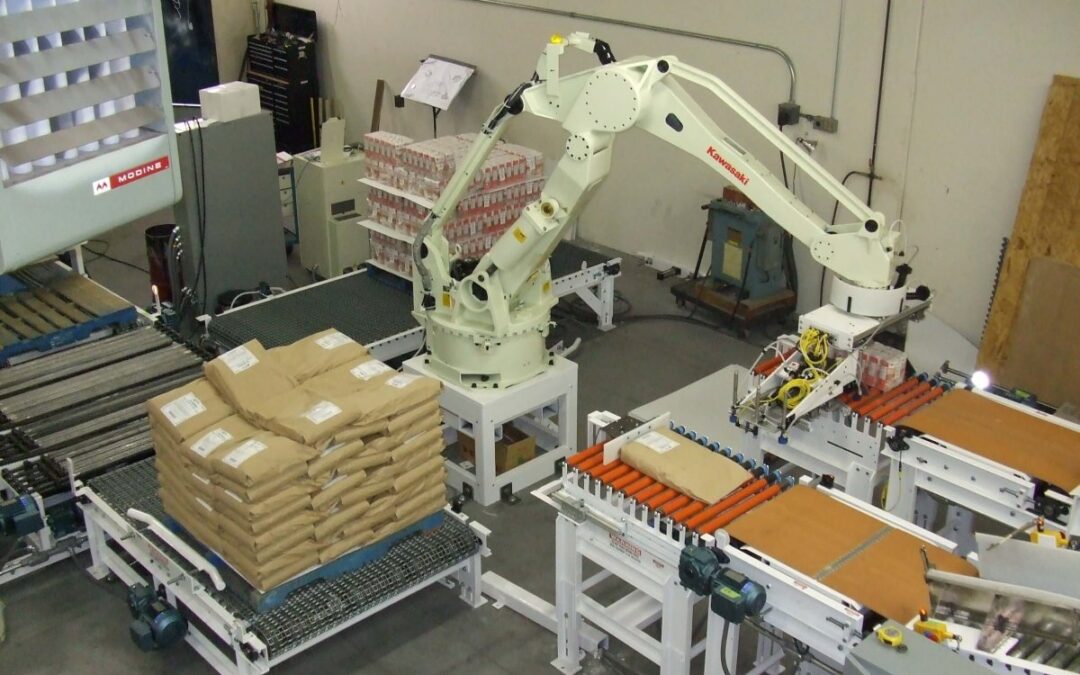
Your manual stacking line is no longer just a bottleneck; it’s a direct threat to your facility’s operational longevity and safety record. Transitioning to automated palletizing systems for bags has become a fundamental requirement for manufacturers who need to maintain a competitive edge in 2026. You’ve likely experienced the frustration of high labor turnover in stacking positions and the costly shipping damage caused by inconsistent pallet quality. These are common industry pain points, but they don’t have to define your production output or your bottom line.
This comprehensive guide provides the technical roadmap you need to master the shift from repetitive heavy lifting to high-speed robotic automation. We’ll examine the latest 2026 safety standards, such as ISO 10218, and detail how to achieve perfectly stable pallets while significantly increasing your bags-per-minute throughput. By viewing automation as a collaborative alliance between hardware and strategy, you can secure a faster return on investment and ensure mechanical longevity. We’ll walk you through the essential components of a synchronized filling-to-shipping line, ensuring your operation remains reliable, efficient, and ready for the demands of the modern market.
Key Takeaways
- Determine whether robotic flexibility or conventional speed fits your facility; it’s the first step in comparing modern stacking architectures.
- Calculate the true ROI of automated palletizing systems for bags through a detailed analysis of labor savings and reduced workers’ compensation claims.
- Enhance transport safety by implementing essential features like bag flatteners and check-weighers. This ensures perfectly stable pallets.
- Form a collaborative alliance backed by 45 years of US-based engineering to transition your end-of-line process into a synchronized operation.
What are Automated Palletizing Systems for Bags?
In the context of modern manufacturing, automated palletizing systems for bags represent the final, critical link in a high-performance production line. These systems are advanced robotic or mechanical assemblies engineered to stack industrial bags onto pallets with precision and speed. While once considered a luxury for high-volume facilities, 2026 has become the definitive tipping point where automation is an operational necessity. Persistent labor market volatility and the rising cost of workplace injuries have forced a shift in strategy. A modern Palletizer ensures every load is uniform, which protects your investment and reduces the risk of transit damage.
To better understand how these systems function within a live production environment, watch this helpful video:
A high-functioning system is more than just a single machine; it’s a synchronized alliance of hardware designed for mechanical longevity. The core components of these systems include:
- Infeed conveyors that regulate the flow and spacing of incoming bags.
- Bag conditioners and flatteners that remove excess air and distribute material evenly.
- Articulated robotic arms or high-level mechanical stackers.
- Automatic pallet dispensers that eliminate the need for manual pallet placement.
The Evolution of Bag Handling Technology
The industry has moved far beyond the days of manual labor and rigid gantry systems. Today’s articulated robotic arms offer multiple axes of motion, providing the dexterity needed for complex stacking patterns. Modern synchronization relies heavily on high-speed Programmable Logic Controllers (PLCs). These controllers act as the central nervous system, ensuring that conveyors, conditioners, and robots work in perfect harmony. Additionally, vision systems have drastically improved accuracy. These cameras detect bag orientation in real-time, allowing for precise pick-and-place maneuvers even if a bag arrives slightly off-center.
Why Industrial Bags Require Specialized Palletizing
Stacking bags is significantly more complex than stacking rigid cases. The physics of “shifting contents” in products like powders or granules means a bag’s shape can change during the move. Valve bags and open-mouth bags present unique challenges regarding air entrapment and center-of-gravity shifts. Maintaining pallet “squareness” is vital for safe warehouse racking and secure transport. Without specialized handling, bags made of poly or paper might slide due to varying surface friction. Specialized robotic palletizing systems account for these variables, applying the necessary compression to create a stable, transport-ready load.
Robotic vs. Conventional Palletizers: Choosing Your Architecture
Selecting the right architecture for automated palletizing systems for bags requires a pragmatic evaluation of your facility’s current output and future goals. Robotic systems have gained significant ground because they offer unmatched flexibility. They can manage multi-line infeeds and various bag sizes simultaneously. Conversely, conventional palletizers remain the industry standard for dedicated, high-speed lines where a single product type is processed in massive volumes. While robotic units often feature a smaller footprint, conventional systems utilize vertical space through mechanical towers.
Maintenance profiles also differ significantly. Conventional machines rely on complex mechanical linkages and layers of conveyors. Robotic cells shift much of that complexity into software. This results in fewer moving parts but requires specialized technical support for programming. Regardless of the choice, ensuring your system meets OSHA’s machine safety standards is non-negotiable for protecting your workforce and maintaining operational uptime.
The Flexibility of Robotic Bag Palletizing
Robotic systems excel when your production demands change frequently. The versatility of a robot is largely determined by its End-of-Arm Tooling (EOAT). You can choose between clamshell grippers for heavy bags, vacuum heads for porous materials, or fork-style grippers for precision stacking. This hardware allows a single robot to handle mixed pallet patterns and different bag weights without manual intervention. Reprogramming the unit for new bag dimensions is a software-driven task. This minimizes downtime compared to the physical reconfiguration required by mechanical stackers. You can view our specialized robotic palletizing systems to see these tools in action.
Throughput and Speed Considerations
Your required bags per minute (BPM) will dictate whether you need a single-robot cell or a more robust configuration. A standard robotic arm typically manages 10 to 25 BPM depending on the weight and pattern complexity. If your line exceeds these rates, a dual-stack configuration or a high-level conventional palletizer might be necessary. Integrating the right palletizing equipment into high-speed environments ensures that your bagging machine’s output isn’t throttled by end-of-line bottlenecks. If you’re unsure which architecture fits your specific volume, contact our engineering team for a technical review.
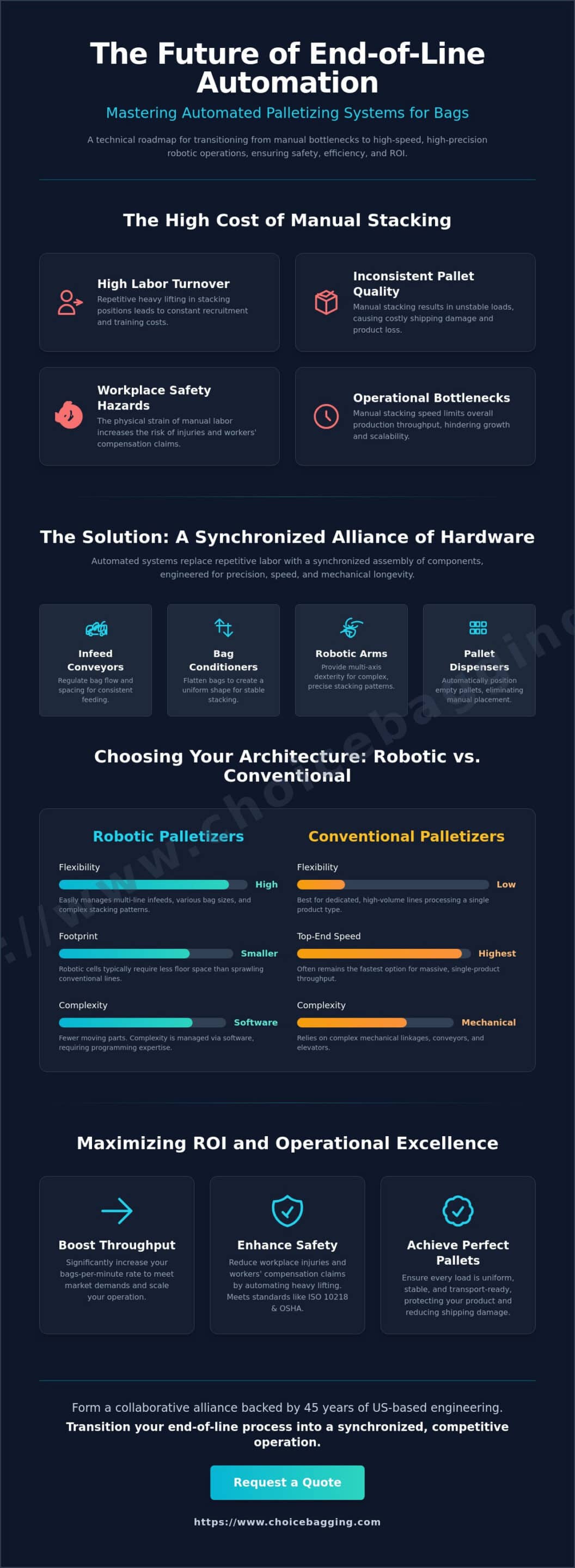
Solving the Labor Crisis and Maximizing Operational ROI
Manual stacking is frequently the most volatile position in a bagging facility. Industry data shows that the average tenure for a manual stacker is often as low as three months, creating a cycle of constant recruitment and training. In contrast, automated palletizing systems for bags offer a machine life cycle that typically exceeds 20 years. Shifting from a high-turnover labor model to a secure mechanical investment stabilizes your production schedule. While the initial capital expenditure is a primary consideration, you must weigh it against the cumulative costs of rising wages, recruitment fees, and the inevitable downtime caused by staffing shortages.
Safety and ergonomics provide additional layers of financial justification. Repetitive heavy lifting of 50-pound bags is a leading cause of workplace strain and long-term injury. These incidents result in expensive workers’ compensation claims and increased insurance premiums. By removing the human element from the physical stacking process, you eliminate these specific liabilities. This transition allows your existing workforce to move into higher-value technical roles, such as system monitoring or quality control, which generally see much higher retention rates.
Beyond Labor Replacement: The Quality Advantage
The “Real ROI” of automation extends into your shipping and logistics efficiency. Manual stacking often leads to “leaning” or irregular pallets that are difficult to load and prone to tipping. Robotic systems produce perfectly square, stable loads every time. This consistency maximizes cube utilization in your trucks, allowing you to fit more product into every shipment. Precise handling also reduces the frequency of “leakers” and bag breakage. When your customers receive a clean, professional pallet, it reinforces your brand’s reputation for quality and reliability. Gentle robotic handling ensures the bag’s integrity remains intact from the moment it leaves the filler until it reaches the end user.
Integrating with Downstream Processes
A palletizer shouldn’t exist as an isolated island of automation. For maximum effectiveness, it must be part of a synchronized alliance with your other equipment. High-quality bag handling conveyors are essential for presenting the bag to the robot in the correct orientation and condition. Once the pallet is built, a seamless connection to stretch wrappers ensures the load is stabilized immediately. This prevents any shifting during internal warehouse movement. Modern systems also act as data hubs. They track production output in real-time, providing you with accurate reporting on bags per minute and total shifts completed. This level of technical oversight allows for better forecasting and more efficient facility management.
Key Features for Successful Bagging Line Integration
Successful implementation of automated palletizing systems for bags depends on the condition of the bag before it ever reaches the robotic gripper. Integration isn’t simply about placing a robot at the end of a line; it’s about creating a synchronized flow from the moment a product leaves your valve bag fillers. If your bags arrive at the palletizer with inconsistent shapes or trapped air, even the most advanced robotic arm won’t produce a stable stack. You must prioritize features that standardize the bag’s dimensions and verify its weight to ensure downstream reliability.
A fully integrated cell should include several non-negotiable components to maximize operational output:
- Bag Conditioning: Systems that settle and flatten the product for a uniform stacking surface.
- Weight Verification: In-line check-weighers that reject out-of-spec bags before they compromise pallet stability.
- Automatic Pallet Dispensing: Mechanical dispensers that feed empty pallets into the cell without operator intervention.
- Slip Sheet Applicators: Automated tools that place protective layers between the pallet and the first layer of bags.
Bag Conditioning and Flattening Technology
Industrial bags, especially those filled with fine powders or granules, often contain entrapped air that causes “slumping.” This is particularly prevalent in valve bags compared to open-mouth varieties. By utilizing bag settling conveyors and agitators, you can remove this air and distribute the product evenly. The bag flattener then compresses the bag into a uniform “brick.” This shape is essential for creating tight, interlocking pallet patterns. Without proper conditioning, bags may shift during long-distance transport, leading to damaged goods and rejected shipments. Speak with an engineer about your specific bagging line integration needs to ensure your product is prepared correctly.
Safety Standards and System Guarding
Safety is a foundational requirement for any automated environment. Modern robotic cells must comply with established industry standards, such as ANSI/RIA R15.06-2012. This involves the installation of physical safety fencing and interlocked gates that prevent unauthorized entry while the system is active. Light curtains are also utilized to create invisible barriers; they trigger an immediate emergency stop if a human limb breaks the plane. These protocols protect your workforce and reduce the liability associated with high-speed mechanical movement. Proper operator training on these emergency stop protocols ensures that your team can interact with the system safely during routine maintenance or pallet swaps. Reliability in safety leads to reliability in production.
Choice Bagging Equipment: Your Partner in End-of-Line Excellence
Selecting automated palletizing systems for bags is a significant capital investment that requires a partner with deep technical expertise and a commitment to your long-term success. Choice Bagging Equipment provides a distinct advantage through our 45 years of US-based manufacturing and engineering experience. We don’t just supply hardware; we establish a collaborative alliance with your team to ensure every component of your production line works in harmony. Our engineering philosophy is rooted in mechanical longevity and operational excellence, providing you with a secure investment that withstands the rigors of industrial environments.
Our approach centers on providing customized robotic bag palletizer solutions tailored specifically to your material and bag type. Whether you are handling fine powders or abrasive minerals, we design the system to maintain high-speed output without compromising pallet stability. To support this hardware, our dedicated field service team offers on-site technical support to ensure maximum uptime and consistent performance throughout the machine’s life cycle.
US-Based Engineering and Manufacturing
Manufacturing our equipment in the United States allows us to maintain high standards of quality and provide immediate domestic parts availability. This reduces the risk of extended downtime often associated with international supply chains. Our “built-to-last” philosophy means every frame and conveyor is constructed with heavy-duty materials designed for continuous operation. When you partner with us, you gain direct access to the engineers who designed your system. This technical transparency ensures that any modifications or troubleshooting needs are handled by experts who understand the specific mechanics of your facility.
From Filling to Wrapping: A Unified Solution
The true value of automation is realized when the entire end-of-line process is synchronized. We specialize in creating unified solutions that seamlessly connect our open mouth baggers or valve bag fillers with robotic palletizing and stretch wrapping systems. By acting as a single-source provider, we eliminate the integration challenges that arise when mixing equipment from multiple vendors. This holistic view of the production line ensures that bag conditioning, weight verification, and palletizing occur in a logical and efficient sequence. If you are ready to modernize your facility, request a custom quote for your palletizing project and let our team design a solution that meets your specific throughput goals.
Secure Your End-of-Line Operational Output
Transitioning to automated palletizing systems for bags is a strategic decision that addresses labor volatility while ensuring consistent pallet quality. You’ve seen how selecting the correct architecture, whether robotic or conventional, transforms your facility’s throughput and safety record. Success depends on a synchronized alliance between your filling equipment and your stacking hardware. This integration eliminates the high cost of manual labor turnover and repetitive strain injuries, replacing them with mechanical longevity and predictable results. It’s about moving from a reactive staffing model to a proactive, technically superior operation.
Since 1978, Choice Bagging Equipment has provided US-based manufacturing and expert production line integration support. Our heavy-duty equipment is engineered for industrial durability, ensuring your investment remains reliable for decades of continuous use. We’re ready to help you design a unified system that maximizes your ROI and stabilizes your logistics. Don’t let manual bottlenecks limit your growth potential. Request a Quote for Your Automated Palletizing System today and take the final step toward a fully optimized bagging facility. We look forward to establishing a long-term collaborative partnership with your team.
Frequently Asked Questions
How many bags per minute can an automated palletizing system handle?
A standard robotic palletizing cell typically manages between 10 and 25 bags per minute. This specific rate depends on the bag weight and the complexity of your required stacking pattern. Conventional high-level palletizers can reach higher speeds for dedicated, single-product lines. Selecting the right architecture ensures your bagging machine’s output remains unthrottled during peak production periods.
Can a robotic palletizer handle different bag sizes on the same line?
Robotic systems offer unmatched flexibility for facilities processing multiple bag dimensions and weights on a single line. By utilizing specialized End-of-Arm Tooling (EOAT), the robot can transition between different products without the need for physical reconfiguration. This versatility allows you to manage mixed pallet patterns and varying bag types through simple software adjustments rather than mechanical downtime.
What is the typical ROI for a robotic bag palletizing system?
Most industrial facilities achieve a full return on investment within one to three years. This timeframe is influenced by significant labor cost savings, reduced workers’ compensation claims, and increased operational throughput. Systems running two or three shifts typically see the fastest payback. Beyond the initial recovery, the 20-year machine life cycle provides long-term financial stability and a secure investment for your facility.
How much floor space is required for a robotic palletizing cell?
A standard robotic cell generally requires a footprint of approximately 15 by 20 feet. This area includes the robot, safety fencing, infeed conveyors, and the pallet discharge zone. Because automated palletizing systems for bags are modular, they can often be configured to fit into tighter spaces where conventional mechanical towers would be physically impossible to install.
Do I need a special technician to operate a robotic palletizer?
You don’t need a dedicated robotics engineer for daily operation or routine product changes. Modern systems utilize intuitive touch-screen interfaces that allow standard operators to manage production runs and select pre-programmed stacking patterns. While initial integration requires technical expertise, the daily interaction is designed for mechanical simplicity. We provide comprehensive training to ensure your team feels confident managing the hardware.
Can these systems handle both paper and plastic bags?
Automated palletizing systems for bags are engineered to handle various materials, including multi-wall paper and heavy-duty plastic. The key to success is selecting the appropriate gripper, such as a vacuum head for non-porous poly or a clamshell tool for paper bags. This ensures a secure pick and precise placement without damaging the bag material or compromising the stack’s integrity during transport.
What happens if a bag is leaking or underweight?
Integrated check-weighers identify and reject defective bags before they ever reach the palletizing cell. If a bag is underweight or shows signs of a leak, the system automatically diverts it to a separate reject station for inspection. This prevents unstable pallets and ensures your customers only receive verified, high-quality shipments. It’s a critical component of a synchronized, high-performance bagging line.
Recent Comments