
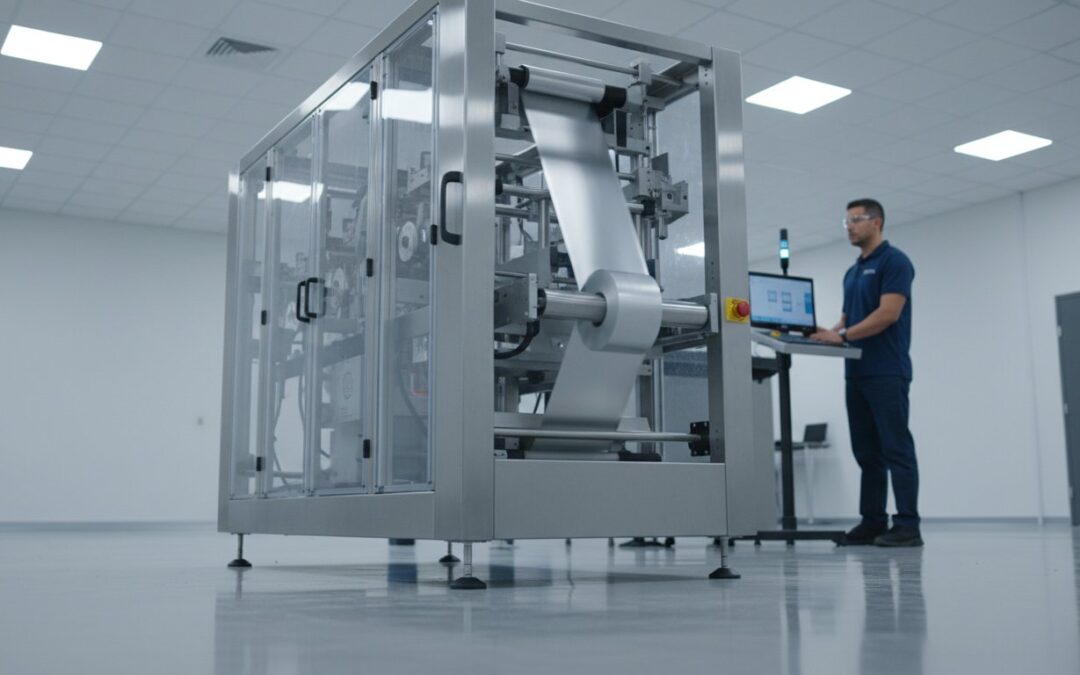
A VFFS machine turns a flat roll of film into finished, filled and sealed bags in one vertical pass: it forms the film into a tube, drops product in from above, then seals and cuts each bag. It is one of the two main types of form fill seal machines, and typical models run about 30 to 120 bags per minute. If you pack snacks, coffee, powders or frozen food into retail-size bags, this is usually the machine doing it.
We have been building and supporting bagging equipment in Taylor, Texas since 1978, and the VFFS questions we hear most come from plants making a jump. Some are hand-scooping into premade pouches and can’t hire fast enough. Others run open mouth or valve baggers for 50 lb sacks and want to add a 2 lb retail line. In both cases, a vertical form fill seal machine is often the right step, but only if the bag size, product and filler are matched to it. A fast machine paired with the wrong filler is still a slow line.
Below, I’ll walk through how a VFFS machine works, the components that decide its performance, and the difference between intermittent and continuous motion. You’ll also find the bag styles and products it handles, an honest comparison with other bagging equipment, a buying checklist and the maintenance habits that prevent most seal problems.
| Spec | Intermittent motion VFFS machine | Continuous motion VFFS machine |
|---|---|---|
| How the film moves | Stops for each cross seal | Keeps moving while jaws travel with it |
| Typical speed | Up to roughly 60–80 bags/min | 100 to 150+ bags/min on small bags |
| Best for | Powders, heavier fills, frequent changeovers | High-volume snacks, candy, small single-product runs |
| Seal dwell time | Longer, easier on tough films | Shorter, needs well-matched film |
| Cost and complexity | Lower | Higher |
| Typical bag weights | Single-serve up to about 10 lb | Mostly small to mid-size retail bags |
Speeds are typical industry ranges. Real output depends on bag length, fill weight, product flow, film and filler.
How a VFFS machine works, from film roll to sealed bag
Every VFFS machine runs the same loop, top to bottom, over and over. Once you can picture that loop, troubleshooting and buying both get easier.
Film unwind and transport
The cycle starts at the back of the machine, where a roll of flat film sits on an unwind spindle. A dancer arm or brake keeps tension steady so the film doesn’t wrinkle or snap. Pull belts on either side of the forming tube grip the film and draw it down, measuring out one bag length per cycle.
On printed film, an eye-mark sensor reads a registration mark on each repeat so the artwork lands in the same place on every bag. Without registration, logos drift and you end up cutting through the brand name.
Forming the tube and back seal
The film travels over a forming collar, sometimes called a shoulder, which folds the flat web around a hollow forming tube. The two edges meet at the back, and a heated vertical seal bar presses them together to make the long back seal.
The collar and tube set the bag width. Change the bag width and you change the forming set, which is why quick-change forming sets matter so much on multi-product lines.
Filling, cross sealing and cutting
A filler mounted above the forming tube drops a measured dose of product down the tube into the bag below. Horizontal sealing jaws then close across the film tube. In one stroke they seal the top of the filled bag, seal the bottom of the next bag, and a knife inside the jaws cuts the two apart.
The finished bag drops onto a take-away conveyor, and the cycle repeats. On a well-tuned vertical form fill seal machine, this whole sequence takes well under a second for small bags.
Timing is everything here. The filler has to finish dropping product before the jaws close, or you trap product in the seal and get a leaker. That is why the best VFFS machine setups treat the filler and bagger as one system with shared controls, rather than two machines bolted together and hoping to stay in sync.
Key components of a vertical form fill seal machine
The frame and controls look similar across brands. The real differences sit in four places: the forming set, the sealing system, the controls and options, and the filler on top.
Forming set: collar and tube
The forming set is the most bag-specific part of any VFFS machine. A collar built for one film thickness and bag width will track poorly with another, so expect one forming set per bag width.
A useful rule for pillow bags: the film web width is roughly twice the finished bag width plus the back seal allowance, often about an inch for a fin seal. Checking that math before you order film saves a lot of trial and error on startup.
Sealing jaws: fin, lap and cross seals
The back seal comes in two styles:
- Fin seal: the film’s inside faces seal together and stand up like a fin. It works with almost any sealable film and is the most common choice.
- Lap seal: one edge overlaps the other and seals inside to outside. It uses slightly less film but needs a film that seals on both faces.
Cross seals are made by heated jaws with serrated or flat faces. Most machines use constant heat, while impulse and ultrasonic sealing suit specific films and products. Temperature, pressure and dwell time all have to match the film’s sealant layer, and that match is where most leaking bags come from.
Controls, registration and options
A modern VFFS machine runs on a PLC with a touchscreen, servo-driven pull belts and stored recipes for each bag and product. Options worth knowing about include:
- Gas flushing with nitrogen to extend shelf life for coffee, nuts and snacks.
- Date and lot coders mounted on the film path.
- Hole punches for hang-tab bags and zipper applicators for resealable packs.
- Static eliminators and product-in-seal detection for dusty or fine products.
The filler on top of the VFFS machine
The VFFS machine forms and seals the bag, but the filler decides how accurately product goes in. Choose it based on the product:
- Auger fillers for non-free-flowing powders such as flour, spices and protein powder.
- Multihead weighers for snacks, candy, frozen food and other irregular solids.
- Volumetric cup fillers for uniform, free-flowing products like rice, sugar and seeds.
- Liquid pumps or piston fillers for sauces, soups and pastes.
For powders, the auger vs gravity question deserves real attention. We compare the two in Auger vs Gravity Filler for Powders: A Performance and ROI Comparison, including accuracy and cost per bag.
Intermittent vs continuous motion VFFS machine designs
Motion type is the biggest single decision after bag size. It sets your speed ceiling, your price and how forgiving the machine is with difficult films.
Intermittent motion
In an intermittent motion VFFS machine, the film stops briefly while the cross-seal jaws close. That pause gives the seal more dwell time, which helps with thick laminates, heavier fills and dusty powders that need time to settle before sealing.
Intermittent machines are simpler, cheaper and easier to maintain. For most powders, coffee, rice and mid-size bags, they are the sensible default. A 1 lb coffee bag running at 40 bags a minute on an intermittent VFFS machine is a very typical, very reliable setup.
Continuous motion
A continuous motion machine never stops the film. The jaws move down with the film while they seal, often on rotating or box-motion mechanisms, so output climbs to 100 bags per minute and beyond on small packs.
The trade-off is complexity and cost. Continuous machines need a fast, accurate filler, consistent film, and operators who understand how to tune them.
Which motion type fits your line
My rule of thumb:
- Below about 60 bags per minute, buy intermittent unless your product or film specifically needs otherwise.
- Above about 80 bags per minute on light, free-flowing product, continuous motion usually pays for itself.
- Between those numbers, test your product on both before committing.
Bag styles and products a VFFS machine handles
A big reason the VFFS machine dominates retail packaging is flexibility. One machine can make several bag styles and run many products with the right forming set and filler.
Bag styles
The most common styles are:
- Pillow bags: the simplest and cheapest, with a back seal and two cross seals.
- Gusseted bags: side gussets add volume and a more boxy shape.
- Quad seal bags: sealed corners give a crisp, premium look that stands up on shelf.
- Flat bottom or block bottom bags: a square base lets the bag stand on its own.
- Stick packs and sachets: narrow single-serve packs for sugar, drink mixes and supplements.
Gusseted, quad seal and flat bottom bags need extra forming hardware, so confirm the styles you want before the machine is built.
Bag size and weight limits
Most retail VFFS lines handle bags from small single-serve packs up to around 10 lb. Larger, heavy-duty machines with wide forming sets can go further, but past that point the film, seal strength and filler start to work against you. If your heaviest bag is 25 lb or more, look hard at premade bags on an open mouth line instead.
Bag length is set by how far the pull belts draw the film each cycle, so it changes with a recipe setting. Bag width is fixed by the forming set, which is why width, not length, drives most tooling costs.
Products by category
We see a vertical form fill seal machine used across food and non-food lines:
- Snacks and confectionery: chips, pretzels, popcorn, nuts, candy, dried fruit.
- Powders and granules: coffee, sugar, flour, spices, protein and drink mixes.
- Frozen food: IQF vegetables, fruit and seafood.
- Grains and pet food: rice, pasta, beans, kibble and treats.
- Industrial and hardware: screws, small parts, seeds and fertilizer.
Film choices
Film choice depends on barrier, shelf life and how the bag will be displayed. Common options include polyethylene, polypropylene, laminated and metallized structures, and compostable films. Higher-barrier laminates protect coffee and snacks from oxygen and moisture but need tighter seal settings, so bring your film spec into the machine conversation early.
VFFS machine vs other bagging equipment
A VFFS machine is the right answer for retail-size bags made from roll film. It is not the right answer for every bag, and we’d rather tell you that before you buy. Fill weight, product type and how the bag will be handled after filling usually point clearly to one technology or another.
VFFS vs HFFS and premade pouch systems
Horizontal form fill seal (HFFS) machines and flow wrappers move product sideways through the film rather than dropping it. They suit solid, fragile or oriented items such as candy bars, baked goods and medical devices that shouldn’t be dropped.
Premade pouch systems fill bags that arrive already formed, often with zippers and spouts. They cost more per bag but give premium packaging without forming hardware. For simpler premade bags filled by hand or on a scale, a standalone bag sealing machine closes them cleanly at low volumes.
When an open mouth bagging machine is the better fit
Once fill weights climb past roughly 10 lb, roll-film bags become less practical. An open mouth bagging machine fills premade bags from about 10 to 110 lb and handles feed, seed, grain, aggregates and chemicals that would overwhelm a retail VFFS line.
Many of our customers run both: a VFFS machine for small retail packs and an open mouth bagger for 25 and 50 lb sacks of the same product.
When a valve bag filler wins
Fine, dense powders such as cement, stucco and flour often go into valve bags. A valve bag filler fills through a small self-closing valve, packs the product tightly and keeps dust down. The result is a square, stable bag that stacks well, which a film bag of the same weight can’t match.
How to choose a vertical form fill seal machine
Choosing a vertical form fill seal machine comes down to five questions: what bags, how fast, what product, what film, and how it fits the rest of your line. Settle those before you compare quotes.
Throughput and bag size
Start with bags per minute at your largest and smallest bag sizes, not the headline speed on a brochure. Factor in film roll changes, product changeovers and cleaning time. We size most lines to run at 70 to 80 percent of a machine’s rated speed so there is margin for the real world.
List every bag width, length and style you plan to run in the next few years. Each width needs a forming set, and some styles need extra hardware.
Product, film and sanitation
Send product samples and film specs to any supplier you are serious about. Testing shows how your product flows through the tube, whether it dusts into the seal area, and what seal settings your film needs.
For food, check product-contact surfaces, washdown ratings and how quickly the forming set and jaws come off for cleaning. Frozen and wet products need components built for cold, damp rooms.
Line integration and automation
A VFFS machine sits in the middle of a line. Upstream you need an infeed conveyor or bucket elevator to keep the filler stocked, ideally with level sensors so the filler never runs dry or overflows. A starved filler is one of the most common reasons a fast bagger underperforms in the field. Downstream, an inline checkweigher rejects light or heavy bags before they reach the case packer, and metal detection is standard on most food lines.
At the end of the line, cases or bags still need stacking. A robotic bag palletizer takes that job off operators once volumes justify it. How far to automate is a payback question, and we walk through the math in Manual vs. Automated Bagging Systems: The 2026 ROI & Efficiency Guide.
Budget and total cost
A VFFS machine typically costs anywhere from around $30,000 for a basic intermittent model to well over $200,000 for a high-speed continuous system with a multihead weigher. The filler, forming sets, gas flush and integration can add as much as the bagger itself. Compare total installed cost and expected film savings, not just the machine price.
Roll film is usually cheaper per bag than premade bags, and that difference adds up fast at retail volumes. Industry reports commonly cite film and material savings of 5 to 30 percent when plants move from older equipment or premade bags to a modern VFFS machine, though your number depends on bag design and baseline. Our team can scope a complete line around form fill seal equipment and the baggers you may already run.
VFFS machine maintenance and troubleshooting
Most VFFS machine downtime comes from a handful of predictable causes. A short daily routine prevents most of them.
Daily and weekly care
We recommend operators:
- Clean the sealing jaws and knife each shift to remove product and film buildup.
- Check pull belts for wear and glazing, which cause slipping and uneven bag lengths.
- Inspect the forming collar for nicks or scratches that tear film.
- Confirm seal temperatures match the film’s recipe after every changeover.
- Lubricate and inspect moving parts on the schedule in the manual.
Common problems and fixes
The most frequent complaints have simple causes:
- Film tracking off center: check roll alignment, tension and belt wear before adjusting the collar.
- Leaking or weak seals: verify temperature, pressure and dwell against the film spec, and look for product in the seal area.
- Inconsistent bag weights: usually a filler or product flow issue, not the VFFS machine itself.
- Product bridging in the tube or funnel: add vibration, adjust filler timing, or reconsider the filler type.
When a problem keeps coming back, a field service visit to retune the whole line is usually cheaper than chasing symptoms one shift at a time.
Spare parts to keep on hand
A short list of spares keeps a vertical form fill seal machine running through a night shift without waiting on freight:
- Cutting knives and anvils for the cross-seal jaws.
- Heater cartridges and thermocouples for the vertical and horizontal seal bars.
- Pull belts, since worn belts are a top cause of short or uneven bags.
- Teflon tape or seal covers if your jaws use them.
Stocking these costs little compared with a lost shift, and it lets operators fix the most common failures in minutes.
VFFS machine FAQs
What does a VFFS machine do?
How fast is a vertical form fill seal machine?
What is the difference between a VFFS machine and an HFFS machine?
How much does a VFFS machine cost?
What bag sizes can a vertical form fill seal machine make?
How accurate is a VFFS machine?
Ready to scope a VFFS machine for your product? Call our team at 512-352-3694 or request a quote with your product, bag size and target speed, and we’ll recommend the right machine, filler and line layout.
Recent Comments