

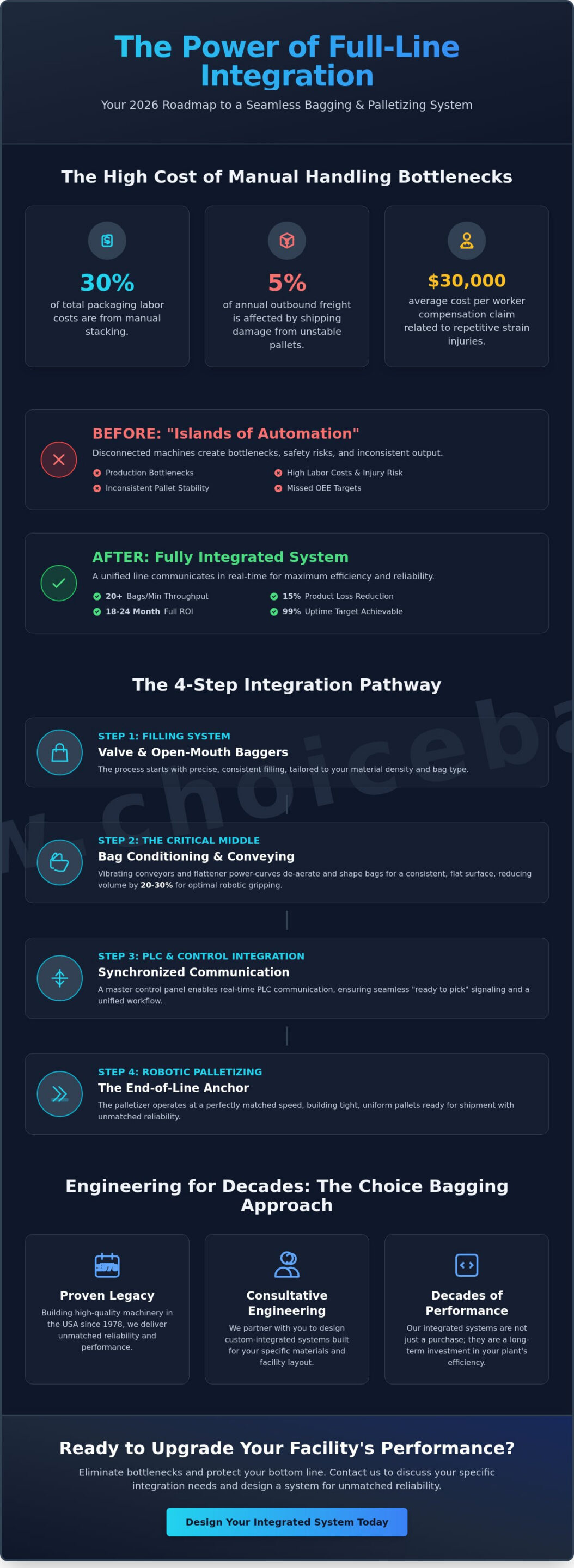
Data from 2023 industrial reports shows that manual stacking accounts for up to 30% of total packaging labor costs. You likely recognize that manual handling is the primary bottleneck in your facility, often resulting in inconsistent pallet stability and shipping damage that affects up to 5% of annual outbound freight. Integrating palletizer with bagging line equipment is the definitive solution to eliminate these variables and protect your bottom line. We’ve built high-quality machinery in the USA since 1978, and we’re committed to being your partner in achieving unmatched reliability and performance.
This 2026 technical guide provides the roadmap to master the strategic steps for connecting your filling and stacking stages. You’ll learn how to achieve a seamless, hands-off production line that reaches a throughput of 20+ bags per minute while reducing product loss by up to 15%. We’ll examine the critical hardware transitions, PLC communication protocols, and safety standards required for a reliable installation. If you’re ready to upgrade your facility’s performance, contact us today to discuss your specific integration needs.
Key Takeaways
- Learn how integrating palletizer with bagging line systems through real-time PLC communication eliminates manual bottlenecks and meets 2026 production standards.
- Discover why bag conditioning—including de-aerating and flattening—is the critical technical requirement for consistent robotic stacking success.
- Understand how to synchronize valve bag fillers or open-mouth systems with master control panels to ensure seamless “ready to pick” signaling.
- Identify how material density and bag type dictate the specific palletizing speed and grip needed to maintain high throughput and reliability.
- Explore a consultative engineering approach to building integrated systems that are designed for decades of dependable performance.
Why Full-Line Integration is Critical for 2026 Production Standards
Integrated bagging lines function as a single, unified organism where filling, sealing, and stacking components communicate in real-time. In the current industrial environment, achieving 99% uptime requires more than just high-quality individual machines. It demands a synchronized workflow. A modern Palletizer serves as the anchor of the end-of-line process, ensuring that the speed of the bagging machine matches the capacity of the stacking unit without human intervention.
Integrating palletizer with bagging line components removes the human variable from the final stage of production. Rising industrial overhead costs, which increased by 4.5% in 2023 according to Bureau of Labor Statistics data, make manual stacking a significant financial liability. Automation isn’t just about speed; it’s about predictable performance and the reliability that Choice Bagging Equipment has delivered to clients since 1978.
To better understand how these systems work together in a real-world environment, watch this helpful video:
The ROI of Connecting Filling and Stacking
Labor remains the highest variable cost in bagging operations. Replacing two manual stackers with one robotic palletizing system typically results in a full ROI within 18 to 24 months based on current industrial wage trends. Beyond simple wages, integration prevents the “bottleneck effect” where a slow human stacker forces the upstream filler to idle, wasting valuable machine hours. Consistent throughput keeps your production moving at 100% capacity. Additionally, automating the heavy lifting reduces the $30,000 average cost per worker compensation claim related to repetitive strain and back injuries. When the machines communicate, the entire plant operates more safely and efficiently.
Moving Beyond Semi-Automated Limitations
“Islands of automation” occur when a filler and a palletizer operate independently without shared controls. This lack of communication leads to missed OEE (Overall Equipment Effectiveness) targets and unexpected downtime. By 2026, market demands will require facilities to maintain 24/7 operational capability to meet just-in-time delivery schedules. A unified line allows for precise data tracking, ensuring every pallet is stacked with the professional aesthetics required for brand reputation and shipping safety. Tight, uniform pallets reduce product damage during transit by 15% compared to hand-stacked loads. If you’re ready to modernize your facility, contact us to discuss a custom layout designed for your specific material needs.
The Critical “Middle”: Conditioning and Conveying for Robotic Success
Successful execution when integrating palletizer with bagging line systems depends on what happens between the fill cycle and the stack cycle. Bags exiting a filler are rarely ready for a robot’s high-speed precision. They often contain trapped air and unevenly distributed material, making them rounded or “pregnant” in the center. A robotic End of Arm Tool (EOAT) requires a consistent, flat surface to maintain a secure grip and build a stable load. Without proper conditioning, 15% of pallet loads may fail during transit due to shifting layers. We’ve built our reputation as a trusted manufacturer since 1978 by focusing on this transition to ensure unmatched reliability and performance.
Bag Flattening and De-aeration
Square, flat bags create the most stable pallet footprints. To achieve this, we integrate vibrating conveyors that settle material toward the bottom and sides of the bag. This mechanical settling can reduce bag volume by 20% to 30%, which allows for much denser pallet patterns. Bag flattener power-curves are also essential. These dual-belt systems compress the bag to a consistent thickness, ensuring the robot always finds the pick-point at the expected height. This level of predictability is a core requirement for meeting OSHA robotic safety standards, as it prevents pick errors that could lead to equipment collisions or dropped product. You can invest confidently knowing your bags are conditioned for maximum stack integrity.
Orientation and Pacing Systems
Properly integrating palletizer with bagging line components requires sophisticated orientation and pacing. High-quality bag handling conveyors serve as the backbone of this transition. Before the robot can engage, the bag must be oriented correctly for the specific layer pattern. A bag kicker or turner mechanism rotates the bag 90 or 180 degrees so the gussets or seals face the correct direction for the pick-station. Pacing is equally vital. Bags must arrive at the pick-point at timed intervals, typically 4 to 6 seconds apart, to prevent line bottlenecks. Precise pacing ensures the robot never “hunts” for a moving target, which maintains a smooth, continuous flow. If you’re planning a new facility, you can contact us now to discuss your specific layout requirements. We’re also your partner in ensuring your robotic palletizing systems deliver the durability you expect from a Made In The USA solution.
PLC and Control Integration: Synchronizing the Bagger and Robot
A seamless production line depends on a centralized master control panel. This hub coordinates the bagger, conveyor system, and palletizer to act as a single, cohesive unit. Integrating palletizer with bagging line systems requires precise timing and reliable data exchange. The master panel eliminates the risk of “islands of automation” where machines work at cross-purposes. The bagger must communicate its status constantly. When a bag reaches the designated pick-up point, the bagger sends a “ready to pick” signal to the robotic controller. This handshake ensures the robot only moves when a product is indexed correctly, preventing dry cycles or collisions with moving machinery.
Safety interlocking is a critical component of this integration. If a safety gate opens or an emergency stop is triggered, the entire line must halt within milliseconds. We utilize Category 3 safety circuits to ensure the robot and bagger stop simultaneously. This prevents equipment damage and protects operators from moving parts. The HMI (Human Machine Interface) serves as the primary window into the line’s health. Operators monitor bag counts, cycle times, and alarm histories from one screen. High-quality complete packing line solutions utilize these interfaces to reduce human error by up to 45% compared to systems with fragmented controls.
Establishing the Communication Protocol
Modern systems rely on Ethernet/IP or Modbus TCP/IP for high-speed data exchange. These protocols allow for complex “rejection logic” that maintains product quality. If an integrated check-weigher detects a bag is 150 grams underweight, the PLC triggers a divert arm before the bag reaches the robot. This ensures only perfect bags reach the finished pallet. Similarly, “line full” sensor logic prevents upstream bottlenecks. When the palletizer is busy with a pallet discharge or a wrapper cycle, the robot signals the bagger to pause. This logic prevents pile-ups and keeps the floor clear of loose product.
Programming for Product Changeovers
Efficiency drops when operators must manually adjust multiple machines for different products. We design systems where a single recipe selection on the HMI adjusts the bagger’s fill parameters and the robot’s stacking pattern at once. Software flexibility is essential for End-of-Arm Tooling (EOAT). The robot’s code must accommodate various bag dimensions and weights without requiring physical hardware modifications. Choice Bagging Equipment provides specialized field service to help customers program these complex transitions. Our team ensures your software logic is as durable and dependable as our machinery. For custom integration assistance, contact us to speak with an applications engineer.
Matching Palletizing Technology to Your Specific Bagging Requirements
Successful execution in integrating palletizer with bagging line depends on how well the end-of-line equipment communicates with the filler. Every material has a different angle of repose inside the bag, which changes how it sits on a pallet. When you select a palletizing solution, you aren’t just buying a machine; you’re investing in a system that maintains the professional appearance and stability of your product during transit.
Conventional high-level palletizers remain the workhorses for operations exceeding 2,000 bags per hour. These systems use stripping plates to form layers and compress them from all four sides, ensuring a tight, rectangular load. Conversely, robotic arms are the standard for rates of 10 to 25 bags per minute. They offer unmatched flexibility for facilities handling multiple SKUs or bag sizes, as software adjustments replace mechanical changeovers. Material density plays a critical role here. High-density products like minerals allow for tighter, shorter stacks, while low-density materials require specific end-of-arm tooling to prevent bag deformation during high-speed movements.
Integrating with Valve Bag Systems
The primary challenge with valve bag fillers is the valve tuck. If the valve isn’t properly handled or if the bag isn’t square after filling, the pallet becomes unstable. Robotic cells are ideal for these high-density applications because they can be programmed to “pat” or shape the bag before placement. This creates the square-stacking profile necessary for safe double-stacking in a warehouse. For maximum filling-side precision, refer to our technical resources on valve bag fillers to ensure your bags are consistently filled and ready for the robot.
Integrating with Open Mouth Systems
When transitioning from bag sealing or sewing to the palletizer, bag top orientation is the priority. Open mouth bags often have “ears” or excess material at the seal that can interfere with a clean stack. Robotic software uses bag overlap patterns to tuck these tops under the next bag in the layer. This technique preserves the aesthetic quality of the pallet and prevents the seals from snagging during shipment. It’s a level of detail that turns a standard pallet into a professional representation of your brand.
Footprint is often the final hurdle. Many bagging rooms were designed before automation was a standard requirement, leaving less than 500 square feet for upgrades. Robotic robotic palletizing systems typically offer a 30% smaller footprint compared to conventional high-level units. This compact design allows us to fit automated solutions into tight corners or between existing pillars without disrupting the workflow of your current bagging line. Our team focuses on integrating palletizer with bagging line layouts that maximize your available floor space while maintaining safe operator access.
Ready to optimize your facility’s throughput with a system built to last decades? Contact us for a professional consultation on your palletizing needs.
Engineering for Decades: The Choice Bagging Approach to System Integration
Since 1978, Choice Bagging Equipment has operated on a simple foundation: Performance and Reliability. We understand that integrating palletizer with bagging line systems isn’t just about moving product from one point to another. It’s about securing your facility’s throughput for the next twenty years. Our engineering team approaches every project through a consultative lens, ensuring that the robotic palletizing systems we deploy are perfectly calibrated to your specific bag weights, material characteristics, and pallet patterns.
Sourcing your entire line from a single US-based partner eliminates the coordination headaches that often occur when mixing different manufacturers. We provide a unified support model that protects your investment long after the initial installation. This comprehensive approach includes:
- Precision-engineered parts that minimize unplanned downtime.
- Expert field service for on-site troubleshooting and maintenance.
- System upgrades designed to adapt to your changing production needs.
- Direct access to the engineers who designed your specific layout.
The “Partner” Advantage in Integration
Choosing a partner is different from hiring a vendor. A vendor delivers a machine; a partner delivers a result. At CBE, we maintain a “Made in the USA” quality standard for all structural components. We use heavy-duty steel and industrial-grade electronics that withstand 24/7 operation in harsh environments. This commitment to domestic manufacturing ensures tighter quality control and faster response times for technical support. You can learn more about our history and values by exploring Why Choice Bagging Equipment? and our commitment to quality since 1978.
Getting Started with Your Integration Project
Success begins with a clear assessment of your current floor operations. We recommend conducting a facility audit to identify where manual labor creates 15% or higher turnover rates or where safety risks are most prevalent. Integrating palletizer with bagging line components is a strategic move that solves these bottlenecks permanently.
Our engineers specialize in layout design for tight spaces, often fitting full automation into footprints that other suppliers find impossible. We don’t guess; we use precise measurements to ensure your new system integrates seamlessly with existing upstream equipment. When you’re ready to move away from manual stacking and improve your bottom line, contact the engineering team to start your consultation. We’re ready to help you build a system that lasts for decades.
Modernize Your End-of-Line Efficiency
Achieving 2026 production standards requires a seamless connection between your filling and stacking operations. Success hinges on the middle stages of conditioning and conveying, alongside precise PLC synchronization that keeps the bagger and robot in perfect harmony. By integrating palletizer with bagging line systems correctly, you eliminate manual bottlenecks and ensure consistent throughput across valve, open mouth, and bulk bag formats. Choice Bagging Equipment has manufactured reliable equipment since 1978, providing the durability your facility demands for long-term performance.
Our expert US-based engineering and field support teams understand the technical nuances of full-line automation. We don’t just sell machines; we’re your partner in long-term success. We’ve proven our integration capabilities across hundreds of installations, ensuring every component works together for decades. Don’t leave your productivity to chance when you can invest in a system built for unmatched reliability. Let’s build a solution that grows with your business and keeps your operators safe.
Request a custom integration quote for your production line
Frequently Asked Questions
Can I integrate a new palletizer with an older, manual bagging machine?
Yes, you can integrate a new palletizer with manual equipment by installing a powered takeaway conveyor system. Since 1978, we’ve helped facilities transition from manual stacking to automated systems by bridging the gap between old and new technology. Adding a 10 foot conveyor section allows the palletizer to receive bags at a consistent pace. This upgrade typically reduces physical labor requirements by 75 percent.
How much floor space is typically required for a robotic palletizing cell?
A standard robotic palletizing cell requires approximately 150 to 250 square feet of floor space. This footprint includes the robot arm, safety fencing, and pallet discharge zones. Compact designs can save 30 percent more space compared to traditional high-level palletizers. We ensure your layout maintains clear access for forklifts and maintenance personnel to keep your facility running smoothly. Reach out to our team at https://www.choicebagging.com/contact/ for a custom layout consultation.
What is the maximum speed (bags per minute) achievable with an integrated line?
Integrating palletizer with bagging line systems allows for speeds reaching 20 to 24 bags per minute on a single robotic arm. High speed conventional palletizers can exceed 40 bags per minute for high volume operations. Efficiency depends on bag weight and material consistency. Our systems maintain 99.9 percent uptime during peak production cycles to ensure you hit your daily targets.
Do I need a specialized programmer on-site to run an integrated bagging line?
You don’t need a specialized programmer on-site because modern systems use intuitive Human Machine Interfaces (HMIs). Operators can select pre-programmed stacking patterns with 3 clicks on a touchscreen. We provide comprehensive training that empowers your current staff to manage the line confidently. Our technical support team remains available for remote troubleshooting to ensure your performance stays high without the need for expensive consultants.
How does the system handle different bag sizes on the same production line?
The system handles multiple bag sizes through adjustable end-of-arm tooling and digital recipe management. A robotic gripper can adjust its width in under 2 seconds to accommodate 20 pound or 50 pound bags. This flexibility allows one integrated line to process 5 different product SKUs with minimal downtime. It’s a reliable way to maximize your equipment investment while maintaining high-quality stacking results.
What happens to the line if the palletizer encounters an error or runs out of pallets?
Integrated lines use interlock signals to pause the bagging machine if the palletizer stops. This prevents bag pile-ups on the conveyor and protects your equipment from damage. An alarm notifies the operator 5 minutes before the pallet magazine is empty. Once you clear the error or reload pallets, the system resumes operation from the exact point it stopped, maintaining your production flow.
Is it better to use a conventional palletizer or a robotic arm for bag stacking?
Robotic arms are better for facilities requiring flexibility and compact footprints, while conventional palletizers excel at high speed, uniform stacking. Robotic systems offer 98 percent reliability across various stacking patterns. Conventional machines are the standard for operations exceeding 30 bags per minute. We’ve manufactured durable solutions for both categories since 1978 and can help you choose the best fit.
How does integration improve the weighing accuracy of the bagging machine?
Integrating palletizer with bagging line components often includes a checkweigher that provides real-time feedback to the scale. If a bag deviates by more than 0.5 percent from the target weight, the system automatically adjusts the feeder. This closed-loop communication reduces product giveaway by 20 percent. It ensures every pallet contains exactly the weight promised to your customer, protecting your profit margins.
Recent Comments