

If your production line processes 50,000 units annually, an overfill error of just 1% means you’re giving away 500 bags of free product every single year. This hidden drain on your profitability often stems from a lack of precision in your weighing system. You likely know that consistent fill weights are the backbone of a professional packaging operation. When weights fluctuate, it doesn’t just hurt your margins. It compromises pallet stability and risks non-compliance penalties for underfilling. At Choice Bagging Equipment, we’ve focused on industrial reliability since 1978, and we understand that precision is non-negotiable.
This guide provides the technical steps for calibrating bagging machine scales to achieve zero-drift performance and eliminate material waste. You’ll learn the industry best practices for load cell maintenance and the specific steps required to ensure every bag meets your target weight. We’ll also cover how to document your calibration process to satisfy quality audits and maintain equipment durability. If you need immediate assistance with your equipment or want to improve your facility’s efficiency, contact us to speak with an expert about your specific application.
Key Takeaways
- Protect your profitability by quantifying the high cost of product giveaway and the regulatory risks associated with underfilled bags.
- Follow a systematic technical guide for calibrating bagging machine scales to ensure your equipment accounts for hardware weight and delivers precise measurements.
- Learn to mitigate environmental interference, such as thermal drift and mechanical vibration, which can distort load cell readings and disrupt production.
- Implement a dual-layered calibration schedule that combines daily operator oversight with monthly audits to maintain long-term reliability and compliance.
- Understand the engineering advantages of heavy-duty, Made in the USA weighing solutions designed to maintain accuracy despite demanding industrial conditions.
The Financial Impact of Bagging Scale Accuracy
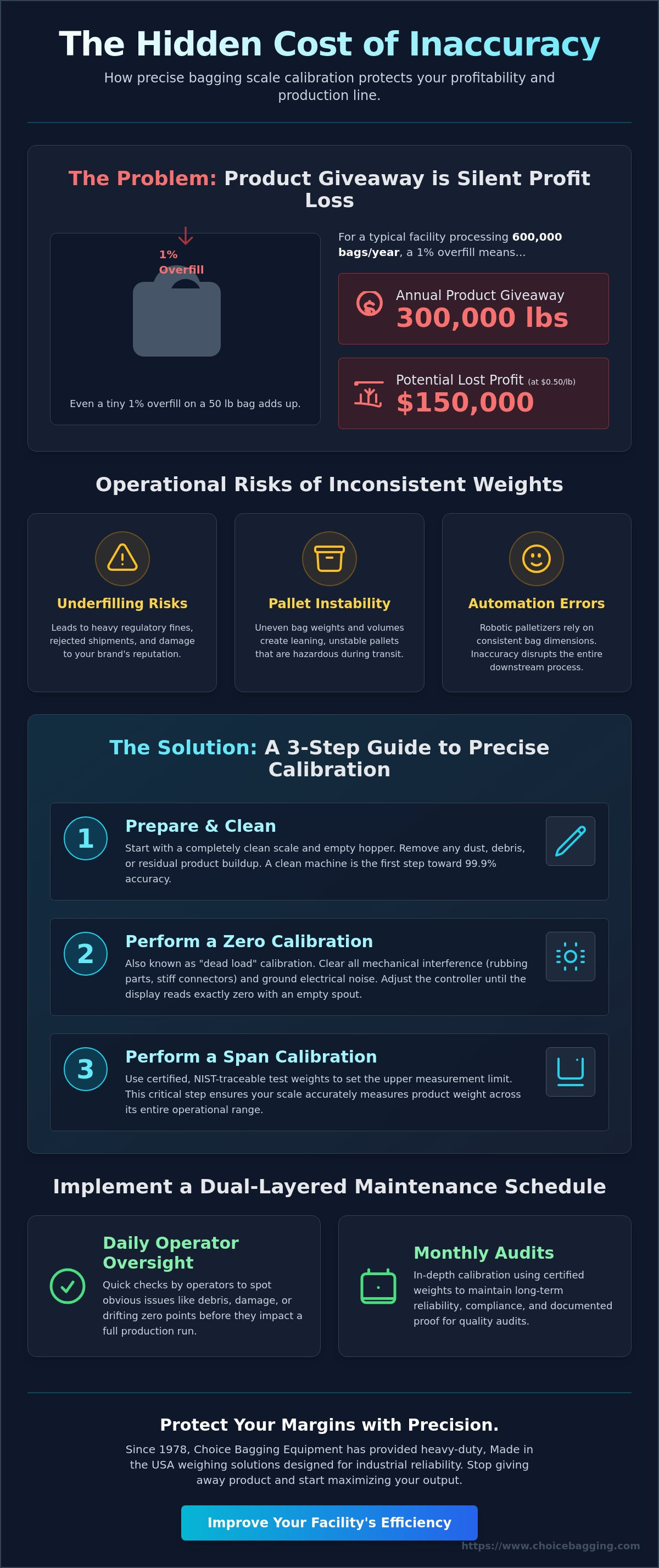
Precision in industrial weighing is the difference between a profitable year and a stagnant one. When you’re calibrating bagging machine scales, you’re protecting your margins from the hidden drain of product giveaway. A 1% overfill on a standard 50-pound bag might seem negligible in the moment. However, for a facility processing 600,000 bags annually, that 1% represents 300,000 pounds of product handed out for free every year. If your material costs $0.50 per pound, you’re losing $150,000 in pure profit.
Underfilling presents an even greater risk to your operations. Regulatory agencies enforce strict guidelines regarding net weight accuracy, and falling short of these standards results in heavy fines or retailers rejecting entire shipments. You can’t afford a “close enough” mentality in high-volume environments where every gram counts toward your reputation and legal standing. Regularly calibrating bagging machine scales ensures that your production line stays within legal tolerances and maintains customer trust. To understand the technical foundations of this process, it helps to review What is Calibration? and how it establishes a traceable standard for measurement.
To better understand the practical application of these adjustments, watch this helpful video:
Calculating Your ROI on Calibration
Estimating your annual loss requires a simple formula: (Total Annual Bags) x (Average Overfill per Bag) x (Cost per Pound of Product). This calculation often reveals that inaccuracy is the most expensive part of your production line. Achieving a 0.5% improvement in accuracy can pay for a new valve bag filler in under a year. You must find the balance between scale sensitivity and throughput. While higher sensitivity can sometimes slow down the fill cycle, modern weigh controllers use advanced algorithms to maintain high speeds without sacrificing the precision required for profitability.
Weight Consistency and Pallet Stability
Inconsistent weights create physical problems in the warehouse. When bags vary in weight, they also vary in volume and shape. This leads to uneven layers and leaning pallets that are prone to tipping during transit. A precise weigh controller ensures that every bag is a uniform building block for your stack. This uniformity is vital if you plan to integrate robotic palletizing systems, which rely on consistent bag dimensions to build stable, shippable loads. Reliable weight control is the first step toward a fully automated, efficient downstream process.
Step-by-Step Guide to Calibrating Bagging Machine Scales
Precision in automated packaging requires a disciplined approach to maintenance. Calibrating bagging machine scales isn’t just a technical requirement; it’s a fundamental step to protect your profit margins. Before you begin, ensure the scale is completely clean and the hopper is empty. Even a small buildup of dust or residual product can create a weight offset that compromises the entire process. Since 1978, we’ve helped operators understand that a clean machine is the first step toward 99.9% accuracy.
Performing a Zero Calibration
Zero calibration, often called dead load calibration, accounts for the weight of the hardware itself. You must clear all mechanical interference from the load cells. Check for rubbing parts, stiff flex connectors, or accumulated debris. The International Society of Weighing and Measurement provides industry standards that emphasize the removal of external vibrations during this phase. Adjust the weigh controller until the display reads exactly zero with an empty spout. If the numbers fluctuate, you’re seeing signal “noise.” You must identify and ground electrical interference or stabilize the mounting structure before moving to the next step.
Span Calibration with Certified Weights
You must use NIST-traceable test weights for span calibration. Don’t rely on “known” bags of product. Product bags lose moisture or gain weight based on humidity, which introduces errors. For a machine rated for 50 lb bags, you should test the scale at 25%, 50%, and 100% of the target weight. This ensures the load cell remains linear across its entire range. Hang the weights, enter the precise value into the controller, and verify the reading. If a 50 lb weight registers as 50.2 lbs, the 0.4% error will lead to 200 lbs of giveaway for every 1,000 bags filled.
Fine-Tuning the Weighing Algorithm
The final step involves optimizing how the controller handles material in motion. You need to adjust “pre-act” or “cutoff” values to account for the product that’s still in the air after the feed gate closes. This “material in flight” is a constant in gravity or belt-fed systems. Set your bulk feed to deliver 90% of the weight quickly, then transition to a dribble feed for the final 10%. This two-stage process allows the scale to settle and catch the exact target weight. If you’re switching between products with different bulk densities, you’ll need to recalibrate these cutoff points to maintain consistency. If you need technical assistance with these settings, our team provides expert field service to optimize your system performance.
Once the settings are locked, run a dynamic test with actual product flow. Verify the first 10 bags on a separate floor scale to confirm the controller’s logic matches reality. If you have questions about your specific setup, contact us for a professional consultation.
Factors That Compromise Bagging Scale Accuracy
Maintaining peak performance requires more than just a sturdy machine; it demands an understanding of the external variables that threaten your weight tolerances. Even a system built for unmatched reliability can see its precision drift due to factors outside the control box. In a 2023 industry survey of packaging facilities, nearly 40% of weight inaccuracies were traced back to environmental interference rather than component failure. Since 1978, we’ve seen how minor changes in the plant environment lead to major production headaches. It’s why we emphasize that the process of calibrating bagging machine scales must account for the specific conditions of your facility. A machine that tests perfectly in a quiet lab will perform differently on a vibrating production floor.
Mechanical vibration is a primary culprit. When a 10,000-pound forklift passes or a heavy-duty mixer cycles nearby, the resulting floor tremors travel directly into the load cells. These vibrations create signal noise that the controller may misinterpret as actual weight, leading to variances of 0.5% or more. Similarly, dust accumulation acts as a silent killer for sensitive weighing linkages. A layer of fine particulates as thin as a business card can increase mechanical friction. This causes the scale to hang or respond slowly during the critical final cutoff phase, resulting in inconsistent fills.
Air pressure fluctuations also play a major role in your daily output. Most industrial systems rely on pneumatic gates to stop product flow. If your plant air drops below the required 90 PSI, the response time of the cutoff gate slows down. This delay, even if it’s only 50 milliseconds, results in consistent overfills that eat into your profit margins over a 10-hour shift.
Environmental Interference and Mitigation
Protecting your equipment starts with physical isolation. We recommend installing the bagging machine on a dedicated, reinforced concrete pad that is physically separated from the rest of the warehouse floor. This prevents kinetic energy from nearby machinery from reaching the scale. Proper electrical grounding is also vital to prevent electromagnetic interference from disrupting low-voltage load cell signals. Additionally, operators must account for thermal drift, which is the expansion of load cell components due to ambient heat. In facilities where temperatures swing by 20 degrees Fahrenheit between morning and afternoon, regular checks are necessary to maintain a 99.9% accuracy rate.
Material Characteristics and Flow
The product you’re bagging is rarely static. Hygroscopic materials, such as certain fertilizers or salts, absorb moisture from the air, which increases their density mid-shift. If you don’t adjust your settings, a 50-pound bag can quickly become a 51-pound bag. Managing “bridging” or erratic flow in the scale throat is another challenge. When material clumps, it creates a “slug” of product that hits the scale all at once, overwhelming the sensors. You’ll need to adjust your dribble-feed settings when switching between fine powders and 4-millimeter granules to ensure the flow remains predictable. If you encounter persistent issues, our field service team can help optimize your setup for specific material behaviors.
Establishing a Maintenance and Calibration Schedule
Precision in industrial weighing isn’t a one-time event; it’s a disciplined routine. Calibrating bagging machine scales requires a rigorous schedule to ensure long-term accuracy and protect your bottom line. While a full calibration should occur at least every 30 days, operators must perform basic functional checks at the start of every shift. This two-tiered approach prevents small drifts from becoming major production errors.
Maintaining a detailed logbook is essential for meeting ISO 9001 requirements and passing quality audits. Every calibration event should record the date, the technician, the test weights used, and the “as-found” versus “as-left” measurements. If a load cell shows signs of non-linearity or physical deformation, it’s time to replace it. Attempting to keep calibrating bagging machine scales with compromised components is a temporary fix that leads to costly product giveaway or underweight bags. Keeping critical spares, such as load cells and pneumatic actuators, on hand can reduce emergency downtime by as much as 48 hours.
The Daily Inspection Checklist
Daily maintenance prevents 15% of common scale errors caused by mechanical interference. Operators should start each shift with a visual check of all fasteners, pneumatic hoses, and linkages to ensure nothing has loosened due to vibration. It’s vital to test air pressure consistency for slide gate actuators; fluctuations often cause 2% to 5% variance in fill weights. Finally, clean the fill spout and bag clamp pads. Product buildup on these surfaces adds “dead load” to the scale, which can interfere with the zeroing process and lead to inaccurate cycles.
Legal for Trade vs. Process Weighing
Understanding the difference between process weighing and commercial transactions is critical for compliance. If you sell your product based on the weight recorded by the machine, the scale must be “Legal for Trade.” This requires the equipment to meet NIST Handbook 44 requirements, which govern the design and accuracy of scales used in commerce. These scales must be certified by local weights and measures officials. For internal process weighing, standard industrial accuracy is often sufficient, but the stakes remain high for quality control. Choice Bagging Equipment provides the technical expertise and field service support needed to ensure your equipment meets these strict industry standards.
Minimize your downtime and maintain peak accuracy with professional support. Contact us today to schedule a service consultation.
High-Performance Weighing Solutions from Choice Bagging Equipment
Choice Bagging Equipment builds machinery designed to withstand the most demanding industrial environments. We understand that calibrating bagging machine scales is only effective if the hardware itself is stable. Our engineering team prioritizes heavy-duty load cells and “Made in the USA” components to ensure your system remains accurate long after the initial setup. Our equipment handles the vibration and dust of a 24-hour production cycle without losing its edge. We build performance and reliability into every frame we weld.
Accuracy isn’t just about the software; it’s about the physical integrity of the weighing system. CBE machines use high-capacity load cells that resist the environmental stressors found in chemical, mineral, and food processing plants. This robust construction prevents the structural flexing that often causes weight fluctuations in lighter, imported equipment. When you invest in a CBE system, you’re investing in a platform designed for decades of repeatable precision.
Precision Engineering Since 1978
Since 1978, our design philosophy has centered on simplicity and durability. We minimize moving parts to reduce mechanical wear, which is the primary cause of scale drift. Our open mouth baggers excel in high-dust applications where inferior machines often fail. We don’t just act as a supplier. We’re a long-term partner dedicated to your operational success. Our engineers focus on creating equipment that’s easy to maintain, ensuring your team can keep the line moving with minimal intervention.
Many facilities struggle with legacy equipment that no longer meets modern accuracy standards. We solve this by upgrading older systems with modern weighing controllers and high-speed processors. These retrofits provide the digital precision of a new machine at a fraction of the cost. By integrating advanced electronics with our proven mechanical designs, we help you achieve tighter weight tolerances and reduce product giveaway.
Expert Support and Field Service
Accuracy requires more than just good hardware. It demands consistent maintenance and technical expertise. Our field service technicians specialize in calibrating bagging machine scales during complex system integrations, ensuring every component works in harmony. We provide on-site calibration services and comprehensive operator training to keep your facility running at peak efficiency. Properly trained staff can identify weighing issues before they lead to significant product loss.
- Access genuine replacement parts to ensure scale longevity and performance.
- Schedule routine on-site inspections to maintain certified weight accuracy.
- Utilize our technical support for troubleshooting complex integration challenges.
Don’t let inaccurate weights erode your profit margins. We provide the tools and the talent to keep your bagging operation precise. Ready to improve your accuracy? Contact Choice Bagging Equipment today for a consultation on your next weighing project.
Maximize Your Operational Efficiency and Product Yield
Precision in your bagging operation isn’t just a technical requirement; it’s a financial necessity. Neglecting the process of calibrating bagging machine scales leads to costly product giveaway and inconsistent package weights that can damage your brand’s reputation. By establishing a strict maintenance schedule and understanding the environmental factors that compromise accuracy, you protect your bottom line and ensure every bag meets exact specifications.
Choice Bagging Equipment provides the industrial strength and technical expertise you need to maintain peak performance. We’ve been manufacturing reliable bagging equipment since 1978, delivering Made in the USA quality and durability to facilities across the globe. Our team offers expert field service and integration support to ensure your system operates flawlessly from day one. You don’t have to settle for “close enough” when precision is within reach. Contact our specialists today to discuss how our high-performance weighing solutions can transform your production line.
Request a Quote for a High-Precision Bagging System
We look forward to helping you achieve unmatched accuracy in your facility.
Frequently Asked Questions
How often should I calibrate my bagging machine scale?
You should calibrate your bagging machine scale at least once every 6 months or after every 2,000 hours of operation. Harsh industrial environments or high-volume facilities often require monthly checks to maintain peak accuracy. Since 1978, we’ve found that a consistent schedule prevents 95% of common weight-related production errors.
What is the difference between a zero calibration and a span calibration?
Zero calibration sets the scale’s baseline when it’s completely empty, while span calibration adjusts the scale’s accuracy using a known test weight. You’ve got to perform a zero calibration first to ensure the machine reads exactly 0.00. Span calibration then confirms the scale correctly measures a specific load, such as a 50 lb certified weight.
Why does my bagging scale drift during the middle of a shift?
Scale drift usually happens because of temperature fluctuations or material buildup on the weighing components. A 10 degree change in ambient temperature can shift load cell readings by 0.1% or more. Regularly cleaning the scale assembly every 4 hours prevents debris from adding ghost weight to your measurements and ensures performance remains steady.
Can I use a pre-filled bag of product to calibrate my scale?
No, you shouldn’t use a pre-filled bag because its actual weight is unverified and can vary by 2% or more. Calibrating bagging machine scales requires NIST-traceable certified test weights to ensure precision. Using a bag of product introduces human error and compromises your equipment’s long-term reliability and durability.
What are the signs that a load cell needs to be replaced?
Erratic weight readings that fluctuate by more than 0.5 lbs while the scale is empty indicate a failing load cell. If the scale fails to return to zero after a discharge, the internal strain gauge is likely damaged. Physical corrosion or frayed cables on the 4-wire leads also signal it’s time for a replacement.
How does air pressure affect the accuracy of my bagging scale?
Fluctuations in plant air pressure cause inconsistent cylinder movements, which leads to weight variances of 0.25 lbs or higher. Most pneumatic bagging systems require a steady 80 to 90 PSI to function correctly. If your compressor drops below this range, the cutoff gates may close slowly and cause overfills.
What is product giveaway and how do I calculate it?
Product giveaway is the extra material put into a bag beyond the labeled weight to avoid underweight penalties. You calculate it by subtracting the target weight from the actual average weight of 10 consecutive bags. If you average 50.2 lbs for a 50 lb bag, your giveaway is exactly 0.2 lbs per bag.
Do I need a “Legal for Trade” scale for my bagging operation?
You need a Legal for Trade scale if you sell your product directly based on the weight measured by the bagging machine. These scales must meet NIST Handbook 44 standards and undergo certification by local officials. If you’re unsure about your specific requirements, contact us to discuss your application with an expert.
Recent Comments