
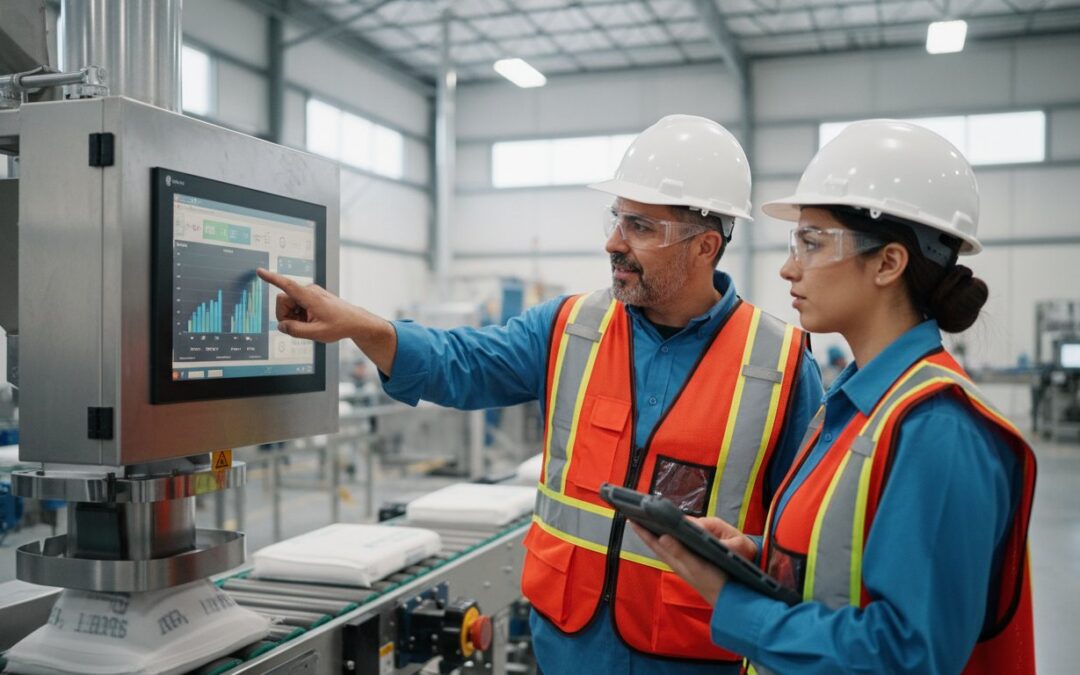
A 2023 industry report indicates that human error accounts for 70% of unplanned downtime in modern packaging facilities. You likely feel the pressure of high staff turnover and the constant need for retraining. This bagging machine operator training guide addresses those challenges by establishing a professional standard for excellence. It’s difficult to maintain consistent bag weights and zero product waste when your team lacks a clear roadmap for success. Precision is non-negotiable.
We understand that your bagging operation depends on reliability and precision. Since 1978, we’ve helped facilities establish safer work environments while reducing maintenance costs through proper daily care. You’ll learn how to achieve consistent throughput and accurate weights through a structured, professional training framework. We’ll explore daily safety checks, calibration techniques, and the preventative maintenance steps that keep your production line moving. If you need specific technical assistance, you can always contact us to speak with an expert.
Key Takeaways
- Cultivate a safety-first culture by mastering PPE standards and protocols that protect your workforce and prevent avoidable equipment downtime.
- Utilize this bagging machine operator training guide to execute precise daily startup and HMI calibration routines for maximum production accuracy.
- Enhance machine longevity by identifying mechanical distress signals and implementing rigorous “Clean, Inspect, Lubricate” (CIL) maintenance procedures.
- Master material handling techniques to balance speed and weight precision across various product types, from fine powders to large granules.
- Learn how to scale your operations effectively through professional training and the integration of high-performance robotic systems.
Establishing the Safety-First Mindset in Industrial Bagging
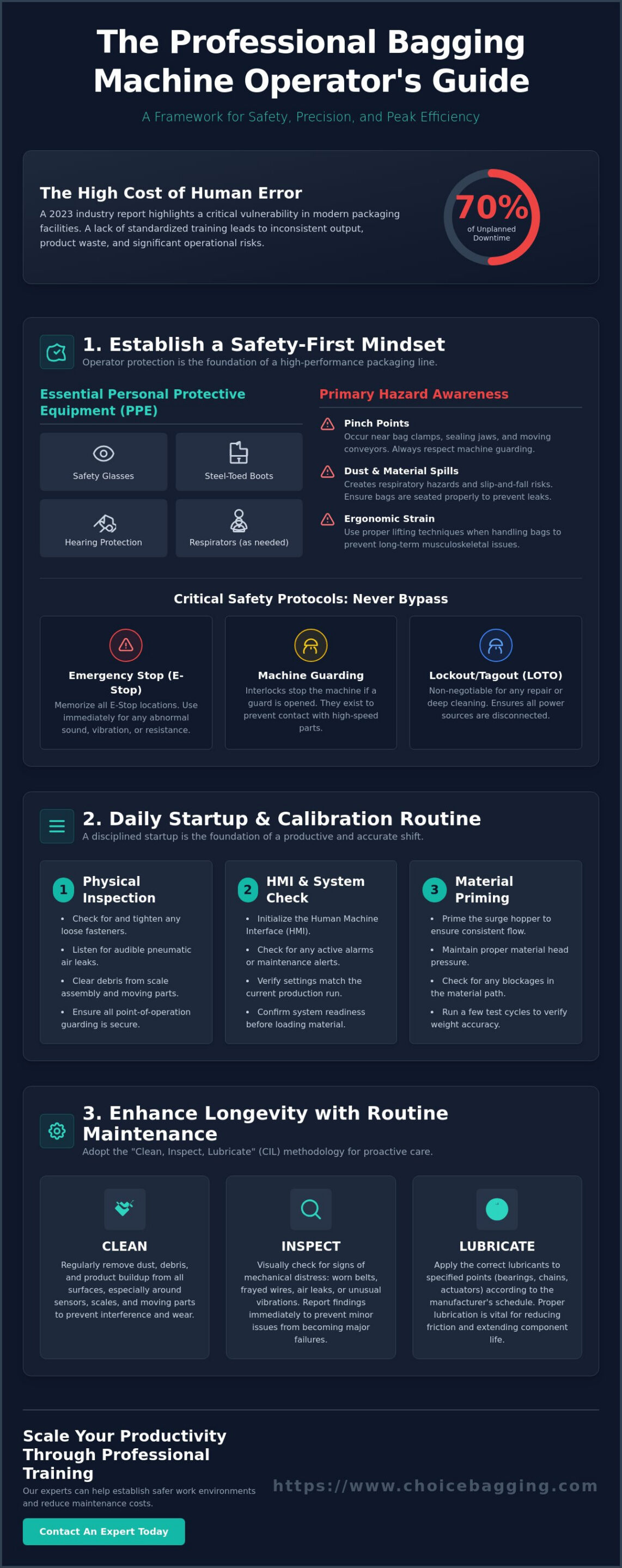
Industrial bagging environments demand more than just mechanical knowledge. They require a rigorous safety-first mindset. Since 1978, Choice Bagging Equipment has prioritized operator protection as the foundation of high-performance packaging lines. A comprehensive bagging machine operator training guide serves as the first line of defense against the 15% increase in industrial accidents often seen in untrained crews. Proper training protects your personnel and prevents costly damage to precision components. Operators must recognize that every safety feature, from machine guarding to electronic interlocks, exists to ensure they return home safely every day. Never bypass an interlock. These systems are designed to stop the machine instantly if a guard is opened, preventing contact with high-speed internal components.
To better understand the interface and safety controls of modern equipment, watch this helpful video:
Operators must memorize the location of every Emergency Stop (E-Stop) button before their first shift. In a crisis, muscle memory saves lives. If any abnormal vibration, sound, or mechanical resistance occurs, the protocol is immediate: hit the E-Stop and notify a supervisor. Reliable operation depends on these quick reactions. Standard Personal Protective Equipment (PPE) usually includes steel-toed boots, safety glasses, hearing protection, and high-visibility vests. Depending on the material being processed, respirators or specific glove types may also be required by OSHA standards.
Primary Hazards in Bagging Operations
Pinch points are the most common physical threat. These occur primarily near bag clamps and moving bag handling conveyors. A Vertical form fill sealing machine, for example, uses high-pressure sealing jaws that can cause severe injury if safety protocols are ignored. Dust management is equally critical. Improperly seated bags lead to product leakage. This creates respiratory hazards and slip-and-fall risks. Operators must also practice safe lifting techniques. Handling 50-pound bags repeatedly without proper form leads to ergonomic strain and long-term musculoskeletal issues.
Lockout/Tagout (LOTO) for Operators
LOTO is a non-negotiable requirement for any intervention beyond simple operational adjustments. Clearing a jam requires a full operational stop, but any repair or deep cleaning necessitates a complete energy isolation. Operators must distinguish between a temporary pause and a locked-out state where all power sources are physically disconnected. If the equipment requires technical repair, contact our field service team to ensure the work is done safely. The operator’s responsibility in LOTO is to act as the primary guardian of their own physical safety by ensuring no machine can be energized while they are within a hazard zone.
Standard Operating Procedures for Daily Startup and Calibration
A disciplined startup routine is the foundation of a productive shift. Operators should begin with a thorough physical inspection of the equipment within the first 30 minutes of arriving at the station. Vibration from daily use can loosen fasteners over time; checking these prevents mechanical failure during peak production. Inspect all pneumatic lines for audible air leaks, as even a small drop in pressure can affect the speed of bag clamps or cutoff gates. Clear any debris or spilled material from the scale assembly and moving parts to ensure unobstructed movement. Adhering to OSHA’s general requirements for all machines ensures that all point-of-operation guarding is secure before the power-up sequence begins.
Once the physical check is complete, initialize the Human Machine Interface (HMI). Look for active alarms or maintenance alerts that may have been logged during the previous shift. Prime the surge hopper so the material head pressure remains consistent. This consistency is vital for flow rate accuracy and overall system reliability. Before starting full-scale production, run a single “test bag” to verify the system’s performance. This step is a core component of any effective bagging machine operator training guide, as it identifies issues before they result in wasted packaging or product.
Valve Bag vs. Open Mouth Startup Nuances
Operators must understand the unique requirements of different filling systems. For valve bag fillers, check the spout for wear or buildup and ensure the fill tube is centered. If you’re running open mouth baggers, confirm the bag magazine is aligned and the vacuum cups are clean. If your line includes bag sealing or bag sewing machine systems, allow the equipment to reach its specific operating temperature. A cold sealer often results in weak bonds that fail during transport.
Weight Calibration and Scale Zeroing
Precision is the primary goal of any bagging machine operator training guide. You must “zero” the scale at the start of every shift to account for the tare weight of the bag and any residual dust on the scale. Adjust the “In-Flight” compensation settings based on the current material density. This setting accounts for the amount of product still in the air after the cutoff gate closes. Scale calibration must happen daily to prevent profit loss through product giveaway or underweight shipments. If you notice consistent weight fluctuations, it’s time to contact our service team for a technical consultation.
Troubleshooting and Routine Maintenance for Operators
Operators serve as the primary defense against unplanned downtime. A critical part of any bagging machine operator training guide involves developing an ear for the equipment. A healthy machine produces a consistent, rhythmic hum. If you hear grinding, high-pitched squealing, or irregular thumping, it signals mechanical distress that requires immediate attention. Identifying these sounds early prevents a minor vibration from turning into a catastrophic failure.
Choice Bagging Equipment advocates for a strict “Clean, Inspect, Lubricate” (CIL) routine. Since 1978, our data shows that 70% of premature component failures stem from neglect of these basic steps. Operators should clear dust buildup every four hours to prevent overheating and ensure moving parts remain visible. During inspection, look for loose fasteners or frayed belts. Lubrication must follow the manufacturer’s schedule exactly; applying too much grease can be as damaging as applying too little because it attracts abrasive particulates.
Distinguishing between operator-level adjustments and technician-level repairs is vital for safety and efficiency. Operators can typically handle bag alignment, weight calibrations, or basic resets. However, if a fault involves opening high-voltage cabinets or internal gearbox repairs, you must call a qualified technician. Document every event in a detailed shift log. Tracking recurring faults helps identify patterns, such as a specific sensor failing every 200 hours, which allows your team to schedule maintenance before the machine stops unexpectedly.
Common Mechanical Faults and Fixes
Clearing jams often occurs at the spout or bag applicator. You should always use non-marring tools to clear obstructions to avoid scarring the metal surfaces or damaging the weighing mechanisms. Air pressure is another frequent culprit for poor performance. If pressure drops below 80 PSI, fill speeds will lag and bag seals may fail. Monitor your gauges constantly during the shift. When a component shows visible wear, order replacement parts immediately to avoid an emergency shutdown. If you are unsure of a fix, contact our support team for guidance.
Electrical and Sensor Maintenance
Dust is the enemy of automation. Clean photo-eyes and proximity sensors with a soft, dry cloth to eliminate “ghost” faults where the machine incorrectly detects a bag. When the HMI displays an error code, follow the specific troubleshooting tree provided in your technical manual. Keep control panels closed and ensure ventilation fans are spinning. A dust-free panel stays cool and prevents circuit board failure, ensuring your equipment delivers the unmatched reliability we’ve promised since 1978.
Mastering Material Handling: Accuracy and Flow Control
Material behavior dictates every setting on your production line. A professional bagging machine operator training guide emphasizes that fine powders behave like liquids when aerated, while large granules rely on gravity. You must adjust flow control valves to manage these specific behaviors. Speed is useless without precision. If you run a system at 100% speed but miss weight targets by 2%, you sacrifice profit and product integrity. Precision requires a balance between rapid filling and controlled finishing.
Environmental factors also play a critical role in consistency. Humidity increases friction in powders and can cause bridging in the hopper. A 15% increase in ambient humidity often results in material clumping, which slows down the fill cycle. Maintain a consistent material temperature to keep flow rates stable. If material “puffs” or aerates during the fill cycle, you should increase the settle time by 1.5 seconds or use a de-aeration probe. These adjustments stabilize the product before the final seal is applied.
Achieving Accurate Weights with Different Material Types
Gravity fillers work best for free-flowing grains and pellets. Air-fed systems are necessary for sticky or extremely fine materials that require fluidization to move. For technical depth on precision for specific materials, consult our Valve Bag Filler guide. To hit target weights consistently, configure the “bulk” feed to reach 90% of the target weight quickly. The “dribble” feed then tops off the last 10% at a significantly slower rate. This dual-stage approach ensures accuracy within 0.5% of the total target weight.
Bag Integrity and Sealing Standards
Inspect every seal for strength and visual quality. Weak seals lead to product loss and contamination during transit. When operating a bag sewing machine, watch for thread breakage or skipped stitches. These issues often stem from incorrect needle tension or the use of blunt needles. Ensure the fill volume doesn’t exceed 95% of the bag’s total capacity. Over-stuffing creates excessive stress on the closure and increases the risk of bag failure during palletizing. Following these steps in your bagging machine operator training guide ensures a professional end-product that stands up to the rigors of shipping.
Scaling Productivity Through Professional Training and Support
Success in 2026 requires more than just high-quality hardware. It demands a workforce that can bridge the gap between manual labor and sophisticated automation. Moving from manual bagging to semi-automated or robotic palletizing systems changes the operator’s role fundamentally. Instead of physical strain, the focus shifts to system oversight and throughput optimization. Choice Bagging Equipment works alongside your team to ensure this transition doesn’t lead to downtime or safety lapses. We’ve seen that facilities with structured training programs see a 25% increase in consistent hourly output compared to those relying on informal peer-to-peer instruction.
A comprehensive bagging machine operator training guide is only effective if it evolves with your facility. We focus on “Training the Trainer” to establish internal subject matter experts. This strategy ensures that your facility retains institutional knowledge even as staff turnover occurs. By empowering a lead operator, you create a first line of defense for troubleshooting; this reduces reliance on external service for minor adjustments and keeps the line moving during critical shifts.
The Path to Full Automation
Real efficiency gains happen when you understand how the bagging machine interacts with downstream conveyors and wrappers. Modern systems require precise timing; a delay at the bagger can cause a bottleneck at the palletizer. Operators must learn to monitor these integrated lines as a single unit rather than isolated machines. For those looking to scale, our Ultimate Guide to Choosing Your Equipment provides deep insights into selecting components that grow with your production needs. This shift from manual handling to automation monitoring is a critical milestone for any growing operation. It requires a bagging machine operator training guide that emphasizes software literacy and sensor alignment over traditional mechanical force.
Partnering with Choice Bagging Equipment
Choice Bagging Equipment has maintained a commitment to reliability and durability since 1978. We don’t just sell machines; we’re also your partner in long-term operational success. Our equipment is built to last decades, and our support matches that lifespan. Whether you need field service for complex production challenges or technical consultation for a line upgrade, our experts provide the stability your business requires. We prioritize performance and reliability in every interaction, ensuring your investment remains profitable for years to come.
Accessing professional support ensures your equipment continues to perform at peak capacity. We offer tailored training sessions that cover safety protocols, preventative maintenance, and high-level troubleshooting. Contact Choice Bagging Equipment today to schedule expert training or discuss your next equipment upgrade. Investing in your people is as vital as investing in your machinery. Our team is ready to help you build a safer, more efficient production environment through proven engineering and dedicated support.
Invest in Long-Term Operational Excellence
Adopting a rigorous bagging machine operator training guide is the most effective way to protect your personnel and your bottom line. Success in industrial bagging relies on a safety-first culture combined with strict adherence to daily calibration and startup protocols. Since 1978, Choice Bagging Equipment has manufactured reliable solutions that simplify these complex processes. Our machinery is proudly Made in the USA, ensuring you receive the durability required for decades of heavy use. We don’t just sell equipment; we provide expert engineering support to ensure seamless production line integration. By focusing on routine maintenance and precise material handling, your facility’s team will see a significant increase in accuracy and flow control. Trust in a partner that’s spent over 45 years refining the art of industrial packaging. It’s time to elevate your team’s competence and secure the unmatched reliability your business deserves.
Take the next step toward a more efficient facility today. Request a Professional Training Consultation or Equipment Quote to see how our expertise can transform your bagging operations.
Frequently Asked Questions
How often should bagging machine operators receive refresher training?
Operators should receive refresher training every 12 months to maintain peak safety and performance levels. This annual schedule ensures that staff stay updated on new safety protocols and equipment software updates. If a facility introduces a new bagging machine operator training guide or modifies its production line, you’ve got to conduct immediate retraining for all affected personnel to prevent accidents.
What is the most common cause of weight inaccuracy in industrial bagging?
Material accumulation on the weigh hopper or scale linkage causes 85% of weight inaccuracy issues in industrial bagging. Dust and debris can interfere with sensitive load cells, leading to drifting measurements over time. Regular cleaning and daily zero-calibration of the scale prevent these errors. Your bagging machine operator training guide should emphasize cleanliness as a core component of accuracy and equipment reliability.
Can one operator manage multiple bagging machines simultaneously?
A single operator can typically manage 2 to 3 automated bagging machines simultaneously if the systems include automatic bag placers and conveyors. For manual or semi-automated systems, one operator per machine is the standard to prevent fatigue and ensure safety. High-efficiency layouts often allow one person to oversee a dual-spout system while maintaining a production rate of 12 to 15 bags per minute.
What are the essential daily maintenance tasks an operator should perform?
Operators must perform a 5 point daily inspection including clearing dust from sensors, checking air pressure gauges for a steady 80 to 90 PSI, and verifying scale accuracy. You should also inspect the bag clamps for wear and ensure the emergency stop buttons function correctly. Spending 10 minutes on these tasks at the start of each shift prevents 40% of common mechanical failures during production.
How do I troubleshoot a bag that won’t stay on the spout during filling?
Check the pneumatic clamp pressure first, as it should typically maintain 60 PSI to secure the bag. If the pressure’s correct, verify that the bag’s gusset width matches the spout dimensions within a 5% tolerance. Worn rubber grips on the spout clamps are another frequent culprit; replace these every 6 months to ensure a reliable seal during high-speed filling operations.
What is the difference between a minor jam and a lockout/tagout requirement?
A minor jam involves clearing a simple obstruction from outside the machine’s guarded areas using tools like long-handled picks. Lockout/tagout (LOTO) is mandatory whenever an operator must bypass a safety guard or place any part of their body into the point of operation. Since 1978, we’ve emphasized that LOTO protocols must be followed for 100% of internal mechanical adjustments to prevent serious injury.
How does material density affect the training of a new operator?
Material density dictates the flow rate and settling time, which changes how an operator interacts with the HMI settings. For example, a material with a bulk density of 50 lbs per cubic foot flows differently than one at 20 lbs per cubic foot. Training must include specific instructions on adjusting bulk and dribble feed rates to account for these physical variations in the product.
What should I do if the bagging machine HMI shows an unknown error code?
Document the specific error code and the machine’s current state before attempting a reset. Consult the manufacturer’s technical manual for the 4 digit code definition or contact our support team for expert guidance. You can contact us directly to speak with a technician who can walk you through the resolution steps to minimize your downtime.
Recent Comments