

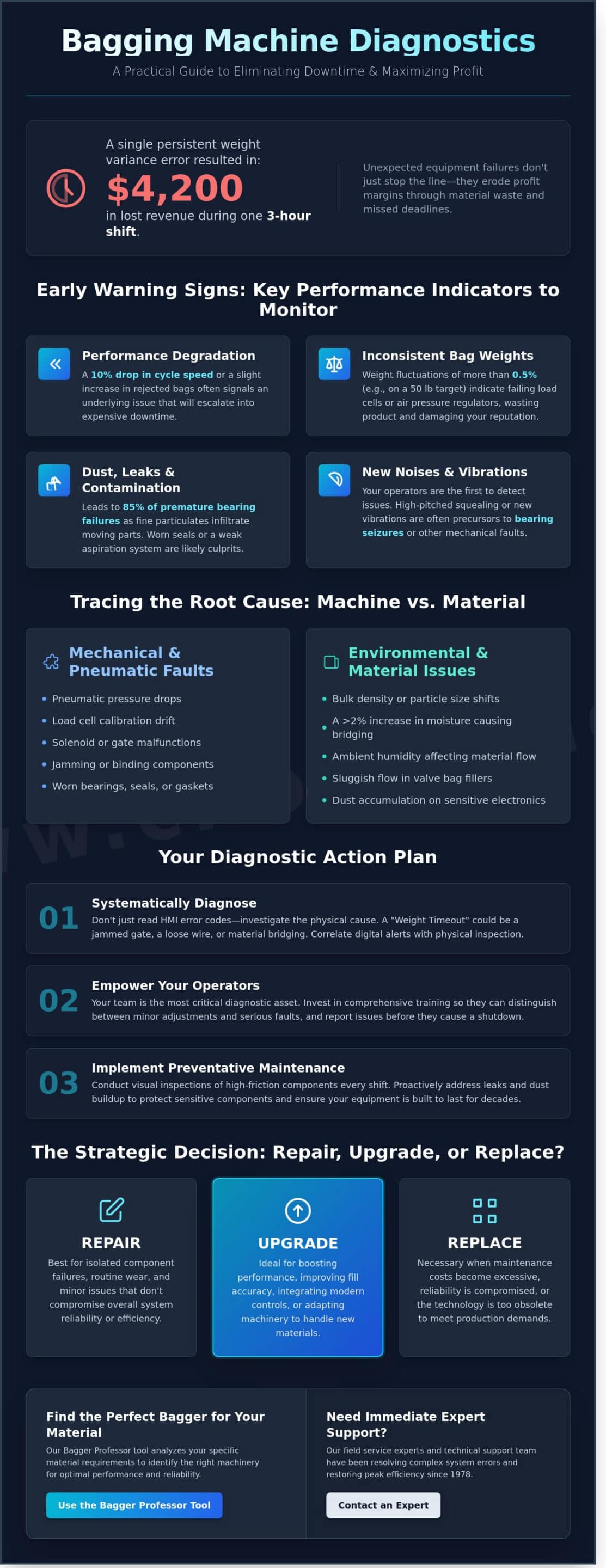
Last Tuesday, a packaging supervisor in Ohio watched 4,200 dollars in potential revenue vanish during a single three-hour shift because of a persistent weight variance error. You likely understand that frustration; an unexpected equipment failure doesn’t just stop the line, it erodes your profit margins through material waste and missed deadlines. Effectively troubleshooting bagging machine problems requires more than just a toolbox. It demands a systematic approach to identify whether the issue stems from pneumatic pressure drops or a simple calibration drift in the load cells.
Since 1978, we’ve helped operators restore their systems to peak efficiency by providing clear, technical guidance. This guide provides the diagnostic steps you need to eliminate downtime and ensure every bag meets your weight specifications. We’ll examine common mechanical failures, pneumatic safety checks, and solutions for inconsistent fills. If you’re still determining which equipment best fits your specific material requirements, our Bagger Professor tool can help you identify the right machinery. By the end of this article, you’ll have the expertise to reduce maintenance costs and maintain the unmatched reliability your production line requires. If you need immediate technical support, you can always contact us to speak with an expert.
Key Takeaways
- Learn to distinguish between sudden mechanical failures and gradual performance shifts to protect your production schedule from unexpected downtime.
- Master the essential diagnostic steps for troubleshooting bagging machine problems to resolve inconsistent fill weights and material flow issues like bridging.
- Identify how to stabilize pneumatic pressure and diagnose solenoid malfunctions to maintain the high-speed performance and durability of your industrial fillers.
- Discover preventative strategies to protect sensitive electronic components from dust accumulation and manage the impact of ambient humidity on material behavior.
- Evaluate the long-term ROI of repairs versus modern upgrades, or use the Bagger Professor tool to identify the right machinery for your specific application.
Identifying Common Symptoms of Bagging Machine Performance Issues
Effective troubleshooting bagging machine problems begins with a clear distinction between a catastrophic mechanical failure and gradual performance degradation. A total system shutdown is easy to spot, but the slow decline in efficiency often causes more long-term financial damage. Since 1978, we’ve observed that a 10% drop in cycle speed or a slight increase in rejected bags often signals an underlying issue that will eventually lead to a complete halt. You should monitor your hourly throughput daily to catch these trends before they escalate into expensive downtime.
Inconsistent bag weights are a primary indicator of system calibration issues or mechanical wear. If your target weight is 50 lbs and your output fluctuates by more than 0.5%, your load cells or air pressure regulators may be failing. These inconsistencies don’t just waste product; they compromise your reputation for reliability. Monitoring these deviations is the first step in maintaining the high-quality standards your customers expect.
To better understand the mechanics of identifying these issues, watch this helpful video:
Excessive dust and material leakage are often dismissed as simple housekeeping tasks, but they significantly impact mechanical longevity. Approximately 85% of premature bearing failures in industrial environments result from fine particulates infiltrating moving parts. If you notice dust accumulating around the bagging head, it’s a sign that seals are worn or the aspiration system is underperforming. Addressing these leaks immediately protects your investment and ensures your equipment remains built to last for decades.
Your operators are the most critical asset in your diagnostic toolkit. They’re the first to hear a new vibration or see a slight change in how a bag sits on the spout. Investing in comprehensive operator training ensures your team can distinguish between a minor adjustment and a serious mechanical fault. If your team needs advanced support, our field service experts provide the technical depth required to resolve complex system errors.
The Role of Material Characteristics in Equipment Faults
Changes in your material can mimic mechanical failures. If your bulk density shifts from 35 lbs/cu ft to 40 lbs/cu ft, your fill rates and accuracy will change instantly. Moisture content also plays a huge role; even a 2% increase in humidity can cause bridging in the hopper or sluggish flow in valve bag fillers. If you’re switching to a new product, use the Bagger Professor tool to ensure your current configuration matches the new material’s particle size and flow characteristics.
Diagnostic Indicators: Error Codes vs. Physical Signs
Modern Human Machine Interfaces (HMI) provide valuable data, but they don’t tell the whole story. An error code might indicate a “Weight Timeout,” but the physical cause could be a jammed gate or a loose wire. Understanding how a Vertical form fill sealing machine operates allows you to trace an HMI alert back to a physical component. Listen for high-pitched squealing or unusual rhythmic vibrations in the bagging head. These are often precursors to bearing seizures. Conduct a visual inspection of high-friction components every shift to catch wear before it stops production. For replacement components, you can order directly through our parts department to ensure compatibility and performance. If problems persist, contact us to speak with an engineer.
Troubleshooting Weight Inaccuracy and Material Flow Problems
Weight accuracy is the foundation of a profitable bagging operation. When troubleshooting bagging machine problems, you must first isolate the weighing system from external vibrations and mechanical interference. Even a minor mechanical bind or a stiff dust boot can cause weight fluctuations exceeding 0.25 pounds per bag. Ensure that the scale frame is completely independent of the main machine chassis. This prevents motor vibrations from distorting the electronic signal during the final stages of the fill cycle.
Load Cell Calibration and Maintenance
Zeroing your scale should be a daily protocol for every operator. Start by ensuring the weigh hopper is completely empty and free of residual material buildup. If the weight signal fluctuates on the controller, check for “noise” caused by poor shielding on load cell cables or proximity to high-voltage power lines. Since 1978, our field data shows that 60% of weighing errors stem from debris lodged between the load cell and the mounting plate. Clean these surfaces thoroughly before you consider replacing expensive components. If the scale still drifts by more than 0.1% of its total capacity, recalibrate the system using certified test weights to restore precision.
Addressing Flow Disruptions in the Hopper
Material flow physics often dictate your maximum bagging speed. Bridging occurs when material forms a structural arch over the outlet, while rat-holing creates a narrow channel that leaves stagnant product on the hopper walls. These issues are particularly common when handling cohesive powders in valve bag fillers. Check your agitator paddles for proper 90-degree alignment and ensure the drive motor is drawing its rated current. Poor venting also hinders flow; a clogged 10-micron dust filter can create backpressure that reduces fill rates by 15% or more.
Fine-tuning your dribble feed settings is essential for high-precision fills. This secondary flow stage should typically account for the final 10% of the target bag weight. If you’re seeing inconsistent “tails” at the end of a fill, use the Bagger Professor tool to verify that your current machine settings align with your specific material density and flow characteristics. Adjusting the dribble gate timing by as little as 0.5 seconds can often stabilize weights and reduce product giveaway significantly. For complex calibration issues that persist, you can contact our service team for a technical consultation.
Mechanical and Pneumatic Troubleshooting for Industrial Fillers
Pneumatic stability serves as the backbone of valve bag packer performance. When air pressure fluctuates by even 5 PSI, it disrupts the timing of fill cycles and reduces weight accuracy. Reliable operation depends on consistent air volume and quality. Troubleshooting bagging machine problems often starts with diagnosing cylinder lag. If an actuator moves slower than its 0.5-second design specification, you must check the solenoid valves. These components typically reach their end-of-life after 10 to 15 million cycles, leading to intermittent sticking or slow response times.
Mechanical alignment is equally critical for maintaining high-speed throughput, especially in open mouth bagging machines. A misalignment of just 0.25 inches in the bag-clamping assembly can cause misfeeds or improper fills that stop production entirely. Testing for air leaks in supply lines and actuators is a non-negotiable weekly task for maintenance teams. A single 1/16-inch leak in a pressurized line can waste 6.5 CFM of compressed air, which significantly increases utility costs and reduces the force available for mechanical movements. If you’re looking to match a specific material to the right equipment, use the Bagger Professor tool to identify the most compatible machine configuration for your application.
Pneumatic System Failures and Solutions
Inspect your FRL (Filter, Regulator, Lubricator) units every shift. Contaminants or moisture in the lines cause 70% of premature pneumatic component failures in industrial environments. If you experience low air pressure during peak production cycles, your plant’s main compressor or receiver tank may be undersized for the total demand. Replacing worn seals in pneumatic actuators restores operational speed and prevents the “stuttering” motion that ruins fill consistency. Choice Bagging Equipment provides high-quality parts to keep your systems running at 100% capacity since 1978.
Bag Sealing and Sewing Machine Alignment
Skipped stitches in bag sewing machine systems usually stem from incorrect needle-to-looper timing or improper thread tension. Troubleshooting bagging machine problems in the closing area also requires monitoring heat sealer temperature fluctuations. A variance of more than 10 degrees can result in weak seals or melted bag materials. Ensure proper bag presentation to the closing conveyor by calibrating the bag top guides. Misaligned guides cause 15% of all bagging line downtime due to jams. If your system requires expert technical support, contact us to speak with a seasoned engineer about your field service needs.
Environmental Factors and Preventative Maintenance Strategies
Success in troubleshooting bagging machine problems often starts with the air surrounding the equipment. Ambient humidity serves as a silent disruptor, especially for hygroscopic materials. When relative humidity climbs above 55%, powders like salt, sugar, or specific chemicals begin to absorb moisture and clump. This change in material behavior alters flow rates and causes weighing inaccuracies that look like mechanical failures but are actually environmental. Maintaining a controlled climate ensures the consistency of your product and the reliability of your machinery.
Managing the Production Environment
Dust accumulation is a primary cause of electronic failure in industrial settings. Fine particulate matter acts as insulation, trapping heat on circuit boards and increasing component failure rates by 22% in unventilated areas. You must implement effective dust extraction at the bagging head to prevent this buildup. Temperature fluctuations also impact pneumatic stability. Air seals and cylinders perform best at a constant 70 degrees Fahrenheit. If temperatures vary by more than 15 degrees, seal wear accelerates and air consumption becomes inefficient. Protecting sensitive sensors from industrial vibration is equally vital. Use dampening mounts to keep sensors within their 0.5mm operating tolerances to prevent false readings.
Proactive Maintenance for Longevity
Consistency is the hallmark of a professional operation. High-speed moving parts require strict lubrication schedules to prevent friction-based seizing. Beyond the bagger itself, you should regularly inspect downstream equipment like conveyors and stretch wrappers to prevent bottlenecks that force the bagging machine to idle. If your internal team is stretched thin, the value of professional field service audits cannot be overstated. A certified technician identifies wear patterns that daily operators might miss, often catching a minor part failure before it causes a major production halt.
Reliability requires a structured approach rather than a reactive one. Use this checklist to guide your team’s routine:
- Daily: Clear dust from sensors and check air pressure settings for consistency.
- Weekly: Inspect drive belts for fraying and grease primary bearings.
- Monthly: Recalibrate load cells and test all emergency stop circuits for safety compliance.
Establishing a critical spares inventory is your best defense against emergency downtime. Facilities that keep 100% of their wear items in stock, such as heating elements, suction cups, and fuses, reduce their mean time to repair by 40%. If you’re unsure which machine fits your specific environment, use the Bagger Professor tool to match equipment to your material properties. We’ve helped partners maintain peak performance since 1978 by focusing on these preventative details.
When to Repair, Upgrade, or Replace Your Bagging Equipment
Every piece of industrial machinery has a definitive lifespan. While consistent maintenance extends the life of your line, there comes a point where troubleshooting bagging machine problems costs more than investing in new technology. If your equipment requires major repairs more than twice a month or experiences downtime exceeding 15% of your scheduled production hours, your profitability is at risk. Modern automation solves chronic issues by replacing wear-heavy mechanical components with electronic precision and simplified designs.
Labor-related downtime is another critical factor in your ROI calculation. Statistics from recent industry reports suggest that labor shortages contribute to nearly 25% of unplanned production stops in manual bagging operations. Integrating robotic palletizing systems can increase your total throughput by 20% or more. This transition reduces the physical strain on your workforce and eliminates the bottlenecks often found at the end of the bagging line. Choice Bagging Equipment provides the expertise needed to integrate these systems into your existing workflow seamlessly.
The Path to System Upgrades
You don’t always need to replace an entire line to see results. Modernizing PLC controls on legacy bagging machines can significantly improve user interface reliability and data collection. Integrating newer weighing technology into existing frames often improves filling accuracy by as much as 0.5%, which reduces product giveaway. If your current material requirements have changed, use the Bagger Professor tool to identify the specific machine configurations that match your current needs. For operations ready for a total system overhaul, our bagging machine buyback program offers a professional way to recover capital from your used assets.
Partnering with a Trusted Manufacturer
Choice Bagging Equipment has focused on American-made durability since 1978. We build our machines to last decades, but maintaining that performance requires the right components. Accessing genuine parts ensures your equipment continues to meet original OEM specifications. Generic parts often lead to the very troubleshooting bagging machine problems you are trying to avoid. We aren’t just a supplier; we’re also your partner in long-term operational success.
Our team understands the complexities of line integration and material handling. If your equipment is no longer meeting your production goals, it’s time for a professional assessment. Request a Quote for a system audit today. We will help you determine the most cost-effective path forward, whether that involves a targeted upgrade or a complete equipment replacement.
Secure Your Production with Reliable Bagging Solutions
Mastering troubleshooting bagging machine problems ensures your facility maintains consistent throughput and weight accuracy. Focus on identifying mechanical wear early and implementing rigorous preventative maintenance strategies to avoid costly pneumatic failures or material flow disruptions. Choice Bagging Equipment has been a trusted manufacturer since 1978, delivering Made in the USA reliability and performance to industrial operations worldwide. It’s vital to treat your equipment as a long-term investment. If you’re currently evaluating your line’s efficiency, use the Bagger Professor tool to identify the specific machinery that matches your material characteristics. We’re more than a supplier; we’re your partner in operational excellence. Our team provides expert field service and integration support to keep your bagging line running at peak capacity for decades. Don’t wait for a total system failure to address performance gaps. Our seasoned experts are ready to help you optimize every aspect of your filling process. Get Expert Technical Support for Your Bagging Line and invest confidently in your facility’s future.
Frequently Asked Questions
Why is my bagging machine consistently overfilling or underfilling?
Incorrect feeder settings or material build-up cause weight inconsistencies in most industrial applications. Check the bulk and dribble flow settings to ensure the transition occurs at exactly 90% of your target weight. Accumulated dust on the scale linkage creates friction, which often leads to a 2% to 5% variance in bag weights during a single shift.
What causes the bags to break or tear during the filling process?
Improper spout sizing or excessive drop velocity typically leads to bag failure and product waste. If a bag is 10% smaller than the required volume for your specific product density, the internal pressure causes seams to burst. You can use the Bagger Professor tool at https://www.choicebagging.com/bagger-professor-tool/ to ensure your machine and bag type are correctly matched for your material.
How often should I calibrate my bagging machine scales?
You should calibrate your scales every 30 days or after 50,000 cycles to maintain peak accuracy. Environmental factors like floor vibrations or temperature shifts of 15 degrees can drift the zero point over time. Regular calibration ensures your equipment maintains the high-quality performance Choice Bagging Equipment has delivered since 1978.
Why is the pneumatic cylinder moving slower than usual?
Worn seals or inadequate air pressure are the primary reasons for sluggish cylinder movement in pneumatic systems. Ensure your compressor provides a steady 90 PSI to the machine inlet. If the cylinder takes 2 seconds longer than its rated cycle time, inspect the internal lubricator and check for 0.5mm leaks in the air lines.
Can I use the same machine for different types of materials?
Yes, but you must adjust the flow controls and spout configurations to match each material’s unique bulk density. A machine designed for 50 lb/ft³ granules may struggle with 20 lb/ft³ powders without specific mechanical adjustments. When troubleshooting bagging machine problems related to material changes, verify the auger speed or vibration settings first to ensure proper flow.
What is the most common cause of downtime in automated bagging lines?
Neglecting routine sensor cleaning accounts for 40% of unplanned downtime in automated packaging facilities. Dust accumulation on photo-eyes prevents the PLC from detecting bag presence, which halts the entire production line. Establishing a 10-minute cleaning protocol at the start of every shift reduces these interruptions and keeps your operation running smoothly.
How do I know if my load cells are failing?
Unstable weight readings or a weight “drift” that doesn’t return to zero indicates a failing load cell. If the digital display fluctuates by more than 0.1 lbs while the machine is empty, the internal strain gauge is likely damaged. Contact us at https://www.choicebagging.com/contact/ for technical support or replacement parts to restore your machine’s reliability and precision.
What should be included in a daily bagging machine inspection?
A daily inspection must include checking the air filter-regulator for moisture and verifying the tightness of all 4 main mounting bolts. Operators should also test the emergency stop circuit and clear any debris from the weighing mechanism. This 15-minute routine prevents troubleshooting bagging machine problems during peak production hours and extends the life of your equipment.
Recent Comments