
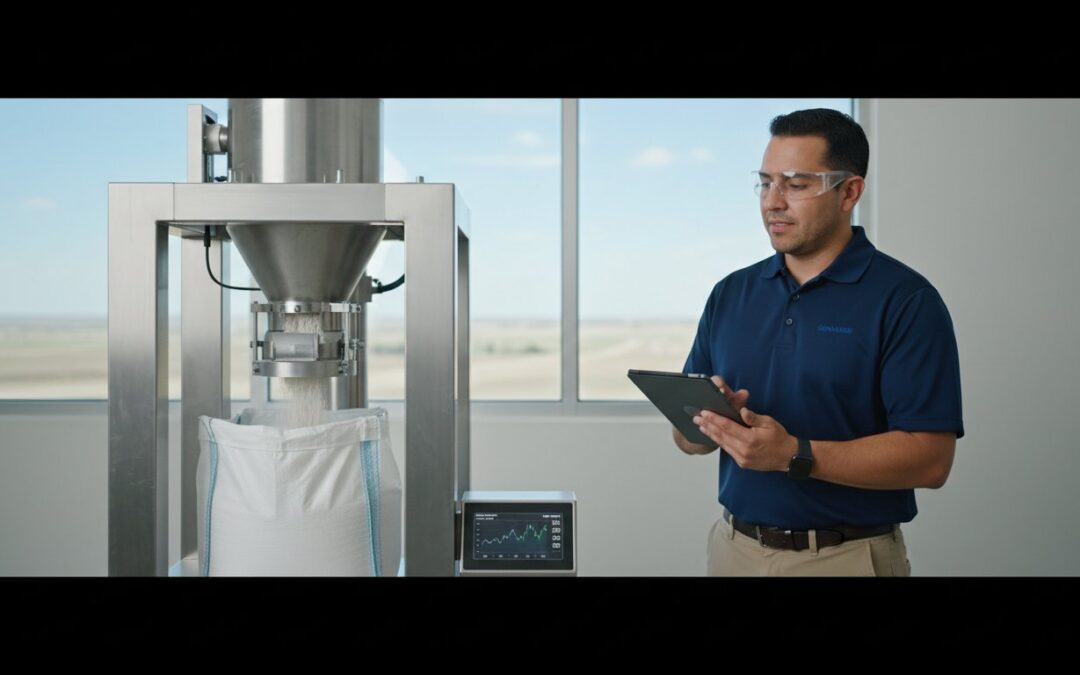
The High Cost of Product Giveaway in Industrial Bagging
In industrial bagging, “product giveaway” refers to the amount of material in a bag that exceeds the labeled weight. While a minor overfill might seem like a necessary buffer for compliance, it represents a significant and often overlooked source of revenue loss. The core challenge is that product giveaway isn’t a software problem; it’s a mechanical synchronization challenge between the feeder and the weigh-scale. Addressing it requires a hardware-first approach to achieve true precision.
- Defining Product Giveaway: It is the measurable volume of material exceeding the labeled weight on the bag, a direct loss of sellable product.
- Calculating the True ROI: Even a 1% giveaway on a high-volume line can translate to six-figure annual losses, eroding margins on every pallet shipped.
- The ‘Hidden Factory’ Concept: Persistent overfilling is a form of overproduction that masks deeper inefficiencies in the bagging line, consuming raw materials without generating revenue.
- Regulatory Compliance vs. Profitability: Meeting NIST Handbook 133 standards for minimum weight doesn’t require excessive overfilling. The goal is to tighten the weight variance, not just shift the average upward.
Economic Impact Across Industries
The financial consequences of giveaway are felt across all bulk material sectors. In high-value industries like pet food, specialty chemicals, and food ingredients, every lost ounce multiplies into substantial financial loss. This issue is compounded by increased shipping and logistics costs, as you are effectively transporting unsold product for free. For example, a facility that reduces giveaway by just 0.5 ounces per bag on a high-speed line can easily save over $50,000 annually in material costs alone.
According to Checkweigher technology, this is a well-documented area of ongoing research and practical application.
Why Traditional ‘Bulk Filling’ Fails Precision Standards
Many older or less sophisticated systems struggle with accuracy. Manual bagging is heavily dependent on operator skill, leading to high variability. Likewise, simple volumetric fillers are easily defeated by inconsistencies in material density, where the same volume can have different weights from batch to batch. The modern industrial environment demands a transition from “good enough” filling to precision-engineered bagging systems designed for consistent, repeatable accuracy.
Mechanical Causes of Weight Inaccuracy in Bagging Machines
Achieving precise bag weights is a function of controlling physical forces and timing. Every component in the filling system plays a critical role in the final outcome. Understanding the mechanical causes of inaccuracy is the first step toward reducing product giveaway in bagging.
- The Feeder Mechanism: This component’s ability to start, stop, and control material velocity is the most critical factor in weight accuracy.
- In-Flight Material: This is the weight of the product that is in the air, falling from the feeder into the bag, after the scale has signaled the feeder to stop. This amount must be precisely calculated and compensated for.
- Load Cell Sensitivity: High-quality load cells are essential, but their accuracy can be compromised by ambient vibration from nearby machinery, which introduces “noise” into weight readings.
- Valve Response Time: A slight lag between the electronic ‘stop’ signal and the physical closure of the valve can allow extra material to enter the bag, causing overfills.
Feed Rate Dynamics: Bulk vs. Dribble Cycles
The most effective bagging machines use a two-stage filling process to balance speed with precision. The initial “bulk” phase rapidly fills the bag to about 95% of its target weight. The system then switches to a slower “dribble” phase, which carefully tops off the bag to the exact weight. This dual-cycle approach is fundamental to high-speed accuracy. For challenging fine powders, specialized valve bag fillers are engineered to manage the material flow, preventing aeration issues that can disrupt weight consistency.
Managing Material Head Pressure
Inconsistent head pressure—the force exerted by the material in the surge hopper above the bagging machine—is a common cause of weight variance. A full hopper exerts more pressure than a nearly empty one, causing the material to flow faster and leading to overfills. Modern systems use level sensors to maintain a constant volume of material in the surge hopper, ensuring a consistent flow rate. Furthermore, engineering solutions like vibrators or air pads prevent material bridging and rat-holing, which can cause sudden, uncontrolled surges of product into the bag.
Choosing the Right Feeding Mechanism for Your Material
There is no one-size-fits-all solution for precision filling. The physical properties of your product—its density, flowability, and particle size—dictate the ideal feeder technology required to minimize giveaway.
- Auger Feeders: Using a rotating screw, augers provide a consistent, powered flow, making them best for non-free-flowing powders like flour or cocoa.
- Vibratory Feeders: These use vibration to gently move material along a pan, ideal for fragile granules, pellets, or products with varying particle sizes.
- Gravity and Air-Flow Systems: For free-flowing materials like grains or plastic pellets, gravity fillers offer high-speed simplicity. Air-flow (pneumatic) packers are used for fine powders that can be fluidized and blown into valve bags.
Precision in Open Mouth vs. Valve Bag Systems
The type of bag used also influences weighing strategy. Open mouth bag fillers are often easier to clean but present unique challenges in controlling dust and material flow during the fill cycle. When comparing gross-weigh (weighing the bag as it’s filled) versus net-weigh (weighing the product in a hopper before it’s discharged) systems, net-weigh often provides a higher degree of accuracy by isolating the weighing process from the bag handling. To help determine the right machine for your needs, you can use the Bagger Professor tool to identify an ideal system based on your specific material and production goals. For a detailed analysis, explore our guide on open mouth bagger vs valve bagger systems.
Handling Difficult and Abrasive Materials
Reducing giveaway when bagging abrasive materials like sand, cement, or minerals requires equipment built for durability. Wear and tear on feeder components can alter their performance over time, leading to a gradual loss of accuracy. Specialized coatings, hardened steel components, and robust designs are essential to maintain precision and reliability over the machine’s lifespan, ensuring your fill weights remain consistent year after year.

Operational Strategies to Minimize Overfilling
Even the most advanced bagging machine requires proper operational procedures to maintain peak accuracy. Implementing a disciplined approach to calibration, operator training, and data monitoring is crucial for long-term success in reducing product giveaway.
- Implement a Routine Calibration Schedule: Regularly verify scale accuracy with certified test weights to compensate for environmental changes or mechanical wear.
- Fine-Tune ‘Pre-Act’ Settings: This crucial setting tells the feeder to shut off just before the target weight is reached, accounting for in-flight material. It must be optimized for each specific product.
- Standardize Operator Training: Ensure all operators understand how to properly run the equipment and resist the urge to make manual overrides that can disrupt automated accuracy settings.
- Integrate Automation: Using downstream equipment like robotic palletizers ensures consistent bag handling and positioning, which can also serve as a final weight verification checkpoint.
The Importance of Regular Scale Calibration
A bagging scale is a sensitive instrument. Its accuracy can be affected by factors like temperature fluctuations, dust accumulation, and vibration. A formal calibration program, using certified test weights, should be a non-negotiable part of your maintenance routine. This simple, proactive step prevents the gradual “drift” that turns minor inaccuracies into significant product giveaway over time. If you encounter persistent issues, it may be time to consult experts in industrial bagging machine repair.
Data Integration and Real-Time Monitoring
Modern bagging systems with PLC controls can offer powerful data-driven advantages. Some systems can automatically adjust the pre-act settings based on the average weight of the last several bags, creating a self-correcting loop that maintains accuracy. Integrating your bagging line with plant-wide monitoring systems allows you to track performance in real-time and identify weight drift before it leads to substantial losses. Furthermore, integrating robotic palletizing systems can provide a final, automated weight check and data log for every completed pallet, ensuring total quality control.
The CBE Partner Approach: Engineering Precision Since 1978
At Choice Bagging Equipment, we understand that lasting accuracy is built into the hardware from day one. Our commitment to robust, American-made engineering is the foundation of every machine we build. We don’t just sell equipment; we partner with you to engineer a solution tailored to the unique challenges of your product and production environment.
- American-Made Hardware: We build our machines in the USA with high-quality components designed for durability and long-term reliability.
- Custom Engineering: We tailor the bagging head, feeder, and controls to your specific product density, flow characteristics, and speed requirements.
- ‘Made in the USA’ Reliability: Our systems are designed to perform consistently in demanding industrial environments, delivering a strong return on investment.
- Long-Term Support: We provide comprehensive support and seamless integration services to ensure your production line performs at its peak.
Reliability Built into Every Component
Our design philosophy emphasizes simplicity and strength. By engineering systems with minimal moving parts, we reduce the potential for mechanical wear that leads to weight drift and downtime. This robust construction ensures that the precision you have on day one is maintained for years to come. We support our customers with complete production line integration and a full inventory of parts and field service to maintain peak performance and protect your investment.
Next Steps: Evaluating Your Current Giveaway Rate
The first step to solving a problem is measuring it. We encourage you to conduct a simple weight audit on your existing bagging line by weighing a sample of 20-30 consecutive bags to understand your current average weight and variance. Once you have that data, our engineers can help you identify the primary causes of giveaway in your process and recommend a clear path to improving your profitability.
Ready to turn product giveaway into profit? Request a professional consultation to reduce your giveaway and discover how a precision-engineered bagging system can improve your bottom line.
Recent Comments