
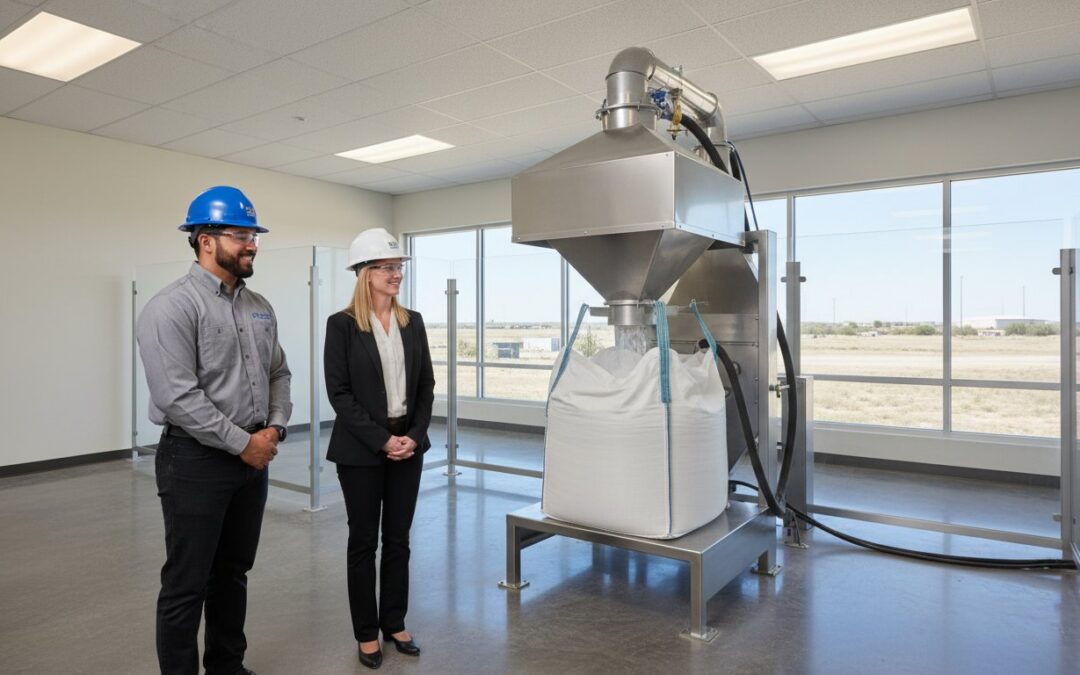
According to OSHA enforcement data from 2023, a single serious citation for combustible dust violations can cost your facility over $15,000. You likely recognize that managing airborne particles is more than just a housekeeping task; it’s a critical safety and maintenance requirement. Implementing robust bagging machine dust control solutions is the only way to prevent product loss and stop abrasive particulates from destroying your equipment’s bearings. Since 1978, Choice Bagging Equipment has helped manufacturers transform dusty, hazardous environments into clean and efficient operations.
In this guide, you’ll learn how to eliminate airborne particles, ensure total OSHA compliance, and extend the lifespan of your machinery through advanced containment strategies. We’ll examine high-performance dust hoods, inflatable neck seals, and integrated vacuum systems that reduce material waste by up to 2%. To find the ideal setup for your specific material, you can use our Bagger Professor tool to narrow down your options. This guide provides the technical expertise you need to protect your team and your bottom line. If you’re ready to upgrade your facility’s air quality, Request a Quote today to speak with our engineering team.
Key Takeaways
- Identify the hidden costs of airborne particulates, including premature equipment abrasion and bearing failure, to protect your long-term capital investment.
- Explore how advanced bagging machine dust control solutions utilize point-of-source extraction and displaced air management to maintain a clean and compliant workspace.
- Compare specialized containment strategies for valve bag fillers and open-mouth systems to ensure the highest levels of efficiency for your specific bagging line.
- Learn how to analyze material characteristics like bulk density and flowability, or use the Bagger Professor tool to select the right equipment for your application.
- Establish a proactive maintenance schedule for seals, gaskets, and vacuum hoses to ensure the durability and reliability of your dust extraction hardware.
The Impact of Dust in Industrial Bagging Operations
Dust control in industrial bagging is the strategic integration of containment, extraction, and filtration to manage airborne particulates. It isn’t just about cleanliness; it’s a fundamental requirement for operational efficiency. Effective bagging machine dust control solutions prevent fine powders from escaping during the fill cycle. Since 1978, Choice Bagging Equipment has engineered “Built to Last” designs that prioritize containment at the point of origin. By keeping product inside the bagging stream, we protect your facility, your staff, and your bottom line.
To better understand the practical application of these containment principles, watch this overview of a high-efficiency extraction system:
The hidden costs of “dusty” operations often manifest as premature equipment failure. Abrasive particles act like sandpaper on moving parts, leading to rapid bearing failure and the degradation of sensitive electrical components. Modern dust collection systems must be integrated directly into the machine design to mitigate these risks. As we move through 2026, the regulatory landscape continues to evolve. OSHA and NFPA 652 standards for combustible dusts have become more stringent, requiring manufacturers to prove they are managing fugitive emissions effectively.
Health, Safety, and Compliance Requirements
Equipment Longevity and Performance
Reliability is the cornerstone of a profitable bagging line. When dust is allowed to migrate, it settles on load cells and sensors, which directly impacts weighing accuracy. This leads to product giveaway or inconsistent bag weights that can frustrate your customers. Dust containment directly extends the service intervals of valve bag fillers by protecting internal seals and pneumatic actuators from abrasive contamination. To find the most compatible equipment for your material characteristics, you can utilize the Bagger Professor tool. If you are ready to upgrade your facility’s safety and efficiency, contact us now to speak with an applications expert.
Core Mechanisms of Bagging Machine Dust Control
Effective bagging machine dust control solutions focus on capturing particles before they migrate into the facility air. We’ve spent decades refining these systems to ensure they handle even the most volatile powders. The core of any dust-free operation relies on three primary mechanisms:
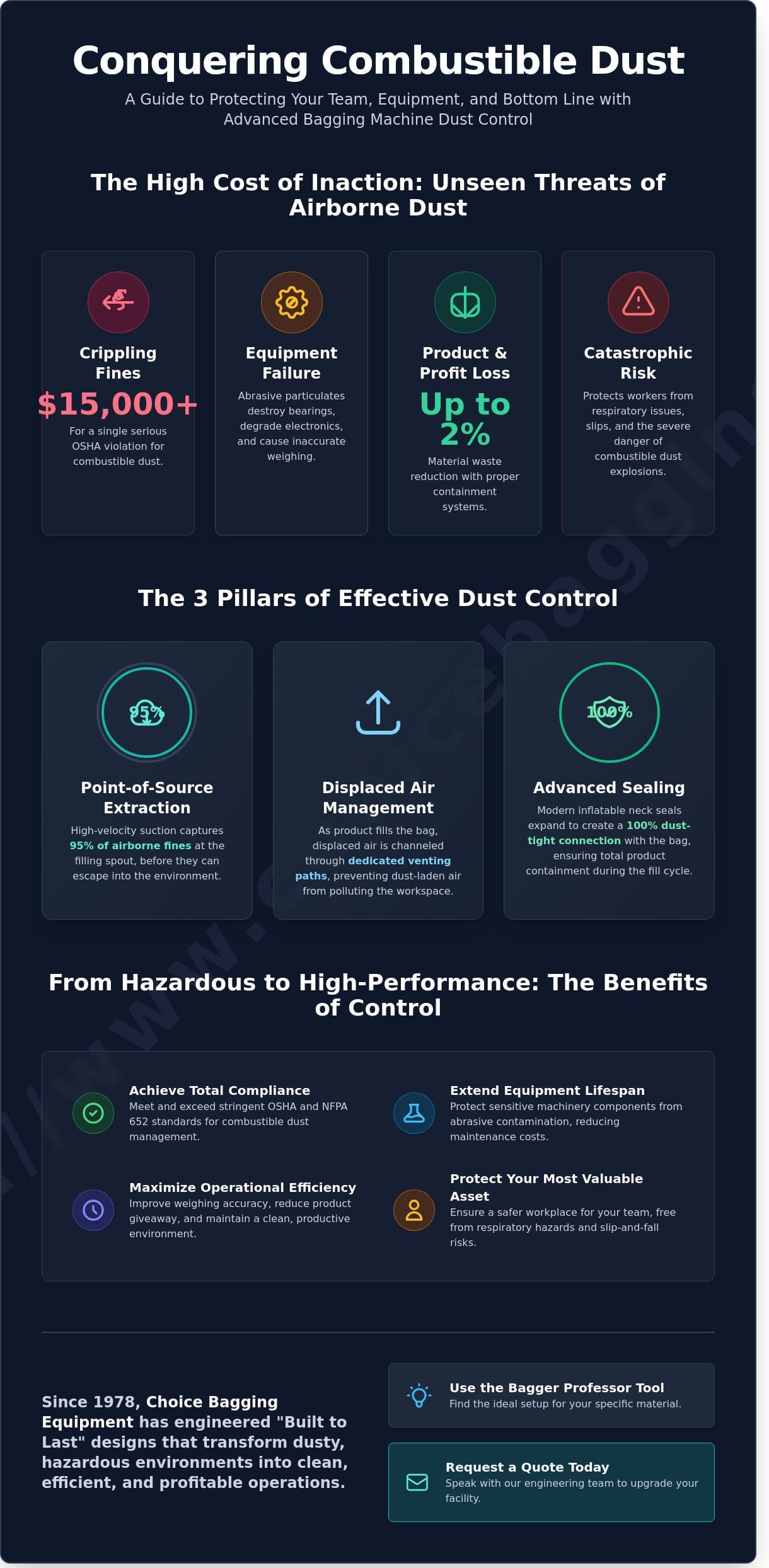
- Point-of-source extraction: This captures dust at the filling spout before it enters the ambient air. High-velocity suction removes 95% of airborne fines at the moment of discharge.
- Displaced air management: As product enters the bag, it forces air out. We design dedicated venting paths to handle this air, preventing it from carrying product into the room.
- Advanced Sealing: Modern inflatable seals expand against the bag neck to create a 100% dust-tight connection.
Implementing these bagging machine dust control solutions protects both your staff and your equipment from long-term damage. Since 1978, we’ve built performance into every machine to ensure a clean work environment.
Active vs. Passive Dust Containment
Passive containment relies on physical barriers like heavy-duty shrouds or flexible curtains to block dust. While these methods are energy-efficient, they don’t capture the smallest micron-sized particles. Active methods use vacuum-assisted extraction to create negative pressure at the fill point. Compliance with OSHA’s combustible dust regulations often requires active systems to ensure safety. For over 70% of chemical processors, the higher containment effectiveness of active systems is necessary to maintain a 40% reduction in airborne particulates compared to passive methods alone.
The Role of Dust Collection Systems
Integrating a central dust collector with individual bagging heads is the most reliable way to maintain a clean workspace. Sizing these systems requires precise calculation of Cubic Feet per Minute (CFM). For standard industrial powders, we recommend an extraction rate of 400 to 600 CFM per spout. Modern systems utilize pulse-jet technology and self-cleaning filters to maintain constant airflow. Since 1978, we’ve found that properly sized extraction reduces equipment wear by 25%.
Sealing technologies have evolved from basic mechanical clamps to advanced inflatable seals. These inflatable bladders expand against the bag neck to create a 100% dust-tight connection. This is a critical feature in modern packaging machinery designed for fine powders. Integrated venting ensures that internal pressure doesn’t compromise the seal’s integrity during high-speed operation. This design prevents the “puff” of dust often seen when a bag is released from the spout. It’s about reliability.
If you’re unsure which setup fits your material, the Bagger Professor tool helps identify equipment configurations based on your specific product characteristics. To see how these components integrate into a full system, you can explore our complete equipment lineup. If you need a tailored recommendation, contact us today to speak with an expert.
Dust Control Solutions by Equipment Type
Effective bagging machine dust control solutions vary significantly depending on whether you’re filling valve bags, open-mouth bags, or bulk bags. Each equipment type presents unique challenges for containment. Choice Bagging has engineered these systems since 1978 to ensure reliability and performance across all industrial applications. Selecting the right hardware depends on your material’s flow characteristics and the specific bag architecture you use.
Specialized Solutions for Valve Bag Packers
Valve baggers operate as a closed system, which makes managing internal air pressure critical. We utilize inflatable spout seals to achieve a 100% dust-tight connection during the fill cycle. This prevents product from escaping the bag valve before it’s securely seated. Our valve bag fillers also incorporate internal venting to handle air displacement. Without proper venting, air trapped in the bag can cause a “puff” of dust when the operator removes the bag from the spout. A 1982 Bureau of Mines report on dust control notes that proper spout maintenance and venting can reduce dust levels by up to 90% in mineral applications. Our designs focus on mitigating this discharge to keep the bagging area clean.
Dust Management for Bulk Bag (FIBC) Systems
Filling large containers requires managing massive air displacement. High-performance bulk bag fillers use a sanitary spout docking system to create a repeatable, operator-friendly connection. One essential technique is the “bag collapse” process. This safely removes air from empty bags before filling without releasing dust into the warehouse. It’s a critical step for maintaining a clean facility and protecting staff from airborne powders. If you’re unsure which configuration fits your material, the Bagger Professor tool helps identify the right equipment for your specific bulk density and bag type.
Open Mouth Bagging and Manual Dump Stations
In high-speed automated lines, open-mouth bagging machines utilize “duck-bill” spouts to maintain control of the bag top during the fill. These spouts work in tandem with dust shrouds that encapsulate the filling zone. For manual tipping operations, integrated fans and cartridge filters pull dust away from the operator’s breathing zone. We also recommend using empty bag compactors to reduce secondary dust release during waste handling. Safety plates and retaining clips provide a total containment strategy that prevents product loss. These bagging machine dust control solutions are essential for meeting strict air quality standards.
Clean bags aren’t just about aesthetics; they’re vital for downstream efficiency. For instance, robotic bag palletizers require clean surfaces to ensure vacuum grippers maintain a secure hold. Dust on the bag exterior can cause slippage or sensor errors, leading to unplanned downtime. If you need help designing a complete system that stays clean from the filler to the pallet, contact us to speak with an engineer about your specific application.
Selecting the Right Dust Control Strategy for Your Material
A “one size fits all” approach to dust containment leads to system failure 100% of the time. Every material behaves differently under pressure and airflow. If you try to apply the same vacuum pressure to 50 lb/ft³ sand as you do to 5 lb/ft³ fumed silica, you’ll either fail to capture the dust or suck your product straight into the collector. Successful bagging machine dust control solutions require a deep analysis of particle size, bulk density, and flowability. For instance, abrasive materials like minerals require hardened steel extraction ports to prevent erosion. Conversely, fragile materials like cereal flakes need low-velocity air to prevent product degradation during the bagging process.
Mismatched hardware causes increased maintenance and unexpected downtime. When a system isn’t tuned to the material, filters clog faster and seals wear out prematurely. Since 1978, we’ve seen that precision in the initial design phase saves thousands of dollars in long-term operational costs. You must evaluate whether your product is prone to bridging or if it’s highly fluidizable, as these traits dictate where the extraction points should be located on the fill spout.
Material Testing and System Design
Expert system design begins in the lab. Testing your specific material determines its “dustiness” factor and how it reacts to different extraction velocities. We use these results to customize nozzle diameters and extraction ports, ensuring high-fines products don’t escape into the plant. To help you narrow down the right equipment based on your specific material and bag type, we provide the Bagger Professor tool on our site. This functional tool assists in identifying which bagging machine models align with your product’s unique characteristics. Customizing the airflow at the point of fill prevents 95% of airborne particulate issues before they start.
Integration with Existing Production Lines
Adding modern dust control isn’t limited to new installations. Retrofitting dust extraction onto older bagging machines is a common way to improve safety and cleanliness in established facilities. The challenge lies in timing. Your dust extraction must be perfectly synchronized with your bag sealers to ensure the vacuum doesn’t interfere with the heat seal or sewing process. Collaborating with an engineering partner ensures that your line flow remains seamless. We’ve helped processors integrate these components to eliminate bottlenecks and reduce maintenance costs by up to 20%. Implementing the right bagging machine dust control solutions ensures your entire line operates at peak efficiency without compromising the health of your operators.
Our team provides the technical expertise to build a system that lasts for decades and meets your specific production goals. We’re your partner in creating a cleaner, more profitable bagging operation.
Maintenance and Long-Term Reliability of Dust Systems
Reliability in industrial bagging operations isn’t a happy accident; it’s the result of deliberate engineering and consistent upkeep. Effective bagging machine dust control solutions require more than just high-quality hardware. They demand a commitment to preventing dust migration. When fine particulates escape the primary containment zone, they settle into sensitive machine internals like bearings, sensors, and electrical cabinets. This buildup often causes 15% to 20% more downtime in facilities that lack a proactive maintenance strategy. We design our equipment with field serviceability as a priority, utilizing Made in the USA components that operators can inspect and replace without specialized tools.
The Daily and Weekly Maintenance Checklist
Consistency keeps your air quality high and your equipment running. Operators should perform these checks to ensure bagging machine dust control solutions remain effective over decades of use:
- Inspect Flexible Connections: Check for pinholes or abrasions in transition sleeves. Even a small 1/4 inch tear can disrupt the vacuum balance.
- Verify Inflatable Seals: Ensure seals on valve bag fillers or bulk bag heads inflate fully and hold pressure. Leaky seals are the primary cause of product puffing during the fill cycle.
- Monitor Pressure Drops: Use differential pressure gauges to track filter health. A sudden drop often indicates a torn filter, while a steady increase signals it’s time for a pulse-clean or replacement.
Choice Bagging: Your Partner in Clean Production
Since 1978, Choice Bagging Equipment has focused on building machines that stand up to the harshest industrial environments. We aren’t just selling a piece of hardware; we’re providing a long-term solution for your facility. Our legacy is built on the fact that our machines are engineered to last for decades, not just a few seasons. If you need to identify the right equipment for your specific material, our Bagger Professor tool is a functional resource to help you narrow down the best machine for your application.
We believe long-term support is more valuable than the initial purchase. You can easily access high-quality parts and expert field service to keep your dust control system at peak performance. Our team is ready to help you integrate these solutions into your existing workflow to ensure a clean, safe, and efficient plant floor. Don’t settle for “good enough” when it comes to air quality and machine longevity. Request a Quote today for a custom dust-controlled bagging solution tailored to your operational needs.
Optimize Your Production Line for Safety and Efficiency
Effective dust management isn’t just about regulatory compliance; it’s about protecting your bottom line and your workforce. By implementing advanced bagging machine dust control solutions, you reduce mechanical wear and significantly minimize product loss. Choice Bagging Equipment has manufactured reliable bagging solutions since 1978, providing the stability and performance industrial facilities demand. Every system is proudly Made in the USA, reflecting a commitment to high-quality craftsmanship and long-term durability. If you’re ready to identify the best equipment for your specific material and bag type, the Bagger Professor tool provides a functional way to narrow your search.
Our team provides expert engineering support for production line integration, ensuring your equipment fits perfectly into your existing workflow. We focus on delivering proven results that keep your facility clean and your operators safe. Invest confidently in a clean facility—Contact Choice Bagging for a quote today. We look forward to partnering with you to achieve a more efficient and profitable bagging operation.
Frequently Asked Questions
Is a dust control system required by law for all bagging machines?
OSHA 1910.1000 requires employers to limit worker exposure to dust like crystalline silica to 50 micrograms per cubic meter over an 8-hour shift. While the law doesn’t name a specific machine, it mandates that you use engineering controls to meet these safety standards. Implementing professional bagging machine dust control solutions ensures your facility remains compliant and your operators stay safe from respiratory hazards. We’ve helped plants meet these 1970-era standards for decades.
How much does a dust containment system affect the speed of my bagging line?
A properly engineered containment system has zero negative impact on your bagging line’s speed. In fact, capturing dust at the source can increase overall efficiency by 5% because it prevents material buildup on sensors and moving parts. Our systems are designed to maintain production rates of 12 bags per minute or higher while capturing 99.9% of airborne particles. You don’t have to choose between high-speed performance and a clean workspace.
Can I retrofit a dust extraction system onto my existing valve bag filler?
You can certainly retrofit a dust extraction system onto almost any existing valve bag filler. Since 1978, we’ve specialized in custom-engineered manifolds and shroud assemblies that integrate with older equipment. This upgrade typically takes less than 8 hours to install and provides an immediate reduction in fugitive dust. If you’re looking to modernize your current line, contact us now to discuss your specific machine model and layout.
What is the difference between a dust shroud and an inflatable spout seal?
A dust shroud acts as a physical hood that surrounds the filling area to capture escaping particles, while an inflatable spout seal creates an airtight physical connection between the machine and the bag. The shroud is a versatile, low-maintenance option for various bag sizes. The inflatable seal is superior for fine powders, as it eliminates 100% of dust leakage during the fill cycle. Both are essential bagging machine dust control solutions for high-volume operations.
How often do filters in an integrated dust collection system need to be replaced?
Filters in an integrated collection system generally require replacement every 2,000 to 4,000 hours of operation. This frequency depends on whether you’re bagging abrasive minerals or fine chemicals. We recommend monitoring the differential pressure gauge daily; a reading above 6 inches of water column usually indicates it’s time for a change. Regular maintenance prevents the system from losing suction and ensures your bagging line continues to operate at peak reliability.
What happens if my bagging machine dust control fails during a production run?
If your dust control fails, you must stop the production run immediately to prevent hazardous accumulation and equipment damage. Uncontrolled dust increases mechanical wear on bearings by up to 25% and can cause electrical short circuits in your control panels. Beyond the physical risks, a failure can lead to OSHA fines that often exceed $14,000 per violation. It’s vital to have a partner who provides dependable support and rapid part replacement.
Does the Bagger Professor tool account for explosive dust environments?
The Bagger Professor tool does account for material characteristics, including whether your product is combustible or requires explosion-proof electrical components. It helps you identify the correct machine configuration based on your specific material and bag type. This functional tool ensures you invest in equipment that meets NFPA 652 standards for handling explosive dust. It’s a reliable way to narrow down your options before starting a formal technical consultation.
Why is “Made in the USA” important for dust control equipment?
Choosing equipment “Made in the USA” ensures you receive high-quality steel and components that meet strict domestic engineering standards. Since 1978, we’ve manufactured our machines in America to provide customers with unmatched reliability and faster access to replacement parts. This proximity means you won’t wait 12 weeks for a simple sensor or manifold to arrive from overseas. It’s about building a partnership based on stability and proven performance.
Recent Comments