
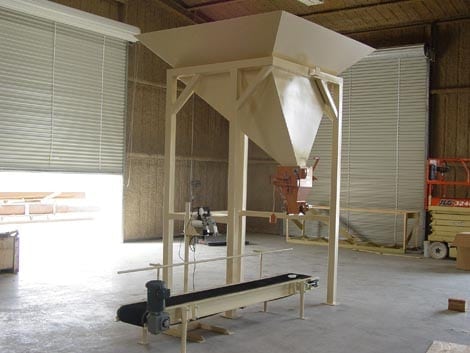
A corn bagging machine doesn’t need to be complicated to fill 240 bags of deer corn an hour. We proved that for a central Texas producer with a gravity-fed Model GB open mouth bag filler, a mechanical scale and a pedestal sewing line. The whole line runs on single-phase 220-volt power and packs 9,600 to 12,000 pounds of corn per hour with two operators.
That project is a good example of what we see every season at Choice Bagging Equipment in Taylor, Texas. Most deer corn packers who call us are not short on demand. They are short on headroom, floor space, plant air or three-phase power, and they assume that rules out automatic weighing. If you are scrolling through every 50lb grain bagger for sale listing you can find, the real question is which constraint will limit your line first, not which machine has the longest spec sheet.
Below, I’ll walk through the original Model GB case study, explain how a mechanical corn bagging machine weighs without air or electricity, and show the throughput math we use to size a line. You’ll also get a plain comparison of our three gravity baggers for corn, a buying checklist, and the maintenance habits that keep 50 lb bags honest.
| Spec (for whole/deer corn) | Model GB | Model GWB | Model NWB |
|---|---|---|---|
| Weighing method | Gross weigh, mechanical pivot beam scale | Gross weigh, digital scale controller | Net weigh, pre-weighed batches |
| Feed | Gravity, 2-position gravity gate | Gravity | Gravity, high speed |
| Top rated speed | Up to 6 bags/min (360/hr) | Up to 6 bags/min (360/hr) | Up to 24 bags/min (1,440/hr) |
| Utilities at the filler | None | Electrical power for controls | Power and plant air (confirm at quote) |
| Bag clamp | Mechanical self-binding | Bag clamp per configuration | Bag clamp per configuration |
| Best fit | Entry-level lines, tight sites, 200–300 bags/hr | Lines that want digital accuracy and set-point memory | High-volume packers adding automation |
Speeds are manufacturer ratings for each model; real rates depend on bag size, operator pace and how fast you can close bags.
What a corn bagging machine does on a deer corn line
A corn bagging machine has one job: put the same weight of corn into every bag, fast enough that the person closing bags is never waiting. Everything else on the line, from the supply hopper to the pallet, exists to feed that job or clear its output.
On a typical deer corn line, the sequence looks like this:
- A supply hopper or bin holds a buffer of whole corn above the filler.
- The filler opens a gate, corn falls into a clamped open mouth bag, and the scale stops the flow at target weight.
- The filled bag drops onto a bag conveyor and travels through a sewing head or sealer.
- An operator or palletizer stacks the closed bags for shipping.
Whole corn is close to an ideal product for this. It flows freely, it doesn’t bridge in a hopper the way meal or sticky feed does, and it produces little dust. That is why a simple corn bagging machine can handle it well, and why we usually talk customers out of over-buying for a straight deer corn application.
Gross weigh vs net weigh corn bagging machine designs
Open mouth fillers come in two classes, and the difference matters for speed.
A gross weigh corn bagging machine weighs the corn while it is going into the bag. The bag hangs from the scale, so the scale reads bag plus product, and flow stops when the target is reached. Gross weigh machines are simpler, cheaper and easier to maintain, and they top out around six bags per minute.
A net weigh machine weighs each batch in a separate scale bucket first, then dumps the pre-weighed charge into the bag. Because the next batch can be weighing while the current bag is filling, net weigh machines run much faster. That speed is the reason our high-speed models use it.
For most deer corn packers filling 200 to 350 bags an hour, gross weigh is the right call. Net weigh earns its price only when bag counts climb well past that range.
Why gravity feed suits whole corn
Feeders move product from the hopper into the bag, and the main options are gravity, vibratory pan, belt and auger. Corn rarely needs anything beyond gravity.
- Gravity feed has no moving feeder to wear out, so there is less to maintain.
- Whole kernels flow at a steady rate through a gate, which keeps cut-off weights consistent.
- Belt feeders are designed for sticky or large-particle feeds such as cattle cubes or molasses blends, not clean corn.
- Auger feeders are built for powders such as flour or cement and would only slow corn down.
If your product is cracked corn mixed with molasses or a sweet feed, the answer changes. For clean whole or shelled corn, though, a gravity corn bagging machine is the honest recommendation.
Case study: a corn bagging machine built around site limits
The client was a deer corn producer in central Texas that wanted a simple, entry-level corn bagging machine with an open mouth sewing line. Nothing about the order was exotic. What made it interesting was the building.
The brief: 240 bags per hour on single-phase power
The producer gave us four hard requirements:
- Fill 40 to 50 lb bags at 240 bags per hour, or 9,600 to 12,000 lb of corn per hour.
- Fit under minimal headroom in an existing building.
- Use very little floor space.
- Run every powered component on single-phase 220-volt service, because that was the only power on site.
The power limit is the one most buyers underestimate. Much of the equipment on a used 50lb grain bagger for sale listing assumes three-phase motors and a compressor for pneumatic clamps and gates. Adding three-phase service or a rotary phase converter can cost more than an entry-level filler, so we designed around it rather than asking the client to rewire.
Line layout from supply hopper to pallet
We kept the system short and linear. An overhead supply hopper holding roughly 2,500 lb of corn fed the Model GB directly by gravity. Below the filler, a purpose-built bag closing conveyor carried filled bags through a pedestal-mounted industrial bag sewing machine, and the line ended at a hand-stacking station.
Two people ran it:
- Operator one placed empty bags on the spout, started each fill, and guided full bags through the sewing machine.
- Operator two palletized the closed bags at the end of the line.
Because the filler itself needed no power, the single-phase supply only had to run the conveyor and sewing head. That kept the electrical scope small and the install quick.
What the 240 bags-per-hour target means in practice
At 240 bags an hour, the line has 15 seconds per bag. That covers hanging the bag, filling, discharge and getting the bag moving toward the sewing head. It is comfortable for a manual-start gross weigh corn bagging machine, which is rated up to six bags a minute, but it leaves little slack for a slow closing step.
In our experience, the sewing station is usually what caps a line like this, not the scale. That is why we matched the conveyor speed to the sewing head rather than to the filler’s top rating.
How a mechanical corn bagging machine weighs without air or power
The Model GB corn bagging machine is the reason the Texas line works. It weighs every bag automatically, yet it has no load cells, no controller, no solenoids and no compressed air. Everything is done with a balance beam, a gate and gravity.
The pivot beam scale and gravity gate
The filler uses a mechanical pivot beam scale tied to a two-position gate valve we call a gravity gate. One fill cycle runs like this:
- The operator hangs an empty bag on the spout and starts the fill by hand.
- The scale linkage holds the gravity gate open, and corn falls straight into the bag.
- As the bag gains weight, the beam tips toward its set point.
- At target weight, the gate slips out of its catch and closes, cutting off the flow.
- The filled bag is released onto the closing conveyor.
Because the gate is held open mechanically and released by the beam itself, there is nothing to program and nothing that can lose a setting during a power blip. Changing from 40 lb to 50 lb bags is a mechanical set-point adjustment on the scale, not a menu change.
One trade-off is worth stating plainly. A mechanical gross weigh filler runs in bulk flow only, with no slower dribble stage near the end of the fill. That makes it fast and simple, but a digital machine with bulk and dribble flow will hold a tighter weight band. For deer corn sold by the bag at retail, the mechanical band is normally fine; for seed sold on tight label tolerances, it may not be.
The self-binding bag clamp
Most bag clamps are pneumatic, which means a compressor, an air dryer, hoses and valves. The GB uses a mechanical self-binding clamp instead. The weight of the bag and product tightens the grip on the spout, so the heavier the bag gets, the more firmly it is held.
For a small plant, this removes a whole utility system:
- No compressor to buy, wire, drain or service.
- No moisture in air lines during humid Texas summers.
- Fewer wear items on the filler itself.
That simplicity is why we call the GB an entry-level corn bagging machine, but entry-level here means easy to own, not flimsy. It is a dependable fit when the budget, the building or the power supply rules out more.
Sizing a corn bagging machine for 40–50 lb bags
Sizing starts with pounds per hour, not bags per minute. Work back from what you need to ship in a day, then check that the hopper, the corn bagging machine and the closing step can all keep up.
Bags per hour from pounds per hour
The math is simple: required pounds per hour divided by bag weight gives bags per hour, and bags per hour divided by 60 gives bags per minute. The Texas line shows how it plays out.
| Bag size | Pounds per hour | Bags per hour | Bags per minute | Seconds per bag |
|---|---|---|---|---|
| 40 lb | 9,600 | 240 | 4 | 15 |
| 50 lb | 12,000 | 240 | 4 | 15 |
| 50 lb | 18,000 | 360 | 6 | 10 |
The last row is the practical ceiling for a gross weigh gravity corn bagging machine. We size lines to run at roughly 70 to 80 percent of a machine’s rating, because bag placement, breaks and changeovers always eat into the theoretical number. If your plan only works at 100 percent of rating, you need the next machine up.
Headroom, hopper capacity and footprint
Low ceilings shape the whole design. Stack the heights from the floor up before you buy anything:
- Pallet or conveyor height at the bag discharge.
- Bag length when filled and hanging from the spout.
- Filler height from spout to inlet.
- Hopper height, including the discharge transition.
- Clearance above the hopper for whatever fills it, such as an auger, bucket elevator or forklift-tipped bin.
Hopper size is a buffer question. Shelled corn weighs about 56 lb per bushel, or roughly 45 lb per cubic foot, so the 2,500 lb hopper in our case study holds around 55 cubic feet. At 12,000 lb an hour, that is only about 12 minutes of run time. The hopper must be refilled continuously or in short cycles, which is fine if your upstream conveyor can deliver at least as fast as you bag.
Bag type and closing method
For deer corn and feed, sewn open mouth bags are the default. They are tough, cheap and easy to open with a pull cord. Most packers choose between two materials:
- Woven polypropylene: strong, tear-resistant and well suited to rough handling and outdoor storage.
- Multiwall paper: prints well for retail shelves and stacks neatly, but dislikes moisture.
The closing method sets your real speed limit. A handheld sewing head is fine at low volumes. A pedestal-mounted head on a variable-speed closing conveyor, like the one in the Texas line, lets one operator keep pace with a corn bagging machine at four to six bags a minute. A bag sealing machine is an option for film bags but is rarely worth it for corn.
Choosing a corn bagging machine: mechanical, digital or high speed
We offer three gravity open mouth fillers that each work as a corn bagging machine, and each one is the right answer for a different plant. My rule of thumb: buy for the volume you will run in the next three years, and make sure the line can grow by adding equipment around the filler rather than replacing it.
When the Model GB is enough
The Model GB fits when most of these are true:
- You bag 200 to 300 bags an hour on a normal shift.
- You have no compressed air, or no three-phase power, at the filling station.
- Your weight tolerance is retail-friendly rather than seed-certification tight.
- You want the lowest purchase price and the fewest parts to stock.
That describes a lot of feed stores, game feed brands and farm operations that bag their own corn. It also describes the Texas producer above.
When to step up to the Model GWB
The Model GWB is our digital gravity open mouth filler, and it is a true workhorse. It has the same top rating as the GB, up to six bags per minute, but adds a digital scale controller. In practice that means:
- Faster changeovers between bag weights, because set points are stored rather than set by hand.
- Tighter fill accuracy, which matters for seed, pelleted feed and anything sold under strict label weights.
- Better records of what each bag actually weighed.
If you pack corn plus several other products, such as pelleted feed, corn meal or fertilizer, the GWB is usually the smarter long-term corn bagging machine. It needs electrical service at the filler, so confirm what your building has before you choose it.
When the Model NWB and automation pay off
The Model NWB is our high-speed gravity net weigh filler, rated up to 24 bags per minute. It belongs in plants that run well beyond what one hand-fed spout can manage, usually alongside automatic bag placing, flattening conveyors and a robotic bag palletizer. Fully built out, an open mouth line like this can package and stack up to 1,440 bags per hour with a single operator overseeing it.
The jump from a manual-start filler to a fully automated line is a labor and payback decision more than a machine decision. Price your operator hours against the equipment cost before you commit.
The short version: if two operators on a GB line are keeping up with orders, automation can wait. If you are running overtime every week in hunting season, it probably can’t.
What to check before buying a 50lb grain bagger for sale
A 50lb grain bagger for sale can look like a bargain on paper and still cost you a season if it doesn’t match your building, your bags or your power. The same gaps show up in listing after listing.
New, used or rented
Each route has a place:
- New: full warranty, current parts, and a machine specified for your product and site from day one. Best when you know your volume and plan to run for years.
- Used: lower price, but you inherit someone else’s wear, missing parts and sometimes a scale that has never been calibrated. A used 50lb grain bagger for sale is worth it only if you can inspect it, test it with your corn and get parts support afterward.
- Rental: lets you prove out volume before committing capital, which suits a new deer corn brand or a seasonal spike.
If you are unsure of next year’s bag count, weigh renting against buying before you sign anything.
Questions to ask any supplier
Before you buy any corn bagging machine, new or used, get clear answers to these:
- What weighing method is it, gross or net, and what fill accuracy can I expect with whole corn?
- What are the real utility needs at the filler: single-phase, three-phase, compressed air?
- What spout size and bag clamp does it use, and will they fit my bag supplier’s open mouth bags?
- How tall is the full assembly with my hopper, and how much floor space does the closing conveyor need?
- Who supplies parts and field service, and how fast?
- Can it be upgraded later with digital controls, a faster closing system or palletizing?
If a seller can’t answer the utility and height questions in writing, treat that corn bagging machine listing with caution.
Red flags in a listing
Some warning signs are easy to spot once you know them:
- No photos of the scale mechanism or the bag clamp, only the frame.
- Speed claims with no bag weight attached. Six bags a minute at 25 lb is not six bags a minute at 50 lb.
- Missing gates, linkages or controllers described as easy to source.
- No product history. A filler that bagged abrasive sand or salt for years has very different wear than one used on corn.
The best 50lb grain bagger for sale is the one sized to your real throughput and building, with a supplier who will still pick up the phone after delivery.
Keeping a corn bagging machine accurate season after season
A well-built corn bagging machine will run for decades, but only if someone owns its upkeep. Overfilling by half a pound a bag sounds small. At 240 bags an hour over an eight-hour shift, it is nearly 1,000 lb of corn given away every day.
Check weights and calibration
A mechanical scale drifts slowly, so the habit that matters most is checking, not adjusting.
- Pull a bag off the line every hour or so and weigh it on a certified platform scale.
- Log the readings. A steady creep in one direction points to wear or buildup, not random error.
- Recheck after any bag change, because bag tare weights vary between suppliers and materials.
- Keep the scale beam and pivots free of corn dust and fines, which can add drag and skew the cut-off.
If weights wander and cleaning doesn’t fix it, call for service before you start adjusting the scale by trial and error.
Wear parts and seasonal prep
Deer corn demand is seasonal, so most lines run hard for a few months and then sit. That pattern is rough on a corn bagging machine if you skip the shutdown and startup checks. Before the busy season, we recommend:
- Inspecting the gravity gate and its catch for wear, so the gate closes crisply at weight.
- Checking the bag clamp grip surfaces and replacing them if bags slip.
- Servicing the sewing head: needles, loopers, thread path and belt tension.
- Checking closing conveyor belt tracking and speed against the sewing head.
- Clearing old corn from the hopper to keep out insects and mold.
When a machine has seen many seasons, a factory rebuild can return it to like-new condition at well below the cost of a new filler. Older equipment, including a used 50lb grain bagger for sale you bought from someone else, is often a good candidate for that.
Corn bagging machine FAQs
How many bags per hour can a corn bagging machine fill?
A gravity corn bagging machine like our Model GB fills up to 6 bags per minute, or 360 an hour. Most manual-start deer corn lines run at 4 bags a minute, about 240 bags an hour.
What size hopper does a corn bagging machine need?
Shelled corn is about 45 lb per cubic foot, so a 2,500 lb hopper holds roughly 55 cubic feet. Size it to cover refill time at your hourly rate so the corn bagging machine never starves.
What size hopper does a corn bagging machine need?
Shelled corn is about 45 lb per cubic foot, so a 2,500 lb hopper holds roughly 55 cubic feet. Size it to cover refill time at your hourly rate so the corn bagging machine never starves.
Is a used 50lb grain bagger for sale a good buy?
Yes, if you can inspect it, test it with your corn and get parts support. Check the scale, gate and clamp closely before you buy any used 50lb grain bagger for sale
Can a corn bagging machine handle other grains and feeds?
Yes. A gravity corn bagging machine also handles free-flowing seed, pelleted feed, fertilizer, plastic pellets and dry pea gravel. Sticky feeds and powders need belt or auger feeders
What bags work best for 50 lb deer corn?
Woven polypropylene or multiwall paper sewn open mouth bags. Woven poly resists tears outdoors; paper prints better for retail. Confirm spout size before buying a 50lb grain bagger for sale.
Ready to size a line for your corn? Call our team at 512-352-3694 or request a quote with your bag weight, target rate and site limits, and we’ll recommend the right filler, closing system and layout.
Read PDF documents to see if our GB Bagger and optional components works for your needs. Then contact us to get a final quote and place your order.
REQUEST A QUOTE!
Recent Comments