

If you believe bagging flour is simply a matter of volume, you’re battling an invisible enemy that compromises every pallet you ship: air. Achieving a stable, stackable product requires more than just a hopper; it demands a sophisticated bagging system for flour designed to manage the unique fluidization of fine powders. You likely recognize the daily struggle of managing “puffy” bags that refuse to stack or the safety risks associated with airborne dust accumulation.
We’ve designed this engineering guide to help you master these technical hurdles through precision de-aeration and mechanical accuracy. You’ll learn how to choose between valve and open-mouth configurations to ensure consistent weight results and eliminate product loss. We also address critical compliance factors, such as the FSMA Food Traceability Rule requirements taking effect in 2026. This technical overview provides a clear roadmap for securing your production line against regulatory fines and operational downtime. If you’re ready to optimize your facility, you can reach out to our team to discuss a collaborative partnership for your next installation.
Key Takeaways
- Understand the mechanics of de-aeration probes to transform aerated flour into dense, stable bags suitable for high-density palletizing.
- Compare the throughput and sealing integrity of valve baggers versus open-mouth fillers to determine the most efficient bagging system for flour for your specific production volume.
- Learn why horizontal auger feeders are the industry standard for maintaining weight accuracy while minimizing dust emissions in powder applications.
- Discover how integrating robotic bag palletizing with squaring and flattening technology ensures secure, retail-ready stacks that meet global shipping standards.
- Evaluate the benefits of a collaborative alliance to ensure mechanical longevity and ongoing technical support for your industrial hardware.
The Unique Challenges of a Bagging System for Flour
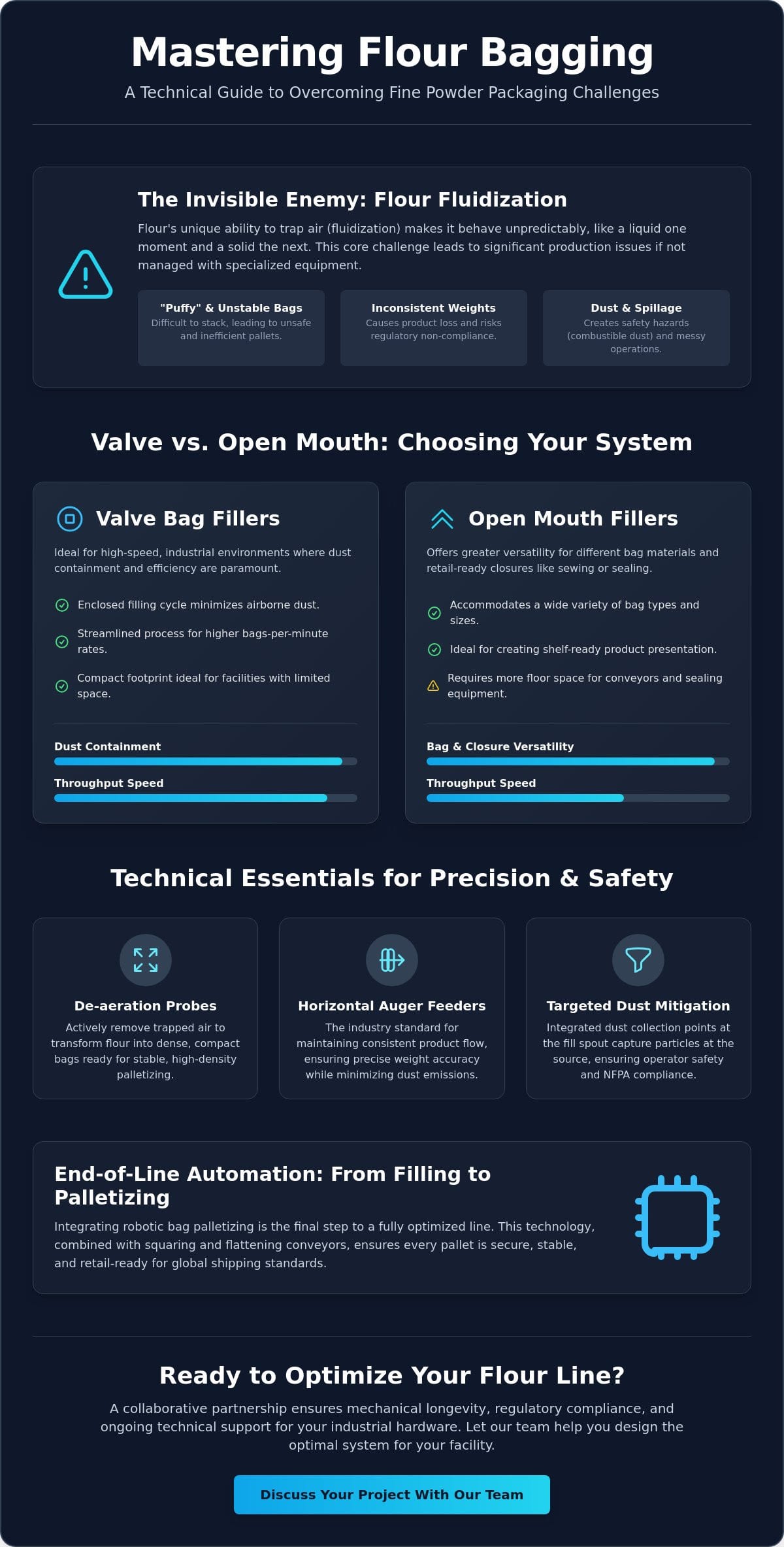
Flour presents a unique engineering puzzle for milling facilities. While many assume it behaves like sand or other granular materials, flour is a fine, aerated powder that changes its physical properties based on how much air is trapped within the particles. This “fluidization” means the material can act like a liquid one moment and a solid the next. A standard gravity filler, which relies on the weight of the material to drop into a bag, often fails with finely ground grain products. Without mechanical force, flour either bridges in the hopper or “floods” uncontrollably. This leads to inconsistent weights, unstable bags, and messy operations that compromise your facility’s efficiency.
Engineers must account for these fluctuations to maintain a high-performance bagging system for flour. Success depends on controlling the air-to-product ratio before the material ever reaches the filling spout. If you don’t manage this aeration, your bags will be “puffy” and difficult to palletize. To better understand this concept, watch this helpful video:
Understanding Bulk Density and Flow Characteristics
Flour is classified as a non-free-flowing material because its particles tend to cling together. Its bulk density is highly variable; freshly milled flour is light and fluffy, while settled flour is dense and compact. This matters for bag sizing. A bag designed for 50 lbs of settled flour might overflow if the product is highly aerated. To achieve weight accuracy, your system needs consistent product head pressure. This ensures that the density remains uniform as it enters the packaging machinery, preventing the weight “drift” that leads to product loss or regulatory fines.
Dust Mitigation: A Non-Negotiable Requirement
Milling environments face strict safety standards, particularly regarding NFPA guidelines for combustible dust. Flour dust isn’t just a housekeeping nuisance; it’s a significant combustion risk. High-quality systems incorporate dust collection “take-off” points directly at the filling spout to capture particles before they become airborne. Enclosed valve bag fillers are particularly effective here, as they keep the product contained throughout the cycle. Reducing airborne dust protects operator health and prevents the accumulation of material on rafters and equipment. Maintaining a clean facility through superior mechanical design is a foundational requirement for any modern milling operation.
Valve Bag vs. Open Mouth: Choosing Your Flour Packaging Method
Selecting the appropriate packaging method is a critical decision for your mill’s long-term operational output. While both systems can handle flour, they serve different market needs and facility layouts. A valve bagging system for flour excels in high-speed industrial environments where dust containment is the primary priority. Conversely, open-mouth systems offer the versatility required for various bag materials and retail-ready closures. Your choice will ultimately impact your labor costs, floor space utilization, and the final appearance of your product on the pallet.
Throughput speeds vary between these two technologies. Valve baggers often achieve higher bags-per-minute rates because the filling and sealing process is more streamlined. Open-mouth fillers require more time for bag top forming and transitioning to a sealer or sewing station. If your facility is tight on space, valve systems offer a more compact footprint. They don’t require the long conveyor runs typically associated with open-mouth finishing equipment.
When to Choose Valve Bag Fillers for Flour
Valve baggers utilize an enclosed filling cycle that is naturally suited for fine powders. Because the bag is placed over a filling spout and sealed around it, the amount of displaced air carrying dust into the facility is significantly reduced. These valve bag fillers are the industry standard for 25lb to 100lb commercial baking sacks. They minimize product spillage during the fill and can be equipped with ultrasonic sealers for a completely sift-proof finish. This method is ideal for mills focused on bulk industrial supply where mechanical simplicity and speed are the main drivers of profit.
The Case for Open Mouth Bagging Systems
If your product line requires diverse packaging materials like paper, polyethylene, or woven polypropylene, open mouth bagging machines provide the necessary flexibility. These systems allow for a wider range of bag sizes and are often preferred for retail applications where aesthetic appeal is vital. Success with open-mouth bags depends on the quality of bag sealing and sewing. Pinch-top heat sealing or industrial sewing machines create a secure closure that prevents product leakage during transport. These machines are also easier to clean, featuring stainless steel contact parts that meet rigorous sanitary requirements for food-grade products.
Automation plays a key role in either choice. While manual bag hanging is possible for lower volumes, fully automated robotic placement reduces labor costs and increases safety. You can consult with a technical expert to determine which path fits your specific facility by visiting our contact page for a detailed application review. We view every equipment selection as a collaborative partnership to ensure your investment delivers verified results for years to come.
Technical Essentials: Augers, De-aeration, and Accuracy
Precision in a bagging system for flour starts with mechanical control over the product’s flow. Because flour is a non-free-flowing powder, it requires positive displacement to move from the hopper into the bag. Auger feeders are the industry standard for this task. They provide the torque necessary to overcome bridging while maintaining a steady output. When paired with modern load cell technology, these systems achieve a weight accuracy of +/- 0.25% per cycle. This level of precision protects your bottom line by eliminating the product “giveaway” that occurs with less sophisticated equipment.
Auger Feeding Systems for Non-Free-Flowing Powders
Choosing between vertical and horizontal auger designs depends on your specific flour grade and bag type. Horizontal augers are frequently integrated into valve baggers to provide a direct, pressurized path for the material. To manage high-speed production, we utilize Variable Frequency Drives (VFDs). These allow the system to switch between a high-speed “bulk” fill and a precise “dribble” flow as the bag reaches its target weight. Regular maintenance is vital for operational excellence. Ensure your team inspects the auger flights for flour buildup. Clean components prevent friction and maintain the mechanical longevity of your hardware.
The Role of De-aeration in Bag Stability
Fluidized flour contains significant trapped air, which creates unstable, oversized bags. De-aeration vacuum probes solve this by extracting air during the filling process. This densification is a technical requirement for successful robotic palletizing systems. A de-aerated bag is flat and firm. This allows for tight, secure stacks that won’t shift during transit. Reducing the bag’s physical volume also lowers your shipping costs by maximizing pallet density. It’s a pragmatic solution that improves both safety and profitability.
For high-capacity operations, feeding your bagging line requires a consistent supply. Integrating bulk bag unloaders ensures a steady flow of material into the surge hopper. This creates a seamless transition from bulk storage to individual sacks. If you’re looking to upgrade your current technical specifications, our team is ready to provide a detailed review of your facility’s requirements. We treat every project as a collaborative partnership, ensuring your bagging system for flour is engineered for long-term reliability.
Automating the Flour Line: From Filling to Palletizing
Integrating a complete bagging system for flour involves more than just the filler. The transition from the spout to the shipping dock requires precise mechanical handling to maintain bag integrity. Flour sacks are prone to shifting if they aren’t properly managed during transit. This is where bag handling conveyors play a vital role. They transport the product through specialized squaring and flattening stations. These components ensure each bag is uniform and dense before it ever reaches the palletizing stage. Without this mechanical intervention, pallets become unstable, leading to product damage and safety hazards in the warehouse.
Robotic Palletizing for Flour Sacks
Manual stacking in a flour mill is a grueling, dusty task that often leads to inconsistent pallet stability. Transitioning to robotic bag palletizing solves these labor challenges while increasing total throughput. Modern robots utilize custom end-of-arm tooling (EOAT) designed specifically for the unique shapes and weights of flour bags. These grippers can handle paper or poly sacks without puncturing the material, placing them with mathematical precision to create interlocking layers. Because robots operate consistently in dusty environments, you’ll see a significant reduction in downtime compared to manual operations.
Stability is the priority for any high-volume mill. Before stacking, the bags must pass through a flattener to distribute the product evenly and remove any residual air trapped in the corners. This creates a square profile that prevents the pallet from leaning or collapsing during long-haul transit. Once the robot completes the stack, stretch wrappers apply a secure film. This provides essential moisture protection and ensures the load remains unitized throughout the supply chain. It’s a pragmatic approach to reducing damage claims and improving customer satisfaction.
Line Integration and System Controls
A truly efficient operation functions as a single, unified machine rather than a collection of isolated parts. Centralized PLC controls monitor the entire line. This includes everything from the initial fill to the final wrapping station. This level of integration allows for real-time data tracking of production yields and weight trends. You’ll have the visibility needed to comply with the FSMA Food Traceability Rule, which requires rigorous recordkeeping for food products. For a deeper look at these technologies, read our robotic palletizing equipment guide.
If you’re ready to modernize your end-of-line operations, contact our engineering team to discuss a custom integration plan. We focus on delivering verified results through a collaborative partnership that lasts for the life of your equipment.
Why Choice Bagging Equipment is Your Partner in Flour Packaging
Choice Bagging Equipment has manufactured industrial equipment in the USA since 1978. We understand that a bagging system for flour represents a significant capital investment that must perform under rigorous conditions. Our approach is built on a collaborative alliance where we act as an extension of your engineering team. Rather than providing a standard transaction, we offer the technical expertise required to solve the specific fluidization and dust control hurdles inherent to milling. By focusing on mechanical simplicity and operational excellence, we ensure your investment remains productive for decades.
Our relationship with our clients extends far beyond the initial installation. We offer comprehensive support services that include production line integration and ongoing maintenance. For facilities with shifting production needs, we provide a bagging machine rental program. This allows you to scale up for seasonal demands without a large capital outlay. We also manage a bagging machine buyback and upgrade program, helping you modernize your line as your volume grows.
Engineering for Longevity and Reliability
Milling operations often run 24/7, requiring hardware built for endurance. Our commitment to quality since 1978 ensures that every component is designed for mechanical longevity. If technical issues arise, our field service team is available to provide on-site support and training. We also maintain a comprehensive inventory of parts to ensure your bagging system for flour never sits idle due to a missing component.
Custom Solutions for Your Specific Milling Needs
Every mill has unique spatial and budgetary constraints. Choice Bagging Equipment specializes in tailoring solutions that range from single manual stations to fully automated turnkey lines. Transitioning from manual labor to robotic bagging can be complex. Our engineers guide you through this process, ensuring your new equipment integrates seamlessly with your existing conveyors and storage silos. This methodical approach reduces the risk of project delays and ensures your facility meets its output targets from day one.
Ready to optimize your milling operation? Contact our engineering team for a flour bagging consultation. We’ll work with you to design a system that delivers the accuracy, safety, and reliability your business demands.
Securing the Future of Your Milling Operation
Implementing the technical strategies discussed, from vacuum de-aeration to robotic stacking, transforms a mill from a manual operation into a high-efficiency production center. Success requires more than just hardware; it demands a system that maintains precision weight accuracy while ensuring a clean, safe work environment. By addressing the fluidization of fine powders at the engineering stage, you eliminate the shipping instability and product loss that erode profitability. This comprehensive approach ensures your facility remains compliant with evolving safety standards and traceability requirements.
Choice Bagging Equipment has focused on these specific industrial challenges since 1978. We provide US-based engineering and field service to ensure your bagging system for flour operates at peak performance for the life of the machine. Our team supports you through the entire lifecycle, offering production line integration that connects your filling stations to final pallet wrapping. It’s about building a dependable foundation for your facility’s growth through a collaborative partnership that prioritizes your operational output.
Request a Custom Quote for Your Flour Bagging System to consult with our technical experts. We’re ready to help you achieve the mechanical excellence and long-term reliability your operation deserves.
Frequently Asked Questions
What is the best bagging machine for fine flour?
Valve bag fillers are the industry standard for fine flour because they utilize an enclosed filling process. This design minimizes air displacement and keeps the product contained, which is essential for managing the fluidization of fine powders. For facilities focused on high-speed industrial output, a valve-based bagging system for flour provides the most efficient balance of speed and cleanliness.
How do you prevent dust leaks during the flour bagging process?
Effective dust control requires a combination of enclosed filling spouts and integrated dust collection take-off points. High-quality systems capture airborne particles at the source before they can migrate into the facility. Choosing a valve bagger further reduces leaks by maintaining a tight seal around the filling tube throughout the entire cycle. This approach protects operator health and ensures compliance with NFPA safety standards.
Can I use a valve bag for organic or specialty flours?
Yes, valve bags are an excellent choice for specialty flours because they offer a sift-proof seal that protects product purity. This packaging method prevents external contaminants from entering the bag and keeps the fine flour particles from leaking out during transit. It’s a pragmatic solution for premium products that require a high level of integrity and a professional, clean appearance on the retail shelf.
How accurate are modern flour bagging systems?
Modern systems achieve a weight accuracy of +/- 0.25% per cycle when utilizing advanced load cell technology. This level of precision is maintained through variable frequency drives that manage the transition from bulk to dribble flow. Investing in an accurate bagging system for flour eliminates product giveaway and ensures your facility remains compliant with global food industry regulations.
Do I need a robotic palletizer for my flour production line?
If your production volume exceeds a threshold of 10 to 12 bags per minute, robotic palletizing becomes a vital asset for maintaining operational excellence. Robots handle the heavy, repetitive task of stacking dusty flour sacks with far greater consistency than manual labor. This automation ensures that every pallet is perfectly square and stable, which reduces product damage during shipping and improves warehouse safety.
What maintenance is required for a flour auger bagger?
Regular maintenance should focus on inspecting the auger flights and seals for signs of wear or flour buildup. You should establish a routine cleaning schedule for all contact parts to prevent friction and ensure mechanical longevity. Keeping the auger assembly clean and well-calibrated is the most effective way to prevent weight drift and maintain the high standards of manufacturing your customers expect.
How does de-aeration improve flour bag stability?
De-aeration uses vacuum probes to extract trapped air from the flour as it enters the bag. This process densifies the material, resulting in a flatter and firmer bag profile. These squared-off bags are much easier to stack and interlock on a pallet, which prevents the load from shifting or leaning during transport. It’s a technical requirement for any mill looking to maximize shipping density and reduce freight costs.
Can Choice Bagging Equipment handle bulk bag (FIBC) filling for flour?
Yes, Choice Bagging Equipment manufactures bulk bag fillers specifically engineered to handle the unique flow characteristics of flour in high-capacity volumes. These systems incorporate the same dust-tight technology and weight accuracy found in our smaller sack fillers. Whether you’re filling 50 lb bags or 2,000 lb FIBCs, our hardware is designed for the endurance and reliability required in a 24/7 milling environment. You can discuss your specific bulk handling needs through a collaborative partnership with our engineering team.
Recent Comments