
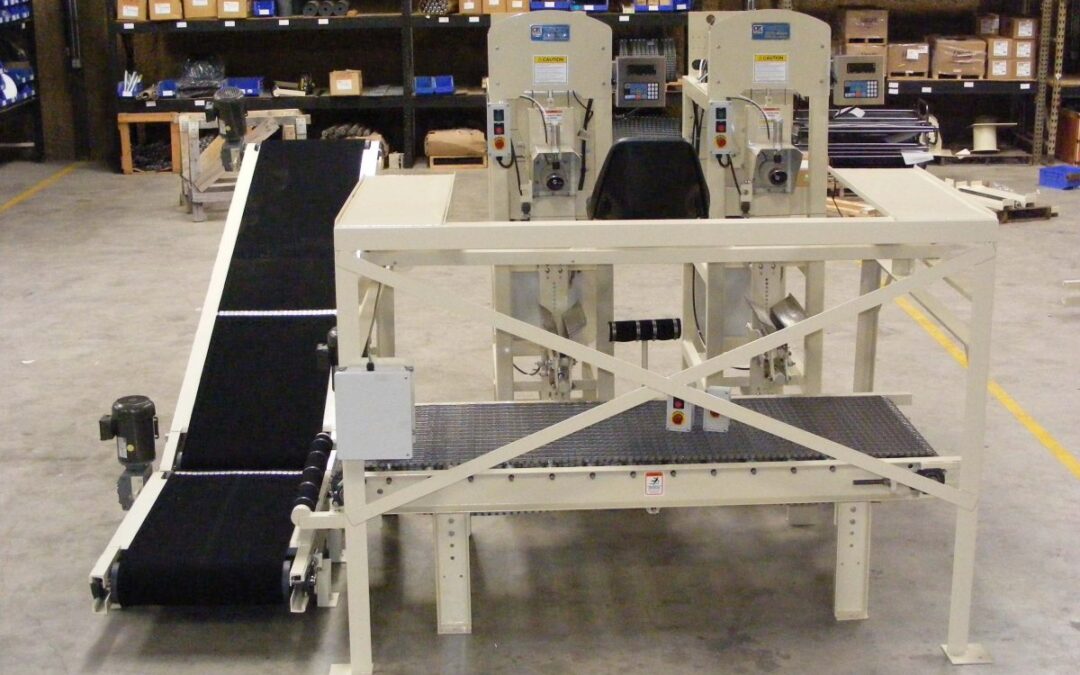
Is a 40% discount on a pre-owned system worth the risk of a $165,514 OSHA penalty if outdated guarding fails an inspection? In 2026, the real new vs used bagging machine value isn’t found on the initial invoice. It’s found in long term reliability and total cost of ownership. You’re likely under pressure to maximize capital expenditure while avoiding the unpredictable downtime that comes with discontinued parts and aging electronics. Since 1978, we’ve helped producers navigate these high stakes decisions with confidence and technical expertise.
We understand the need for a dependable packaging line that delivers consistent results. This guide provides a direct comparison of ROI, including how the $2,560,000 Section 179 deduction and 100% bonus depreciation apply to your equipment choice. You’ll gain a clear framework to justify your investment to stakeholders and lower the risk of production halts. We’re your partner in optimizing efficiency for the next decade. If you’re ready to secure your production future, contact us for a professional consultation.
Key Takeaways
- Learn to look beneath the surface of purchase prices to calculate the “Iceberg Effect” of long-term maintenance and downtime costs.
- Discover how modern precision engineering and seamless integration with robotic bag palletizers can maximize your line’s throughput.
- Identify the specific scenarios where immediate availability makes used equipment the right choice for seasonal backups or short-term contracts.
- Use our 5-point comparison framework to determine the precise new vs used bagging machine value based on your current production volume.
- Explore low-risk alternatives like equipment rentals and buyback programs that offer high performance without the uncertainty of the used market.
Defining Bagging Machine Value: Upfront Cost vs. Total Cost of Ownership (TCO)
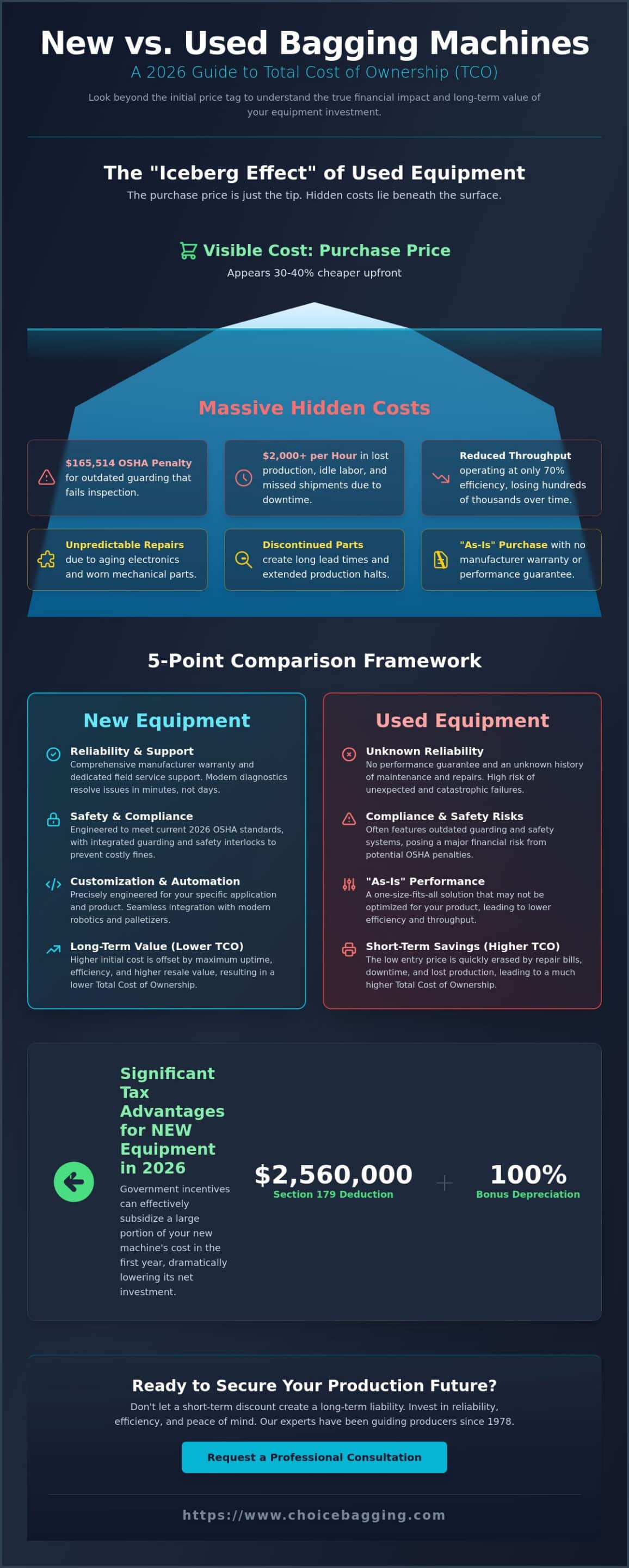
True value in industrial packaging isn’t a static number on a quote. It’s the ratio of throughput and uptime against your total investment over a 10 to 20 year lifecycle. When you evaluate the new vs used bagging machine value, you’re looking at the difference between a short term budget fix and a long term profit center. A machine that costs 30% less upfront but operates at only 70% efficiency will eventually cost you hundreds of thousands in lost production capacity.
We often describe the purchase of pre-owned equipment as the “Iceberg Effect.” The low purchase price is the only part visible above the water. Beneath the surface lies a massive, hidden mass of expenses. These include emergency repairs, difficulty sourcing parts for discontinued models, and the lack of modern safety guarding. Since 1978, we’ve focused on building “Made in the USA” durability into our systems to ensure the bulk of your investment remains productive, not buried in repair bills.
To better understand the variety of systems available and how their design impacts your line, watch this helpful video:
To make an informed decision, you must use the Total Cost of Ownership (TCO) formula. TCO is the comprehensive financial impact of equipment over its entire service life. The calculation is straightforward: Purchase Price + Installation + Maintenance + Downtime – Resale Value = TCO. While a Vertical form fill sealing machine or a specialized filler may have a higher entry point, its lower maintenance requirements and higher resale value often result in a much lower TCO than a used alternative.
The Real Cost of Production Downtime
Downtime is the silent killer of profitability. For a high volume facility, a halted bagging line can cost upwards of $2,000 per hour in idle labor, missed shipping windows, and lost orders. Investing in a new valve bag filler provides a level of reliability that an unknown used unit can’t match. New systems come with modern diagnostics and manufacturer support, ensuring that if a problem occurs, it’s resolved in minutes rather than days.
Depreciation and Tax Advantages
Tax incentives significantly shift the financial landscape in 2026. Under Section 179, businesses can deduct the full purchase price of qualifying equipment up to a limit of $2,560,000. This immediate deduction, combined with 100% bonus depreciation, means the government effectively subsidizes a large portion of your new machine’s cost in the first year. Furthermore, new machinery maintains a higher resale value, allowing you to recover more capital when it’s time for future upgrades.
The Case for New: Reliability, Customization, and Modern Automation
Choosing factory-new equipment is a strategic move that prioritizes precision and long term security. When analyzing new vs used bagging machine value, the most significant advantage of a new system is its ability to be engineered for your specific application. A machine built in 2026 incorporates the latest safety features required to avoid increasing OSHA penalties. With serious violations now carrying fines up to $16,550 per occurrence, the built-in guarding and safety interlocks of a new system provide essential financial protection. You aren’t just buying hardware; you’re buying a system designed to meet current legal and operational standards.
Reliability is reinforced through comprehensive manufacturer warranties and dedicated field service support. Unlike the “as-is” nature of the used market, new equipment comes with a performance guarantee. This security is a vital component of the Total Cost of Ownership (TCO), as it eliminates the risk of catastrophic repair bills in the first few years of operation. Since 1978, we’ve focused on providing this level of assurance to our partners. If you are unsure which technology fits your plant, request a professional consultation to review your options.
Customization for Specific Materials
Material characteristics dictate machine design. A system optimized for abrasive sand will likely fail when processing fine, aerated chemical powders. Using the wrong equipment leads to dusting, inaccurate weights, and premature component wear. New equipment allows for factory-testing of your specific material before delivery. This ensures the feeder, scale, and discharge components are tuned for your product’s flowability. For a deeper dive into these technical requirements, consult our ultimate guide to bagging machines.
Future-Proofing with Automation
Modern production lines require data. New systems feature advanced PLC controls that allow for real-time data tracking and remote troubleshooting. This digital infrastructure is essential for seamless integration with robotic bag palletizers and bag handling conveyors. By investing in new technology, you ensure your line can scale as automation trends continue to evolve through 2035. This connectivity reduces labor reliance and maximizes the efficiency of your entire packaging operation.
The Reality of Used Equipment: When Does It Make Business Sense?
While we emphasize long term performance, we recognize that pre-owned machinery serves specific operational needs. The new vs used bagging machine value proposition shifts when your requirements are temporary or low volume. If you’re managing a short term contract or need a seasonal backup to handle peak demand, a used unit can bridge the gap without the capital commitment of a new system. It’s a pragmatic choice for facilities where the machine won’t be running 24/7.
Availability is the primary driver for used purchases in 2026. Custom engineering a new system can take several months to complete. If a critical component on your primary line fails and you need an immediate replacement to keep orders moving, a used machine provides a “plug and play” solution. However, this speed comes with significant trade offs. You’re often inheriting someone else’s maintenance history. Buying from a general equipment liquidator is a gamble; they rarely understand the nuances of pneumatic timing or load cell calibration. It’s always safer to source used equipment from a trusted manufacturer who can verify the machine’s integrity.
The Parts Availability Trap
The most dangerous risk with used equipment is the “orphaned” machine. Many companies that manufactured bagging equipment in the 1990s and early 2000s no longer exist. If a proprietary circuit board or a specific casting fails, you might find yourself with a 2,000 pound paperweight. Choice Bagging Equipment supports older models with a dedicated parts department, but even we can’t always save a machine with obsolete electronics. Before you buy, ensure the machine uses standard, off the shelf components that are still in production.
Due Diligence Checklist for Used Buyers
Don’t let a fresh coat of paint fool you. Use this checklist to evaluate any used asset before committing your capital:
- Inspect Wear Parts: Check the bagging heads, seals, and conveyor belts for thinning or cracks. Replacing these immediately after purchase can erase your initial savings.
- Verify Software Backups: For PLC controlled units, ask for the original software program. Without it, you can’t troubleshoot logic errors or modify the machine’s timing.
- Check for Corrosion: Examine the frame and pneumatic cylinders. Corrosion in the air lines leads to erratic performance and expensive valve failures.
We’re also your partner in managing equipment lifecycles. If you’re looking to offload an older system while upgrading, our buyback program offers a secure way to transition to modern technology without the risks of the open used market.
Evaluating the Choice: A 5-Point Comparison Framework
To maximize your new vs used bagging machine value, you must move beyond the sticker price. Decision makers often focus on the immediate capital expenditure without accounting for the operational friction of aging hardware. A high volume facility running three shifts requires a different value weight than a seasonal operation. Since 1978, we’ve advised partners to evaluate their choice across five specific pillars to ensure long term stability. Your production volume is the primary indicator of which path to take. High volume lines almost always require the reliability of new equipment to remain profitable.
Accuracy in bag sealing is another critical variable that impacts your bottom line. A used sealer that leaks only 2% of your product can waste thousands of pounds of material annually. This hidden loss is often overlooked during the initial purchase. Our packaging machinery guide provides deeper context on how these individual components impact your entire production line’s health. If you’re ready to secure your production future, contact us for a professional consultation today.
The 5-Point Decision Matrix
This matrix helps you visualize the trade offs between a lower purchase price and long term performance. It’s important to remember that used equipment often requires immediate additional investment in refurbishment to meet modern safety and efficiency standards.
| Pillar | New Equipment | Used Equipment |
|---|---|---|
| Warranty | Comprehensive Factory Support | Limited or “As-Is” |
| Customization | Engineered to Material Spec | Rigid Existing Configuration |
| Parts | Guaranteed Availability | Risk of Obsolescence |
| Initial Cost | Higher Capital Outlay | Lower Upfront Price |
| Lead Time | Built to Order | Immediate Shipping |
ROI Calculation: The 3-Year Horizon
New equipment often becomes the more economical choice by the end of year three. This is due to superior energy efficiency and reduced material waste. Modern precision scales on new fillers can reduce overfilling by as much as 0.5%. While that sounds small, it compounds quickly across 100,000 bags. When you add the 2026 tax advantages discussed earlier, the “expensive” new machine often costs less in total capital than a used unit plagued by downtime.
Choice Bagging Equipment’s Hybrid Approach: Maximizing Your Investment Value
Many suppliers present a binary choice: you either invest in a new system or gamble on the used market. We recognize that industrial reality is rarely that simple. Maximizing new vs used bagging machine value often requires a more flexible strategy. Our hybrid approach allows you to secure the performance of modern technology while managing the capital constraints of your specific business cycle. Whether you need a temporary stopgap or a permanent upgrade, we provide pathways that reduce your financial risk.
The Bagging Equipment Rental Program is a cornerstone of this strategy. It offers a low risk alternative to purchasing used machinery of unknown quality. If you have a short term contract or a sudden surge in demand, renting allows you to maintain high production standards without a long term commitment. Additionally, our Buyback and Upgrade Program helps you transition away from aging assets. Choice Bagging Equipment buys your existing machinery, providing you with capital to put toward a new, high performance system. This creates a sustainable cycle of improvement for your facility.
Support doesn’t end at the point of sale. Our expert Field Service team provides on site optimization for both new installations and existing equipment. We don’t just drop off a machine and leave. We ensure your technicians are trained and your settings are calibrated for maximum throughput. Since 1978, we’ve operated with the belief that we’re your partner, not just a vendor. This relationship ensures your packaging line remains an asset rather than a source of stress.
Rent-to-Own and Flexible Sourcing
Renting is an excellent way to prove a concept before a full capital expenditure. For instance, testing a bulk bag filler in your actual environment allows you to verify material flow and bag weight accuracy. If the machine performs to your standards, our rent to own options provide a clear path to permanent ownership. This method eliminates the uncertainty of the new vs used bagging machine value debate by letting the equipment prove its ROI on your floor first.
The Partner Advantage
Choosing an American manufacturer means you have direct access to the engineers who built your equipment. You don’t have to wait for international time zones or deal with language barriers when you need phone support or emergency repairs. Our deep technical descriptions and history of reliability provide the assurance you need to invest confidently. We’re here to help you navigate the complexities of modern industrial bagging. Contact Choice Bagging Equipment today for a personalized value assessment and find the right solution for your production goals.
Secure Your Production Future with Proven Reliability
Successful industrial investment requires looking past the initial price tag to the decades of performance that follow. We’ve shown that true new vs used bagging machine value is found in high uptime, modern safety standards, and the 2026 tax incentives that make new systems more accessible than ever. Since 1978, Choice Bagging Equipment has focused on delivering Made in the USA quality that withstands the rigors of high volume production.
Your choice should align with your specific throughput goals and technical requirements. Whether you leverage our rental program to test a new line or utilize our buyback program to upgrade your current facility, you aren’t just buying equipment. You’re gaining a long term partner dedicated to your growth. Our team is ready to help you optimize your packaging efficiency and eliminate the risks of unpredictable downtime. It’s time to invest confidently in a system that builds value with every bag filled. Visit Choice Bagging Equipment to learn more about our durability, or Request a Quote for Your Bagging Machine Project today to begin your transition to a more reliable production future.
Bagging Machine Investment FAQs
Is it better to buy a new or used bagging machine for a startup?
Startups should prioritize new equipment if they anticipate high volume production. The $2,560,000 Section 179 deduction and 100% bonus depreciation available in 2026 often make the net cost of new machinery comparable to used. While used machines have lower entry prices, the risk of downtime can cripple a new business before it gains momentum. Investing in reliability from day one ensures you can meet your first customer contracts without equipment failure.
How long does a new industrial bagging machine typically last?
A high quality, American-made machine typically lasts 20 to 30 years when maintained correctly. We’ve seen systems built since 1978 still operating in heavy duty environments today. This durability is why we focus on minimal moving parts and easy-to-use controls to ensure your investment remains productive for decades. Choosing a machine with a proven track record is the best way to secure long term performance for your facility.
What are the biggest risks when buying used bagging equipment from an auction?
The primary risks are unknown maintenance history and non-compliance with 2026 OSHA safety standards. Auctioned machines are sold “as-is” and often lack modern guarding. If a machine fails an inspection, you could face penalties up to $16,550 per serious violation. You also risk buying “orphaned” equipment with no available technical manuals or software backups. These hidden costs can quickly exceed the savings of a lower purchase price.
Can I upgrade an old bagging machine with new automation features?
You can often upgrade a sound mechanical frame with modern PLC controls or robotic bag palletizers. This strategy improves the new vs used bagging machine value by modernizing your line without a full replacement cost. However, if the base machine is heavily corroded or uses obsolete pneumatic logic, a full system upgrade is usually more cost-effective. We can help you assess if your current frame is a candidate for automation.
How does lead time affect the value of a new bagging machine?
Lead time is a critical factor in your ROI calculation. While a used machine is available immediately, a new system is engineered to your specific material. The 0.5% increase in weight accuracy provided by a custom-tuned machine can save thousands of pounds in product “giveaway” annually. This long-term savings often outweighs the initial wait for delivery. Planning your capital expenditure in advance allows you to secure these precision benefits without rushing into a compromise.
Are parts for older bagging machines still available?
Parts availability varies significantly by brand. Choice Bagging maintains a robust inventory for our legacy models, but machines from manufacturers that are no longer in business are difficult to support. If a proprietary circuit board fails on an orphaned machine, the unit may become unrepairable. Always verify the manufacturer’s current status before purchasing a used asset. We specialize in sourcing components that keep your line running, even for older systems.
What is the typical ROI period for a new valve bag filler?
Most facilities see a full return on investment within 18 to 36 months. This timeline is accelerated by the 100% bonus depreciation tax benefit and the reduction in labor costs. Modern automatic machines now account for 65% of the market share because they significantly lower the cost per bag through speed and precision. When you calculate the new vs used bagging machine value over three years, the new system often costs less in total capital.
Does Choice Bagging Equipment offer warranties on refurbished machines?
Yes, we offer limited warranties on machines that pass our rigorous refurbishment process. This provides a level of reassurance that general liquidators cannot match. By purchasing a certified pre-owned unit from a trusted manufacturer, you secure a reliable asset while maintaining a lower initial capital expenditure. It’s a safer way to buy used equipment because you have the support of our field service team and parts department behind every sale.
Recent Comments