
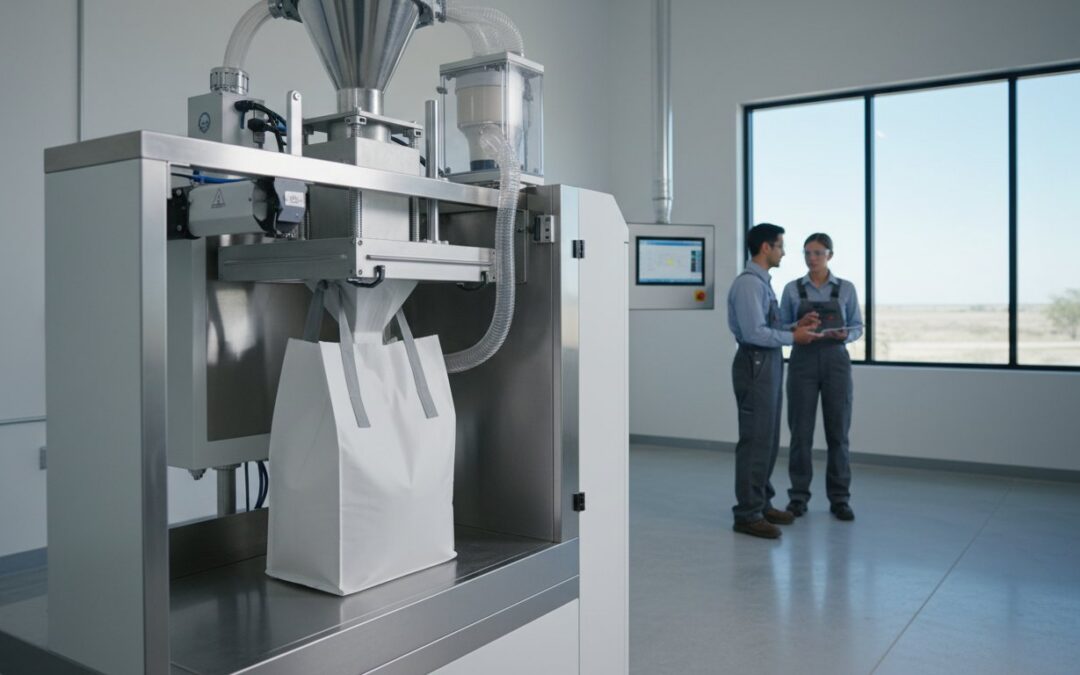
Are inaccurate bag weights eating into your profits? Is fugitive dust creating a hazardous work environment and causing product loss? These challenges are not just minor annoyances; they are significant obstacles to achieving peak operational efficiency. The right valve bag packer is more than just a piece of equipment—it’s the core of a reliable and profitable packaging line, an investment that should deliver decades of performance, not years of high maintenance costs.
Choosing the correct machine requires a deep understanding of the technology. This comprehensive guide is engineered to provide the expert knowledge you need to invest confidently. We will demystify the technical nuances of selection, integration, and performance, moving beyond simple specifications to explore the principles of long-term value. By the end, you will have the insight to choose a system that eliminates product waste, ensures a clean and safe operation, and delivers the unmatched reliability your business demands for years to come.
Key Takeaways
-
Learn how to analyze your product’s bulk density and flowability to ensure you select the most accurate and efficient machine for your needs.
-
Differentiate between air, impeller, and auger technologies to determine which packer is engineered for your specific material, from fine powders to granular products.
-
Understand how a complete valve bag packer system improves cleanliness and pallet stability, and how automation can further enhance production speed.
-
Discover why downstream equipment like bag handling conveyors is essential for achieving accurate final weights and preparing bags for palletizing.
Table of Contents
-
What is a Valve Bag Packer and Why is it the Industry Standard?
-
Comparing Valve Bag Packer Technologies: Air, Impeller, and Auger
-
Integrating Your Valve Packer into a Complete Production Line
What is a Valve Bag Packer and Why is it the Industry Standard?
In modern industrial operations, efficiency and cleanliness are paramount. A valve bag packer is a specialized piece of packaging machinery designed to fill bags through a small, built-in opening, or "valve." Instead of filling from an open top, this system uses internal pressure or mechanical force to precisely dose material into a pre-made bag, creating a clean, compact, and secure package. This technology is the trusted standard for handling fine, dusty, or aerated products where contamination and material loss are major concerns.
To see this high-performance technology in action, watch the video below:
Industries handling products like cement, minerals, chemicals, and fine food powders rely on valve bags for two primary reasons: superior cleanliness and exceptional pallet stability. The enclosed filling process drastically reduces airborne dust, while the resulting square, brick-like bags stack securely. This translates directly into a safer work environment, reduced product loss, and a higher return on investment by eliminating the need for secondary sealing equipment like heat sealers or sewing machines.
The Mechanics of Valve Bag Filling
The ingenuity of the valve bag system lies in its simplicity and effectiveness. The bag features an internal sleeve that acts as a one-way valve; once the bag is filled and removed from the machine, the pressure of the product inside forces the sleeve shut, creating an automatic, sift-proof seal. The filling spout on the packer is engineered to create a dust-tight connection with the bag’s valve during the filling cycle. Packers operate on one of two weighing principles:
-
Gross Weigh: The bag and its contents are weighed together during the filling process.
-
Net Weigh: The product is weighed in a hopper above the packer and then discharged into the bag for maximum accuracy.
Key Benefits: Cleanliness, Speed, and Stability
A modern valve bag packer delivers performance benefits that directly impact your bottom line. Integrated aspiration systems capture fugitive dust at the source, eliminating the hazardous "dust cloud" common with other methods. The uniform, square shape of the finished bags is ideal for stable stacking and efficient robotic palletizing, maximizing warehouse space and load security. Furthermore, these machines are built for high-speed throughput, providing the reliability and durability required for demanding 24/7 industrial operations.
Comparing Valve Bag Packer Technologies: Air, Impeller, and Auger
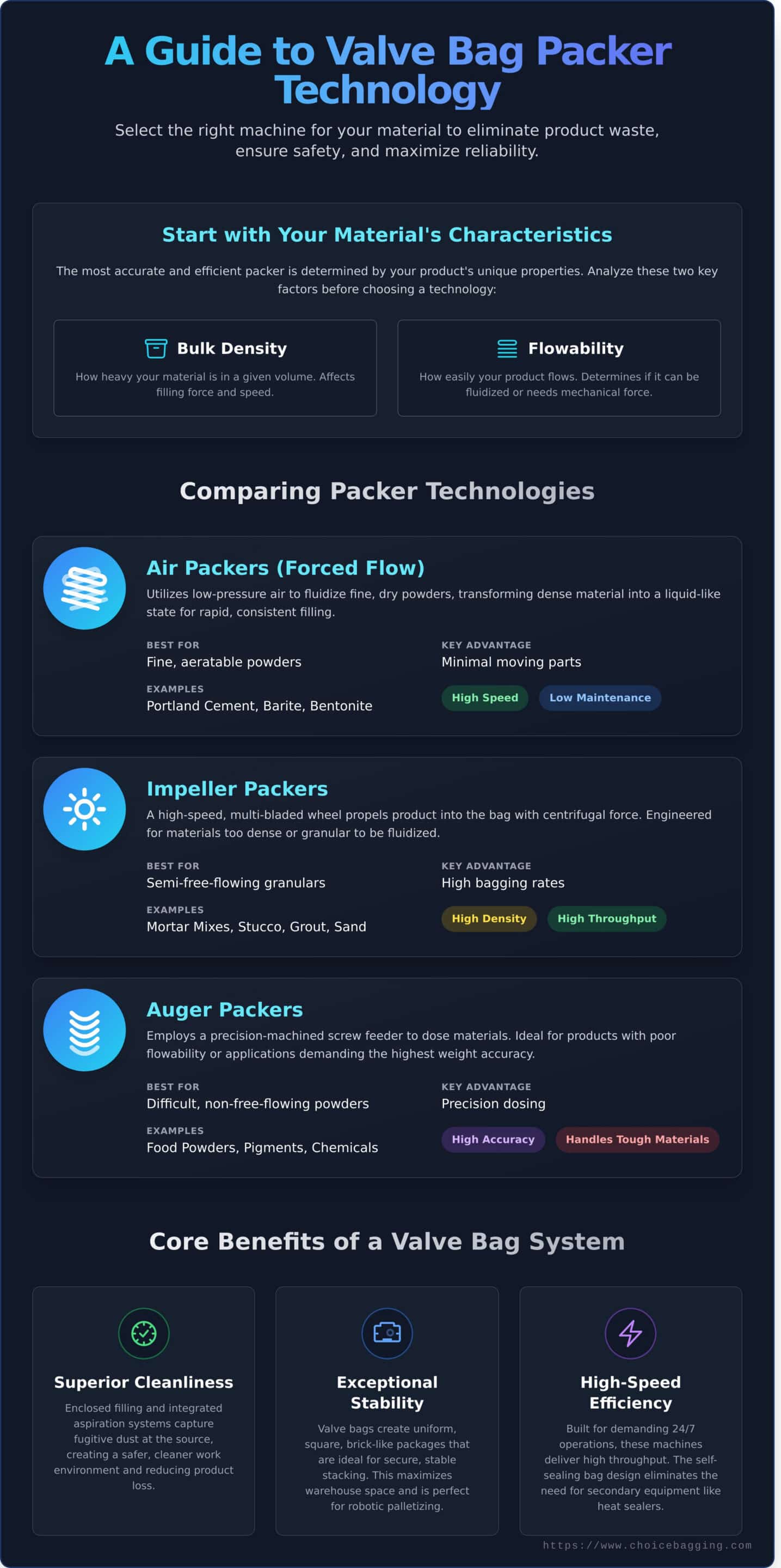
Selecting the correct valve bag packer technology is critical for achieving optimal performance, accuracy, and reliability. The choice is driven entirely by your product’s characteristics—its density, flowability, and abrasiveness. Understanding the core differences between air, impeller, auger, and gravity systems ensures you invest in a machine engineered for your specific application and production goals.
Air Packers (Forced Flow) for Fine Powders
Air packers, also known as pneumatic packers, utilize low-pressure air to fluidize fine, dry powders. This process transforms the dense material into a liquid-like state, allowing it to flow rapidly and consistently into the valve bag. Their primary advantage lies in a design with minimal moving parts, which significantly reduces maintenance requirements and costly downtime. This streamlined operation delivers high-speed, dust-controlled bagging for compatible products. For this reason, pneumatic packers are the gold standard for bagging Portland cement, where high throughput and machine uptime are non-negotiable.
Impeller and Auger Packers for Specialized Materials
When materials are too dense or granular to be fluidized, mechanical packers provide the necessary force and control. Each system offers distinct advantages:
-
Impeller Packers: These machines use a high-speed, multi-bladed wheel to propel products like high-density minerals, mortar mixes, or stucco into the bag with centrifugal force. They are ideal for achieving high bagging rates with semi-free-flowing granular materials.
-
Auger Packers: An auger (or screw) packer employs a precision-machined screw feeder to dose materials with exceptional consistency. This makes them the definitive choice for non-free-flowing, fibrous, or abrasive products where volumetric accuracy is paramount.
Choosing a mechanical feeder over a pneumatic system is necessary when your product resists fluidization or requires the precise, powerful handling that only an impeller or auger can provide. Regardless of the internal mechanism, the overall machine must prioritize operator safety by adhering to the latest industry regulations, such as the ANSI/PMMI B155.1-2023 Safety Standard.
Gravity Packers for Free-Flowing Granules
For materials with excellent flow characteristics, the Gravity Packer offers a straightforward and highly cost-effective solution. This type of valve bag packer uses a simple gate or valve to control the flow of free-flowing, granular products like sand, corn, soybeans, or plastic pellets directly into the bag. While mechanically simpler, it provides reliable, durable performance for applications where the product’s natural properties do most of the work.
How to Select the Right Valve Bag Packer for Your Material
Selecting the correct valve bag packer is not a one-size-fits-all decision. The performance, reliability, and efficiency of your bagging line depend entirely on matching the machine’s technology to your product’s specific characteristics. To invest confidently, a thorough analysis of your material is the critical first step. By evaluating four key properties—bulk density, flowability, speed requirements, and environmental hazards—you can specify a system built for precision and durability.
Matching Bulk Density to Feeder Type
The weight and flow of your product directly determine the ideal feeder mechanism. Light, aerated powders (3-25 lbs/ft³) often trap excess air and require an auger-style packer with de-aeration cycles to achieve consistent bag weights. In contrast, dense, heavy aggregates like gravel or sand (over 90 lbs/ft³) demand robust machinery, such as an air packer, designed to handle high-impact flow without damaging internal components. Understanding this relationship is foundational to operational success. You can browse our valve bag fillers by material type to see these principles in action.
Addressing the Accuracy vs. Speed Trade-off
Every operation must balance throughput with precision. Modern valve bag filling systems achieve this with advanced load cell technology and intelligent controls. A two-stage "bulk and dribble" feed cycle rapidly fills the majority of the bag, then slows to a precise dribble to hit the target weight, consistently delivering +/- 0.5% accuracy. For facilities running multiple products, integrated PLC controls allow you to store and recall specific filling recipes, ensuring repeatable performance and minimizing changeover time between runs.
Finally, you must assess the operational environment. Highly abrasive materials like cement or stucco require a valve bag packer constructed with hardened steel components to ensure longevity and reduce maintenance downtime. For combustible dusts, which pose a significant explosion risk, the equipment must meet stringent safety standards. Choosing the right machine is a primary safety measure, a concept supported by a detailed NIOSH study on engineering controls for bagging systems. Proper equipment selection minimizes airborne particles, protecting both your team and your facility.
Integrating Your Valve Packer into a Complete Production Line
A high-performance valve bag packer is the heart of your bagging operation, but its true value is realized when it functions as part of a seamless, automated system. Integrating your packer is a strategic investment in efficiency and output. The first step often involves moving from manual bag placement to automated applicators, which immediately increases speed and reduces labor dependency. This sets the stage for a fully optimized production line.
Once filled, bags must be managed correctly. This is where specialized bag handling conveyors become essential. These systems do more than just transport bags; they are engineered to gently settle and condition the product, creating a stable, flat bag shape that is critical for consistent stacking and palletizing.
From Filling to Robotic Palletizing
The consistent, uniform bag shape produced by a quality valve bag packer is ideal for robotic palletizers, which rely on predictable dimensions for a secure grip. To guarantee product quality, a check-weigher can be integrated after the filler to automatically reject any under-filled bags. This streamlined workflow ensures that only on-spec bags proceed from the conveyor to the palletizer and, finally, to an automated stretch wrapper, resulting in a secure, market-ready pallet.
Ensuring Long-Term Reliability
An integrated system must be built for longevity. Our American-engineered designs prioritize reliability with minimal moving parts, reducing the potential for failure and simplifying service. To ensure your equipment provides over 20 years of dependable performance, establishing a preventative maintenance schedule is key. This includes regular inspection and service of:
-
Wear-prone components like filling spouts and tube clamps.
-
Inflatable seals and air system components.
-
Scales and load cells for continued accuracy.
Downtime is costly. Having direct access to a comprehensive inventory of replacement parts ensures that any necessary repairs can be completed swiftly, keeping your production line running at peak efficiency. Planning for maintenance from day one is not an expense—it is an investment in decades of uninterrupted performance. As your long-term partner, we can help you design a system built to last. Contact us to discuss your integration goals.
Why Choice Bagging Equipment is Your Strategic Partner
Selecting the right equipment is a critical investment in your plant’s productivity and future. At Choice Bagging Equipment, we understand that you’re not just buying a machine; you’re building a reliable production line. Since 1978, we have moved beyond the role of a simple manufacturer to become a strategic partner for businesses across industries, delivering solutions built on a foundation of trust and proven performance.
Our commitment to quality begins with our materials. Every machine is proudly Made in the USA, constructed from heavy-duty domestic steel for superior structural integrity and longevity. This dedication to high-quality domestic manufacturing ensures that your equipment is not only robust but also consistently dependable, minimizing downtime and maximizing your return on investment.
The Bagger Professor: Expert Selection Guidance
Navigating equipment options can be complex. That’s why we developed our "Bagger Professor" approach—an expert-led consultation process designed to ensure you get the right machine. Our proprietary search tool analyzes your material characteristics to identify the ideal equipment for your specific application. We engineer for reliability over flash, focusing on proven, durable designs that deliver consistent performance. Choice Bagging acts as a partner, not just a supplier, guiding you to the most effective long-term solution for your operation.
Custom Engineering and Integration
Standard solutions don’t always fit. Our engineering team excels at tailoring a valve bag packer to integrate seamlessly into your existing lines, even in plants with restricted footprint areas. This custom approach ensures optimal workflow and efficiency. We build machines to last for decades, and our rugged construction is a testament to that promise. Let our team design a system that meets your exact specifications. ******Request a custom consultation and quote today. **
Our partnership extends far beyond the sale. We provide comprehensive support, from initial line integration planning to ongoing maintenance and field service. We ensure your equipment is installed correctly, your team is trained, and your operations run smoothly for years to come. Choose a partner committed to your success. Choose Choice Bagging Equipment.
Your Strategic Partner for Valve Bagging Performance
Choosing the right bagging equipment is a critical investment in your operational efficiency. As this guide has shown, success depends on matching packer technology—be it air, impeller, or auger—to your specific material and ensuring seamless integration into your production line. An optimal valve bag packer solution doesn’t just fill bags; it enhances throughput, ensures accuracy, and delivers long-term reliability.
At Choice Bagging Equipment, we are more than a manufacturer; we are your partner. Since 1978, we have engineered high-performance bagging solutions built with heavy-duty, USA-made components. We leverage this experience to ensure you receive a system designed for maximum durability and performance. Don’t leave your selection to chance—use our exclusive Bagger Professor tool to identify the perfect fit for your needs.
Ready to enhance your packaging line? **Contact Choice Bagging for a Custom Quote ** and invest confidently in a solution built to perform for decades to come.
Frequently Asked Questions About Valve Bag Packers
How many bags per minute can a typical valve bag packer fill?
The filling rate depends on the packer type, product characteristics, and target weight. Pneumatic air packers are excellent for fine powders and typically fill between 1 to 8 bags per minute (BPM). For higher throughput, impeller or auger-style packers can achieve rates from 4 to 12 BPM or more. Achieving maximum efficiency requires correctly matching the machine’s capabilities with your specific material and operational goals to ensure consistent, reliable performance.
What is the difference between a gross weigh and a net weigh valve bagger?
The key difference is the weighing method. A gross weigh bagger weighs the product as it enters the bag, meaning the bag and its contents are on the scale during the fill cycle. This design is simpler and more compact. In contrast, a net weigh bagger weighs the product in a separate hopper before discharging the pre-weighed batch into the bag. Net weigh systems deliver higher speeds and greater accuracy, making them the superior choice for high-volume production lines.
Can one valve bag packer handle multiple different types of products?
Yes, a single valve bag packer can often handle multiple products if they share similar flow characteristics. However, a machine optimized for a fine, aeratable powder may not perform well with a dense, granular material. Critical factors include product density, abrasiveness, and the necessity for thorough clean-out procedures to prevent cross-contamination. We recommend a consultation to ensure the selected machine provides the versatility and high performance your operation demands.
Do valve bags require heat sealing or sewing after they are filled?
Most valve bags feature a self-closing sleeve that automatically shuts after the bag is filled and removed from the spout, eliminating the need for secondary sealing like sewing. For applications that demand a more secure, airtight closure for sensitive products, bags with an ultrasonic sealable valve are an excellent option. This technology securely welds the sleeve shut, providing a superior seal without requiring additional closing equipment and ensuring product integrity.
How do I reduce dust emissions during the valve bag filling process?
Effective dust management is essential for safety and cleanliness. Modern packers are equipped with a dust collection port on the filling spout, which should be connected to a central dust collector. Ensuring the bag is seated correctly on the spout creates a tight seal and minimizes leakage. Additionally, utilizing a bag settling device helps de-aerate the product, which compacts it within the bag and reduces dust release when the bag is discharged from the machine.
What maintenance is required for a pneumatic air packer?
Pneumatic air packers are engineered for durability with minimal moving parts, which simplifies maintenance. Routine checks should include draining the air line filter and regulator to remove moisture, inspecting fittings for air leaks, and examining the rubber spout and product chamber seals for wear. The most critical factor for ensuring long-term, dependable performance is maintaining a clean and dry compressed air supply, which protects the machine’s internal components from damage.
Is it better to buy a new valve bag packer or a used one?
Your choice depends on your budget and tolerance for risk. A new machine from a trusted manufacturer guarantees you receive a full warranty, the latest safety and efficiency features, and dedicated technical support. While a used packer offers a lower initial investment, it can carry risks like an unknown operational history, unexpected downtime, and difficulty sourcing parts or service. Investing confidently in new equipment ensures unmatched reliability and a long-term partnership for your success.
What size valve bags are compatible with Choice Bagging equipment?
Our valve bagging equipment is engineered for outstanding versatility to handle a wide range of industry-standard bag sizes, typically from 20 to 110 lbs. However, peak performance is achieved when the filling spout is precisely sized for the bag’s valve dimensions. To ensure perfect compatibility, we recommend a direct consultation with our experts. As your partner, we will configure the equipment to meet your exact operational requirements and deliver maximum efficiency.
Recent Comments