
Decommissioned machinery sitting on your warehouse floor isn’t just taking up square footage; it is an idle asset that loses market value every day while increasing overhead costs. Many production facilities struggle with the uncertainty of what their used equipment is actually worth, often leaving thousands of dollars in potential revenue untouched. Utilizing a professional bagging machine buyback program allows you to reclaim that lost space and convert stagnant hardware into immediate liquid capital. This approach transforms a simple liquidation into a strategic reinvestment in your facility’s operational future.
You likely recognize that keeping obsolete gear on life support is a drain on both maintenance budgets and operational output. We understand that making the leap to modern automation requires a clear path for capital recovery and technical assurance. This article explains how to leverage professional evaluations and current tax incentives, such as the restored 100% bonus depreciation, to fund your transition to more efficient systems. You will learn how a collaborative partnership simplifies the trade-in process, ensuring your surplus assets provide the highest possible return on investment while streamlining your production line for long-term success.
Key Takeaways
- Learn how a professional bagging machine buyback program serves as a strategic asset management tool to convert surplus equipment into liquid capital for future growth.
- Understand the five critical factors that determine the market value of your used machinery, including the essential role of documented maintenance history.
- Discover why manufacturer-led trade-ins offer superior financial returns and technical assurance compared to traditional industrial auctions or scrap liquidation.
- Follow a systematic preparation guide to ensure your equipment is ready for a professional technical evaluation and a seamless, high-value payout.
- Explore how leveraging the value of your existing assets can facilitate a cost-effective transition to advanced automated systems, such as robotic bag palletizers.
Understanding the Bagging Machine Buyback Program in 2026
A bagging machine buyback program is a professional acquisition service designed to help manufacturers manage surplus industrial equipment with technical precision. It isn’t a simple scrap transaction; it’s a strategic process where an industry authority evaluates your decommissioned assets to facilitate a secure capital recovery. By participating in these programs, businesses align themselves with the principles of a circular economy, ensuring that robust hardware is refurbished and returned to the supply chain rather than being discarded. This collaborative approach turns what would be a logistical burden into a valuable liquidity event for your facility.
The primary objective is to convert stagnant physical assets into liquid capital or credit toward high-performance upgrades. In 2026, this shift is more relevant than ever as production demands increase and floor space becomes a premium commodity. Whether you’re looking for an immediate cash purchase or a structured trade-in, this program provides a verified path to optimize your balance sheet and maintain operational excellence.
To understand the operational challenges that often lead to asset replacement, watch this technical overview:
The Financial Benefits of Asset Recovery
Recovering capital from idle machinery offers immediate liquidity to fund other areas of your operation. Competitive cash offers for surplus equipment allow you to stop paying overhead costs for storage and maintenance on machines that no longer contribute to your output. Removing these depreciated assets also provides significant tax advantages. Under the 2026 tax laws, the restoration of 100% bonus depreciation and the increased Section 179 expensing limit of $2.5 million make it financially prudent to cycle out old gear. This strategy cleans up your warehouse floor and optimizes your financial reporting simultaneously. You don’t have to let capital sit idle when it could be fueling your next phase of growth.
The Strategic Shift to Modern Technology
A buyback program acts as a financial bridge toward automated bagging systems. Instead of facing the full brunt of a capital expenditure, you can apply the value of your existing hardware to lower the entry cost of new technology. This minimizes the financial risk associated with large-scale facility upgrades. Modernizing your line ensures operational safety and compliance with the latest regulations, such as the 2026 PFAS packaging prohibitions and EU recyclability standards. By removing outdated, non-compliant hardware through a bagging machine buyback program, you maintain brand consistency and technical excellence across your entire production floor. It’s a pragmatic way to secure a competitive edge while ensuring your equipment remains reliable and efficient.
Equipment Evaluation: How Your Bagging Machine Value is Determined
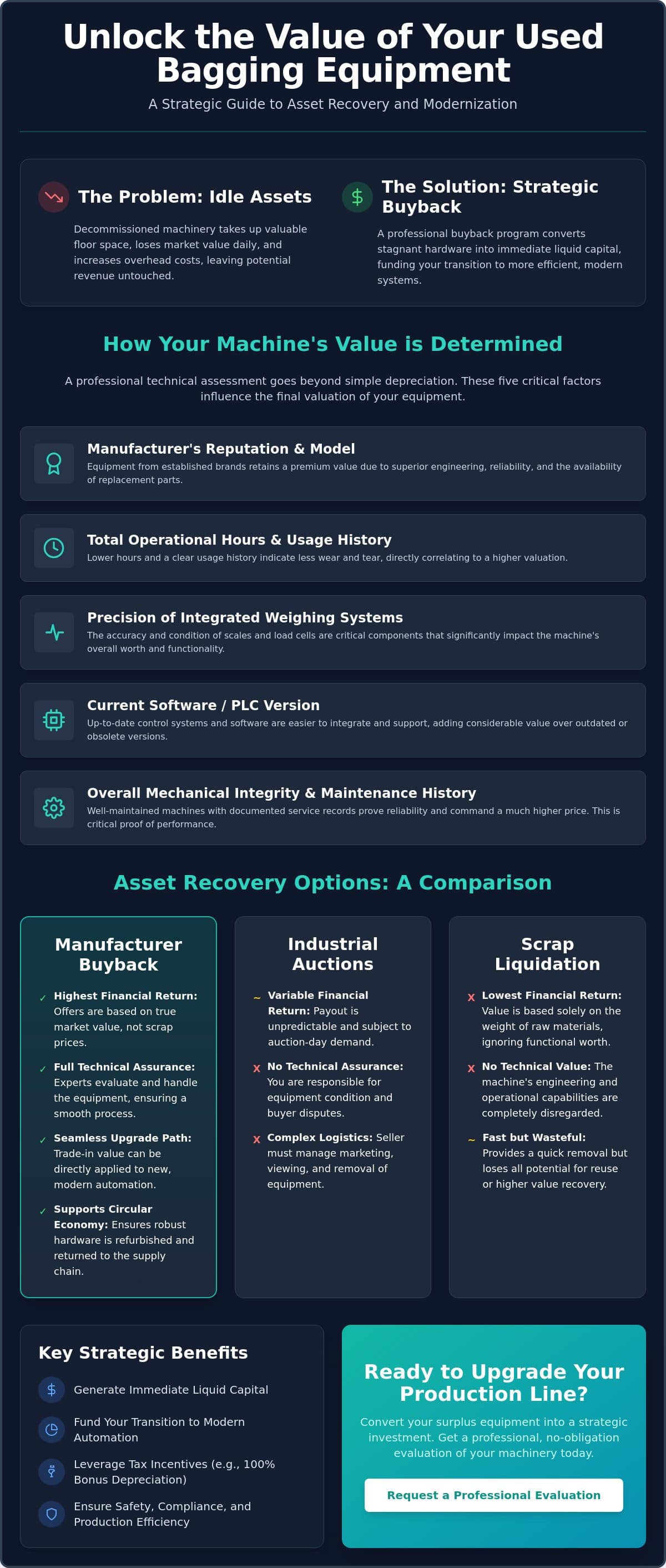
Determining the fair market value of used industrial assets requires a methodical technical assessment. A professional bagging machine buyback program utilizes a specific framework to evaluate equipment, moving beyond simple age-based depreciation. The five primary factors influencing your offer include the manufacturer’s reputation, the total operational hours, the precision of the integrated weighing systems, the current software or PLC version, and the overall mechanical integrity. While a generic machine might lose value rapidly, equipment from established brands often retains a premium due to the enduring nature of its engineering and the consistent availability of replacement parts.
Documentation serves as the critical proof of performance during this evaluation. Historical maintenance records demonstrate that the machine has been serviced according to technical standards, which significantly reduces the risk for the buyer. Providing high-resolution photographic and video evidence of the machine in operation allows for a more accurate preliminary valuation. This level of transparency aligns with the circular economy for industrial equipment, where verified data ensures that assets are priced according to their true remaining service life. Clear evidence of a well-maintained system can often bridge the gap between a standard offer and a premium valuation.
Technical Factors in Valuation
Age and model are important, but they don’t tell the whole story. Certain legacy machines are built with heavy-duty frames and over-engineered motors that outlast newer, lighter models. Operational hours provide a more granular look at wear and tear than the manufacture date alone. We look closely at the condition of critical wear parts, such as bagging heads and sealing elements, to determine if the unit requires minor refurbishment or a complete technical overhaul. High-precision weighing systems or updated PLC versions can also increase the final offer because they ensure the machine remains compatible with modern production standards.
Market Demand and Equipment Type
Market liquidity varies significantly across different machinery categories. Valve Bag Fillers and Open Mouth systems are currently in high demand, often commanding premium prices in the secondary market. Ancillary equipment, such as bag sealing machines, sewing systems, and high-speed conveyors, also adds substantial value to a buyback package. Market demand for specific material handling capabilities shifts valuation, as food-grade stainless steel systems often command higher prices than standard industrial-grade carbon steel units due to stricter hygiene regulations. If you’re curious about the current market position of your assets, you can submit your equipment details for a professional review to see how these factors apply to your specific machinery.
Buyback vs. Liquidation: Why Manufacturer Programs Offer Superior Value
Choosing the right exit strategy for decommissioned machinery is as critical as the initial procurement decision. When you decide to offload surplus equipment, you’ll typically face a choice between a public liquidation and a structured buyback. Industrial auctions often promise high visibility, but they introduce significant volatility and uncertainty into your financial planning. A professional bagging machine buyback program, by contrast, offers a predictable outcome based on the technical merit of the hardware. Manufacturers pay what we call an “Expert Premium” because they possess the specialized facilities and engineering knowledge to refurbish and certify pre-owned hardware. This internal capability allows them to offer values that third-party liquidators, who only see the resale or scrap value of the raw materials, simply can’t match.
Opting for a buyback also significantly reduces the “Hassle Factor” associated with asset disposal. Instead of managing dozens of inquiries from unvetted buyers or coordinating complex auction logistics, you work with a single, dependable partner. This collaborative approach transforms a standard transaction into a strategic alliance. You gain the peace of mind that comes from working with experts who understand the enduring nature of industrial assets and are committed to maintaining high standards of operational excellence across the entire secondary market.
The Pitfalls of Industrial Auctions
Industrial auctions come with several hidden risks that can erode your final return on investment. Seller commissions and administrative fees often take a significant percentage of the final hammer price, leaving you with less capital than anticipated. There’s also the lack of a guaranteed sale; your equipment might sit in inventory for months, continuing to take up valuable floor space while its market value depreciates. Furthermore, allowing unknown parties into your facility for inspections and removal creates security and liability concerns. These disruptions can interfere with your active production lines and create unnecessary administrative burdens for your safety and maintenance teams.
Advantages of Manufacturer Buybacks
A manufacturer-led buyback provides a guaranteed offer that isn’t subject to the whims of bidding volatility. This stability allows for better financial forecasting and immediate reinvestment into newer, more efficient technology. These programs often integrate directly with your next purchase, simplifying the procurement cycle by using the trade-in value to bridge the funding gap for modern packaging machinery. You also benefit from professional decommissioning and removal performed by technicians who understand the equipment’s mechanical complexities. This ensures the asset is handled with care and removed from your facility safely and efficiently, without the risks associated with third-party riggers. This method prioritizes technical competence and long-term service integration over a simple, one-off transactional sale.
How to Prepare Your Bagging Equipment for Sale or Trade-In
Securing the highest possible return in a bagging machine buyback program depends largely on how you present the asset’s technical history and current condition. A machine that appears neglected or lacks proper documentation will inevitably face a lower valuation. By taking systematic steps to prepare your equipment, you demonstrate mechanical integrity and reduce the buyer’s perceived risk. This preparation phase is your opportunity to prove the enduring nature of your hardware and justify a premium payout.
Effective preparation involves a blend of administrative diligence and physical maintenance. You want to provide a transparent view of the equipment’s life cycle. This transparency builds trust and accelerates the evaluation process, moving you closer to a final agreement and capital recovery. If you’re ready to begin this process, you can submit your equipment for a professional buyback evaluation today.
Documentation and History
The paper trail is often as valuable as the hardware itself. Start by gathering all original operation manuals, physical wiring diagrams, and software backup files for the PLC. These documents are essential for any future refurbishment or integration. You should also compile a comprehensive log of preventive maintenance and part replacements. This data serves as verified proof of reliability and consistent operational output. If your team performed any custom engineering or modifications to the original system, identify these clearly. Specialized modifications can often increase the machine’s utility and market demand if they’re documented correctly.
Physical Preparation and Logistics
Industrial packaging environments are notoriously prone to dust and debris. Thoroughly cleaning the equipment to remove residual powders or granules is the simplest way to improve its shelf appeal. Pay close attention to the bagging heads, weighing scales, and sealing elements. Once the machine is clean, conduct a final test run. Capture high-quality video of the machine in operation to provide undeniable evidence of its functional status. This video acts as a technical baseline for the preliminary valuation phase.
Finally, coordinate with professional field service teams for the decommissioning process. Professional disconnection ensures that sensitive electronic components and mechanical sensors remain intact during transport. Palletizing the equipment correctly is vital for safety and compliance during shipment. Using specialized technicians for these final steps protects the asset’s value and ensures a seamless transition from your floor to the buyer’s facility. Proper logistics management is the final hurdle in maximizing your return on investment.
The Choice Bagging Equipment Collaborative Approach to Asset Upgrades
At Choice Bagging Equipment, we view our relationship with clients as a collaborative alliance rather than a simple series of transactions. Our bagging machine buyback program serves as a critical component of this partnership, allowing you to manage the entire lifecycle of your industrial assets with technical precision. We don’t just help you offload surplus machinery; we provide the engineering expertise needed to reinvest that value into a more efficient production future. This lifecycle advantage ensures that from the initial design of your line to the eventual trade-in and upgrade, your facility maintains high standards of operational excellence.
Transitioning to higher levels of automation requires a partner who understands the mechanical complexities of your specific industry. We specialize in identifying how your current assets can fund the next generation of your production line. Whether you’re scaling up output or modernizing for safety compliance, our team ensures that every piece of equipment contributes to your long-term success. This approach transforms a standard equipment replacement into a strategic move toward a fully integrated, high-performance facility.
Funding Your Automation Journey
One of the most significant hurdles to facility modernization is the initial capital expenditure. By leveraging credits from a bagging machine buyback program, you can significantly offset the cost of advanced hardware like bulk bag fillers or robotic bag palletizing systems. This strategy reduces the total cost of ownership (TCO) by capturing the remaining value of your legacy assets before they become technologically obsolete. Our engineers can even help you design a hybrid production line that seamlessly incorporates both new technology and certified refurbished elements. This flexibility allows you to achieve the operational output you need without overextending your capital budget, providing a secure investment path for your business.
Get Started with Your Evaluation
Reclaiming the value of your surplus equipment begins with a professional appraisal. We invite you to contact our team to initiate a technical review of your current assets. Once you submit your inquiry, you can expect a preliminary response and a request for specific documentation within 48 hours. Our evaluation process is thorough, transparent, and rooted in the deep industry expertise we’ve cultivated since 1978. We remain committed to providing the reliability and technical competence you need to make informed procurement decisions. Let us help you convert your idle machinery into the momentum your production line needs for the years ahead.
Reclaim Your Capital and Modernize Your Production Line
Transforming stagnant industrial assets into liquid capital is a strategic necessity for maintaining a competitive edge. A professional bagging machine buyback program offers a secure, technical alternative to the volatility of public auctions. By prioritizing expert appraisals and meticulous equipment preparation, you ensure your facility recovers the maximum possible value from its surplus hardware. This approach doesn’t just clean up your warehouse floor; it actively funds your transition toward high-performance automated systems.
As a trusted industry leader since 1978, Choice Bagging Equipment provides the technical competence required for fair market value evaluations. Our expert appraisals guarantee an accurate assessment of your machinery’s worth, offering seamless trade-in options for the latest automated technology. Don’t let your decommissioned assets continue to lose value when they could be fueling your next operational milestone. Request a Professional Buyback Evaluation Today and take the first step toward a more efficient, automated future. We look forward to establishing a long-term collaborative partnership with your facility.
Frequently Asked Questions
What types of bagging machines are eligible for the buyback program?
Eligible machinery includes valve bag fillers, open mouth bag fillers, and bulk bag fillers from most reputable industrial manufacturers. We also evaluate ancillary assets such as bag sealing machines, sewing systems, and high-speed conveyors. Our technical team assesses each unit based on its mechanical longevity and current market demand. This inclusive approach ensures that your entire surplus inventory can contribute to your facility’s capital recovery goals.
How long does the evaluation and offer process typically take?
You can expect an initial response within 48 hours of submitting your equipment details through our secure portal. The full technical appraisal and final offer typically follow shortly after we review your documentation and video evidence. We prioritize a methodical yet efficient timeline so you can make procurement decisions without unnecessary delays. This streamlined process is a hallmark of our collaborative partnership with industrial clients.
Do you accept equipment that is currently non-functional or needs repair?
We accept non-functional equipment provided the core mechanical frame and critical components remain viable for professional refurbishment. Our engineers evaluate the cost of repair against the machine’s eventual resale value to determine a fair offer. This allows you to recover value from idle assets that would otherwise be sold for scrap. Participating in a bagging machine buyback program is often the most cost-effective way to handle damaged or obsolete hardware.
Can I trade in a different brand of machine for a new Choice Bagging system?
Our program facilitates the trade-in of equipment from any reputable manufacturer toward the purchase of a new Choice Bagging system. We understand that many facilities operate mixed-brand environments and require a flexible path to standardization. By accepting a variety of brands, we help you bridge the financial gap toward modernizing your line with our high-performance fillers or palletizers. This flexibility supports your long-term operational excellence and technical consistency.
Who is responsible for the shipping and removal of the used equipment?
We coordinate the entire logistics process, including the professional decommissioning and removal of the machinery from your facility. Our field service technicians ensure that the equipment is disconnected safely and palletized correctly for secure transport. In many cases, professional freight hauling from experts like Sev7nty Trucking LLC is used to ensure the machinery reaches its destination without incident. This full-service approach minimizes the administrative burden on your maintenance staff and eliminates the liability concerns associated with unvetted third-party riggers. We handle the heavy lifting so you don’t have to disrupt your active production.
Is there a minimum age or model requirement for participating in the program?
There is no strict minimum age requirement, as we evaluate every machine based on its individual technical merit and mechanical condition. While newer models often command higher prices, legacy hardware from premium brands frequently retains significant value due to its robust construction. We focus on the enduring nature of the equipment and its potential for continued service life. Our goal is to maximize your return regardless of the machine’s manufacture date.
How do buyback credits apply to the purchase of new robotic palletizers?
Buyback credits are applied directly to the purchase price of new robotic palletizers or other automated systems to lower your total cost of ownership. This capital recovery allows you to fund advanced automation projects that might otherwise exceed your current budget. By leveraging the value of your existing assets, you can accelerate your facility’s transition to Industry 4.0 technologies. It’s a strategic reinvestment that ensures your production line remains efficient and competitive.
What documentation do I need to provide to get an accurate quote?
To provide a precise quote, we require original operation manuals, wiring diagrams, and a detailed log of preventive maintenance history. High-resolution photographs and video evidence of the machine in operation are also critical for our preliminary technical evaluation. Providing these documents helps our engineers verify the machine’s reliability and current performance standards. Accurate data is the foundation of a fair and transparent bagging machine buyback program offer.
Recent Comments