

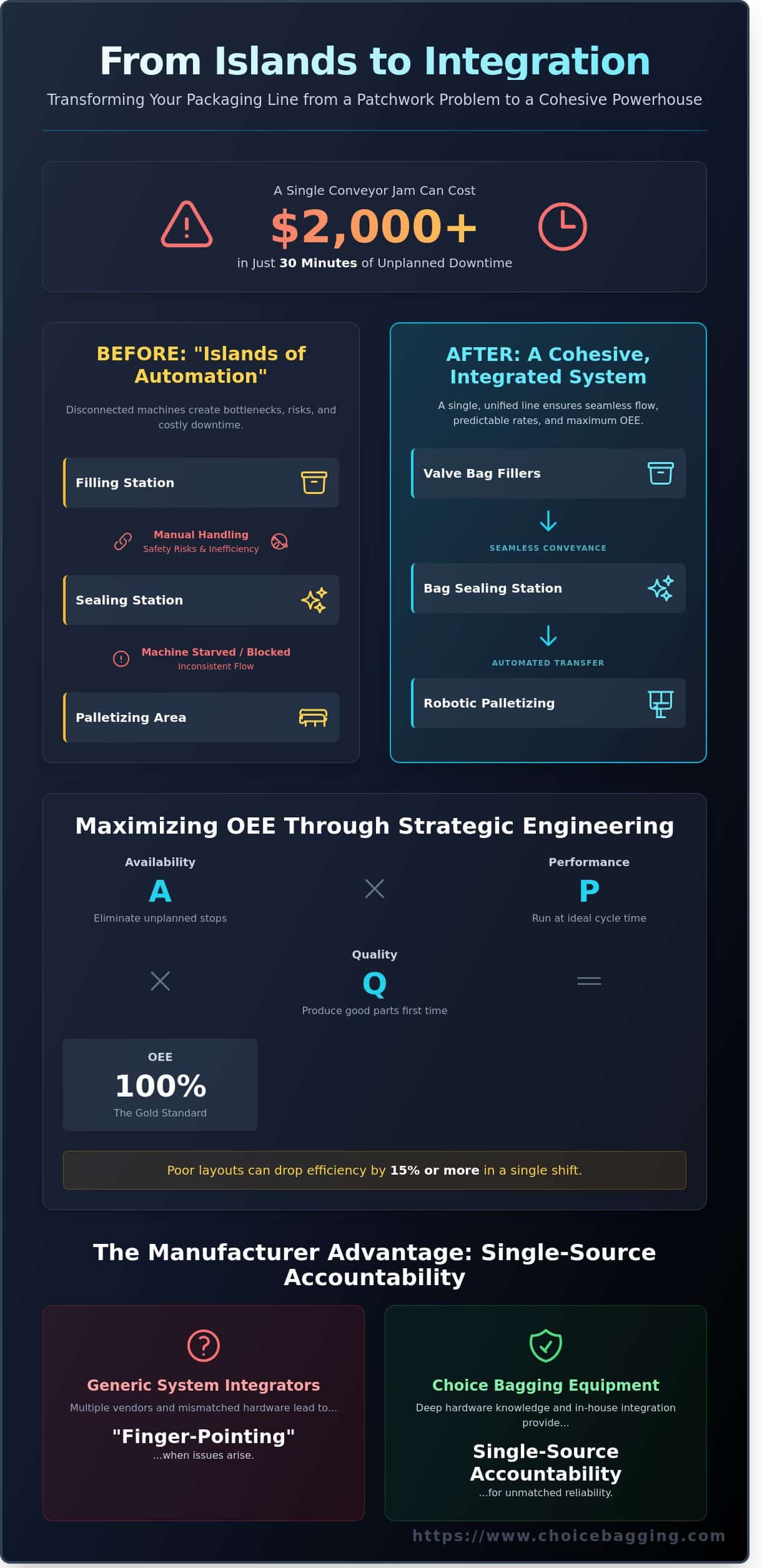
A single conveyor jam can cost a facility upwards of $2,000 in lost labor and throughput in just 30 minutes of unplanned downtime. You’ve likely seen your most expensive machines sit idle because they’re "starved" for product or "blocked" by a downstream bottleneck. It’s frustrating to watch your OEE drop because your equipment isn’t communicating, which is why professional packaging line integration services are essential for modern plants. We agree that your production floor should run like a single, cohesive unit rather than a collection of independent islands.
Since 1978, Choice Bagging Equipment has acted as a partner to manufacturers looking to eliminate these technical gaps. This guide will show you how a turnkey system provides single-source accountability and predictable production rates. You’ll learn how to reduce manual handling risks and optimize your entire flow from the initial fill to the final pallet. If you’re starting a new project, our Bagger Professor tool can help you identify the right equipment to anchor your integrated line. We’ll preview the steps to achieving a seamless, automated facility that operates at peak performance, or you can contact us to discuss your specific layout today.
Key Takeaways
-
Learn how to transform isolated manual stations into a cohesive, automated system that ensures a seamless production flow from filling to palletizing.
-
Discover how professional packaging line integration services maximize Overall Equipment Effectiveness (OEE) by eliminating layout-related downtime and bottlenecks.
-
Understand the advantage of partnering with a manufacturer who applies deep hardware knowledge to customize filling cycles for your specific material density.
-
Explore a proven engineering framework for integration success that utilizes 3D layouts to visualize and guarantee your throughput goals.
-
Identify the ideal equipment for your specific production needs by utilizing the functional Bagger Professor search tool.
Table of Contents
What Are Packaging Line Integration Services?
Packaging line integration services represent the technical engineering required to turn individual, disconnected machines into a unified production force. Since 1978, Choice Bagging Equipment has helped facilities move away from "islands of automation" where machines operate in silos, creating bottlenecks and manual handling risks. True integration involves the custom design, physical connection, and complex programming of various types of packaging machinery to ensure a seamless product flow from the silo to the shipping dock.
To see these principles in action, watch this video on how professional integration transforms a production floor:
Choosing a manufacturer that performs its own integration provides single-source accountability. Unlike generic system integrators who might not understand the mechanical nuances of a specific filler, a manufacturer-partner ensures the hardware and software are perfectly matched. This eliminates the "finger-pointing" that often occurs when a line goes down and multiple vendors are involved. It’s about investing confidently in a system that’s built to last decades and delivers unmatched reliability.
The Core Components of an Integrated Bagging Line
A high-performance line requires every stage to work in harmony. The process begins with primary packaging, typically utilizing valve bag fillers or open mouth bagging machines for precise weight accuracy. Once filled, bags move through secondary processes such as bag sealing or stitching stations to ensure product integrity. The final stage incorporates robotic palletizing systems, which automate the heavy lifting and stacking required for shipment readiness.
Why Modular Integration Beats Patchwork Systems
Many plants fall into the trap of building "Frankenstein" lines using mismatched hardware from different eras. These patchwork systems often suffer from inconsistent communication protocols, leading to frequent downtime and safety hazards. Professional packaging line integration services prioritize modular design. This approach allows you to scale production as demand grows without replacing the entire system. If you’re ready to upgrade your efficiency, contact us to speak with an application engineer today.
Maximizing OEE Through Strategic Engineering
Overall Equipment Effectiveness (OEE) serves as the ultimate metric of success for any modern production facility. It provides a clear, data-driven snapshot of how effectively your equipment is utilized during scheduled hours. Overall Equipment Effectiveness (OEE) is defined as the product of Availability, Performance, and Quality. When these three factors align, your facility achieves maximum throughput with minimal waste. Since 1978, Choice Bagging Equipment has focused on these metrics to ensure every system we deliver provides unmatched reliability.
Achieving high OEE requires more than just high-quality machines; it requires expert packaging line integration services to ensure every component works in harmony. Poor layout design often results in "starved" machines that wait for product or "blocked" machines that have nowhere to send finished bags. These imbalances can drop efficiency by 15% or more in a single shift. By applying Lean manufacturing principles, our engineers design lines that maintain a steady production rhythm. This approach eliminates the stop and start cycles that increase mechanical wear and decrease total output.
Eliminating Common Causes of Line Downtime
Identifying bottlenecks before they occur is a hallmark of strategic engineering. We utilize 3D layout modeling to simulate product flow and identify potential choke points in the system before a single bolt is turned. A critical component in this regulation is the use of bag handling conveyors. These systems act as a functional buffer, providing the necessary accumulation to keep the filler running even if the palletizer experiences a brief pause. This synchronization reduces changeover time and keeps the line moving at its rated capacity, ensuring you invest confidently in your infrastructure.
Precision Controls and Programming Synchronization
A truly integrated line requires machines that talk to one another. Programmable Logic Controllers (PLCs) serve as the brain of the operation, coordinating speeds between the filler, the sealer, and the palletizer. A centralized Human Machine Interface (HMI) provides total line visibility, allowing operators to monitor performance from a single screen. We’re also your partner in long-term maintenance, providing remote support and diagnostics that prevent operational delays from turning into days of downtime.
To ensure you start with the right foundation for your project, use the Bagger Professor tool to identify the ideal machine for your specific material and bag type. If you are ready to optimize your facility’s output and increase your OEE, contact our engineering team for a professional consultation.
The Manufacturer Advantage: Why Hardware Knowledge Matters
Choosing an integrator who actually builds the machinery provides a distinct advantage that third-party firms can’t match. When the team designing your packaging line integration services also manufactures the steel, the margin of error drops significantly. We don’t guess at machine tolerances because we’ve engineered them since 1978. This deep hardware knowledge allows us to customize bagging heads and filling cycles for specific material densities. A powder with a density of 35 lbs/ft³ requires a different displacement strategy than a heavy granular product at 90 lbs/ft³.
Our engineering team focuses on the critical synergy between bulk bag unloaders and downstream filling equipment. If these components don’t communicate perfectly, you’ll face bottlenecks and product degradation. By maintaining "Made in the USA" quality across every integrated component, we ensure that every bolt, sensor, and frame meets our rigorous durability standards. You aren’t just buying a collection of machines; you’re investing in a unified system built to last decades.
Seamless Primary Packaging Integration
The transition from product supply to open mouth bagging machines is where most efficiency is lost. We optimize this interface by using integrated weighers that communicate directly with the filler. This real-time data exchange allows the system to adjust for mid-batch density changes, ensuring weight accuracy within grams. Citing the benefits of automation in manufacturing, this precision reduces product giveaway and improves your bottom line. We also prioritize safety by integrating dust collection ports directly into the fill spouts, keeping your facility clean and compliant.
Coordinating End-of-Line Automation
Efficiency must continue through the final palletizing stage. Our packaging line integration services bridge the gap between the bagger and the robotic palletizing systems. We utilize bag-flattening conveyors to ensure each unit is uniform before the robot picks it up. This preparation is vital for creating a stable load for stretch wrappers to secure for transit.
Space-saving layouts are a priority for 85% of the facilities we service. We design compact footprints that utilize 90-degree transfers and vertical lifts to keep your production area navigable. Our goal is to maximize your throughput without requiring a massive expansion of your floor space. If you’re ready to see how a manufacturer-led integration can transform your plant, contact us to start the consultation process.
A Step-by-Step Framework for Integration Success
Successful packaging line integration services rely on a disciplined, repeatable process. We’ve refined this approach over 45 years to eliminate guesswork and ensure your system hits the ground running. It begins with an initial consultation where we define your throughput goals, bag types, and specific material characteristics. We then move into an engineering study, developing detailed 2D and 3D layouts. These visualizations allow you to see the production flow and identify potential bottlenecks before a single bolt is turned.
Phase 1: Front-End Engineering and Analysis
Material testing is the foundation of every project. Since bulk density can vary by as much as 20% depending on environmental factors, testing your actual product ensures the equipment handles it correctly. We use these results to determine the optimal footprint, often saving clients 15% or more in facility floor space through smarter layout design. During this phase, we set clear KPIs. Whether you need to hit 600 bags per hour or maintain weight accuracy within 0.25%, these metrics guide the hardware selection. To identify the right technology, we utilize the
[Bagger Professor
](https://www.choicebagging.com/bagger-professor-tool/)functional tool to match your material with the ideal filling system.
Phase 2: Installation and Long-Term Support
Before any equipment leaves our floor, we conduct Factory Acceptance Testing (FAT). This proves the line meets your specifications at our facility, reducing your downtime during the actual swap. Once shipped, our professional
[field service
](https://www.choicebagging.com/field-service/)team manages the on-site commissioning and operator training. This hands-on support is vital for a smooth startup.
Reliability doesn’t end at installation. We help you establish a preventative maintenance schedule to protect your investment for decades. By keeping critical parts on hand, you can minimize repair windows and keep production moving. We aren’t just a vendor; we’re also your partner in long-term operational success.
Ready to optimize your facility? Contact our engineering team today to discuss your project requirements.
Partnering with Choice Bagging Equipment for Turnkey Success
Choice Bagging Equipment has operated since 1978. We don’t just sell machines; we act as a long-term partner for your facility. Our team leverages nearly 50 years of experience to design packaging line integration services that solve complex flow issues. We build systems to last 20 or 30 years, not just a few seasons. This commitment to longevity ensures that your investment continues to pay dividends long after the initial installation.
Choosing us means single-source accountability. We take responsibility for every motor, sensor, and PLC in your line. If a component fails or a timing issue arises, you have one point of contact. This eliminates the finger-pointing common when dealing with multiple vendors. We ensure every piece of equipment communicates perfectly, creating a seamless flow from the product inlet to the final pallet.
Reliability Built into Every Machine
We prioritize heavy-duty construction and minimal moving parts to reduce wear. Our "Made in the USA" status is a core signature of our quality. It allows us to provide faster technical support and maintain higher manufacturing standards than overseas competitors. Companies in the agriculture, chemical, and building materials sectors have relied on our equipment for decades. For instance, some of our original 1980s installations are still bagging industrial minerals at peak capacity today. We build for performance because we know downtime is the enemy of your bottom line.
Ready to Automate Your Packaging Line?
Starting your automation journey begins with a professional site evaluation. We analyze your floor space and material characteristics to ensure a perfect fit. If you aren’t ready for a full capital purchase, our bagging equipment rental program offers a flexible way to scale without a massive upfront cost.
Stop managing disconnected vendors and start building a cohesive system. Our engineers are ready to help you optimize every inch of your production floor. Contact us today to discuss your integration project and secure the reliability your operation deserves.
Secure Your Production Future with Strategic Engineering
Achieving a high OEE isn’t just about buying fast machines; it’s about how those components communicate. When you utilize professional packaging line integration services, you’re investing in a system engineered to minimize downtime and maximize throughput from day one. Choice Bagging Equipment has served the industry since 1978, providing heavy-duty solutions that are proudly Made in the USA. We don’t just supply hardware. We provide dedicated field service and engineering support to ensure your facility operates at peak capacity for decades.
If you’re still determining which specific equipment fits your material, use the Bagger Professor tool to identify the right machine for your bag type. Our team brings over 45 years of manufacturing expertise to every project, ensuring your line isn’t just a collection of parts but a cohesive, reliable asset. It’s time to eliminate compatibility concerns and start focusing on your production targets.
Request a Quote for Your Integrated Packaging Project and let’s build a solution that stands the test of time.
Frequently Asked Questions
What is the difference between a turnkey system and a partial integration?
A turnkey system is a single-source solution where we manage 100% of the project from initial engineering to final startup. Partial integration involves adding specific Choice Bagging units to your existing production line. Our packaging line integration services cover both scenarios to ensure your facility achieves maximum throughput and reliability.
How long does a typical packaging line integration project take from design to startup?
A standard integration project requires 16 to 24 weeks to complete. The process begins with 4 weeks of technical design and layout planning. Manufacturing takes 10 to 14 weeks, followed by 2 weeks for on-site installation and testing. We’ve refined this timeline since 1978 to ensure every component meets our strict performance standards.
Can you integrate new Choice Bagging machines with my existing third-party equipment?
We routinely integrate our machines with equipment from other manufacturers using universal communication protocols. Our engineers design custom interfaces to ensure 100% compatibility between different brands. If you’re looking for the right machine to fit your current layout, use the Bagger Professor to find a match based on your specific material and bag type.
What kind of ROI can I expect from automating a manual bagging line?
Most customers achieve a full return on investment within 12 to 18 months of installation. Automating a manual process typically reduces labor costs by 60% and increases total output by at least 40%. These gains in efficiency allow you to scale production without increasing your overhead. Contact us to discuss your specific production goals.
Do I need a specialized programmer on-site to manage an integrated line?
You don’t need an on-site programmer because we build our systems with easy-to-use HMI controls. A standard operator can learn to manage the entire line after just 4 hours of instruction. We prioritize simple, declarative interfaces that make daily operation and troubleshooting straightforward for your existing team.
What happens if one machine in the integrated line breaks down?
We design our lines with buffered accumulation to prevent a single machine failure from halting your entire operation. If one component stops, the rest of the line can typically continue running for 10 to 15 minutes. This design strategy helps you maintain 98% uptime and prevents costly bottlenecks during minor maintenance tasks.
How do you ensure weight accuracy across an automated high-speed line?
Our systems maintain 99.7% weight accuracy through the use of high-speed load cells and precision feed controllers. These sensors sample product weight 1,000 times per second to adjust the flow in real-time. This level of precision virtually eliminates product giveaway and ensures you meet all regulatory requirements for weight consistency.
Is training included with your packaging line integration services?
Yes, we provide 3 days of comprehensive on-site training as a standard part of our packaging line integration services. We’re also your partner for the long term, so we train your staff on both operation and preventative maintenance. This thorough approach reduces 90% of common operational errors and ensures your investment delivers peak performance for decades.
Recent Comments