
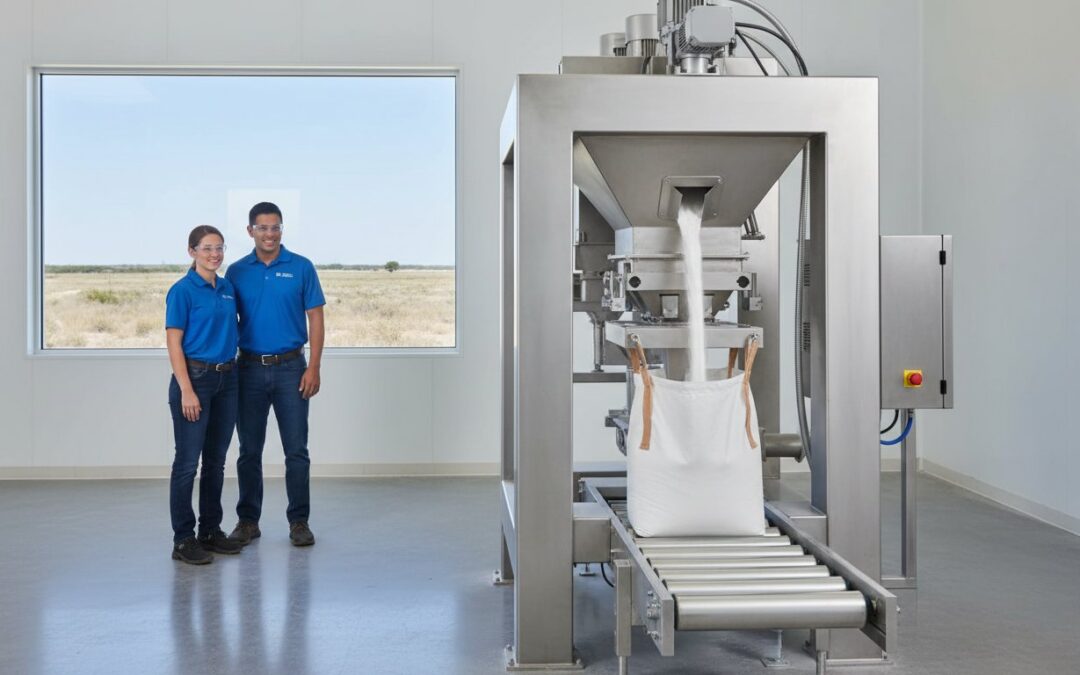
Is your bagging line a source of constant frustration? Dust clouds, inaccurate bag weights, and slow manual processes don’t just create operational headaches-they directly impact your bottom line through product giveaway and lost efficiency. Selecting the right powder bagging equipment is the definitive solution, transforming your packaging operation from a cost center into a reliable, high-performance asset.
This complete manufacturer’s guide is designed to provide the clarity you need to invest confidently. We will walk you through the critical steps of choosing the ideal system for your specific application, even for the most difficult, non-free-flowing powders. You will learn how to analyze your product’s characteristics, compare key machine technologies, and evaluate the performance factors that ensure a clean, safe, and highly productive work environment. By the end, you’ll have the expert knowledge to select a durable, low-maintenance machine that delivers consistent accuracy and a strong return on investment.
Key Takeaways
-
Learn to analyze your powder’s unique characteristics to prevent common operational issues like product bridging and inaccurate weights.
-
Discover the primary types of powder bagging equipment and the key performance metrics you must use to compare them for your specific application.
-
See how integrating your bagging machine with upstream and downstream equipment is essential for creating an efficient and profitable packaging line.
-
Understand the criteria for selecting a manufacturer who will act as a long-term partner, providing expert engineering support beyond the initial sale.
Table of Contents
-
First, Analyze Your Powder: Why Product Characteristics Matter Most
-
Choosing Your Equipment Partner: What to Look For in a Manufacturer
First, Analyze Your Powder: Why Product Characteristics Matter Most
In the process of selecting powder bagging equipment, the most common and costly mistake is choosing a machine before thoroughly understanding the product it will handle. A successful bagging operation is built on a foundation of precise product analysis. This critical first step ensures you invest in a system that delivers accurate weights, minimizes product waste, and operates with unmatched reliability, preventing common issues like product bridging in the hopper or flushing during the fill cycle.
To see how different powders behave in a filling system, watch this brief demonstration:
Free-Flowing vs. Non-Free-Flowing Powders
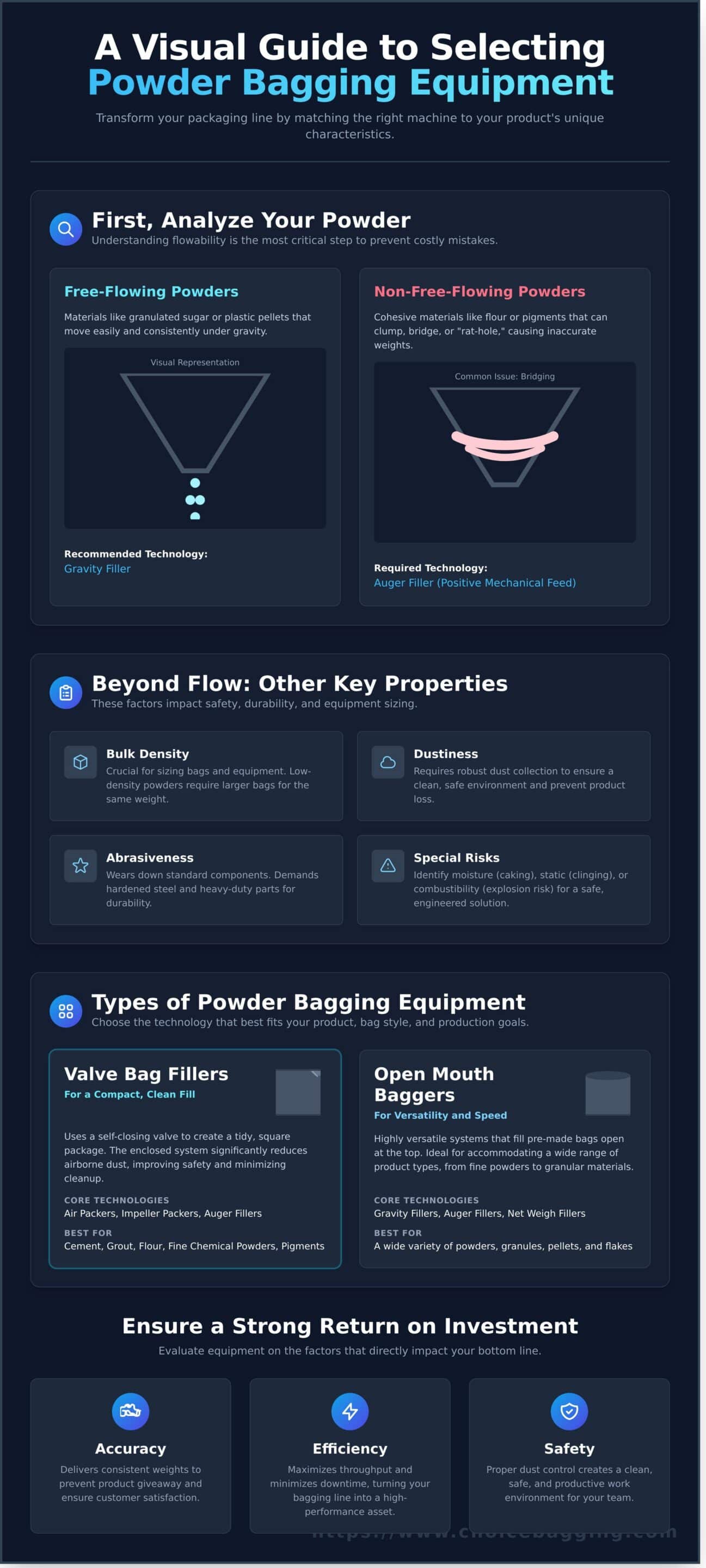
The flowability of your material is the primary factor in determining the right filling technology. Free-flowing powders, like granulated sugar or plastic pellets, move easily and consistently under gravity. In contrast, non-free-flowing powders, such as flour, pigments, or whey protein, tend to be cohesive. They can clump, bridge, or "rat-hole" in the supply hopper, leading to inconsistent flow and inaccurate bag weights. This distinction directly impacts your choice: a gravity filler is efficient for free-flowing products, while an auger filler is essential for non-free-flowing materials to provide a positive, mechanical feed.
Bulk Density and Particle Size
Bulk density-the mass of your powder per unit of volume-is critical for sizing your equipment and bags correctly. A low-density powder requires a larger bag and potentially more fill time than a high-density product of the same weight. Similarly, particle size affects how the material behaves. Fine particles can become aerated and fluid-like, causing flushing, while inconsistent particle sizes can lead to segregation. Understanding these properties is vital for calibrating the filling mechanisms inside systems like Vertical Form Fill Seal (VFFS) machines to ensure repeatable accuracy and performance.
Dustiness, Abrasiveness, and Other Factors
Beyond flow and density, other characteristics demand careful consideration to ensure safety and equipment longevity. Properly specified powder bagging equipment must account for these variables:
-
Dustiness: Highly dusty products require robust dust collection at the fill spout and other transfer points to maintain a clean, safe work environment and prevent product loss.
-
Abrasiveness: Abrasive materials like cement or sand will quickly wear down standard components. Machines for these applications must be built with hardened steel and heavy-duty parts for long-term durability.
-
Other Properties: Factors like high moisture content (caking risk), static charge (clinging), or combustibility (explosion risk) must be identified to engineer a safe and efficient solution.
Types of Powder Bagging Equipment: An In-Depth Comparison
Selecting the correct powder bagging equipment is a critical investment in your operational efficiency, product integrity, and workplace safety. The technology you choose depends directly on your product characteristics, bag style, and production targets. This comparison explores the core mechanics, advantages, and ideal applications of the primary systems to help you identify the most reliable piece of powder bagging equipment for your specific needs.
Valve Bag Fillers: For a Compact, Clean Fill
Designed for minimal product loss and dust emission, valve bag fillers use bags with a self-closing opening, or "valve." Once filled, internal product pressure seals the valve, creating a clean and compact package. This enclosed system significantly reduces airborne dust, improving workplace air quality and minimizing cleanup. Our full line of Valve Bag Fillers offers unmatched reliability for these demanding applications.
-
Core Technologies: Air packers (for fluidized powders), impeller packers (for denser materials), and auger fillers (for non-free-flowing products).
-
Best For: Cement, stucco, grout, flour, fine chemical powders, and pigments.
Open Mouth Bagging Machines: Versatility and Speed
These highly versatile systems fill pre-made bags that are open at the top, accommodating a wide range of product types, from fine powders to granular materials. After filling, the bag requires a secondary closing station, such as a heat sealer or industrial sewing machine. This separation allows for greater customization in bag sealing, from simple stitching to hermetic seals for food-grade products. Known for their durability and speed, our Open Mouth Bagging Machines are a cornerstone of packaging lines in many industries.
- Best For: Animal feed, seeds, minerals, plastic pellets, and food ingredients like sugar or salt.
Bulk Bag (FIBC) Fillers: For Large-Volume Handling
When you need to package and transport large quantities, Bulk Bag Fillers are the definitive solution. These heavy-duty systems are engineered to safely and accurately fill Flexible Intermediate Bulk Containers (FIBCs), which can hold up to 4,000 lbs. Densification systems vibrate the bag during filling to create a stable, compact load for safer transport, while integrated weighing platforms ensure each FIBC meets exact specifications. Proper operation is paramount, as handling such weight requires strict adherence to OSHA safety standards for material handling. Learn more about our robust Bulk Bag Fillers, built for maximum performance and safety.
- Best For: High-volume transport of raw materials like sand and resin, agricultural products, and finished chemical goods.
Key Performance Metrics for Evaluating Bagging Equipment
Once you have identified the right type of machine for your product, the next step is to evaluate specific models based on their performance capabilities. These metrics are not just technical specifications; they are direct indicators of your future operational efficiency, profitability, and workplace safety. A thorough evaluation goes beyond the initial purchase price to consider the total cost of ownership, ensuring your investment delivers sustained value for years to come.
Weighing Accuracy and Consistency
Precision is paramount in packaging. Even a minor inaccuracy of +/- 1% can translate into thousands of dollars in product giveaway over a year. High-performance powder bagging equipment relies on advanced weighing technologies to ensure every bag meets its target weight with minimal deviation. Systems are typically categorized as:
-
Gross Weigh: The bag and product are weighed together during the filling process. This is a simpler, more cost-effective method suitable for many applications.
-
Net Weigh: The product is weighed in a separate hopper before being discharged into the bag. This method offers superior accuracy and speed, making it ideal for high-value products or high-volume operations.
The reliability of these systems depends on high-quality load cells and sophisticated digital controllers that manage the fill cycle for consistent, repeatable results.
Production Rate (Bags Per Minute)
Production rate, measured in bags per minute (BPM), determines the throughput of your packaging line. While a fully automated system can achieve rates of 20+ BPM, a semi-automated line may operate in the 5-12 BPM range, and manual systems are dependent on operator speed. The key is to select a machine whose rate is synchronized with your upstream production capacity. Investing in a high-speed bagger is inefficient if your mixer or blender cannot supply product fast enough to keep it running.
Dust Control and Containment Features
Handling fine powders presents unique challenges, primarily fugitive dust. Effective dust control is critical for worker safety, product integrity, and maintaining a clean facility. Look for equipment designed with integrated containment features, such as dust-tight fill spouts that create a seal with the bag mouth and bag inflation systems that pre-shape the bag to prevent powder from puffing out. An integrated dust collection port is a must-have, allowing you to connect the filler to a central dust collector to safely capture any airborne particles at the source.
Building a Complete System: From Filler to Pallet
An industrial bag filler is the heart of your packaging operation, but it is only one component of a larger production line. To achieve maximum efficiency, reliability, and return on investment, it is crucial to integrate upstream and downstream equipment into a single, cohesive system. A complete line of powder bagging equipment ensures that bags are handled, closed, and prepared for shipment without bottlenecks or manual intervention.
Working with a single-source supplier guarantees that every component is designed to work together seamlessly, from the initial product infeed to the final wrapped pallet.
Bag Handling and Conveying
Once a bag is filled and discharged, it must be transported to the next station. Conveyors are the essential link, moving bags efficiently and safely. While flat belt conveyors are versatile for most applications, roller conveyors may be better suited for heavier bags. For superior pallet loads, a bag conditioning conveyor can be used to flatten and shape the filled bag, creating a more uniform surface for stable and consistent stacking.
Bag Sealing and Closing
For open mouth bags, a secure closure is critical to protect your product. The two primary methods are sewing and heat sealing, and the right choice depends on your bag type and containment needs.
-
Sewing Machines: Provide a strong, durable, and cost-effective closure for multi-wall paper and woven polypropylene bags.
-
Heat Sealers: Essential for bags with a plastic liner (poly-lined paper or poly bags), creating an airtight seal that protects against moisture and contamination.
Note that valve bags are self-closing by design and do not require a separate closing station.
End-of-Line Automation: Robotic Palletizing
The final step in a fully automated packaging line is palletizing. Robotic palletizers deliver unmatched speed, precision, and safety, transforming your end-of-line operations. These systems consistently place bags in a pre-programmed pattern, building perfectly square and stable pallet loads that are ready for wrapping and shipment. By automating this labor-intensive task, you reduce operational costs, improve workplace safety, and increase overall plant output. Boost throughput with our robotic palletizing systems.
Choosing Your Equipment Partner: What to Look For in a Manufacturer
Selecting your powder bagging equipment is more than a simple purchase; it is a long-term investment in your operational efficiency. The right manufacturer functions not as a vendor, but as a dedicated partner committed to your success. They provide a comprehensive solution engineered for your specific application, ensuring reliability and performance for decades. When evaluating potential partners, look beyond the machine itself and focus on the core principles of engineering excellence, quality construction, and unwavering support.
Proven Experience and Engineering Capability
An established history is a powerful indicator of reliability and expertise. Look for a manufacturer with decades of proven success in the industry-a history like ours, Since 1978, demonstrates a deep understanding of complex bagging challenges. A capable engineering team will not offer a one-size-fits-all machine; they will work to customize equipment to handle the unique flow characteristics of your product. Insist on a partner who offers product testing services to validate performance with your materials before you commit, ensuring the solution is a perfect fit for your production line.
Durability and Quality of Construction
The service life and reliability of your equipment are directly tied to the quality of its construction. Prioritize machines built with heavy-duty steel frames and designed with minimal moving parts, as this engineering philosophy drastically reduces maintenance requirements and potential points of failure. Equipment that is Made in the USA often signifies a higher standard of quality control and the use of superior-grade components. This commitment to durable construction translates directly to a lower total cost of ownership and a more dependable operation.
After-Sale Support, Parts, and Service
The relationship with your manufacturer should begin, not end, with the purchase. A strong support network is critical for maximizing uptime and protecting your investment throughout the equipment’s entire lifecycle. Before making a decision, confirm the manufacturer offers a robust support system that includes:
-
Field Service Technicians: Ensure experts are available for on-site installation, training, and repair to get you running quickly and solve issues efficiently.
-
Readily Available Spare Parts: A well-stocked inventory of spare parts is essential for minimizing downtime when routine maintenance or repairs are needed.
-
Ongoing Technical Consultation: Your partner should be available to provide guidance and support as your operational needs evolve over time.
Choosing a manufacturer that delivers on these three pillars ensures you acquire more than just high-performance powder bagging equipment-you gain a reliable partner dedicated to your long-term productivity. To see how a true equipment partner operates, explore our American-made solutions.
Your Partner in High-Performance Powder Bagging
Choosing the right powder bagging equipment starts with a thorough analysis of your product’s characteristics and ends with selecting a partner who understands full system integration. As we’ve covered, evaluating key performance metrics and understanding how each machine works together are critical steps to ensure your operation achieves maximum efficiency, accuracy, and long-term reliability.
An investment in your production line is an investment in your company’s future. As a trusted manufacturer since 1978, Choice Bagging Equipment delivers reliable, heavy-duty equipment, all proudly Made in the USA. We don’t just sell machines; we provide expert engineering support to build complete, high-performance systems designed to last for decades.
Ready to invest with confidence and build a system that works as hard as you do? Contact our experts to find the right powder bagging solution for your plant.
Frequently Asked Questions About Powder Bagging Equipment
How much does industrial powder bagging equipment cost?
The investment for industrial powder bagging equipment varies based on speed, automation level, and product characteristics. A semi-automatic, standalone machine may start around $20,000. Fully integrated and automated lines, designed for high-throughput and precision, can exceed $200,000. We provide detailed consultations to engineer a solution that aligns with your specific production goals and budget, ensuring a high-performance system that delivers a strong return on investment.
What is the typical maintenance schedule for a bagging machine?
Our machines are engineered for durability with minimal moving parts, simplifying maintenance. A typical schedule includes daily checks of pneumatic components and safety guards, weekly lubrication of key points, and a thorough annual inspection of wear parts like seals and bearings. Following this proactive schedule ensures decades of unmatched reliability and consistent performance. We provide a detailed maintenance checklist and full support to keep your operation running efficiently.
Can you test my powder to determine the best type of bagging equipment?
Yes. We operate a comprehensive in-house testing facility to analyze your product’s unique properties. By evaluating factors like bulk density, flowability, and dust content, we gather the critical data needed to recommend the most effective and accurate bagging solution. This commitment ensures the equipment you invest in is precisely configured for your material, guaranteeing optimal performance and reliability from day one. Contact us to arrange a no-obligation product test.
How do you handle combustible or hazardous powders?
Safety and compliance are paramount when handling hazardous materials. We engineer systems with specific safeguards, including dust-tight enclosures, integrated dust collection ports, and proper grounding to mitigate static discharge. For combustible dust environments, we can build equipment with intrinsically safe electronics and components that meet Class II, Division 1 hazardous location standards. Our expertise ensures your bagging operation is both safe and efficient, protecting your team and facility.
What is the difference between gross weigh and net weigh filling?
The primary difference lies in how the product is weighed. In a gross weigh filler, the product is weighed directly in the bag as it is being filled. This method is straightforward and cost-effective. A net weigh filler weighs the product in a separate weigh hopper above the machine and then discharges the pre-weighed dose into the bag. Net weigh systems offer higher speeds and are often preferred for high-volume production environments.
How long does it take to install and commission a new bagging line?
Installation timelines depend on system complexity. A standard, single-piece bagging machine can typically be installed and commissioned by our expert technicians in 2 to 3 days. For a complete, multi-component powder bagging equipment line-including conveyors, sealers, and palletizers-the process generally takes 1 to 2 weeks. As your partner, we manage the project efficiently to minimize downtime and ensure a smooth transition to full production.
Recent Comments