

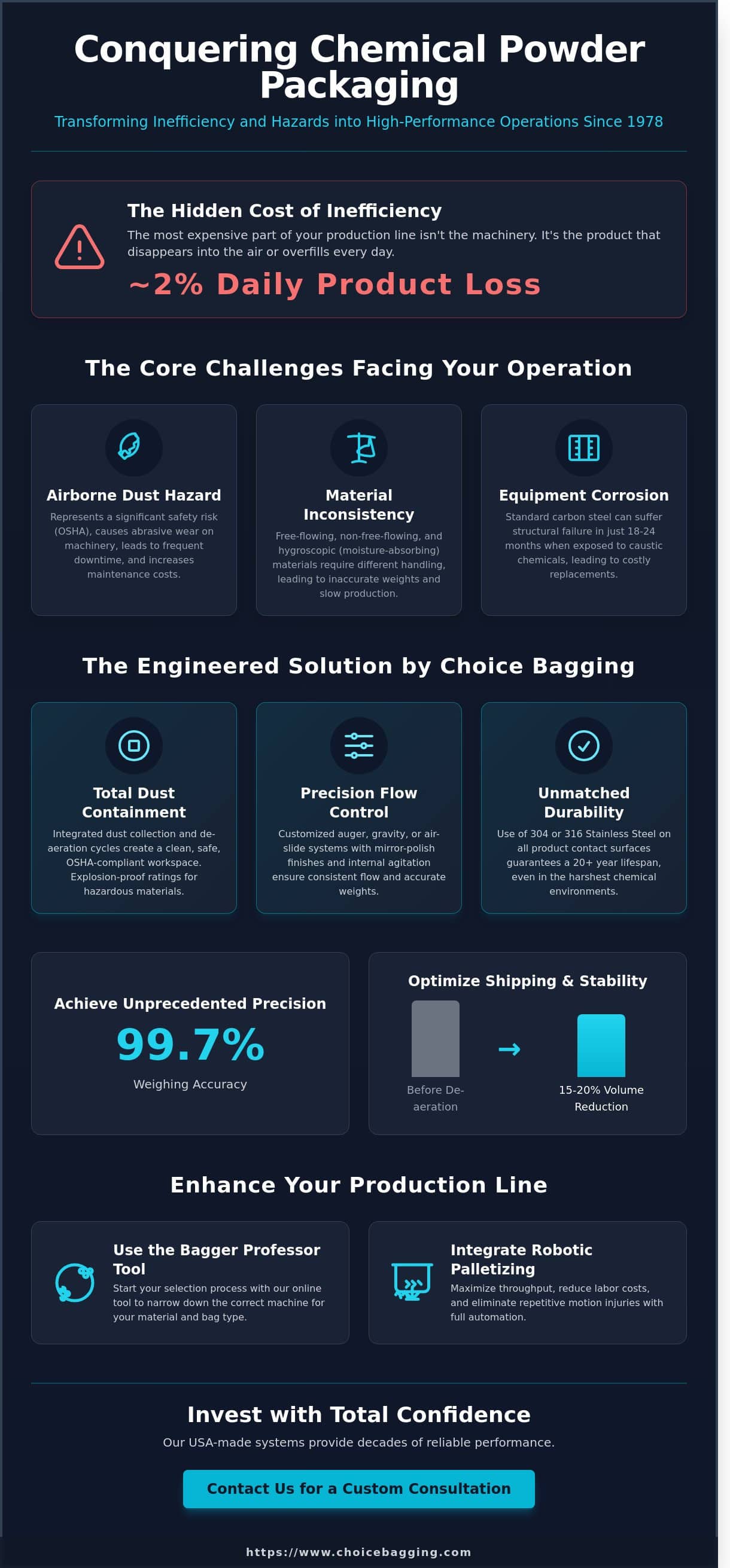
The most expensive part of your production line isn’t the machinery; it’s the 2% of product that disappears into the air as dust or overfills every single day. You understand that managing hazardous or abrasive materials requires more than just a standard filler. It demands precision and durability to prevent equipment corrosion and ensure operator safety. Since 1978, we’ve focused on engineering chemical powder packaging equipment that transforms dusty, inaccurate workspaces into high-performance environments where machinery lasts 20 years or more.
This guide provides the technical insights you need to select, integrate, and maintain bagging systems designed for the toughest chemical environments. You’ll learn how to achieve 99.7% weighing accuracy while maintaining a pristine facility. To help you get started, you can use the Bagger Professor, which is an online tool intended to help you narrow down the correct bagging machine based on your material and bag type. We’ll cover everything from dust-tight seals to advanced controls so you can invest with total confidence. If you’re ready for a custom consultation, please contact us to speak with an expert.
Key Takeaways
-
Learn how to mitigate airborne dust hazards to ensure OSHA compliance and protect your workforce from fine or abrasive chemical particles.
-
Identify the specific advantages of valve, open-mouth, and bulk bag fillers to determine the most efficient chemical powder packaging equipment for your specific material properties.
-
Utilize the Bagger Professor tool to narrow down the correct bagging machine selection based on your specific material and bag type.
-
Discover how integrating robotic palletizing systems can maximize throughput while significantly reducing labor costs and repetitive motion injuries.
-
Understand the long-term ROI of full automation and contact us today to learn how our USA-made systems provide decades of reliable performance.
Table of Contents
-
Understanding the Unique Challenges of Chemical Powder Packaging
-
Selecting the Right System for Your Specific Chemical Properties
-
Why Partner with Choice Bagging Equipment for Chemical Operations?
Understanding the Unique Challenges of Chemical Powder Packaging
Since 1978, Choice Bagging Equipment has engineered solutions for the toughest materials on the planet. Chemical powder packaging equipment is not a standard off-the-shelf product; it is a specialized system designed to fill, seal, and palletize fine or granulated chemicals while protecting the integrity of the product and the plant environment. Standard packaging machinery often fails in these applications because it cannot handle the unique physical and chemical properties of industrial powders. We build performance and reliability into our machines to ensure they withstand the rigors of chemical processing for decades.
Dust remains the primary adversary in any chemical bagging operation. Airborne particles don’t just create a mess; they represent a significant safety risk. According to OSHA 1910 standards, managing combustible dust and respiratory hazards is a legal mandate. Fine chemical powders act as abrasives that can grind down internal bearings and seals in a matter of months. If your equipment isn’t specifically designed for dust containment, you’ll face frequent downtime and high maintenance costs. We focus on creating sealed environments that keep the product in the bag and out of the air.
Material flowability is another critical factor that dictates machine design. Chemical powders generally fall into two categories: free-flowing and non-free-flowing. A free-flowing granulated fertilizer behaves differently than a sticky, non-free-flowing pigment. Using the wrong feed mechanism leads to inaccurate weights and inconsistent production speeds. Beyond flow, we must account for corrosion. Standard carbon steel often shows signs of structural failure within 18 to 24 months when exposed to caustic chemicals. We solve this by utilizing 304 or 316 stainless steel for all product contact surfaces, ensuring your investment remains durable and productive.
Dust Containment and Environmental Safety
Maintaining a clean plant requires more than just a vacuum; it requires integrated dust collection ports at the point of fill. Our systems use specialized de-aeration cycles to remove trapped air from the powder before the bag is sealed. This process typically results in a 15% to 20% reduction in total bag volume, which improves pallet stability and lowers your shipping costs. When handling hazardous materials, we provide explosion-proof ratings, such as Class II, Division 1 or 2, to ensure all electrical components meet National Electrical Code requirements for safety.
Material Characteristics and Flow Control
The choice between using an auger, gravity, or air-slide system depends entirely on your material’s bulk density and moisture content. For example, hygroscopic chemicals absorb moisture from the air and tend to clump, which requires specialized internal agitation to maintain a steady flow. If you aren’t sure which configuration fits your needs, our Bagger Professor is an online tool intended to help customers narrow down the correct bagging machine based on their specific material and bag type. It’s a practical way to start your selection process before consulting with our engineering team.
We’re also your partner in long-term success, helping you navigate the complexities of moisture levels and internal finishes. A mirror-polish finish on a bagging head can prevent product buildup that would otherwise cause weight inaccuracies. If you are ready to upgrade your facility with reliable chemical powder packaging equipment, contact us now to discuss your specific material requirements with an expert who understands the industry.
Primary Types of Chemical Powder Bagging Machines
Selecting the right chemical powder packaging equipment requires a deep understanding of your material’s flow characteristics and your facility’s production goals. Since 1978, Choice Bagging Equipment has refined these technologies to address the specific rigors of chemical processing. The industry generally categorizes bagging solutions into three primary types: valve bag fillers, open mouth systems, and bulk bag fillers. Each serves a distinct purpose based on particle size, dust control requirements, and total volume. Choosing the wrong interface can lead to 15% more product waste and significant housekeeping challenges.
Valve Bag Fillers for Fine Powders
For fine, aerated, or hazardous powders, valve bag fillers represent the gold standard. These machines fill product into a pre-closed bag through a small internal sleeve or "valve." This method provides a closed-loop environment that keeps 99.8% of airborne particulates contained within the system. When handling hazardous materials, maintaining compliance with the OSHA Hazard Communication Standard is easier when your equipment inherently minimizes dust escape. You’ll typically choose between air packers, which use low-pressure air to fluidize the powder, and impeller packers, which use a high-speed rotor for denser materials. To ensure a completely sift-proof package, we recommend ultrasonic sealing technology. This process uses high-frequency vibrations to weld the valve shut, creating a hermetic seal that prevents leaks during 2,000-mile transit cycles.
Open Mouth Bagging Systems
While valve bags excel at dust containment, open mouth bagging machines offer unmatched versatility for various bag types and materials. These systems are ideal for larger granules, pellets, or corrosive chemicals that require heavy-duty polyethylene liners. Because the bag top is completely open during the filling process, these machines allow for faster cleaning and easier inspection of the product stream. To maintain a secure environment, we integrate specialized bag sewing machine systems or heavy-duty heat sealers. In chemical environments where moisture is a concern, a 6-mil plastic bag with a heat seal provides a moisture barrier that multi-wall paper bags can’t match.
Bulk Bag (FIBC) Filling and Unloading
As industrial distribution scales up, many plants are shifting toward Flexible Intermediate Bulk Containers (FIBCs). High-capacity bulk bag fillers allow a single operator to package 2,000 to 4,000 pounds of chemical powder in a single container. These systems utilize integrated load cells to ensure weight accuracy within 0.1% of the target, which is critical for high-value chemical precursors. On the receiving end, bulk bag unloaders provide a safe, dust-free way to discharge these massive volumes into your downstream process. Modern bulk systems often include bag massagers to promote the flow of chemicals that tend to pack or bridge during storage. This equipment is built to last decades, providing a reliable foundation for your heavy-duty industrial operations. You can contact our team to discuss a custom configuration for your facility’s unique footprint.
Selecting the Right System for Your Specific Chemical Properties
Selecting the right chemical powder packaging equipment requires a framework that balances throughput with the physical reality of your product. A plant running 12 bags per minute has different requirements than a high-volume facility pushing 25 or more. If you choose a "one size fits all" system, you’re inviting maintenance nightmares. Chemical powders are often abrasive or corrosive. Without specialized seals and dust collection, these materials will degrade your components in months rather than years. Following the AIChE Guidelines for Safe Handling of Powders ensures your equipment choice aligns with safety standards for combustible or hazardous materials.
Automation offers a clear ROI for most chemical producers. A manual bagging station often requires two operators and limits output to 4 bags per minute. By investing in automated chemical powder packaging equipment, you can reduce labor costs by 50% while increasing consistency. Most of our partners see a full return on investment within 18 to 24 months. This calculation includes the reduction of product giveaway. If you overfill a 50-pound bag by just 0.5 pounds, and you’re running 500 bags a day, you’re losing 250 pounds of product every shift. Digital engineering tools now make it easier to visualize these savings before you break ground on a new line.
Accuracy and Weighing Technology
Accuracy is the difference between profit and loss when handling expensive chemicals. You have two primary options for weighing:
-
Gross Weigh Systems: These weigh the product directly inside the bag. They’re compact and cost-effective for speeds up to 5 bags per minute.
-
Net Weigh Systems: These pre-weigh the chemical in a dedicated bucket before discharging it into the bag. This allows for higher speeds and superior precision.
Modern load cell technology now provides accuracy of +/- 0.5% or better. To achieve this, we use "dribble feed" cycles. The system delivers 95% of the material at high speed through a bulk flow setting, then slows to a fine trickle to hit the exact target weight. This precision prevents overfilling, which can save a plant upwards of $15,000 annually depending on the chemical’s value. Since 1978, Choice Bagging Equipment has focused on building this level of reliability into every system. We build performance into our machines so you can invest confidently in your plant’s future.
Enhancing the Production Line: Integration and Automation
Efficiency in a chemical plant doesn’t end at the fill head. High-performance chemical powder packaging equipment requires a seamless flow from the moment product leaves the silo until it’s secured on a pallet. Since 1978, Choice Bagging Equipment has focused on this total-system approach. We ensure that your bagging machine integrates perfectly with upstream mixers or surge bins, preventing bottlenecks that stall production. Connecting your equipment directly to existing silos requires precise level controls. We use high-accuracy sensors to trigger the filling cycle, ensuring the surge bin never runs dry or overflows, which maintains a consistent head pressure for accurate weights.
Looking beyond the filler involves evaluating how product moves through the entire facility. A disconnected process leads to manual handling, and manual handling leads to errors. By automating the transition from the bagging station to the warehouse floor, you create a predictable output that matches your mixing capacity. This integration allows for a 15% to 20% increase in total daily throughput compared to semi-automated setups.
Robotic vs. Conventional Palletizing
Chemical facilities often face footprint constraints. A robotic arm typically requires 30% less floor space than a traditional high-level palletizer, which allows for more efficient traffic flow for forklifts. These robotic palletizing systems handle 50lb bags with 100% consistency, eliminating the human fatigue that leads to stacked-pallet instability. You can reprogram these arms in under 5 minutes to accommodate different bag sizes or pallet patterns. This flexibility is vital for chemical producers who switch between industrial bags and smaller retail-sized units on the same line.
Conveying and Handling Chemical Bags
The journey from the filler is critical. Our bag handling conveyors move product through the line with precision. Incline conveyors lift bags to the necessary height, while bag flatteners remove excess air to create a dense, stackable shape. For plants processing corrosive materials, we build equipment using 304 or 316 stainless steel to withstand daily wash-down protocols. This durability ensures your chemical powder packaging equipment lasts for decades, even in harsh environments. Proper bag orientation on the conveyor prevents 98% of potential jams before the product reaches the palletizer.
To protect the integrity of the chemical powder during long-haul transport, stretch wrappers apply consistent tension to the load. This prevents moisture ingress, which is vital for hygroscopic chemicals that clump when exposed to humidity. Automated wrapping reduces plastic film waste by 25% compared to manual wrapping, providing a faster ROI and a more professional presentation for your customers. If you’re unsure which components fit your specific chemical application, use our Bagger Professor tool. This online tool helps you narrow down the correct bagging machine and supporting equipment based on your material properties.
Our team of experts is ready to help you request a quote for a fully integrated system that meets your specific production goals.
Why Partner with Choice Bagging Equipment for Chemical Operations?
Since 1978, Choice Bagging Equipment has focused on a single mission: building the most reliable bagging machines in the industry. We manufacture every piece of equipment in the USA. This commitment to domestic production isn’t just about a label; it’s about maintaining total control over quality and material standards. When you invest in chemical powder packaging equipment, you need a system that can withstand the corrosive and abrasive environments common in chemical processing plants. We don’t build machines for a five year lifecycle. We build them to perform for decades. Many of our original systems from the 1980s are still in active service today, proving that robust industrial design pays for itself many times over.
The Choice Bagging Equipment advantage is rooted in our role as a long term partner rather than a simple vendor. We understand that downtime in a chemical plant is expensive. A single day of lost production can cost a facility upwards of $20,000 in missed shipments. To prevent this, we provide comprehensive support that starts long before the machine arrives at your dock. Our field service team offers onsite technical support, installation, and operator training to ensure your team is ready from day one. We also maintain an extensive inventory of parts to ensure that wear components are always available when you need them.
We recognize that every operation has different financial requirements. Flexibility is a core part of our business model. For companies testing a new product line or managing a short term contract, we offer bagging equipment rentals. We also provide high quality used machinery options for those looking to optimize their budget without sacrificing performance. This range of choices allows you to scale your bagging capacity at a pace that makes sense for your bottom line.
Engineering for Durability and Performance
Our engineering team specializes in robust industrial design. We don’t believe in a one size fits all approach for chemical powder packaging equipment. We customize our standard machine designs to meet the specific challenges of your material. If you’re handling caustic soda or abrasive minerals, we utilize specialized coatings and stainless steel contact points to prevent premature wear. The Bagger Professor tool is an excellent online resource designed to help you narrow down the correct bagging machine based on your specific material and bag type. It’s a great starting point for the selection process, but it’s only the beginning. Our engineers provide the human expertise required to integrate that machine into your specific facility layout and workflow.
Ready to Optimize Your Chemical Bagging Line?
Dust, product giveaway, and slow cycle times are the enemies of profitability. If your current system is inaccurate, you’re literally throwing money into every bag. An accuracy error of just 0.5 lbs on a 50 lb bag can lead to thousands of dollars in lost product every month. Don’t let outdated technology or poor support slow down your production. Invest confidently in a system that’s built to grow alongside your business. Our team is ready to help you find the perfect balance of speed and precision. Contact Choice Bagging Equipment today for a custom quote and take the first step toward a more efficient chemical bagging operation.
Optimize Your Chemical Bagging Operation Today
Selecting the right chemical powder packaging equipment requires a balance of safety, precision, and durability. You’ve learned how specialized dust collection and automated palletizing reduce labor costs while protecting your staff. Choice Bagging Equipment has been manufacturing reliable bagging machines in Taylor, Texas, since 1978. Every system we build is Made in the USA and backed by our full-service engineering and field support teams. You don’t have to navigate these technical requirements alone. Use our Bagger Professor tool to narrow down the correct bagging machine based on your specific material and bag type. Whether you’re handling corrosive powders or fine particulates, our 45 plus years of experience ensures your production line stays operational and efficient. Our team provides the expertise needed to transform your bagging process into a high-performance asset. It’s time to invest in a partner that prioritizes your facility’s long-term success. Request a custom quote for your chemical bagging project to get started. We look forward to helping you build a safer, more productive operation.
Frequently Asked Questions
What is the best bagging machine for fine, dusty chemical powders?
An air packer or a vacuum valve bagger is the best choice for handling fine, dusty chemicals. These machines utilize sealed systems to contain particles during the filling cycle. Choice Bagging Equipment has refined these designs since 1978 to ensure 99.9% dust containment when paired with proper collection systems. This keeps your facility clean and protects your operators from breathing in 0.3 micron hazardous airborne particles.
How do I prevent corrosion on my chemical packaging equipment?
Specify 304 or 316L stainless steel construction for all contact parts to prevent chemical degradation. Standard carbon steel often fails within 12 to 18 months in caustic environments. We provide specialized coatings and wash-down rated components that extend the life of your chemical powder packaging equipment by 300% compared to untreated machinery. These durable materials ensure your investment lasts for 20 years or more.
Can I use a valve bag filler for granulated chemicals?
Yes, an impeller or gravity-fed valve bag filler works efficiently for most granulated chemicals. These systems handle particles ranging from 50 microns to 0.5 inches without damaging the product. If your granules are fragile, a belt-fed system reduces product breakage by 15% compared to high-velocity air packers. We’ve engineered our fillers to maintain product integrity while achieving 99.7% weight accuracy on every bag.
How much does a chemical powder packaging system cost?
A basic semi-automatic system starts around $25,000, while fully integrated, high-speed lines can exceed $250,000. Total cost depends on your required automation levels and material handling needs. Investing in a Made in the USA system ensures you get heavy-duty components that reduce total cost of ownership by 20% over 10 years through lower maintenance needs. You can contact us for a detailed project quote today.
Is it better to buy new or used bagging equipment for a chemical plant?
New equipment is the superior choice for chemical plants due to the 12-month warranty and modern safety features. Used machines often have hidden structural fatigue or outdated seals that lead to leaks. Buying new ensures your chemical powder packaging equipment meets current OSHA standards and provides a 98% uptime rate from day one. It’s a safer investment that eliminates the 30% higher repair costs associated with second-hand gear.
What safety certifications are required for chemical bagging machines?
Machines must meet UL listed control panel standards and often require NEMA 4X ratings for corrosive wash-down environments. If you handle combustible powders, the equipment must comply with NFPA 652 and NFPA 654 standards to mitigate dust explosion risks. We’ve built our equipment to these rigorous specifications for over 45 years. Every machine we ship includes documentation proving compliance with these 4 critical safety benchmarks.
How often does a chemical bagging machine require maintenance?
Perform a weekly inspection of seals and a monthly deep-clean of the weighing system. Most Choice Bagging machines feature minimal moving parts, which reduces the need for daily intervention. Following a 500-hour preventative maintenance schedule prevents 90% of unplanned downtime and keeps your production line running at peak efficiency. We’ve designed our systems to be easy to maintain, ensuring they stay in service for 3 decades or longer.
How does the Bagger Professor tool help me choose a machine?
The Bagger Professor is an online tool intended to help you narrow down the correct bagging machine based on your specific material and bag type. It’s a digital assistant that simplifies the selection process by matching your product’s flow characteristics with our proven technology. Using the Bagger Professor ensures you select a machine that delivers unmatched reliability. Once you have a recommendation, contact us for a consultation.
Recent Comments