
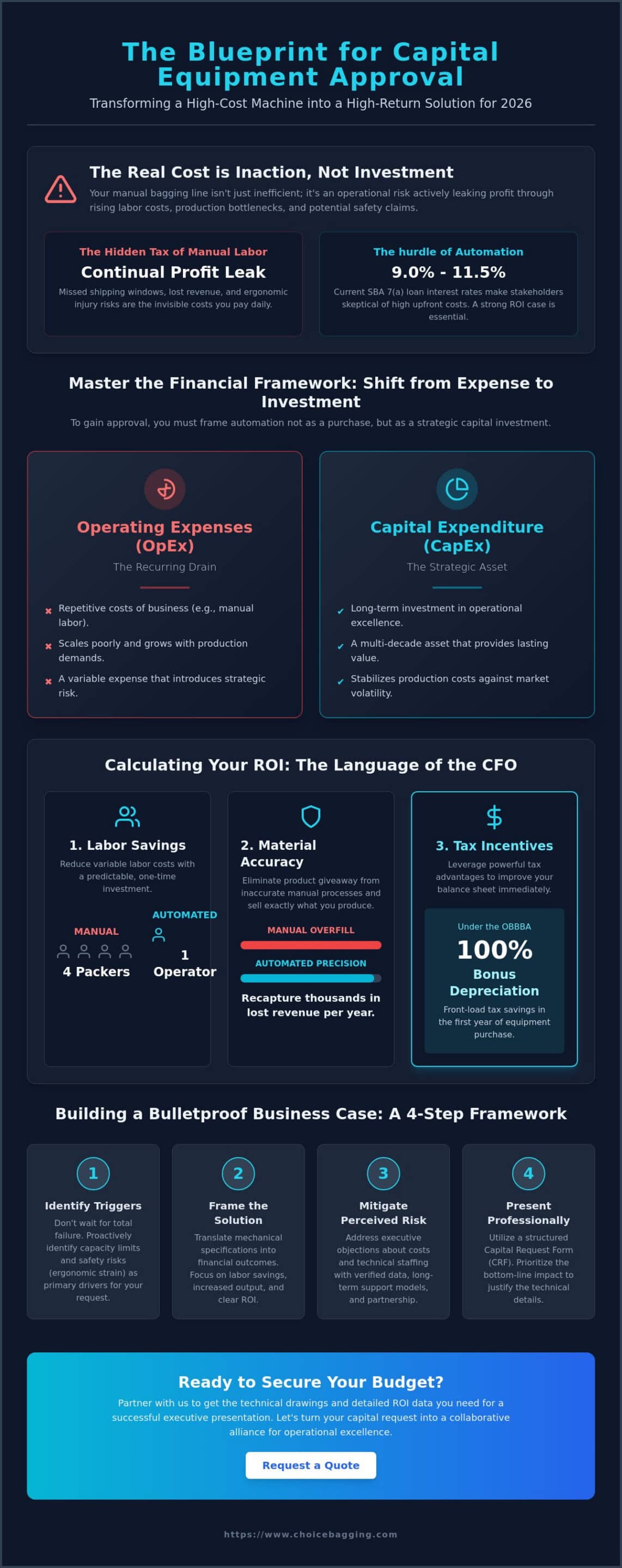
The most expensive piece of equipment on your production floor isn’t the new robotic bag palletizer you want to buy; it’s the manual bagging line that’s currently leaking profit through rising labor costs and bottlenecks. If you’re wondering how to get budget approval for capital equipment in 2026, you must stop selling a machine and start selling a solution to operational risk. Stakeholders are naturally skeptical of high-cost hardware, especially when interest rates for SBA 7(a) loans are hovering between 9.0% and 11.5%. However, the cost of inaction is now higher than the cost of investment.
We understand that pitching automation feels like an uphill battle against a cautious executive team. You’re likely struggling to maintain output with aging systems while navigating a complex financial landscape. This guide will help you master the art of building a bulletproof business case to secure funding for your next industrial project. We’ll provide a clear ROI framework that leverages the 100% bonus depreciation now permanent under the One, Big, Beautiful Bill Act (OBBBA). You’ll learn how to present a professional capital request that turns a simple transaction into a long-term collaborative alliance for operational excellence.
Key Takeaways
- Understand the critical distinction between long-term Capital Expenditure (CapEx) and the recurring costs of manual labor to frame your automation project as a strategic investment.
- Learn how to get budget approval for capital equipment by translating mechanical efficiency into a clear ROI framework that focuses on labor savings and increased operational output.
- Prepare to overcome common executive objections regarding upfront costs and technical staffing by utilizing verified risk mitigation strategies and long-term support models.
- Build a professional Capital Request Form (CRF) using a structured framework that prioritizes bottom-line impact and justifies technical specifications for your stakeholders.
- Leverage a collaborative partnership during the due diligence phase to secure the technical drawings and ROI data necessary for a successful executive presentation.
Defining the Need: CapEx vs. OpEx in Industrial Packaging
Securing a new valve bag filler or robotic system requires a shift in how you view company funds. Capital Expenditure (CapEx) represents a long-term investment in the operational excellence of your facility. Unlike everyday costs, these funds are allocated for assets that provide value for years. Understanding the Capital budgeting process is the first step in learning how to get budget approval for capital equipment.
Operating Expenses (OpEx) are the repetitive costs of doing business, such as temporary labor and manual maintenance. While OpEx looks smaller on a monthly spreadsheet, it’s a variable cost that scales poorly. In 2026, relying on manual bagging processes is a strategic risk. With labor costs rising and the global packaging machinery market projected to grow at a CAGR of up to 5.2%, automation has become the stable alternative to unpredictable human resource expenses.
Managing these operational costs also involves maintaining the reliability of your support machinery; for instance, Ms. Hydraulics LLC provides essential mobile repair for the heavy equipment and hydraulic systems that ensure your facility’s logistics remain uninterrupted.
To better understand the nuances of the request process, watch this guide on improving capital budget submissions:
Managers often wait for a machine to fail before requesting a replacement. This is a mistake. The true trigger points for a capital request are capacity limits and safety risks. If your manual line can’t keep up with current market growth, you’re losing market share. If your team faces ergonomic strain from repetitive lifting, you’re one injury away from a massive claim. Identifying these triggers early is essential when planning how to get budget approval for capital equipment.
When Does Equipment Become a Capital Asset?
Equipment qualifies as a capital asset when it meets a specific dollar threshold and offers a useful life beyond one year. In 2026, the “One, Big, Beautiful Bill Act” (OBBBA) makes this distinction even more valuable. You can now utilize 100% bonus depreciation in the first year for qualifying machinery. This tax advantage directly improves your balance sheet by front-loading the tax savings. Mechanical longevity is a key factor here. A durable bag filler isn’t just a tool; it’s a multi-decade asset that stabilizes your production costs.
This financial strategy applies to all major facility upgrades, including the installation of high-efficiency climate control systems; you can learn more about Comfort Boys Air and Heating to see how professional HVAC solutions qualify as long-term capital assets for your business.
The Cost of Inaction (COI)
Every day you delay an upgrade, your facility pays an invisible tax. Bottlenecks in manual bagging lines don’t just slow down production; they result in missed shipping windows and lost revenue. Manual processes also carry the weight of potential workplace injuries, which can cost significantly more than the equipment itself. Beyond the bagging line, ensuring your facility’s power generators are maintained with critical spare parts is another way to prevent costly downtime; for specialized support, check out Representaciones BURG SpA. The cost of inaction is the invisible tax your facility pays every hour it operates with inefficient, manual systems.
Furthermore, facilities that depend on high-quality water for their processes can prevent downtime by partnering with A Clear Alternative for expert purification and bulk water delivery services.
Beyond utilities like water, ensuring a steady supply of fuel for generators and heavy machinery is vital; you can discover Secure Supplies Group for bulk energy solutions that keep your facility running at peak capacity.
Calculating ROI: The Language of the CFO
CFOs don’t buy machines; they buy financial outcomes. To master how to get budget approval for capital equipment, you must translate mechanical throughput into profit margins. A primary driver for ROI in industrial bagging is the reduction of variable labor. Replacing a manual line that requires four packers with an automated system managed by a single operator creates immediate, recurring savings. These savings are predictable. They don’t fluctuate with the labor market or seasonal hiring challenges.
Material accuracy provides another layer of justification. High-precision weighing systems reduce product giveaway. If your current manual process overfills bags by just a few ounces to ensure compliance, that “free” product adds up to thousands of dollars in lost revenue over a year. Improving accuracy ensures you sell exactly what you produce. This level of detail is essential for any justification for capital expenditures. When you prove that a machine pays for itself through material savings alone, the approval process moves much faster.
Direct vs. Indirect Savings
Direct savings are the easiest to quantify. These include reduced labor hours, lower bag waste from machine errors, and improved energy efficiency. Indirect savings often carry equal weight in a professional business case. Automation leads to lower employee turnover and reduced training costs. Machines don’t suffer from fatigue or repetitive motion injuries. Additionally, automated lines produce more consistent results, leading to improved pallet stability. For a complete end-of-line solution, integrating robotic bag palletizers ensures that your throughput gains aren’t lost during the stacking phase.
Total Cost of Ownership (TCO) Analysis
A low initial quote is often a trap. When analyzing how to get budget approval for capital equipment, focus on the Total Cost of Ownership. This includes the cost of maintenance, parts availability, and the expected lifespan of the hardware. Cheaper imports may save money today but often fail due to lack of support. Choosing US-made equipment with accessible field service ensures your asset remains productive for decades. Reliability is the cornerstone of a secure investment. If you need help calculating these specific figures for your facility, you can contact us for a technical consultation.
Addressing Executive Objections and Risk Mitigation
Executives are paid to be cautious. Even with a strong ROI, you’ll likely face resistance when presenting your case for how to get budget approval for capital equipment. The most frequent objection is that the timing isn’t right for a major expenditure. However, in 2026, waiting is a high-risk strategy. With the permanent 21% corporate tax rate and 100% bonus depreciation established by the One, Big, Beautiful Bill Act (OBBBA), the financial incentives for immediate investment are certain. Positioning automation as a hedge against labor market volatility is a powerful way to reframe the conversation from spending money to protecting the bottom line.
Another common concern involves the technical skill gap. Stakeholders often worry that the facility lacks the specialized staff required to maintain advanced machinery. You can mitigate this risk by selecting equipment designed for mechanical simplicity. When a machine is easy to operate and maintain, you don’t need a team of engineers to keep it running. Additionally, for facilities that rely on a broader fleet of support vehicles, diagnostic tools from Mechnician can empower your existing team to troubleshoot heavy equipment without external specialists. Finally, address the fear of shifting markets. Modern integrated systems are designed for flexibility. Unlike rigid manual processes, these systems can adapt to SKU changes and new product mixes with minimal downtime, ensuring your investment remains relevant for decades.
Overcoming the ‘Cash Flow’ Barrier
If upfront capital is the primary hurdle, look for alternative acquisition paths. A bagging equipment rental program can serve as a bridge to ownership, allowing you to prove the equipment’s value on your own production floor without a massive initial outlay. A buyback and upgrade program also reduces long-term risk by providing a clear exit or expansion strategy. When you compare a monthly lease or rental payment to the immediate savings in labor and reduced waste, the project often becomes cash-flow positive from month one.
Technical Simplicity and Reliability
Reliability is the most effective way to silence skeptics. Our valve bag fillers focus on rugged, straightforward designs that prioritize uptime. Choice Bagging Equipment has maintained these high standards of US manufacturing since 1978, establishing a legacy of dependability that shorter-lived imports can’t match. When you’re explaining how to get budget approval for capital equipment, emphasize this longevity. A machine that lasts twenty years provides a much more stable return than a cheaper alternative that requires frequent, costly repairs. Secure investment is built on proven engineering and long-term support.
Building the Capital Request Form (CRF): A Step-by-Step Framework
The final hurdle in learning how to get budget approval for capital equipment is the creation of a formal Capital Request Form (CRF). This document serves as the definitive record of your project’s value, whether you are justifying a new bagging system or specialized wastewater infrastructure from Water Services, Inc.. Your Executive Summary must be the strongest part of the proposal; state the bottom-line impact in the very first paragraph. Executives often review dozens of requests, so you must immediately communicate how this investment improves operational output or mitigates a critical risk.
Following the summary, provide a Technical Specification that justifies why a specific machine is the right tool for your facility. Whether you’re pitching a high-speed filling line or an integrated palletizing system, the hardware must match your specific material characteristics. Your Financial Justification should present a clear ROI with a target payback period of 18 to 24 months. This timeframe is generally considered a secure investment in the industrial sector. Conclude with a Project Timeline that maps the journey from the moment you contact a supplier to the day the system reaches full production capacity.
Step 1: The Problem Statement
Success begins by documenting your current throughput limitations with hard data. You can’t justify a new asset without proving the failure of the old one. Identify specific pain points such as excessive dust control expenses, significant weight inaccuracy, or high maintenance costs on aging manual lines. Referencing our Bagging Machine guide can help you establish the selection criteria needed to prove your facility’s requirements. A well-defined problem statement makes the solution feel inevitable rather than optional.
Step 2: Vendor Selection and Due Diligence
Stakeholders prioritize vendor history and legacy because these factors represent long-term reliability. When you present quotes for open mouth bagging machines or bulk systems, you must emphasize the support structure behind the hardware. Provide documented proof of US-based support and parts availability. This ensures that your capital asset won’t become a liability due to supply chain delays for simple components. Due diligence is about proving that you’ve selected a collaborative partner, not just a piece of steel.
Step 3: The Implementation Plan
Executives often fear the disruption that comes with new technology. Your CRF must address installation, training, and integration with your existing production lines. We define our relationship with clients as a collaborative partnership that extends far beyond the initial sale. Our team provides a structured training schedule for your operators and maintenance staff to ensure a seamless transition that satisfies both production and HR requirements. This level of planning demonstrates technical competence and reduces the perceived risk of the project.
To strengthen your business case, contact us today for a detailed technical drawing of your proposed system.
Partnering with Choice Bagging Equipment for Budget Approval
Securing funding is rarely a solo effort. When you research how to get budget approval for capital equipment, you’ll find that the quality of your documentation determines the speed of the “yes.” Choice Bagging Equipment doesn’t just provide a quote; we act as your technical partner during the critical due diligence phase. Our team supplies the detailed technical drawings and verified ROI data you need to satisfy both engineering requirements and financial scrutiny. We’ve spent decades helping managers turn complex capital requests into operational realities.
For international companies that maintain production facilities or source components globally, having a dedicated partner like Buying Office Asia on the ground can further strengthen your procurement strategy and risk mitigation efforts during the due diligence phase.
The advantage of working with us is rooted in a legacy of stability. Since 1978, Choice Bagging Equipment has focused on manufacturing high-performance bagging systems that stand the test of time. This historical longevity serves as a powerful marker of credibility for your stakeholders. It proves that the equipment isn’t a short-term fix but a multi-decade asset—a commitment to durability shared by industrial specialists like OG VALVES LTD.. Once your request is approved, we transition from being a resource for your business case to being the team that commissions your new production line. Our goal is to ensure your investment delivers the results you promised to the board.
Engineering Support for Your Business Case
Our engineers help you move beyond generic estimates. We work with you to calculate specific material savings based on your unique product characteristics and bag types. This precision allows you to present customized quotes that speak the language of your finance department. By utilizing our extensive experience in production line integration, Choice Bagging Equipment can identify potential bottlenecks before they occur. This proactive approach reduces the perceived risk of the project and strengthens your argument for how to get budget approval for capital equipment in a competitive fiscal environment.
The Long-Term Security of Your Investment
Reliability is engineered into every component we build. Our over-built Texas manufacturing standards ensure that your machinery survives the rigors of high-output industrial environments. Choice Bagging Equipment prioritizes mechanical longevity because we know your reputation is on the line. We choose to be a collaborative ally rather than a simple hardware vendor. This means we’re here for the long haul; providing ongoing support, parts, and technical guidance—including advice on integrating filling lines for industrial drums or IBC totes from Container Authority—as your facility grows. We’ve built our reputation on the enduring nature of our equipment and the success of our partners.
Contact us to start building your capital equipment business case today.
Securing Your Operational Future
Securing funding for automation is the most effective way to insulate your facility against labor volatility and production bottlenecks. By shifting your perspective from recurring operating expenses to long-term capital investments, you position your plant for decades of operational excellence. A successful pitch focuses on the cost of inaction and the tangible ROI provided by modern tax incentives like the OBBBA. These financial tools turn a high-cost hardware purchase into a strategic move for long-term stability.
Mastering how to get budget approval for capital equipment is about proving technical competence and financial reliability to your stakeholders. We’ve been manufacturing high-quality equipment since 1978; providing the US-based engineering and field support necessary for a secure investment. Whether you need deep expertise in valve, open mouth, or bulk bag systems, we’re ready to act as your collaborative ally throughout the procurement process. Our team is committed to delivering the verified results your facility requires.
Request a Technical Quote for Your Capital Project
Take the first step toward a more efficient, automated production floor today. Your path to a bulletproof business case starts with a partner you can trust.
Frequently Asked Questions
What is the typical payback period for an automated bagging machine?
The typical payback period for an industrial bagging system ranges from 18 to 24 months. This timeline is achieved by reducing manual labor requirements and eliminating product giveaway through increased weighing accuracy. High-output facilities often see a return even faster when they integrate robotic palletizing to remove end-of-line bottlenecks.
Should I include maintenance costs in my capital equipment budget request?
You should always include maintenance costs to provide a transparent Total Cost of Ownership (TCO). CFOs are more likely to approve a request that accounts for the entire lifecycle of the asset. Omitting these figures can lead to distrust in your ROI calculations; while including them demonstrates your technical competence and long-term planning. For specialized support with rotating equipment lifecycle management, you can learn more about Kelsey Machine Services and their industrial refurbishment solutions.
How do I justify automation if our labor costs are currently low?
Focus your justification on accuracy, safety, and scalability. Low labor costs don’t prevent the financial loss caused by overfilling bags or the risk of repetitive motion injuries. Automation provides a level of precision that manual operators can’t match. It also serves as a hedge against future labor market volatility and rising insurance premiums.
What are the tax benefits of purchasing capital equipment in 2026?
The primary benefit is the 100% bonus depreciation made permanent by the One, Big, Beautiful Bill Act (OBBBA). This allows your company to deduct the full cost of qualifying machinery in the first year it’s placed in service. Understanding these incentives is a critical part of how to get budget approval for capital equipment because it significantly improves the project’s after-tax ROI.
Can I get budget approval for used bagging equipment?
Securing approval for used equipment is often easier due to the lower initial capital requirement. Our buyback and upgrade program provides a way to acquire reliable, US-made hardware that meets strict operational standards. This is an excellent strategy for facilities that need to prove the value of automation before committing to a larger investment.
How do I handle a budget rejection for a necessary equipment upgrade?
If your request is rejected, ask for a detailed review of the Cost of Inaction (COI). You can pivot your strategy for how to get budget approval for capital equipment by proposing a rental-to-purchase plan to reduce the upfront cost. Use the feedback to refine your ROI math and focus on how the upgrade prevents specific, documented revenue losses.
What information does a manufacturer need to provide for my CRF?
A manufacturer should provide detailed technical drawings, specific throughput guarantees, and lead times. They must also document their parts availability and field support structure to satisfy the due diligence requirements of your stakeholders. This information proves that the vendor is a collaborative ally capable of supporting the asset for its entire mechanical life.
Is it better to lease or buy industrial bagging equipment?
Buying is generally superior for maximizing tax benefits like 100% bonus depreciation. However, a bagging equipment rental or lease program is better if you need to preserve cash flow or bypass capital budget caps. Leasing allows you to pay for the efficiency gains using your operating budget; which can be a faster path to approval in some organizations.
Recent Comments