

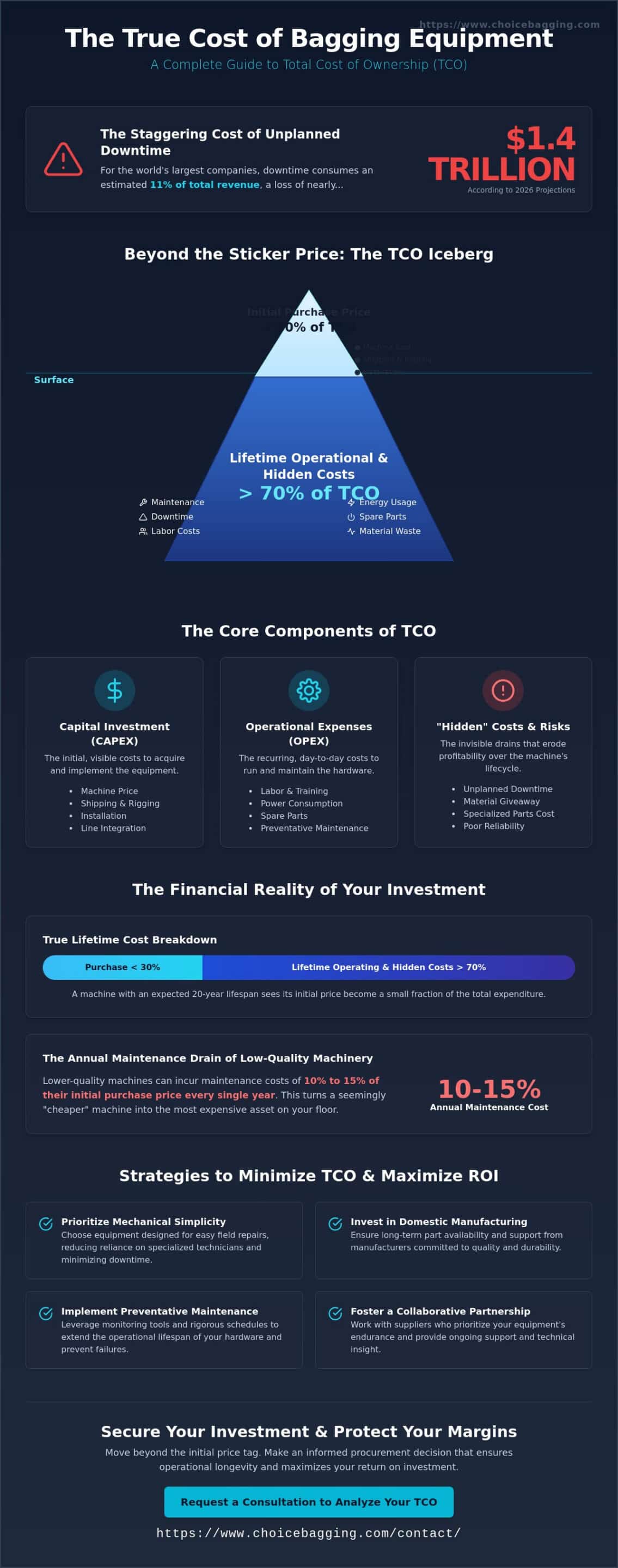
Unplanned downtime costs the world’s largest companies approximately 11% of their total revenue, which is a staggering $1.4 trillion according to 2026 data. For your facility, these disruptions often stem from poor mechanical reliability or the high cost of specialized replacement parts. Understanding the total cost of ownership bagging equipment is the only way to protect your margins from these invisible drains on your capital. It’s vital to look beyond the initial sticker price to ensure your investment remains secure over its entire operational lifecycle.
You already know that a cheaper machine often ends up being the most expensive asset on your floor. It’s a common frustration when inaccurate weighing leads to material giveaway or when integrating new machines becomes a technical nightmare. We’re here to help you move past these operational hurdles by focusing on mechanical simplicity and durable manufacturing standards.
This guide provides a clear framework to calculate and minimize your long-term expenses, ensuring you maximize ROI and operational longevity. We’ll examine how predictive maintenance and high standards of manufacturing can reduce your overhead. You’ll gain the technical insight needed to foster a collaborative partnership that prioritizes your equipment’s endurance and ongoing support.
Key Takeaways
- Distinguish between the initial acquisition price and the true lifecycle expenses to make more informed procurement decisions for your facility.
- Quantify the financial impact of unplanned downtime and material giveaway to protect your margins from hidden operational drains.
- Utilize a strategic framework to calculate the total cost of ownership bagging equipment, ensuring a secure investment and maximized ROI.
- Prioritize mechanical simplicity and domestic manufacturing to simplify field repairs and ensure long-term part availability.
- Implement rigorous preventative maintenance schedules that leverage modern monitoring tools to extend the operational lifespan of your hardware.
What is Total Cost of Ownership (TCO) for Bagging Equipment?
In heavy-duty manufacturing, the Total Cost of Ownership (TCO) represents the comprehensive financial commitment required to operate a system from procurement to decommissioning. It isn’t just the number on the invoice. It includes every dollar spent on power, labor, and spare parts. For bagging operations, this metric provides a far more accurate view of profitability than initial ROI alone. While ROI focuses on how quickly a machine pays for itself, TCO reveals how much profit that machine will actually leave on the table after years of service.
Calculating the total cost of ownership bagging equipment requires a shift in perspective. You’re moving from a “buy-and-forget” mindset to a lifecycle management strategy. High-quality machinery is designed to endure harsh environments for decades. If you only look at the purchase price, you’re seeing less than 30% of the actual cost you’ll pay over the next twenty years. Understanding this total expenditure is the only way to ensure your procurement decisions support operational excellence.
To better understand this concept, watch this helpful video:
Beyond the Purchase Price
Direct costs like the machine and installation are easy to track. Indirect costs are where the real danger lies. These include material giveaway due to inaccurate weighing and the high cost of specialized replacement parts for proprietary systems. Maintenance costs for lower-quality packaging machinery can range between 10% to 15% of the machine’s purchase price every single year. A low-cost machine often leads to higher lifetime expenses because it lacks the mechanical simplicity required for easy field repairs. Quality machinery is an investment in longevity. We build hardware with an expected lifespan of 20 years or more, ensuring the initial capital expenditure is amortized over a much longer period of reliable output.
Why TCO Matters for Industrial Budgeting
Predictable budgeting is the backbone of operational excellence. When you understand TCO, you can forecast cash flow for maintenance and scheduled upgrades with precision. This data makes it easier to justify the investment in higher-quality valve bag fillers. Instead of reacting to emergency repairs, you’re executing a proactive strategy. Choosing durable equipment aligns your procurement decisions with long-term production goals. It transforms a simple transaction into a collaborative alliance focused on sustained mechanical performance. You aren’t just buying hardware; you’re securing the future capacity of your production line.
The Core Components: Capital Investment vs. Operational Expense
Every strategic procurement decision begins with a clear distinction between initial capital expenditure (CAPEX) and ongoing operational expense (OPEX). While the purchase price is the most visible figure, it’s merely the foundation of your investment. To accurately calculate the total cost of ownership bagging equipment, you must account for every dollar required to bring the machine online and keep it running at peak efficiency. This includes everything from the physical footprint in your facility to the specialized training your staff requires to operate the hardware safely.
Upfront Acquisition and Integration
The acquisition phase involves more than just the sticker price of the machine and its specialized bagging heads. You must budget for shipping, heavy rigging, and professional installation to ensure the equipment is level and secure. Integration is often where hidden costs surface. If a machine doesn’t communicate with your existing conveyors or palletizers, you’ll face costly delays. Investing in professional production line integration ensures that your new asset works in harmony with your current workflow from day one. These upfront engineering costs are essential to prevent the mechanical friction that leads to long-term reliability issues.
Daily Operational Costs
Daily expenses typically represent the largest portion of your lifecycle costs. Labor is a primary driver. As of June 2026, the average hourly rate for a packaging machine operator in the United States is $21.00. High-volume plants often find that automated bagging systems provide a return on investment within 6 to 24 months by reducing these headcount requirements. Energy consumption is another critical factor. There’s a significant difference in the utility draw between air-flow fillers and impeller-style fillers. You must also account for rising consumable prices. In 2026, European plastic packaging materials saw increases of over 30%, making material waste and thread consumption for sewing machines more expensive than ever before.
Beyond these direct expenses, you must consider the ongoing costs of ownership such as floor space and utility infrastructure. A machine that requires a massive footprint or specialized high-voltage electrical drops adds to your facility’s overhead. Training and onboarding costs are equally vital. A team that isn’t properly trained will cause more frequent downtime and material giveaway. We focus on mechanical simplicity to shorten the learning curve for your operators, ensuring your team is proficient and productive in less time. If you’re ready to see how these factors impact your specific facility, you can request a technical assessment from our engineering team.
The “Hidden” Costs: Downtime and Material Waste
While CAPEX and OPEX are the visible pillars of the total cost of ownership bagging equipment, the hidden drains on profitability often occur during active production. These costs don’t appear on a monthly utility bill. Instead, they manifest as lost revenue during a mechanical failure or as thousands of dollars in product literally given away for free. In high-volume industrial environments, these inefficiencies compound rapidly. Managing these risks requires a shift from reactive repairs to a strategy centered on mechanical reliability and precision engineering.
The High Price of Production Losses
Unplanned downtime is a massive risk to your facility’s output. For the world’s 500 largest global companies, unplanned failures result in a loss of 11% of total revenue, totaling $1.4 trillion in 2026. In a bagging plant, an hour of failure means missing production targets and idling your labor force. If your line produces 600 bags per hour and a critical component fails, you aren’t just losing those bags. You’re risking delayed shipments and customer dissatisfaction.
Mechanical simplicity is your best defense against these losses. Machines with fewer proprietary electronic components and more robust mechanical designs are easier to troubleshoot in the field. This reduces the time your line sits idle. Keeping a stock of critical spare parts on-site is a necessary expense. It prevents a minor repair from turning into a week-long shutdown while waiting for a shipment. Reliability isn’t just a feature; it’s a financial safeguard.
Weighing Inaccuracy: The Material Giveaway Problem
Material giveaway is the silent killer of bagging ROI. When a machine consistently overfills a 50lb bag by just 1%, you lose one full bag for every hundred produced. Over a year of high-volume production, this represents a significant financial drain that most operators fail to quantify. High-quality load cells and advanced control systems pay for themselves by tightening these tolerances.
With the cost of raw materials and plastic packaging rising, every gram of wasted product impacts your bottom line. In early 2026, Polypropylene prices rose by 43.4% and HDPE by 39.2%. These increases make material waste more expensive than ever. Improper seals or bag breakage during the palletizing process add another layer of unnecessary cost. These failures force you to re-bag material or dispose of contaminated product. Reliable equipment ensures that every bag leaving the facility contains exactly what the customer paid for. This precision preserves your margins and your professional reputation.
Strategies to Minimize Long-Term Bagging Costs
Reducing the total cost of ownership bagging equipment requires a proactive approach that prioritizes design integrity and consistent upkeep. You can’t control the rising cost of raw materials or the fluctuation of global freight charges, but you can control how your machinery responds to the stress of a high-volume production environment. Implementing a strategic maintenance plan and choosing hardware designed for durability are the most effective ways to protect your long-term margins. It’s a shift from merely managing a machine to managing a critical financial asset.
Standardization and Mechanical Simplicity
Simple designs reduce your dependency on highly specialized technicians. When a machine uses standard, non-proprietary components, your own maintenance team can often perform repairs without waiting for a factory-trained engineer to arrive on-site. This mechanical simplicity is a direct cost-saving measure that competitors often overlook. It allows you to maintain a leaner parts inventory by standardizing components across multiple production lines.
By using off-the-shelf bearings, motors, and sensors, you avoid the high markups and long lead times associated with proprietary hardware. This approach ensures your facility remains self-sufficient and operational even when global supply chains are strained. Standardizing your hardware also simplifies the training process. Operators don’t have to learn multiple different interfaces or mechanical layouts, which reduces the risk of human error during production changeovers.
The ROI of Preventative Maintenance
Moving from a reactive to a proactive service model is essential for operational excellence. While reactive repairs only address failures after they’ve already halted production, preventative maintenance identifies wear before it causes a shutdown. Industry data from 2026 suggests that predictive maintenance can forecast failures with over 85% accuracy. This foresight leads to a 20% to 30% reduction in overall maintenance costs compared to traditional calendar-based schedules. Utilizing a comprehensive bagging machine maintenance checklist ensures that your team never misses a critical inspection point.
Manufacturer-supported annual inspections further strengthen this strategy. These deep-dive audits catch subtle mechanical shifts that daily checks might overlook. Beyond the hardware, investing in thorough operator training prevents the common misuse that leads to premature wear. With the average salary for a packaging machine operator reaching $21.00 per hour in 2026, you can’t afford the inefficiency of an untrained workforce. A team that understands the technical limits of their equipment will operate it more efficiently, reducing the likelihood of catastrophic failure. If you’re ready to optimize your facility’s performance, partner with us for a collaborative alliance focused on mechanical longevity.
Partnering for Low TCO: The Choice Bagging Advantage
Managing the total cost of ownership bagging equipment requires more than just high-quality hardware. It requires a partner with a deep historical legacy and a commitment to your facility’s long-term operational excellence. Since 1978, we’ve focused on building a collaborative alliance with our clients rather than engaging in simple one-off transactions. This perspective ensures that every procurement decision you make is backed by decades of technical competence and a steadfast commitment to quality. When you choose Choice Bagging Equipment, you aren’t just buying a machine. You’re securing the future capacity of your production line with a seasoned industry authority.
Dependable Support and Field Service
Operational stability is rooted in dependability and ongoing support. Our American manufacturing origin serves as an immediate marker of credibility and ensures that you aren’t at the mercy of volatile global supply chains. While European and US markets saw significant material price increases in early 2026, our domestic part availability provides a sense of security for your investment. We provide expert assistance with production line integration to eliminate the technical friction that can lead to unplanned downtime. You’ll have direct access to high-quality spare parts and technical expertise whenever your team needs a solution.
Our field service team remains focused on delivering verified results. We understand that mechanical longevity is the primary driver of a lower TCO. By offering on-site maintenance and repair services, we help you maximize uptime and extend the life of your hardware. This proactive approach prevents the minor wear-and-tear of industrial bagging from turning into a catastrophic failure. We adopt the persona of an engineer and a long-term collaborator. Our goal is to ensure your equipment operates at peak efficiency for 20 years or more, protecting your margins from the high cost of frequent replacements.
Secure Your Investment
A secure investment requires a partner who supports the entire equipment lifecycle. Your production needs will likely change as your business grows. We address this evolution through our Bagging Machine Buyback & Upgrade Program. This initiative allows you to recover value from your current assets when it’s time to modernize your line. It’s a pragmatic way to lower your overall total cost of ownership bagging equipment while maintaining the highest standards of manufacturing. We offer the stability and assurance you need to make confident procurement decisions.
Don’t leave your facility’s ROI to chance. We’re ready to help you analyze your current operation and identify opportunities for cost reduction. Our team provides the proprietary educational resources and technical insight needed to foster a truly collaborative partnership. Request a professional TCO assessment for your next project today. Let’s work together to ensure your bagging operation remains a reliable and profitable asset for decades to come.
Secure Your Long-Term Operational Excellence
Success in industrial bagging requires a shift from short-term procurement thinking to a lifecycle management strategy. You’ve seen how hidden costs like unplanned downtime and material giveaway can erode your margins if left unmanaged. Optimizing the total cost of ownership bagging equipment is a continuous process that begins with selecting hardware built for endurance and mechanical simplicity. By prioritizing domestic support and rigorous preventative maintenance, you protect your facility from the volatility of global supply chains and rising material costs.
Since 1978, we’ve manufactured high-quality bagging machines designed to withstand the most demanding environments. Our expertise in valve, open mouth, and bulk bag fillers ensures that your specific material needs are met with precision. We provide expert field service and integration support to foster a collaborative partnership that lasts for decades. Take the first step toward a more profitable and reliable production line today. We remain committed to your long-term output and mechanical reliability.
Contact Choice Bagging Equipment for a custom TCO analysis
Frequently Asked Questions
How do you calculate the TCO of a bagging machine?
You calculate TCO by summing the initial acquisition price with all operational expenses over the equipment’s expected lifespan. This includes direct costs like shipping, installation, and labor alongside indirect costs such as material giveaway and unplanned downtime. By analyzing these factors together, you gain a transparent view of the true financial commitment required for your bagging operation.
What is the average lifespan of industrial bagging equipment?
High-quality bagging machinery is designed for mechanical longevity and typically lasts 20 years or more in an industrial environment. This lifespan depends heavily on the use of durable manufacturing standards and consistent preventative maintenance. Choosing equipment with a long operational life allows you to amortize your capital investment over a much longer period, significantly reducing your annual costs.
How much does downtime actually cost a bagging operation?
Downtime costs are measured by lost production revenue and the continued expense of idle labor. Industry data from 2026 indicates that unplanned downtime can result in a loss of 11% of total revenue for large global companies. In your facility, even an hour of failure disrupts shipments and forces your team to manage backlogs, which compounds the financial impact beyond simple repair costs.
Why is weighing accuracy so important for TCO?
Weighing accuracy is critical because material giveaway acts as a silent drain on your margins. Overfilling bags by as little as 1% means you lose one full bag for every hundred produced, which adds up to significant capital loss over a year of high-volume production. Investing in precision load cells reduces this waste and ensures you only ship the exact amount of product your customers paid for.
Does automated bagging equipment always have a lower TCO than manual systems?
Automated systems often provide a lower total cost of ownership bagging equipment in high-volume facilities due to significant labor savings. While the initial capital expenditure is higher, the reduction in headcount and human error typically results in a return on investment within 6 to 24 months. However, for low-volume or highly specialized applications, manual systems with lower maintenance requirements might remain more cost-effective.
What are the most common hidden costs in a bagging line?
The most common hidden costs include production line integration, specialized operator training, and the high price of proprietary replacement parts. Many facilities also overlook the cost of floor space and the utility infrastructure required to support high-voltage hardware. Identifying these expenses during the procurement phase prevents unexpected budget overruns and ensures your operational overhead remains predictable throughout the equipment’s lifecycle.
How can preventative maintenance reduce my total cost of ownership?
Preventative maintenance reduces your total cost of ownership bagging equipment by identifying mechanical wear before it leads to a catastrophic failure. Implementing a proactive schedule can reduce overall maintenance expenses by 20% to 30% compared to reactive repair models. This strategy ensures your hardware remains operational during peak production periods and extends the total service life of your investment.
Should I consider used bagging equipment to lower my TCO?
Used bagging equipment can be an effective way to lower initial capital costs if the machinery is refurbished and supported by a reliable partner. We offer programs to buy used bagging machines and upgrade existing lines, which provides a middle ground between new investment and mechanical reliability. You should always verify the availability of spare parts and technical support before committing to used hardware to avoid high long-term maintenance expenses.
Recent Comments