

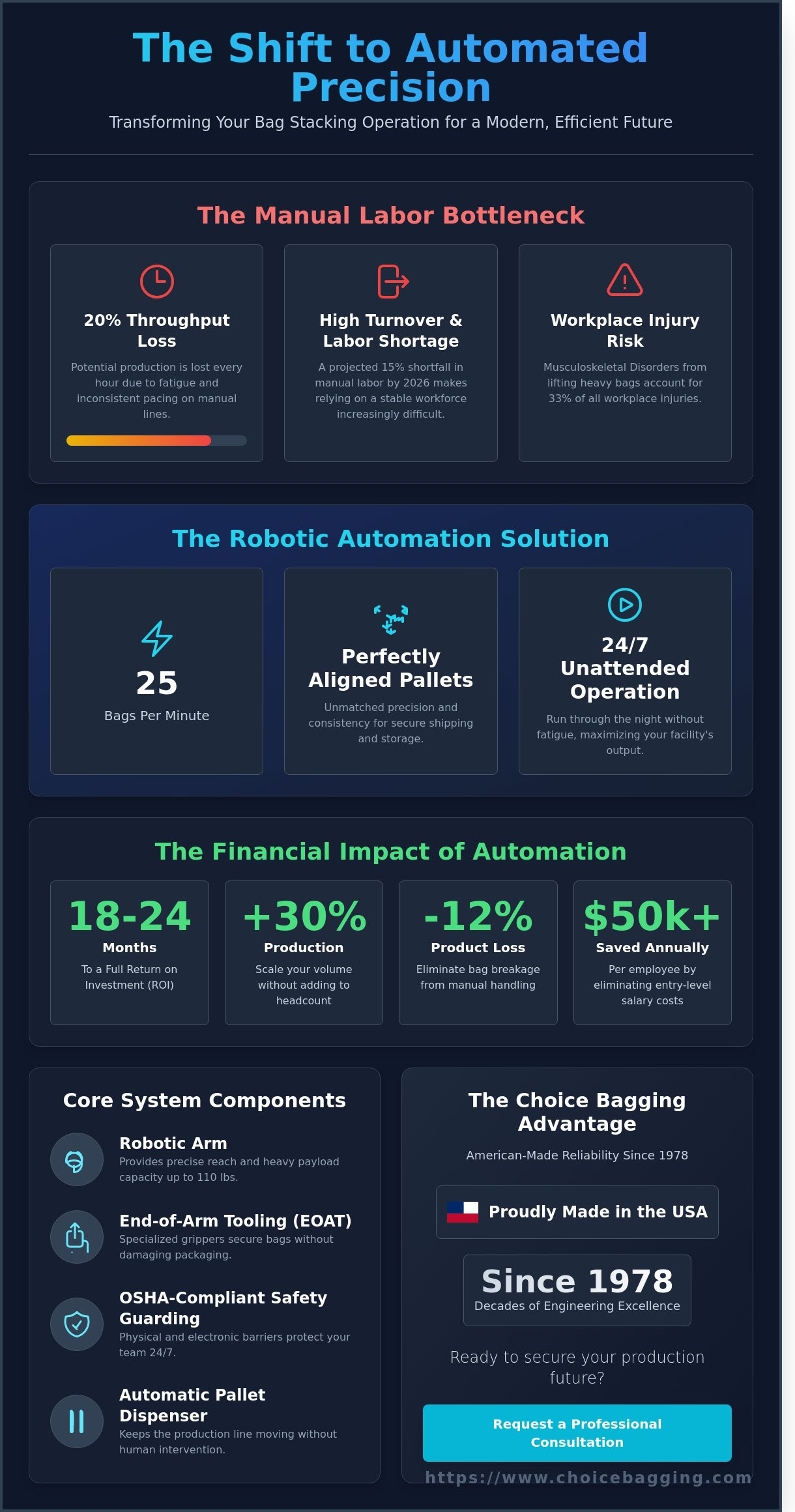
Your manual stacking line is likely losing 20% of its potential throughput every hour due to fatigue and inconsistent pacing. It’s a reality many plant managers face when relying on manual labor for repetitive tasks. You’ve likely seen the impact of high turnover and the rising costs of workplace injuries first hand. We understand that maintaining a stable workforce for these demanding roles is an uphill battle, which is why a robotic bag stacking machine is no longer a luxury, but a necessity for modern growth.
Since 1978, we’ve helped facilities transition from manual struggle to automated precision with equipment proudly Made in the USA. This guide explores how you can achieve rates of 25 bags per minute while ensuring every pallet is perfectly aligned for shipping. You’ll learn how to reduce labor costs and build a safer, more reliable operation. If you aren’t sure which configuration fits your material, our Bagger Professor tool helps narrow down the ideal equipment for your specific needs. Let’s look at how you can secure your production future and contact us to discuss your specific goals.
Key Takeaways
-
Learn how to navigate the 2026 labor market by transitioning from manual stacking to automated systems that maximize production line efficiency and consistency.
-
Understand the precision mechanics behind a robotic bag stacking machine, including how PLC coordination handles heavy payloads up to 110 lbs with unmatched accuracy.
-
Compare the compact footprint and pattern flexibility of robotic cells against conventional palletizers to determine the most strategic fit for your facility’s layout.
-
Discover the critical steps for integrating upstream equipment and use the Bagger Professor tool to identify the ideal bagging technology for your material density.
-
Explore the long-term value of American-made engineering since 1978 and learn how to request a quote for a system built for decades of reliable service.
Table of Contents
-
What is a Robotic Bag Stacking Machine and Why Automate Now?
-
Robotic vs. Conventional Palletizers: A Strategic Comparison
-
The Choice Bagging Advantage: American-Made Reliability Since 1978
What is a Robotic Bag Stacking Machine and Why Automate Now?
A robotic bag stacking machine is a precision-engineered industrial system designed to pick bags from a discharge conveyor and stack them in precise, interlocking patterns on pallets. As we approach the 2026 labor market reality, where a 15% shortfall in manual labor is projected for the manufacturing sector, automation is no longer optional for growing businesses. To understand the technical foundation of these systems, it helps to explore What is a Palletizer? and how it has evolved from basic mechanical stacking to agile robotic control. Choice Bagging Equipment builds performance and reliability into every system, ensuring your investment is built to last decades in the most demanding environments.
To see how these systems operate in a high-volume facility, watch this demonstration of a Fanuc robotic arm:
Every robotic bag stacking machine we build integrates four core components for maximum durability. The robotic arm provides the specific reach and payload capacity needed for heavy industrial bags. The end-of-arm tooling (EOAT) uses specialized mechanical or vacuum grippers to ensure a secure hold without damaging the packaging. Safety guarding protects your staff from moving parts, while automatic pallet dispensers keep the line moving without human intervention. These components work together to provide 24/7 operational capability, allowing your plant to run through the night without fatigue.
The Economic Impact of Automated Stacking
Switching to automated stacking provides a measurable boost to your bottom line. Most of our partners see a full ROI within 18 to 24 months by eliminating the costs associated with $50,000 annual entry-level salaries and high turnover rates. Precision stacking also reduces product loss by 12% because robots eliminate the bag breakage common with manual handling during high-speed shifts. You can use the Bagger Professor tool to identify the exact equipment required for your specific material and bag type. This investment allows you to scale production volumes by 30% without adding to your headcount.
Safety and Ergonomics in the Modern Warehouse
Manual lifting of 50lb bags is a primary cause of Musculoskeletal Disorders (MSDs), which currently represent 33% of all workplace injuries according to the Bureau of Labor Statistics. By implementing robotic palletizing systems, you create a safer environment and ensure strict OSHA compliance. High-speed robotic guarding creates a physical and electronic barrier that prevents accidental contact between operators and moving machinery. This shift doesn’t just protect your team; it also helps reduce insurance premiums by lowering your facility’s risk profile. If you’re ready to improve your efficiency, contact us today for a professional consultation.
How Robotic Bag Palletizers Work: Mechanics and Precision
Every robotic bag stacking machine relies on a High-Speed PLC to act as the system’s brain. This controller synchronizes the bag inflow from the conveyor with the precise movements of the robotic arm. It monitors sensors to ensure the bag is positioned correctly before the arm engages. Since 1978, we’ve seen how precise timing reduces cycle times by as much as 15 percent compared to manual stacking. This coordination ensures that the bagging head, conveyors, and robot work as a single, unified cell.
Safety is paramount in these high-speed environments. Adhering to OSHA robotic safety standards ensures that light curtains and physical fencing protect your team during 24/7 operations. If you aren’t sure which configuration fits your product, the Bagger Professor tool helps identify the right equipment based on your specific material and bag type.
Modern systems handle heavy-duty loads with ease. A standard industrial arm manages payloads up to 110 lbs while maintaining a wide work envelope. This reach allows the robot to service two pallet stations simultaneously. While one pallet is being filled, an operator can safely remove the completed stack from the other side. Programming software allows operators to save dozens of pallet recipes; this flexibility means you can switch from a 5-bag pattern to a 3-bag pattern in under 60 seconds.
End-of-Arm Tooling (EOAT): The Robot’s Hand
The EOAT is the most critical component for maintaining grip during high-velocity movements. Mechanical grippers use side-clamping plates to secure heavy paper or plastic bags. For non-porous materials, vacuum grippers provide a faster pick-and-place cycle. Hybrid tools are a versatile choice. They feature forks for bags and integrated hooks to pick up empty pallets, which eliminates the need for a separate pallet dispenser and saves floor space.
4-Axis vs. 6-Axis Robots for Stacking
A 4-axis robot is the industry standard for high-speed palletizing because it keeps the bag level throughout the motion. This simplicity leads to higher uptime and lower maintenance costs. 6-axis robots offer more flexibility, which is necessary when working in tight footprints or when bags must be tilted for complex stacking patterns. You can explore our specific robotic palletizing systems to see these configurations in action. If you need a custom layout for your facility, contact us to speak with an application engineer.
Robotic vs. Conventional Palletizers: A Strategic Comparison
Choosing between automation styles requires a clear look at your long-term production goals. A robotic bag stacking machine offers a compact footprint that saves significant floor space. While traditional high-level palletizers often demand 1,500 square feet of area, a robotic cell typically fits within 600 square feet. This 60% space saving allows for better traffic flow and easier access for forklifts in tight manufacturing environments.
Maintenance remains a primary differentiator for facilities focused on uptime. Robotic arms utilize sealed bearings and high-precision gearboxes, resulting in 70% fewer moving parts than the complex mechanical elevators found in conventional units. Over a 10-year lifespan, the Total Cost of Ownership (TCO) for a robotic system is roughly 25% lower when you factor in spare parts, specialized labor, and energy consumption. If you need help identifying which equipment matches your material, the Bagger Professor tool is a functional resource to help you narrow down your options based on bag type.
When to Choose a Conventional Palletizer
High-speed requirements are the main driver for conventional systems. If your facility consistently runs at 40 to 50 bags per minute on a single product line, a high-level palletizer provides the necessary throughput. These machines are less ideal for plants with 5 or more SKU changes per shift because they lack the software-driven agility of a robotic bag stacking machine. To ensure success in either system, high-quality bag handling conveyors are essential for flattening and positioning bags to ensure a stable, square stack.
The Robotic Advantage in Versatility
A single robotic cell can service two or three production lines simultaneously. The arm picks different bag types from separate infeed points and places them on individual pallets. This versatility extends to plant growth; you can relocate or reconfigure a robot in about 48 hours, while a conventional system often takes 7 to 10 days to dismantle and move. While a conventional machine often requires 30 to 45 minutes of mechanical adjustment for a new bag size, a robotic system completes the same pattern change in less than 120 seconds via the touchscreen interface. Since 1978, we’ve helped processors transition to these flexible systems to improve their bottom line.
If you’re ready to upgrade your end-of-line process, contact us now to speak with an application expert. We build performance and reliability into every system to ensure your investment lasts for decades.
Integrating Your Stacker with Upstream Bagging Equipment
Seamless integration between your filling station and your robotic bag stacking machine determines the overall uptime of your production line. If these components don’t communicate effectively, you’ll face bottlenecks that negate the speed benefits of automation. Achieving a synchronized flow requires a methodical approach to equipment selection and mechanical alignment.
The first step involves selecting a filler that matches your material density and bag type. High-accuracy valve bag fillers are ideal for fine powders, while open mouth bagging machines provide versatility for granular products. To ensure you select the correct configuration for your material’s fluidity and aeration, you can use the Bagger Professor tool to narrow down the best machine for your specific application. Since 1978, we’ve found that matching the filler to the product’s physical characteristics is the only way to guarantee a consistent bag shape.
Proper bag conditioning is the second critical phase. Once a bag is filled, it often contains trapped air or unevenly distributed product. Using bag flatteners or square-up conveyors is essential for creating a uniform "brick" shape. A 10% variation in bag thickness can lead to a leaning pallet, which often results in product damage during transit. Flattening the bags ensures the robot can pick and place them with 100% repeatability.
Synchronization of conveyor speeds is the third requirement. The conveyor system must deliver bags to the robot’s pickup point at a rate that matches the robot’s cycle time. If the bagger produces 15 bags per minute, the indexing conveyor must precisely space those bags so the robot doesn’t "hunt" for the target. Finally, you must establish seamless data communication. Using modern PLC protocols allows the filler to signal the robotic bag stacking machine when a bag is ready, preventing dry cycles and reducing wear on the mechanical arm.
Connecting with Valve and Open Mouth Systems
Optimizing the flow from valve bag fillers requires precise discharge timing to keep the robot moving. For open mouth systems, the transition through the sewing or sealing phase must be managed to avoid disturbing the product settled in the bag. Consistent bag weight is the primary driver of pallet stability. A weight variance of just 0.5 lbs can cause uneven compression in the stack, leading to a 20% decrease in overall load integrity. We build performance and reliability into every integration to ensure your end-of-line automation matches the high output of your primary filling station.
Reliability is our cornerstone at Choice Bagging Equipment. We’re more than a supplier; we’re your partner in engineering a system built to last decades. Our team ensures that every conveyor and sensor works in harmony with your upstream assets. If you’re ready to modernize your facility with proven American-made technology, contact us today to discuss your integration needs.
The Choice Bagging Advantage: American-Made Reliability Since 1978
Choice Bagging Equipment has manufactured industrial solutions in the USA for over 45 years. We don’t just build a robotic bag stacking machine; we engineer a long-term asset for your facility. While some competitors design for a five-year replacement cycle, our machines frequently remain in operation for 25 to 30 years. This longevity stems from our commitment to heavy-duty materials and simplified mechanical designs that prioritize durability over planned obsolescence. Choosing American-made equipment means you won’t wait weeks for overseas shipping. We maintain a massive inventory of components in our domestic warehouse to ensure your facility stays productive.
Dependable Support and Field Service
Unplanned downtime can cost a facility upwards of $2,500 per hour in lost productivity. Our field service team travels directly to your site to resolve complex issues and perform preventative maintenance. We stock essential parts in our Texas facility for rapid deployment, often shipping the same day. Training is a core part of our partnership. We ensure your operators are fully confident with the robotic controls. Proper training reduces human error by 40% on average during the first year of operation. We’re also your partner for long-term optimization, providing technical support long after the initial sale.
Custom Engineering for Unique Applications
Every production floor has specific constraints. We specialize in handling difficult materials like 80-grit abrasives, corrosive chemicals, and certified food-grade powders. If you’re unsure which setup fits your material, use the Bagger Professor tool to narrow down the right equipment based on your specific bag type. We’ve helped clients increase stacking precision by 18% through custom-tailored end-of-arm tooling. Our team treats every project as a collaboration, acting as your technical partner from the first CAD drawing to the final installation. We integrate your robotic bag stacking machine seamlessly into existing production lines to maximize throughput.
Our commitment to American-made quality has defined our brand since 1978. We build machines meant to last decades, providing you with a reliable return on investment. By choosing Choice Bagging Equipment, you gain a dedicated partner focused on your long-term success. We provide the technical expertise and domestic support necessary to keep your bagging and stacking operations running at peak efficiency every single day. Contact us today for a custom bagging machine quote to start your project.
Future-Proof Your Production Line with Robotic Precision
Investing in a robotic bag stacking machine isn’t just about speed; it’s about securing your facility’s long-term reliability. Choice Bagging Equipment has manufactured high-quality bagging solutions in the USA since 1978. We understand that precision matters when you’re integrating new technology with existing upstream equipment. Our American-made systems reduce labor costs and eliminate the physical strain of manual palletizing. If you’re unsure which configuration fits your specific material, use our Bagger Professor tool to narrow down the right machine for your bag type. We provide expert engineering to ensure your production line remains seamless and efficient. You can rely on our 46 years of experience and local parts support to keep your operations running 24/7. Don’t leave your 2026 growth strategy to chance. Partner with a team that’s built a reputation on durability and performance since the 1970s. We’re ready to help you optimize every square foot of your warehouse floor with proven automation.
Request a Quote for Your Robotic Stacking Project
Frequently Asked Questions
How many bags per minute can a robotic bag stacking machine handle?
A standard robotic bag stacking machine typically processes between 12 and 24 bags per minute depending on the product weight and pallet pattern. High-speed configurations equipped with specialized end-of-arm tooling can reach speeds of 30 bags per minute. This performance ensures your production line maintains a consistent flow without the bottlenecks associated with manual labor. Since 1978, we’ve focused on delivering this level of efficiency to industrial facilities across the globe.
Can one robotic palletizer handle different bag sizes at the same time?
Yes, a single robotic palletizer can manage multiple bag sizes and weights simultaneously by using advanced sensors and multi-zone programming. The system identifies the incoming product dimensions and adjusts its grip and placement in real time. This flexibility allows one cell to service two or more production lines at once. If you’re unsure which configuration fits your facility, use our Bagger Professor tool to narrow down the right equipment for your specific materials.
What is the typical lifespan of a robotic bag stacker?
You can expect a robotic bag stacker to have a service life of 15 to 20 years with proper preventative maintenance. Most industrial robotic arms are rated for 80,000 to 100,000 hours of operation before they require a major mechanical overhaul. We build our systems for durability because we know you need equipment that lasts for decades. Invest confidently knowing these machines provide a long-term return on your capital and unmatched reliability.
How much floor space is required for a robotic stacking cell?
A standard robotic stacking cell typically requires a footprint of 150 to 250 square feet, which includes the safety fencing and pallet conveyors. This setup uses 30% less space than traditional mechanical palletizers often require. Compact designs are available for facilities with tighter constraints or unique architectural hurdles. Reach out to our team to request a quote for a customized layout that fits your specific floor plan.
Is it difficult to reprogram the robot for a new pallet pattern?
Reprogramming the robot for a new pallet pattern is a straightforward process that usually takes less than 20 minutes using modern touch-screen interfaces. Operators don’t need to write complex code; they simply select pre-configured recipes or use a drag-and-drop pattern builder. We design our controls to be intuitive so your team can make changes without external support. This ensures your robotic bag stacking machine remains versatile as your product line evolves over time.
What happens if a bag breaks during the stacking process?
If a bag breaks or loses vacuum pressure, the system triggers an immediate safety stop to prevent product contamination or equipment damage. Sensors in the end-of-arm tool detect the drop in pressure within 50 milliseconds and alert the operator via the interface. This quick response protects your investment and minimizes the time spent on cleanup. We’re also your partner in troubleshooting these issues to keep your line running at peak performance.
Do I need a specialist on-site to maintain the robotic arm?
You don’t need a full-time robotics specialist on-site because 95% of required maintenance involves routine lubrication and simple inspections. Your existing maintenance staff can handle these tasks after a brief training session during the initial installation. For more complex technical needs, our support team provides remote diagnostics and on-site service calls. We’ve provided this level of reliable support since 1978 to ensure your operation never skips a beat.
Can a robotic stacker be integrated into an existing manual bagging line?
A robotic bag stacking machine integrates seamlessly into existing manual lines by replacing the final hand-stacking station with a conveyor and the robotic cell. This transition typically increases palletizing speed by 40% while reducing labor costs and workplace injuries. The installation process is designed for minimal disruption to your current workflow. Contact us now to discuss how we can automate your manual process for better reliability and performance.
Recent Comments