

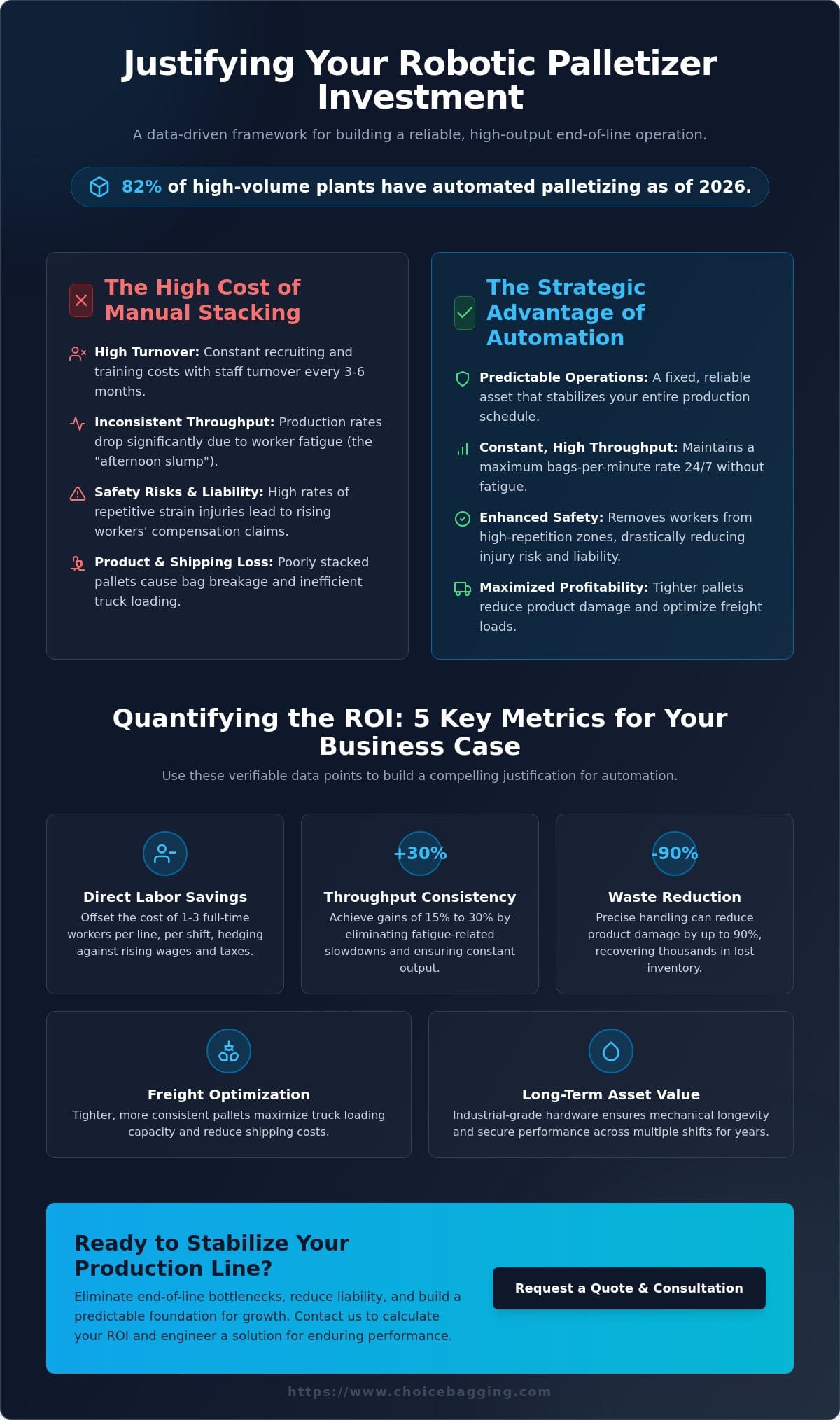
Over 82% of high-volume manufacturing plants have already deployed automated palletizing systems as of 2026. If your facility still relies on manual stacking, you’re likely facing the relentless cycle of high turnover and rising workers compensation claims from repetitive strain. It’s frustrating to watch inconsistent pallet quality lead to avoidable shipping damage while you struggle to staff your end-of-line operations. You understand that manual labor is no longer a stable foundation for growth, yet the path to automation often feels obscured by complex financial hurdles.
Justifying robotic palletizer investment is about more than replacing a worker; it’s a strategic move to preserve capital and stabilize your entire production line. This guide provides the comprehensive framework you need to calculate a precise ROI and justify the transition to automated bag palletizing in your facility. We’ll explore a clear roadmap for improving end-of-line reliability and reducing your dependence on a volatile labor market. By the end of this article, you’ll have the technical data and business logic necessary to present a secure investment case to your executive team.
Key Takeaways
- Identify why manual stacking is no longer sustainable and how to calculate the hidden costs of turnover and inconsistent throughput.
- Master five essential metrics for justifying robotic palletizer investment to build a data-driven business case for your executive team.
- Learn how to synchronize your end-of-line systems to ensure your palletizer and bagging machines operate as a single, high-efficiency unit.
- Overcome the complexity barrier by utilizing intuitive HMI interfaces that allow standard operators to maintain peak operational output.
- Evaluate the long-term value of industrial-grade hardware designed for mechanical longevity and secure, multi-shift performance.
The Evolution of End-of-Line Automation: Beyond Labor Replacement
The landscape of end-of-line production has fundamentally changed. Historically, manual stacking was seen as a flexible, low-entry cost solution. However, as we move through 2026, the labor market can no longer sustain these roles. High-volume manufacturing plants are seeing an 82% adoption rate of automated systems because the human element has become too unpredictable. A modern Palletizer is no longer an optional luxury; it’s a core necessity for maintaining operational output.
When justifying robotic palletizer investment, leadership must look past the simple replacement of a wage. You’re actually investing in a reliability anchor for your facility. Manual lines suffer from the afternoon slump where throughput drops significantly as fatigue sets in. In contrast, a robotic system maintains a constant bags-per-minute rate, regardless of the time of day or environmental conditions. This consistency transforms your end-of-line from a potential bottleneck into a predictable asset.
To better understand this concept, watch this helpful video:
The Real Cost of Manual Stacking Turnover
Manual stacking roles typically see high turnover, often every three to six months. Each time an employee leaves, your facility incurs direct expenses for recruiting, background checks, and safety training. There are also significant soft costs, such as the time your supervisors spend managing scheduling gaps or correcting errors made by new hires. Transitioning to robotic bag palletizing systems replaces these volatile variables with a fixed, predictable hourly operational cost. This allows for more accurate long-term budgeting and financial stability while ensuring your production schedule never depends on a volatile labor pool.
Safety and Ergonomics: Mitigating Long-Term Liability
Manual bag handling is a primary driver of repetitive strain injuries in the warehouse. These injuries often lead to long-term medical claims and increased workers’ compensation insurance premiums. By automating this process, you effectively remove human workers from high-repetition zones where the risk of physical degradation is highest. This proactive approach to safety doesn’t just protect your staff; it builds a stronger case for justifying robotic palletizer investment by reducing future legal and insurance liabilities. Removing personnel from high-repetition zones through automation eliminates the primary source of musculoskeletal strain and long-term physical fatigue.
Quantifying the ROI: 5 Key Metrics for Your Business Case
Building a persuasive business case requires moving beyond generalities and into verifiable data. Justifying robotic palletizer investment is most effective when you present hard metrics that reflect both immediate savings and long-term capital preservation. While labor reduction is the most visible factor, a comprehensive ROI analysis must account for the systemic improvements that automation brings to the entire production line.
Consider these five primary metrics when calculating the value of a robotic transition:
- Direct Labor Savings: Calculate the Full-Time Equivalent (FTE) reduction across all active shifts. In high-volume environments, a single robotic cell often offsets the cost of one to three workers per line, providing a hedge against rising wages and payroll taxes.
- Throughput Consistency: Unlike manual labor, robots do not experience fatigue or an “afternoon slump.” Data shows that facilities automating their palletizing process typically report throughput gains between 15% and 30%.
- Waste Reduction: Precise mechanical handling prevents bag breakage and product loss. One industry example highlights a manufacturer that reduced product damage by 90% after implementation, directly recovering thousands in lost inventory each month.
- Freight Optimization: Tighter, more consistent pallets allow for maximum truck loading and significantly reduced shipping damage. Stable loads are less likely to shift during transit, protecting your product until it reaches the end user.
- Floor Space Efficiency: Modern robotic cells are compact. Many systems reduce floor space requirements by 30% to 40% compared to manual stacking zones, allowing you to reclaim valuable square footage for other production needs.
Calculating the Payback Period
A standard framework for justifying robotic palletizer investment involves comparing the initial capital expenditure (CAPEX) against the monthly operational savings (OPEX). For most operations running two or three shifts, the ROI is typically achieved within one to three years. Smaller operations often see a full payback within 12 to 30 months. To ensure a secure investment, factor in the 24/7/365 availability of the hardware and potential tax incentives, such as accelerated depreciation. It is also vital to adhere to OSHA robotics safety standards during the integration phase to avoid the hidden costs of non-compliance and ensure long-term operational stability.
Improving Pallet Stability and Quality
Robots provide a level of bag overlap and compression that manual stacking cannot replicate. This is particularly critical for valve bags and bulk bags, where “slumping” can lead to rejected loads at the customer site. High-quality, perfectly squared pallets reflect your brand’s commitment to excellence and reliability in the marketplace. If you are ready to evaluate how these metrics apply to your specific facility, you can explore our range of robotic palletizing systems to find a configuration that matches your throughput requirements.
Integration Synergy: The Impact on Your Bagging Line
A robotic palletizer is not a standalone island of automation. It is the final, critical component of a larger bagging ecosystem. When justifying robotic palletizer investment, it is essential to view the system as a reliability anchor that stabilizes the performance of the machines upstream. If your bagging machine operates at high speeds but your stacking process is manual, you create a permanent bottleneck that limits your total operational output. High-performance robotic bag palletizing systems eliminate this constraint by ensuring the end-of-line can always match or exceed the filling speed.
This integration allows your facility to manage “surge” capacity effectively. During peak production periods, filling speeds may fluctuate based on material density or bag quality. A robotic cell handles these fluctuations without the need for additional labor or breaks. By coordinating the entire sequence, from the initial fill to bag sealing and finally the stack, you create a seamless flow that maximizes the value of your existing capital equipment.
Manual vs. Robotic: The Bag-Handling Comparison
The differences between human and mechanical stacking become clear when you examine the technical requirements of modern packaging. Robots utilize specialized End-of-Arm Tooling (EOAT) that is precision-engineered for specific bag materials and weights, ensuring a secure grip every time.
| Metric | Manual Stacking | Robotic Palletizing |
|---|---|---|
| Speed | Variable; decreases with fatigue | Constant; matches line capacity |
| Precision | Inconsistent bag overlap | Exact, repeatable placement |
| Safety | High risk of repetitive strain | Personnel removed from risk zones |
Specific handling requirements also vary by bag type. For example, bags from valve bag fillers often require specific compression to flatten the product for a stable stack. Robots apply this pressure consistently, whereas manual operators may skip this step to maintain speed, resulting in leaning pallets that are prone to shipping damage.
Reducing Downput Through Line Integration
Integrating your palletizer with automated conveyors reduces the need for constant forklift traffic in the packing area. This transition creates a safer, more organized workspace where pallets are automatically moved to a stretch wrapper or staging area. Furthermore, integrated controls allow the palletizer to communicate with upstream equipment. If a filling error occurs, the system can identify the issue before the bag reaches the pallet, preventing a single mistake from compromising an entire load. Plants that transition to a fully integrated end-of-line solution often realize a 15% to 30% increase in Overall Equipment Effectiveness (OEE) by removing human-induced variability from the stacking process.
Overcoming the Complexity Barrier: Support and Longevity
A common hurdle when justifying robotic palletizer investment is the perceived technical complexity of the hardware. Many facility managers assume that adopting robotics requires hiring a specialized team of on-site engineers. This is a misconception. Modern robotic systems are designed for mechanical simplicity and ease of operation, often requiring less technical intervention than the complex mechanical linkages found in conventional, high-level palletizers. The hardware is built for endurance, not just sophistication.
The shift toward intuitive user interfaces (HMI) means that your standard operators can manage the palletizing cell with minimal training. These interfaces provide clear, visual guidance for pattern changes and troubleshooting. Instead of manual stacking, your team transitions into a supervisory role. They oversee the cell’s performance while the robot handles the physical burden, ensuring that your production flow remains uninterrupted across multiple shifts.
Maintenance and Operational Simplicity
Industrial robots are engineered for high-duty cycles and mechanical longevity. Annual maintenance for these systems is predictable and manageable compared to the upkeep required for aging manual-assist equipment. Integrated diagnostic tools and remote support capabilities allow technicians to identify potential issues before they cause downtime. By investing in a structured field service program, you protect your capital and ensure the system remains a reliable anchor for your production line for decades. This proactive approach to maintenance keeps your end-of-line operational without the need for constant, emergency repairs.
The Value of a Collaborative Partnership
Choosing the right partner is as critical as choosing the right hardware. A vendor simply sells a machine; a collaborative partner provides the ongoing technical support and parts availability necessary for long-term success. At Choice Bagging Equipment, we’ve maintained a commitment to quality and engineering excellence since our founding in 1978. This legacy ensures that you aren’t just buying a robot, but entering a long-term alliance with a team that understands the specific nuances of bag handling and pallet stability.
You can learn more about our history and dedication to industrial performance by reading Why Choice Bagging Equipment?. Our goal is to provide the technical security you need to make an informed procurement decision. We focus on delivering verified results that stabilize your facility’s output for the long haul.
If you’re ready to discuss a customized automation strategy for your facility, contact our engineering team today to begin your ROI evaluation.
The Choice Bagging Advantage: Engineered for Enduring Performance
Selecting the right hardware is only half of the equation; the other half is the engineering support that stands behind it. Choice Bagging Equipment’s approach to building heavy-duty, reliable palletizing solutions is rooted in our history as industrial experts. We don’t focus on superficial marketing claims. Instead, we prioritize the mechanical longevity of our hardware and the operational output it provides. By integrating your palletizer with our open mouth bagging machines, you create a seamless line that maintains peak efficiency through every shift.
Mechanical simplicity is a core brand value. We design our systems so they’re easy to operate and maintain, reducing the total cost of ownership over the life of the machine. This commitment to technical competence ensures your facility remains productive without the need for constant, complex interventions. Understanding these technical specifications is a fundamental step in justifying robotic palletizer investment for your executive team. We build for the long haul, ensuring your capital is protected by hardware that lasts.
Customized Solutions for Your Material
Every material behaves differently during the stacking process. Whether you’re handling fine powders or coarse granules, our team evaluates the physical properties of your product to determine the optimal stacking pattern. This customization ensures each pallet is stable and secure for transport, regardless of bag size or configuration. We focus on the pragmatic details that make a difference in your daily operations, such as bag overlap and stack compression.
Our systems offer the flexibility to adapt to various bag weights and pallet dimensions. This allows your facility to handle multiple product lines with a single robotic cell. For a deeper look at how to coordinate your entire end-of-line setup, consult our bagging machine guide. This resource helps you plan holistically, ensuring every piece of equipment works in a collaborative alliance to maximize your throughput.
Start Your Automation Journey
Moving from financial justification to physical implementation requires a tailored technical assessment. We invite you to request a comprehensive line evaluation where our engineers will provide a detailed ROI projection based on your specific throughput and labor costs. This data-driven approach removes the guesswork from your procurement decision and provides a clear roadmap for your transition to automation. It’s a methodical way to build a case that your leadership can trust.
You don’t have to manage the complexities of facility upgrades alone. We view every client relationship as a long-term partnership, providing the ongoing support and service integration necessary for enduring success. You can contact our engineering team today to receive a custom quote and begin the evaluation process. Investing in CBE hardware is a secure decision that guarantees stability, quality, and verified results for your manufacturing operation.
Stabilizing Your Production for Long-Term Growth
Transitioning from manual stacking to an automated cell is a definitive step toward capital preservation and operational excellence. As we have explored, justifying robotic palletizer investment involves a shift in perspective from viewing automation as a mere cost to recognizing it as a reliability anchor for your entire facility. This strategic upgrade replaces the unpredictability of manual labor with a fixed, dependable output that ensures your product reaches the market in high-quality, stable loads.
Choice Bagging Equipment remains committed to providing the technical competence and industrial-grade hardware required for these high-demand environments. Since our founding in 1978, we have established a reputation for mechanical longevity and customer-centric support. By focusing on a collaborative partnership rather than a transactional sale, we ensure that your facility benefits from ongoing field service, rapid parts availability, and deep integration expertise across diverse material sectors.
Request a custom ROI analysis and quote from our engineering team. We are prepared to assist you in evaluating your specific line requirements and delivering a technical solution that ensures long-term performance and security for your manufacturing operation.
Frequently Asked Questions
How long does it typically take for a robotic palletizer to pay for itself?
A robotic palletizer typically achieves a full return on investment within one to three years for facilities running multiple shifts. Smaller operations often see a payback period between 12 and 30 months. This timeline is a central component when justifying robotic palletizer investment, as it accounts for direct labor offset, reduced turnover costs, and significant gains in throughput consistency across the entire production year.
Can a robotic palletizer handle different bag sizes on the same line?
Yes, robotic palletizers are engineered for high flexibility and can handle varied bag sizes and weights on a single line. The end-of-arm tooling is programmed to recognize different dimensions and adjust its grip and placement patterns accordingly. This versatility allows a single robotic cell to manage multiple product lines without the need for time-consuming hardware changeovers or manual intervention.
What kind of maintenance is required for an industrial robotic palletizer?
Industrial robots require minimal annual maintenance, primarily focused on routine lubrication, sensor calibration, and software updates. These systems are designed for mechanical longevity and have fewer moving parts than traditional high-level mechanical palletizers. Adhering to a structured preventative maintenance schedule ensures that the hardware remains a dependable asset in your facility for decades with very little unplanned downtime.
Is my facility too small for a robotic palletizing system?
Most facilities are not too small for automation because modern robotic cells are compact and efficient. These systems often reduce floor space requirements by 30% to 40% compared to traditional manual stacking zones. This footprint reduction allows smaller plants to reclaim valuable square footage for other production needs while stabilizing their end-of-line output and reducing their dependence on volatile labor markets.
What happens if the robot breaks down? How do we maintain production?
Our systems include advanced diagnostic tools and remote support capabilities to identify and resolve technical issues before they cause extended downtime. Many line configurations also include bypass conveyors or manual override zones to maintain production during scheduled maintenance. We provide specialized field service and rapid parts support to ensure your facility remains operational and your investment stays protected at all times.
How does a robotic palletizer improve workplace safety?
Automation improves workplace safety by removing personnel from high-repetition zones where repetitive strain injuries are most frequent. Eliminating the physical burden of manual bag stacking directly reduces workers’ compensation claims and long-term liability. This proactive approach to ergonomics is a compelling factor when justifying robotic palletizer investment to your safety and risk management teams, as it creates a more stable work environment.
Do I need a special programmer on staff to operate the robot?
You don’t need a specialized programmer on staff because modern HMI interfaces are designed for standard operators to manage. Your existing team can be trained to supervise the cell, manage pattern changes, and perform basic troubleshooting through intuitive, visual controls. We prioritize mechanical simplicity and ease of operation to ensure your staff can operate the hardware with total confidence and minimal technical oversight.
Can a robot handle fragile or vented bags without causing damage?
Robotic systems utilize specialized end-of-arm tooling that is precision-engineered to handle fragile or vented bags without compromising their integrity. Vacuum grippers or gentle side-clamp tools provide a secure grip without puncturing the bag material or crushing the product inside. This level of precision ensures that even delicate materials are stacked with consistent quality, significantly reducing product loss and shipping damage compared to manual handling.
Recent Comments